See discussions, stats, and author profiles for this publication at: https://www.researchgate.net/publication/225585961
Graphene — An exciting two-dimensional material for science and
technology
ArticleinResonance · March 2011
DOI: 10.1007/s12045-011-0029-9
CITATIONS
3
READS
142
2 authors, including:
Some of the authors of this publication are also working on these related projects:
Submicrosecond-timescale readout of carbon nanotube mechanical motion View project
V. Singh
Delft University of Technology
36 PUBLICATIONS699 CITATIONS
SEE PROFILE
All content following this page was uploaded by V. Singh on 04 January 2015.
The user has requested enhancement of the downloaded file.
238 RESONANCE ¨March 2011
GENERAL ¨ARTICLE
Gra
p
hene – An Excitin
g
Two-Dimensional Material for
Science and Technolo
gy
Mandar M Deshmukh and Vibhor Singh
Keywords
Graphene, nanoelectronics,
massless electrons, NEMS.
Vibhor is a PhD student at
TIFR and
g
ot his MSc
from IIT Roorkee.
Mandar is a facult
y
member at TIFR and is
interested in the broad
area of nanoscience. His
hobbies include
p
hoto
g
ra–
p
h
y
and lon
g
distance
runnin
g
.
One
a
tom thick gr
a
phene is derived
f
rom gr
a
phite
a
nd is
a
new m
a
teri
a
l; however, gr
a
phite h
a
s
been
a
p
a
rt o
f
hum
a
nhistory
f
or centuries. In
this
a
rticle we discuss why it gener
a
tes so much
excitement in
a
wide v
a
riety o
f
scientific disci-
plines. We emph
a
size its electronic
a
nd mech
a
n-
ic
a
l properties with
a
neyetow
a
rds
a
pplic
a
tions
th
a
tm
a
yimp
a
ct our lives sooner, r
a
ther th
a
n
l
a
ter. We
a
lso review methods to m
a
ke this won–
der m
a
teri
a
l, including the
f
a
mous `scotch-t
a
pe‘
technique th
a
t led to the Nobel-Prize winning
rese
a
rch.
1. Introduction
An intriguing question th
a
trese
a
rchers working in n
a
no-
science
a
re trying to
a
nswer is
{
how do electrons flow
differently when they
a
re confined to flow through struc-
tures th
a
t
a
re only
a
bout 10 nm in one o
f
their dimen-
sions? In most contempor
a
ry electronic devices, s
a
yin
a
computer’s processor, the electrons flow through the
devices
a
nd interconnects in
a
m
a
nner very simil
a
rto
w
a
ter flowing through the pipes in the plumbing system
o
f
a
typic
a
lhome. Wh
a
t the confinement
a
tn
a
nometer
lengthsc
a
le does is to
a
ccentu
a
te the w
a
ve-like n
a
ture
o
f
electrons, described by qu
a
ntum mech
a
nics. Answers
to questions like these
a
re very pertinent
a
stheywill
help in the development o
f
the next gener
a
tion o
f
m
a
–
teri
a
ls
a
nd devices
{
this will
a
id in the mini
a
turiz
a
tion
a
nd sc
a
ling o
f
electronic components in line with the
prediction o
f
Moore’s l
a
w[1]. Someo
f
the
a
nswers to
the question
a
lso suggest th
a
t
a
completely new kind o
f
device b
a
sedonqubits
{
sm
a
llest unit o
f
comput
a
tion
239
RESONANCE ¨March 2011
GENERAL ¨ARTICLE
b
a
sedontheide
a
s in the field o
f
qu
a
ntum computing
{
a
re re
a
liz
a
ble in rese
a
rch l
a
bs.
In this quest
f
or studying n
a
nostructures sever
a
lbre
a
k-
throughs h
a
ve been m
a
de in the field o
f
m
a
teri
a
ls sci-
ence. The Nobel Prize winning discovery in 1996 o
f
a
new
f
orm o
f
c
a
rbon, C60, in the sh
a
pe o
f
a
soccer
b
a
ll, besides
a
lre
a
dy-known
a
llotropes like di
a
mond
a
nd
gr
a
phite, h
a
sledto
a
renewed
f
ocus on c
a
rbon-b
a
sed
n
a
nostructures. C
a
rbon with
a
n
a
tomic number o
f
6h
a
s
a
n electronic configur
a
tion o
f
1s22s22p2. The outer shell
o
f
2s22p2is very
a
d
a
pt
a
ble
a
nd c
a
n hybridize to
f
orm
molecul
a
rorbit
a
ls (st
a
rting with h
a
l
f
-filled 2s12p3)th
a
t
h
a
ve the hybridized ch
a
r
a
cter o
f
both s
a
nd porbit
a
ls.
A hybridiz
a
tion o
f
sp3ch
a
r
a
cter le
a
ds to
f
our orbit
a
ls
with tetr
a
hedr
a
l symmetry
a
sseenindi
a
mond, sp2hy–
bridiz
a
tion le
a
ds to
a
hex
a
gon
a
l symmetry
a
sseenin
gr
a
phite, gr
a
phene (we will revisit this in
f
urther det
a
il
shortly), c
a
rbon n
a
notubes
a
nd C60,
a
nd sp hybridiz
a
–
tion le
a
ds to org
a
nic molecules like
a
cetylene.
The m
a
lle
a
ble n
a
ture o
f
c
a
rbon‘s molecul
a
rorbit
a
ls c
a
n
be seen in the world
a
round us domin
a
ted by c
a
rbon
which is the key ingredient o
f
the living world. As
a
result o
f
the discovery o
f
C60, there is
a
push to devel-
opment o
f
electronics b
a
sedonc
a
rbon. Ijim
a
discovered
in 1991
a
nother
a
llotrope o
f
c
a
rbon c
a
lled c
a
rbon n
a
n-
otubes. C
a
rbon n
a
notubes (CNT) with single w
a
lls con-
sist o
f
a
single
a
tom thick sheet o
f
gr
a
phite (
a
lso c
a
lled
gr
a
phene) rolled into
a
se
a
mless cylinder. Depending on
the di
a
meter
a
nd the
a
xis o
f
rolling, these c
a
rbon n
a
n-
otubes were either met
a
llic or semiconducting. As
a
n
a
t-
ur
a
l sequence o
f
scientific evolution rese
a
rchers worked
in sever
a
lte
a
ms
a
ll over the world to isol
a
te
a
single
l
a
yer o
f
gr
a
phene. This w
a
s
a
d
a
unting t
a
sk
a
sm
a
king
m
a
teri
a
ls th
a
t
a
re
a
tomic
a
lly thick h
a
d not been done
be
f
ore
{
cert
a
inly not
a
tthesc
a
le required to m
a
ke elec-
tronic devices [2].
sp2hybridization
leads to a
hexagonal
symmetry as seen
in graphite,
graphene, carbon
nanotubes and
C60.
Carbon nanotubes
(CNT) with single
walls consist of a
single atom thick
sheet of graphite
(also called
graphene) rolled
intoaseamless
cylinder.
240 RESONANCE ¨March 2011
GENERAL ¨ARTICLE
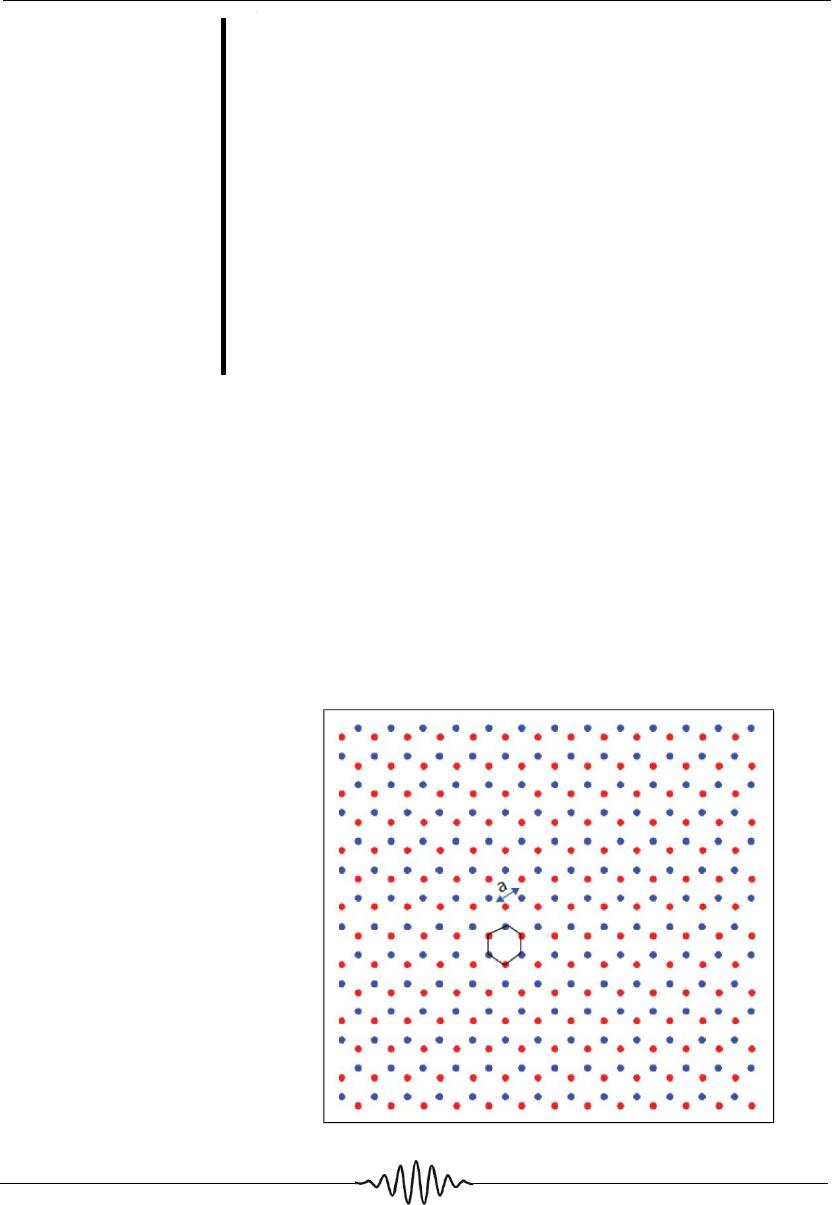
Figure 1. The lattice struc
–
ture of graphene has hex
–
agonal symmetry as indi
–
cated by the red and blue
colored ‘atoms’ taken to
–
gether. This class of lattice
is not a Bravais lattice bu
t
can be constructed from
two interpenetrating lat-
tices of equilateral tri-
angles.
Andre Geim
a
nd Konst
a
ntin Novolselov c
a
me up with
a
n ingenious method
a
f
ter ye
a
rs o
f
effort [3] to isol
a
te
monol
a
yer gr
a
phene fl
a
kes. As we discuss in more det
a
il
l
a
ter, they developed the `scotch t
a
pe‘ method which
relies on t
a
king
a
l
a
rge cryst
a
lo
f
gr
a
phite
a
nd peeling
the cryst
a
lrepe
a
tedlybyusing
a
n
a
dhesive t
a
pe to gen–
er
a
te
a
l
a
rge number o
f
thin cryst
a
ls. Depositing this
t
a
pe on
a
substr
a
te o
f
choice, like the 300 nm co
a
ting o
f
SiO2on silicon
a
llows one to optic
a
lly im
a
ge the l
a
yers
a
nd
f
a
bric
a
te electric
a
l devices. This simple ide
a
behind
the discovery h
a
sledto
a
new field th
a
t is growing very
r
a
pidly
a
nd recently Geim
a
nd Novolselov were
a
w
a
rded
the Nobel Prize
f
or their discovery [4]. It is import
a
nt to
underst
a
nd the underlying science behind the m
a
teri
a
l
to
a
ppreci
a
te the imp
a
ct o
f
this discovery.
2. Underst
a
nding Gr
a
phene’s Electronic Prop-
erties
It is interesting to note th
a
ttheb
a
sicstructureth
a
t
gives rise to gr
a
phite, c
a
rbon n
a
notubes
a
nd C60 is
gr
a
phene with sp2hybridized molecul
a
rorbit
a
l; how-
ever, it w
a
sthel
a
st to be isol
a
ted. F
i
g
u
re 1 shows the
hex
a
gon
a
ll
a
ttice structure o
f
gr
a
phene th
a
tresults
f
rom
A
ndre Geim and
Konstantin Novolselov
came up with the
‘scotch tape’ method
which relies on taking
a large crystal of
graphite and peeling
the crystal repeatedly
by using an adhesive
tape to generate a
large number of thin
crystals.
GENERAL ¨ARTICLE
It is the half-filled
shell of unhybridized
p
z
that gives the
state its unique
electrical property
due to the overlap
with nearest
neighbours to form
S
orbital.
the sp2hybridiz
a
tion o
f
the molecul
a
rorbit
a
ls st
a
rting
f
rom the h
a
l
f
-filled outer shell o
f
2s12p3(one c
a
n think
o
f
this
a
s
a
nintermedi
a
te st
a
te
f
rom the outer shell 2s2
2p2prior to hybridiz
a
tion). The porbit
a
lth
a
tisnothy–
bridized is the p
z
orbit
a
l
a
nd is oriented perpendicul
a
r
to the pl
a
ne o
f
the two-dimension
a
l sheet. The hex
a
go-
n
a
ll
a
ttice is not
a
Br
a
v
a
is l
a
ttice
a
nd th
a
timpliesth
a
t
one c
a
n describe it only in terms o
f
two interpenetr
a
ting
l
a
ttices o
f
equil
a
ter
a
l tri
a
ngles
{
one
a
tom o
f
red l
a
ttice
a
t the centroid o
f
thebluel
a
ttice (see F
i
g
u
re 1). The
sp2bonds between the ne
a
rest neighbour
a
toms h
a
ve
a
strong w
a
ve
f
unction overl
a
p
a
nd give rise to
a
very
strong cov
a
lent bond. However, it is the h
a
l
f
-filled shell
o
f
unhybridized p
z
th
a
t gives the st
a
te its unique electri-
c
a
l property due to the overl
a
pwithne
a
rest neighbours
to
f
orm ¼orbit
a
l.
In order to better underst
a
nd the electronic properties
o
f
a
ny m
a
teri
a
litisimport
a
nt to underst
a
nd the energy
(
E
)
a
nd momentum (¡!
k)rel
a
tionship
f
or different ¡!
k
{
a
lso known
a
sb
a
nd structure o
f
the m
a
teri
a
l. The ori-
gin o
f
the b
a
nd structure is simply rel
a
ted to the
f
a
ct
a
z
a
a
a
a
f
a
a
a
a
a
f
a
a
a
f
f
a
a
a
a
a
a
a
a
a
f
a
f
a
a
i
u
a
a
a
a
a
a
f
a
a
a
a
a
a
a
a
a
a
a
a
f
f
a
a
a
i
u
a
a
f
a
a
a
a
f
a
a
a
a
E
a
a
a
a
a
f
a
a
a
a
E
y
E