Zwang 1
Adam Zwang
Professor Helfers
College Writing
04 April 2018
The Google Smart City: A Heavily Watched and Censored City that Could Possibly be
Too Invading of Privacy
Google has decided to construct a “smart city” in Toronto, which is a heavily wired up
city that includes censors, cameras, and other data collecting tools. Google is attempting to take
innovation to the next level by creating a fully internet-run city. By doing this, it is supposed to
gather data about the Toronto town, such as traffic and how citizens go about their days in order
to manage assets and resources, such as power plants, water supplies, schools, etc.
For example, cameras located around street lights and other places in which traffic tends
to build up are promised to help prevent traffic by figuring out and monitoring where exactly the
main source of the traffic is. Censors on the sidewalks and streets are to help provide developers
with data in order to do things like figure out which direction and where most people tend to
walk, in order to create shorter walking distances. Even driverless cars covered in censors and
cameras are one of the innovations promised, which are supposed to make ride sharing services
cheaper and more convenient. However, while this may seem like a new and useful concept, how
invading to the citizens’ privacy is this smart city? It is imperative that this be researched in
order to determine how this might impact human rights.
This essay looks to investigate the impact of googles smart cities in relation to privacy
and security in the sense of how this is deleterious with such a heavily monitored city. I will
Zwang 2
define a smart city in a manner that engages in explaining the general features that separates a
smart city from a regular one by explaining what goes into such a development, for example,
tools, new inventions, technology, etc. This will then provide information to determine whether
or not the Google smart city is more detrimental than it is beneficial.
Alphabet, a parent company of Google, and Sidewalk Labs are teaming up to create this
smart city, located in Toronto Waterfront in Quayside, the name of the future neighborhood.
Sidewalk Labs is an organization affiliated with Alphabet. The company’s main purpose is to
innovate cities and develop technological solutions to problems that a city might be facing. As of
right now, their main project is developing the smart city in Toronto Waterfront, in order to test
the development of a fully internet-run town. The developers promise to benefit the city with
technology such as buildings made from eco-friendly material, traffic congestion censors to help
the flow of traffic, air pollution censors to reduce pollution, and even using non-fossil fuel
generated energy to heat and cool buildings.
Some argue for in favor of Google, as according to Eleanor Gibson, a writer and reporter
for Deezen Magazine, the Google smart city will “help solve a slew of current city issues, like a
lack of affordable housing, traffic congestion and safety, and environmental impact” (3).
However, I believe that Gibson is mistaken because she is overlooking the many possible
challenges that go into such a wired-up city. It is with no doubt that todays technology has
created a serious privacy issue since technology is very easily hacked, misused, and used for
illegal activities. With many cases of people being stalked through the webcams of their
computers or the government listening in on phone conversations, something like a smart city
that is heavily monitored should not just be accepted without considering the possible detriments.
This essay looks to research this possibility.
Zwang 3
What is a smart city?
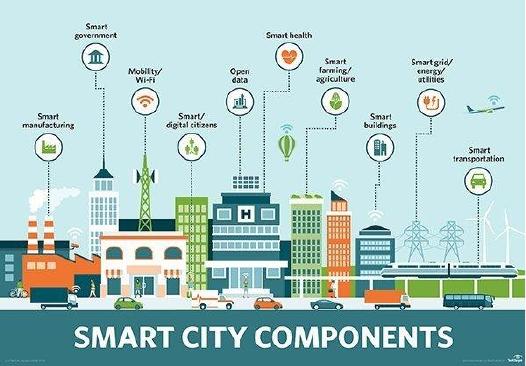
To start off, it is important to define what a smart city even is. According to Matt
Hamblen, journalist and Senior editor of Computerworld Magazine, a smart city is one that
partakes in “using sensors to wirelessly manage streetlights and traffic signals to lower energy
costs… or using sensors to monitor
water mains for leaks or to monitor air
quality for high pollution levels” (1).
Simply put, a smart city is a city that is
heavily wired and monitored to track
resources of the city which in turn, these
data that are collected and are
supposedly used to benefit the city by making changes.
With such a heavily wired and censored city, the idea is that everything that is used by
the public and by those who live in the city to be monitored and tracked. What goes into a smart
city is not limited as, according to Margaret Rouse, a writer for WhatIs.com, TechTarget’s IT
encyclopedia and learning center, “theoretically, any area of city management can be
incorporated into a smart city initiative” (4). Any idea can be incorporated into a smart city, so
really when the word “smart city” is used, there is no single definition of what the developer
means by this, other than a thoroughly wired and censored area with technology being
incorporated into many everyday tools and corners.
To further elaborate on this, Songdo is a very popular smart city in South Korea that is
also highly censored with wires and cameras. According to Philippe Mesmer, journalist and
writer for Lemonde Magazine, Songdo is a city that is constantly under surveillance in which
Zwang 4
“500 cameras ensure total grid coverage to regulate the traffic or detect ‘suspicious’ behaviour.
Even the opening of a sewer cover is immediately notified to the IFEZ management centre” (8).
As stated in the example, even the sewer cover is surveilled and monitored. This clearly
demonstrates that really anything goes when it comes to technology in a smart city, even
something as strict and controlling as surveillance of a sewer cover.
With this being said, what does Google mean when they say they are building a smart
city? How far are they trying to take this concept? In the modern age, we already have
technology such as computerized parking meters in which you pay using a smart phone.
However, these cities are not considered smart cities. This could lead to a dangerous place where
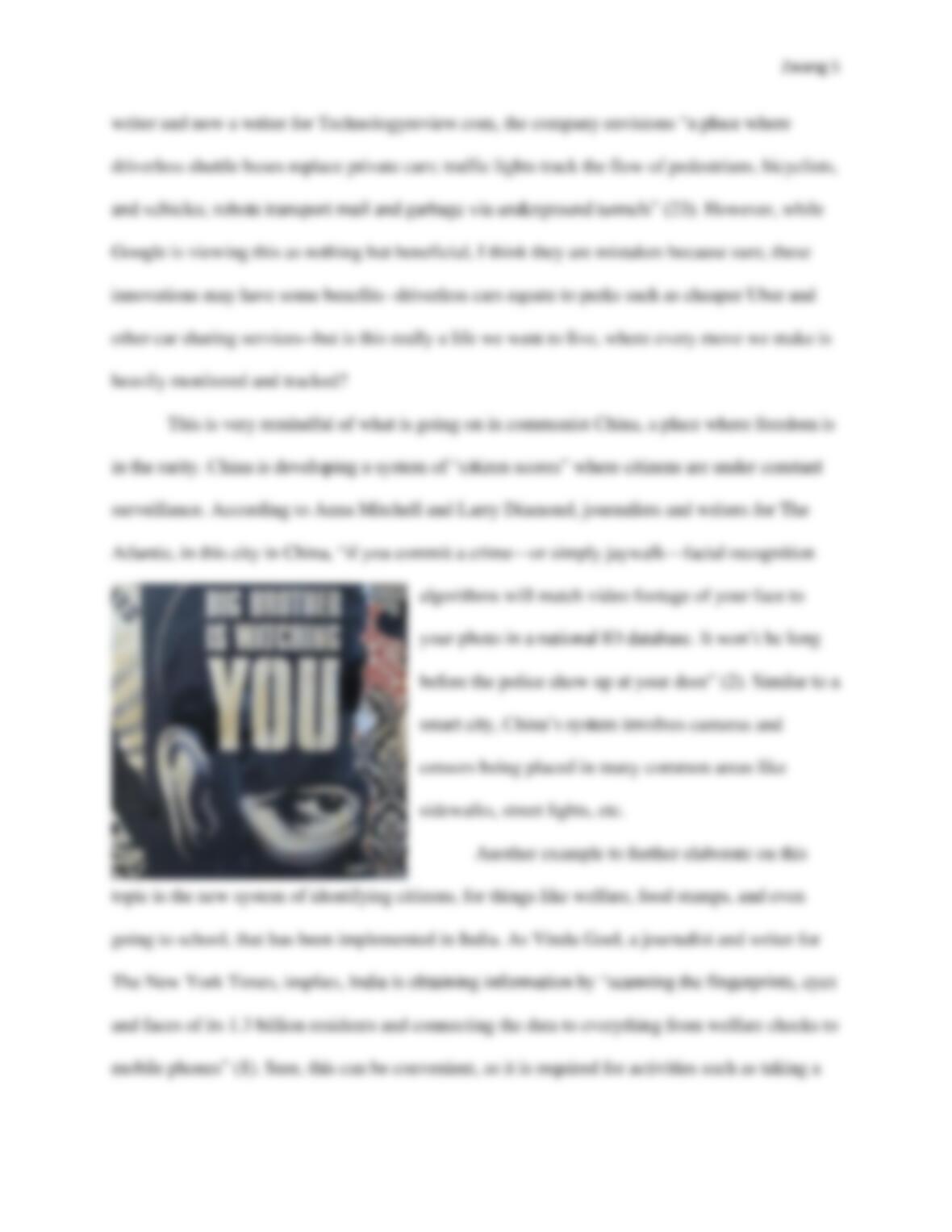
the citizens have their every move tracked and watched 24/7.
How can a smart city have detrimental effects?