GOAT SITUATION
REPORT
January-December 2020
ISSN-2546-0625

GOAT SITUATION
REPORT
January-December 2020

ii
REPUBLIC OF THE PHILIPPINES
HIS EXCELLENCY
PRESIDENT RODRIGO ROA DUTERTE
PHILIPPINE STATISTICS AUHORITY
DENNIS S. MAPA, Ph.D.
Undersecretary
National Statistician and Civil Registrar General
ISSN-2546-0625
Copyright © 2020 by Philippine Statistics Authority
PSA Complex, East Avenue, Diliman,
Quezon City, Philippines

iii
FOREWORD
The Goat Situation Report presents the industry situation in terms of volume and value
of production, supply and disposition, number of heads slaughtered in
slaughterhouses, and monthly average farmgate prices.
The Philippine Statistics Authority (PSA) disseminates the Goat Situation Report
annually, every March, with the previous year as the reference period. The report
serves as a ready reference for PSA’s various clients and stakeholders in the
agriculture sector.
The PSA would appreciate comments and suggestions from our data users and
readers for further improvement of this report.
DENNIS S. MAPA, Ph.D.
Undersecretary
National Statistician and Civil Registrar General
Quezon City, Philippines
March 2021
v
TABLE OF CONTENTS
Page
Foreword iii
Technical Notes vi
Standard Symbols, Unit of Measure, Initials and Acronym viii
Highlights 1
1. Volume of Production 1
2. Prices 3
3. Value of Production 3
4. Supply and Disposition 3
Figure
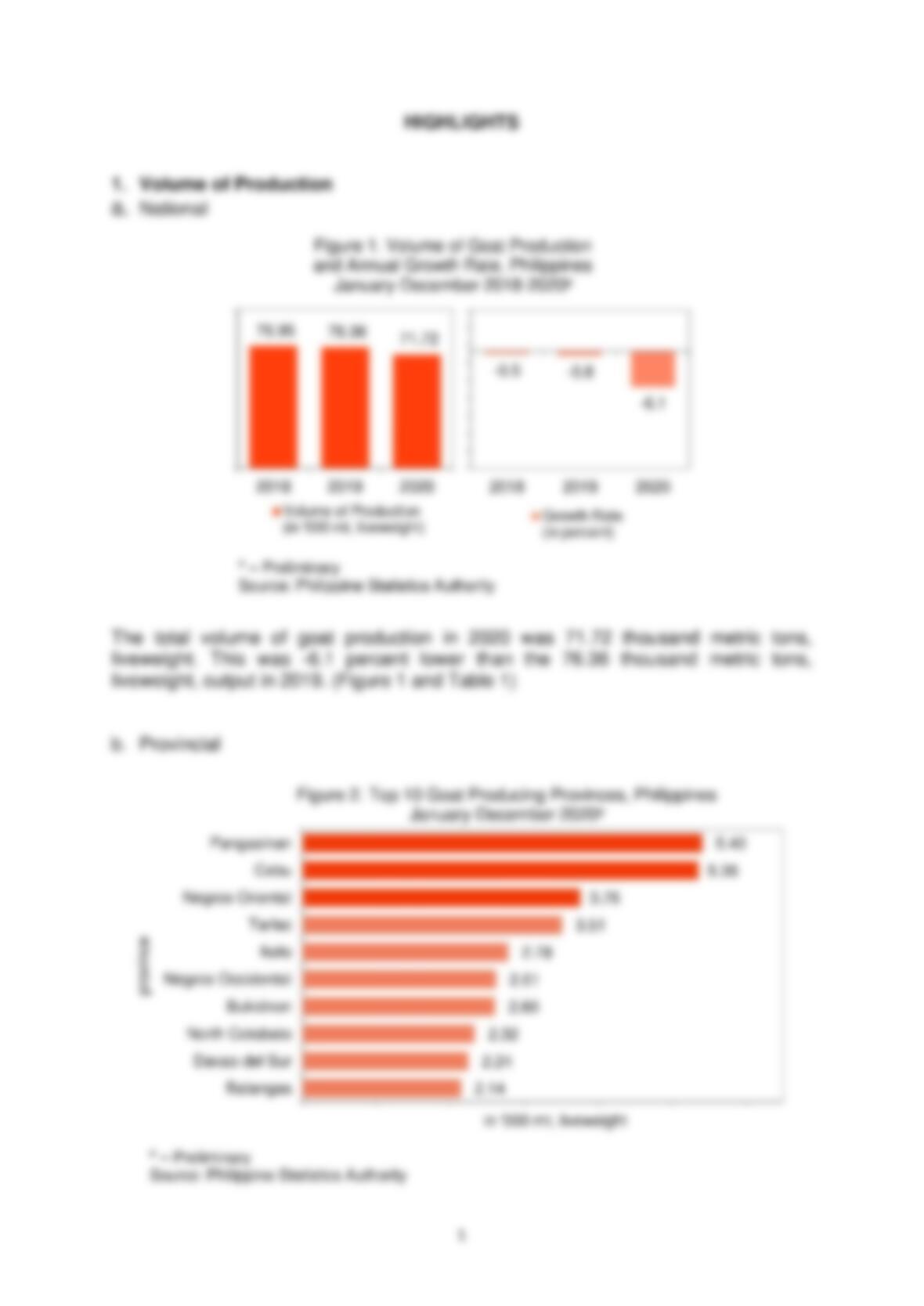
1 Volume of Goat Production and Annual Growth Rate
Philippines: January-December 2018-2020p 1
2 Top 10 Goat Producing Provinces, Philippines
January-December 2020p 1
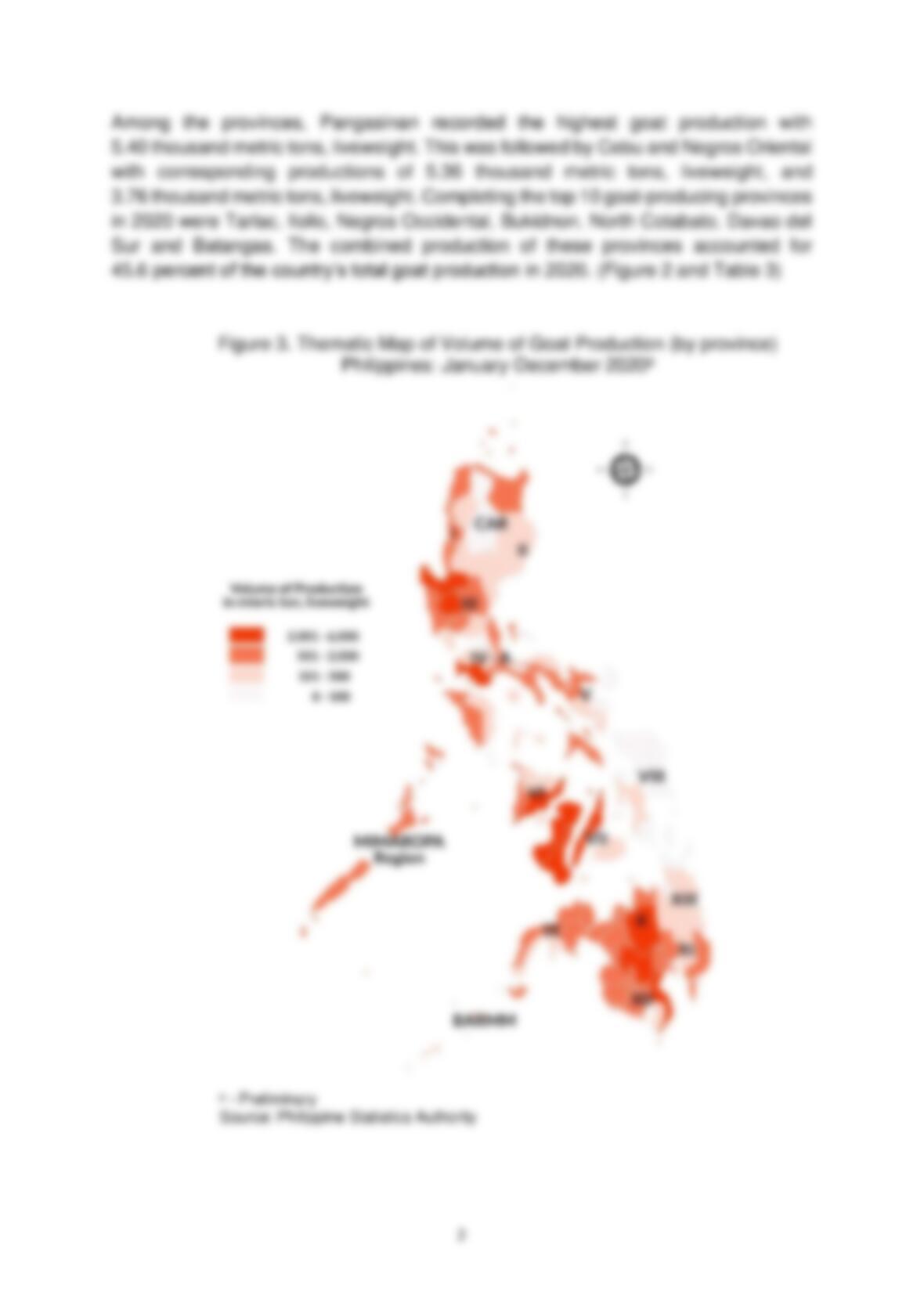
3 Thematic Map of Volume of Goat Production (by province)
Philippines: January-December 2020p 2
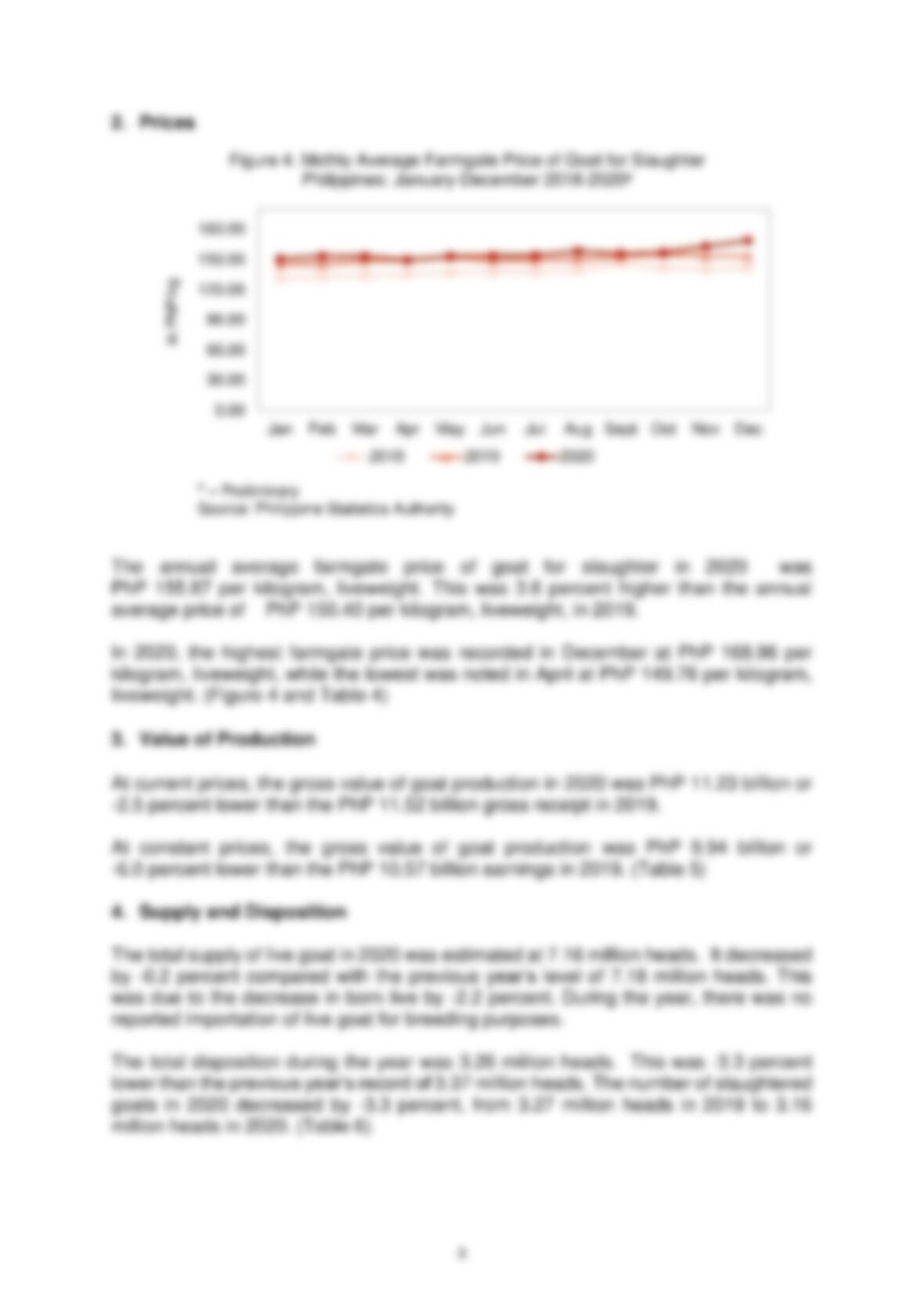
4 Monthly Average Farmgate Price of Goat for Slaughter
Philippines: January-December 2018-2020p 3
Table
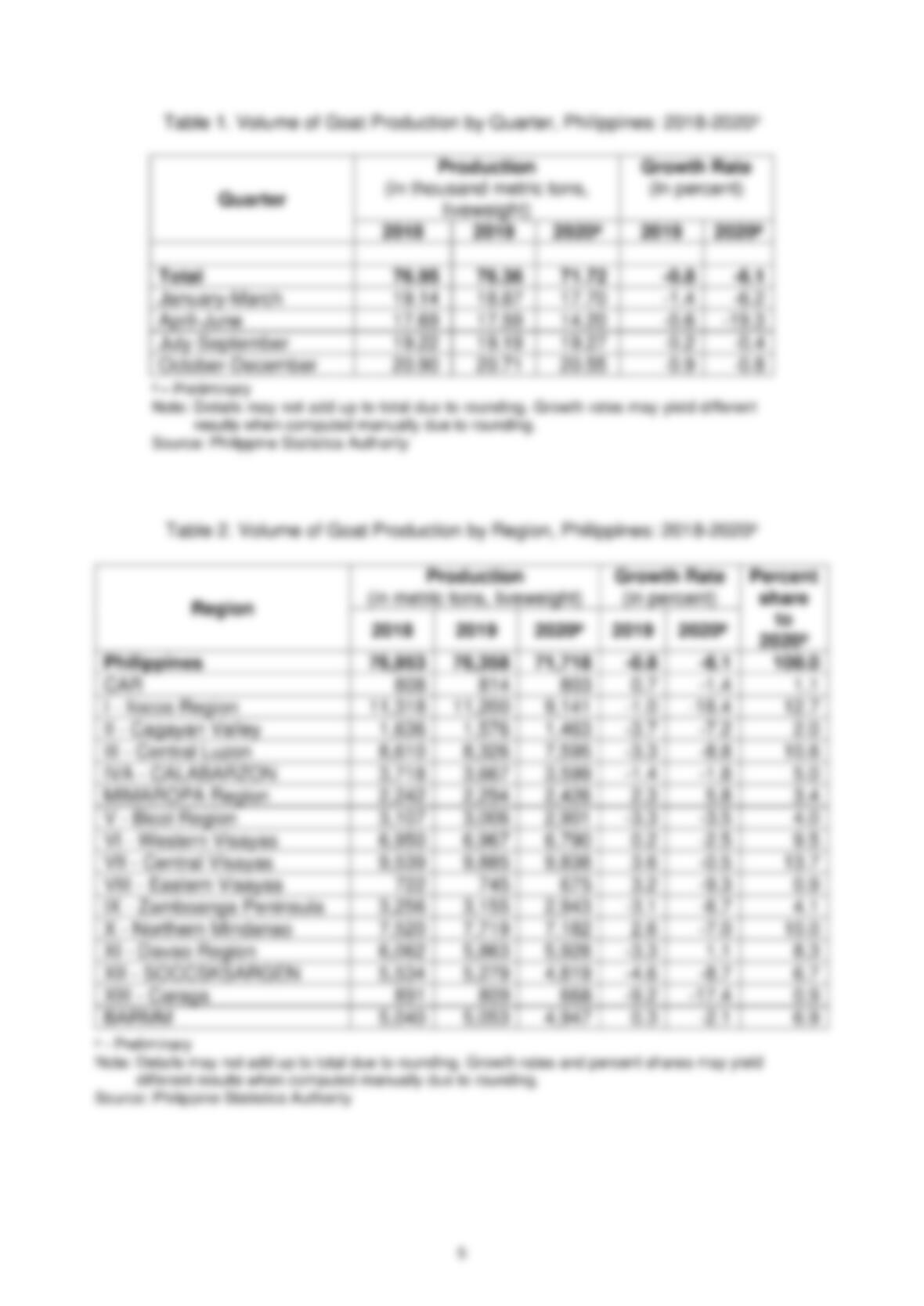
1 Volume of Goat Production by Quarter
Philippines: 2018-2020p 5
2 Volume of Goat Production by Region
Philippines: 2018-2020p 5
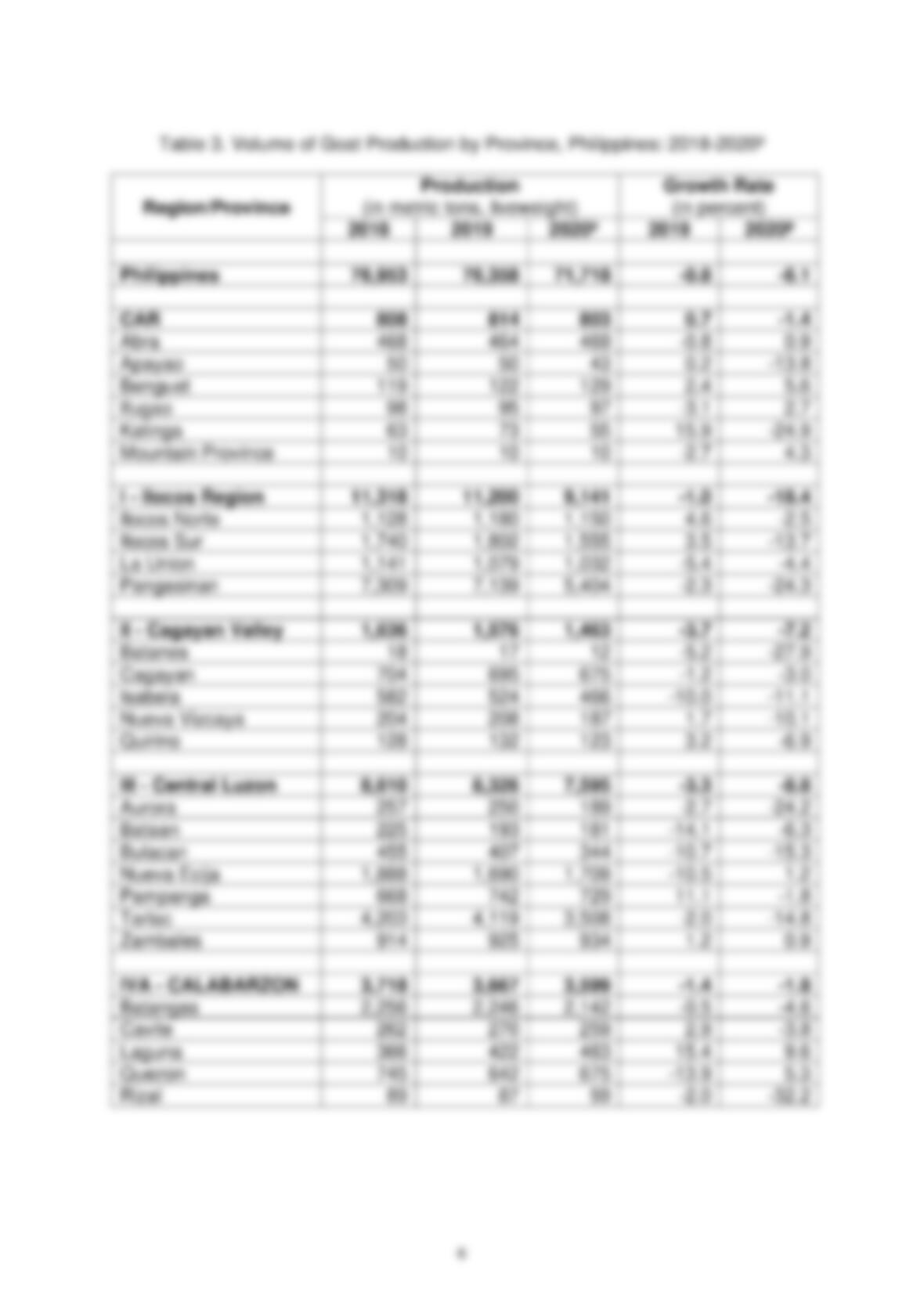
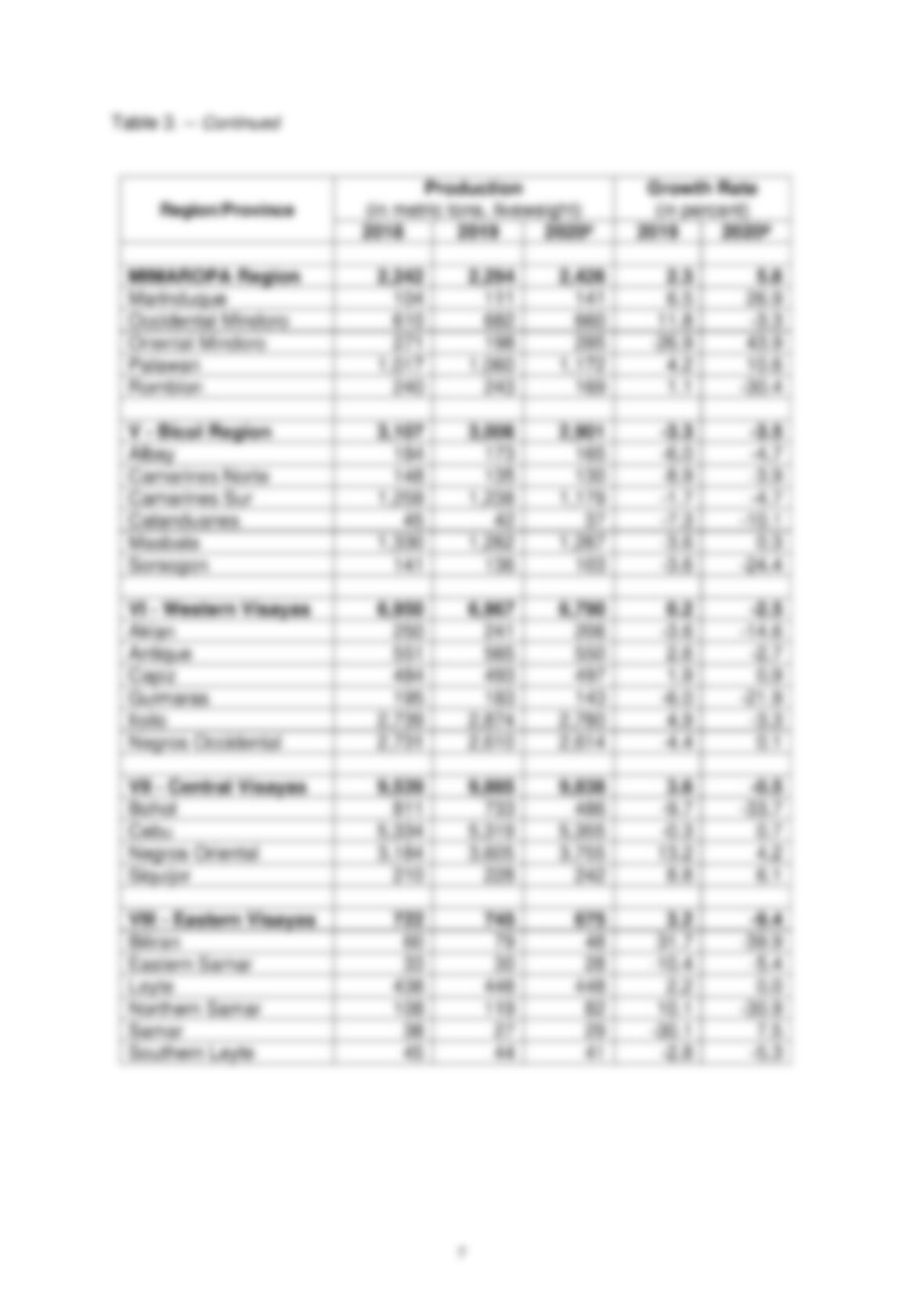
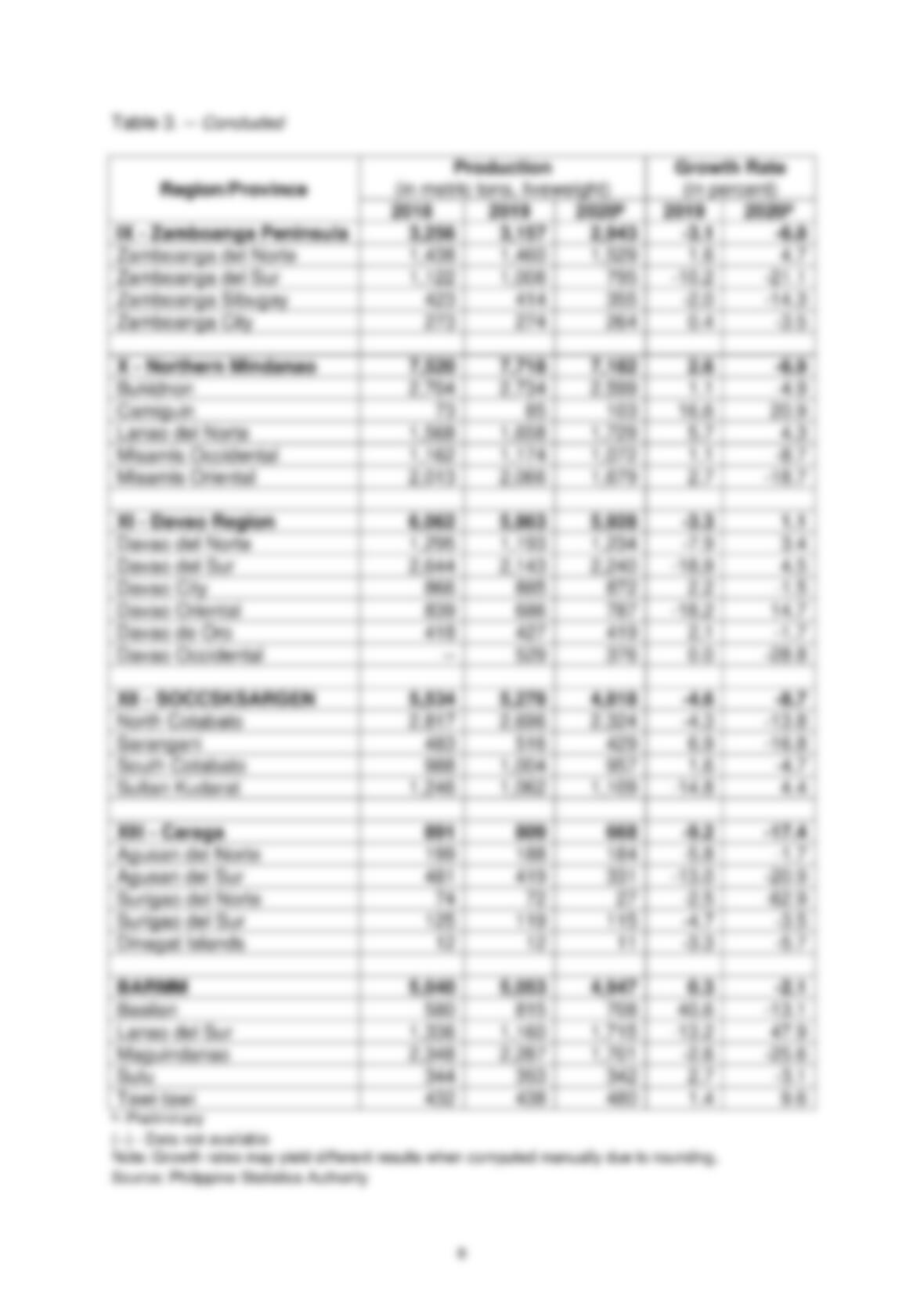
3 Volume of Goat Production by Province
Philippines: 2018-2020p 6
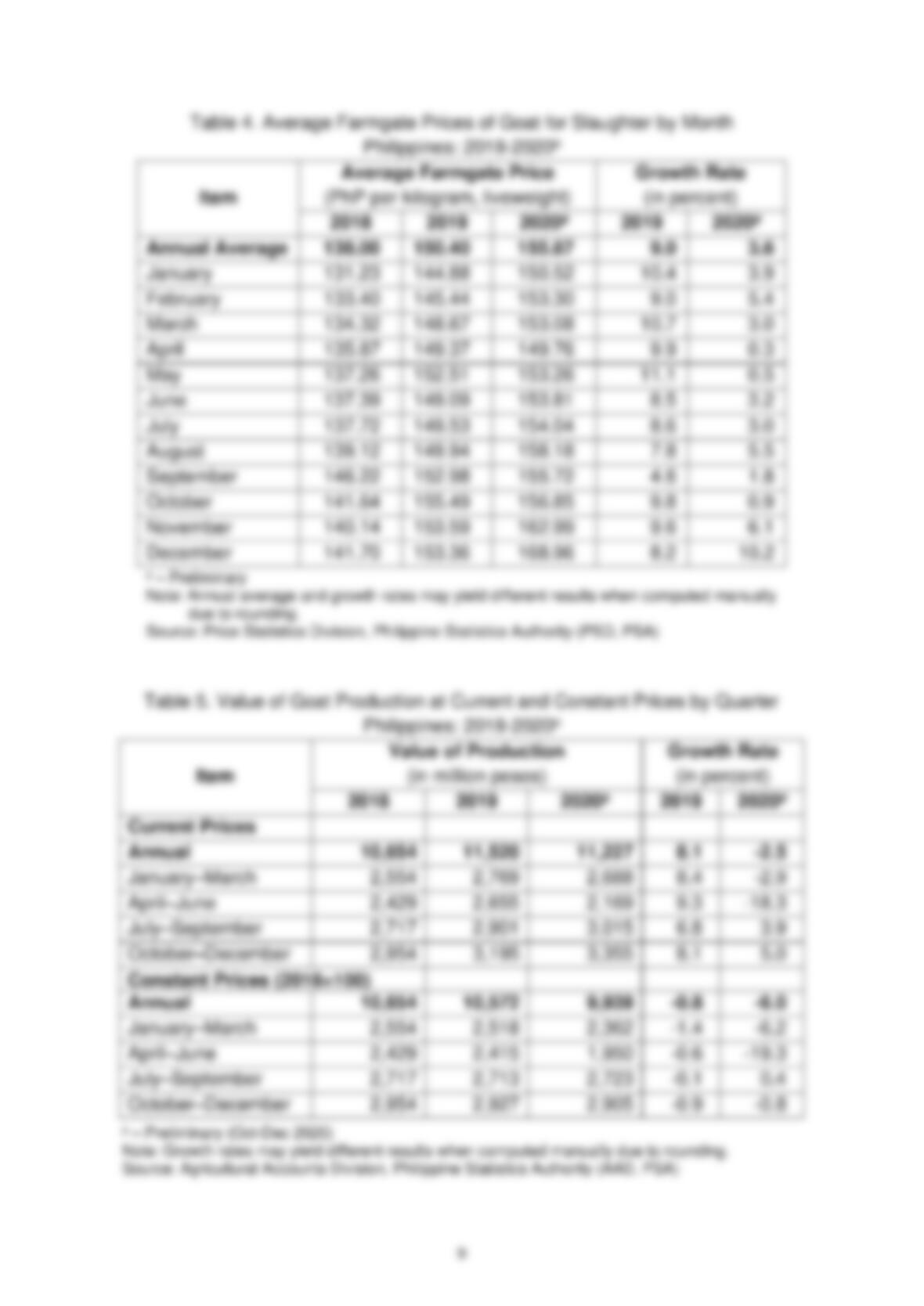
4 Average Farmgate Prices of Goat for Slaughter by Month
Philippines: 2018-2020p 9
5 Value of Goat Production at Current and Constant Prices
by Quarter, Philippines: 2018-2020p 9
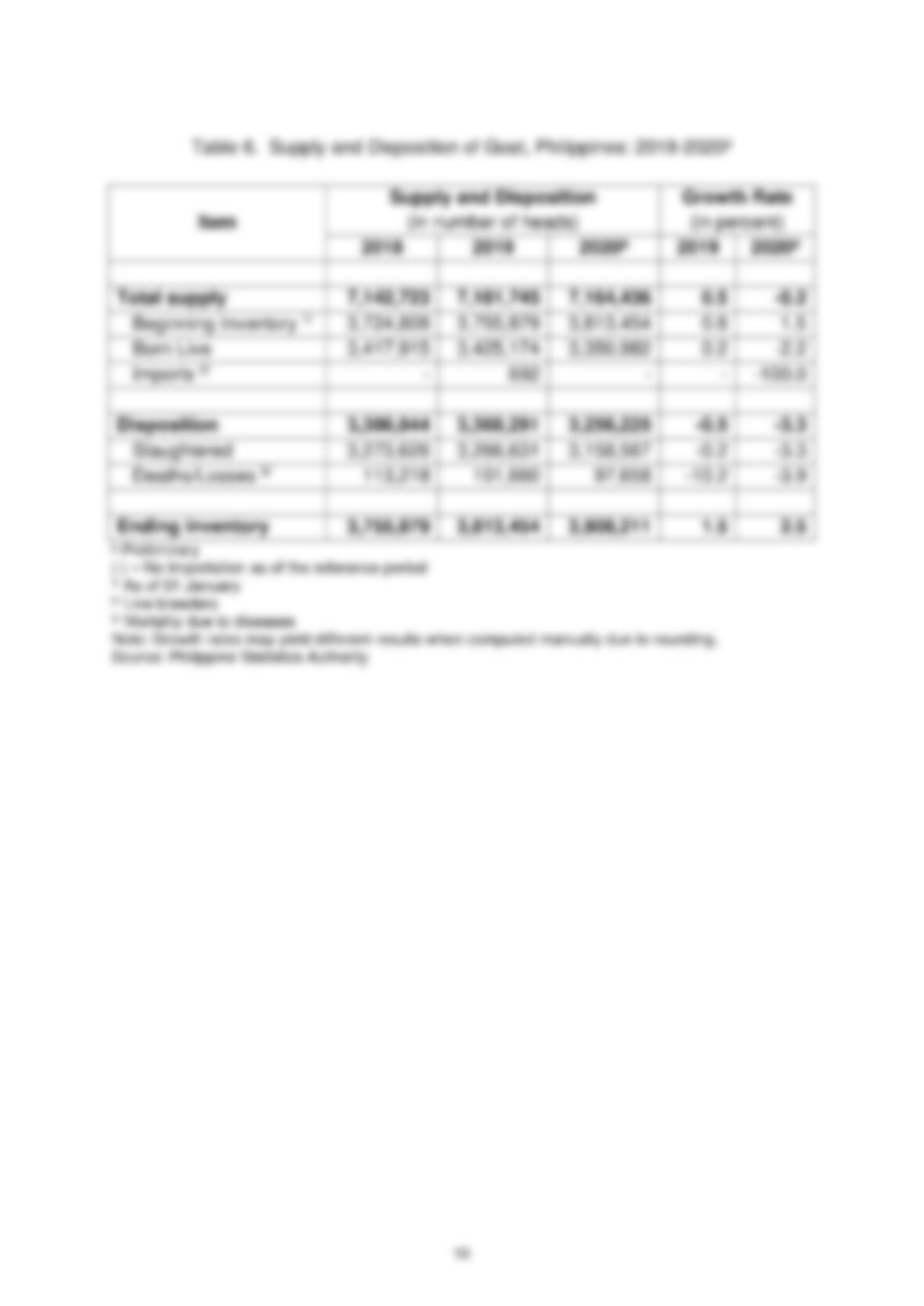
6 Supply and Disposition of Goat, Philippines: 2018-2020p 10
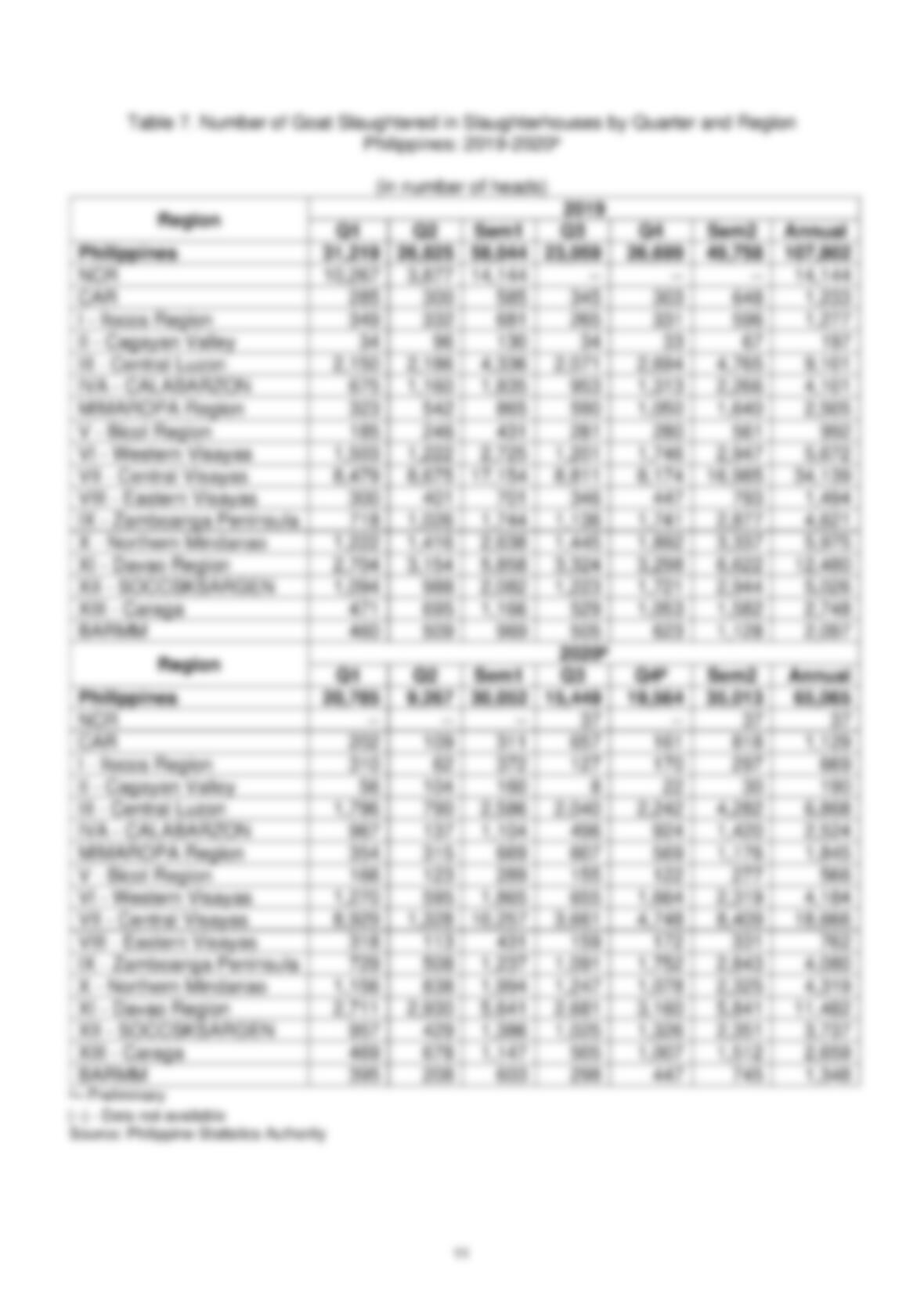
7 Number of Goat Slaughtered in Slaughterhouses
by Quarter and Region, Philippines: 2019-2020p 11
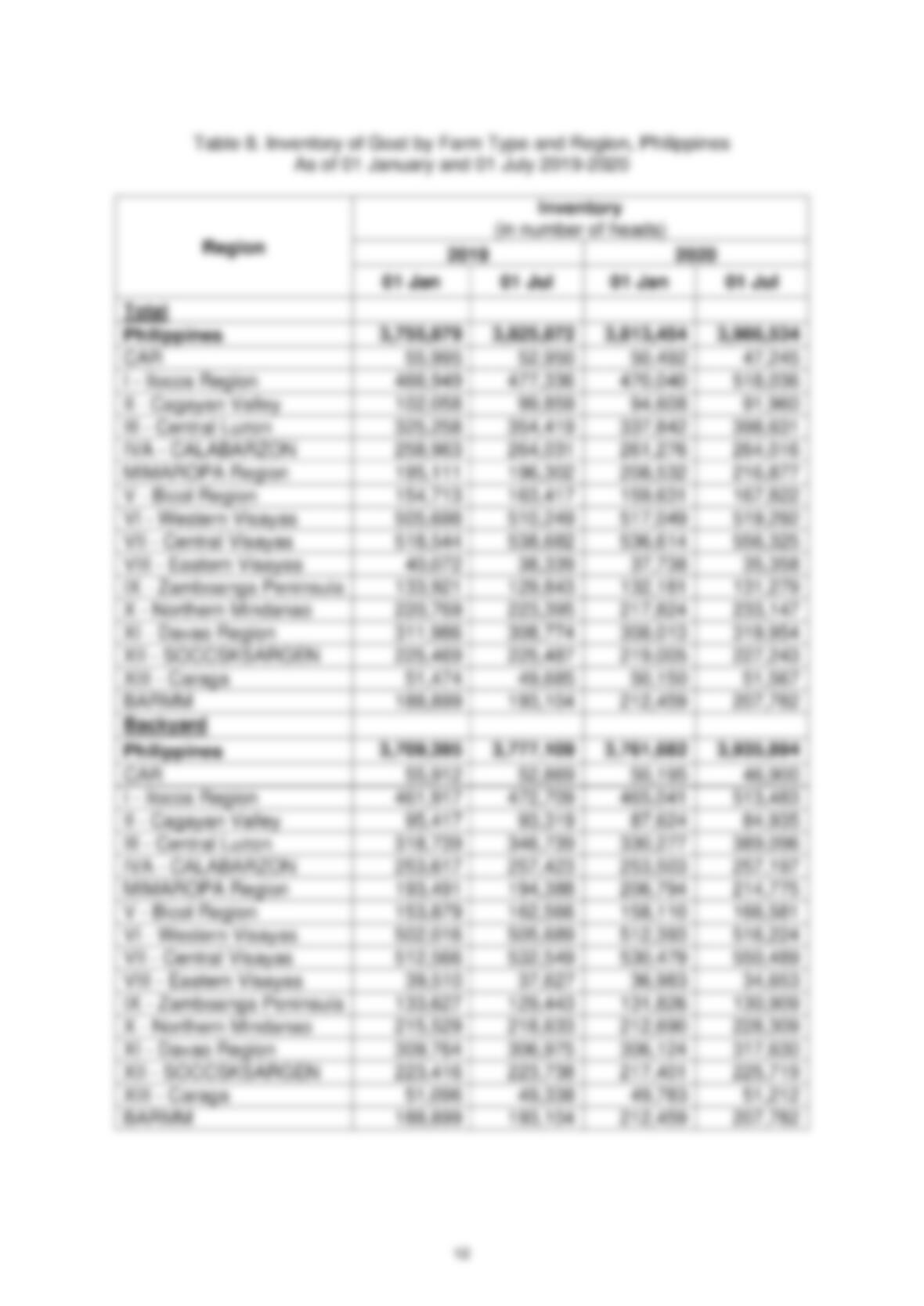
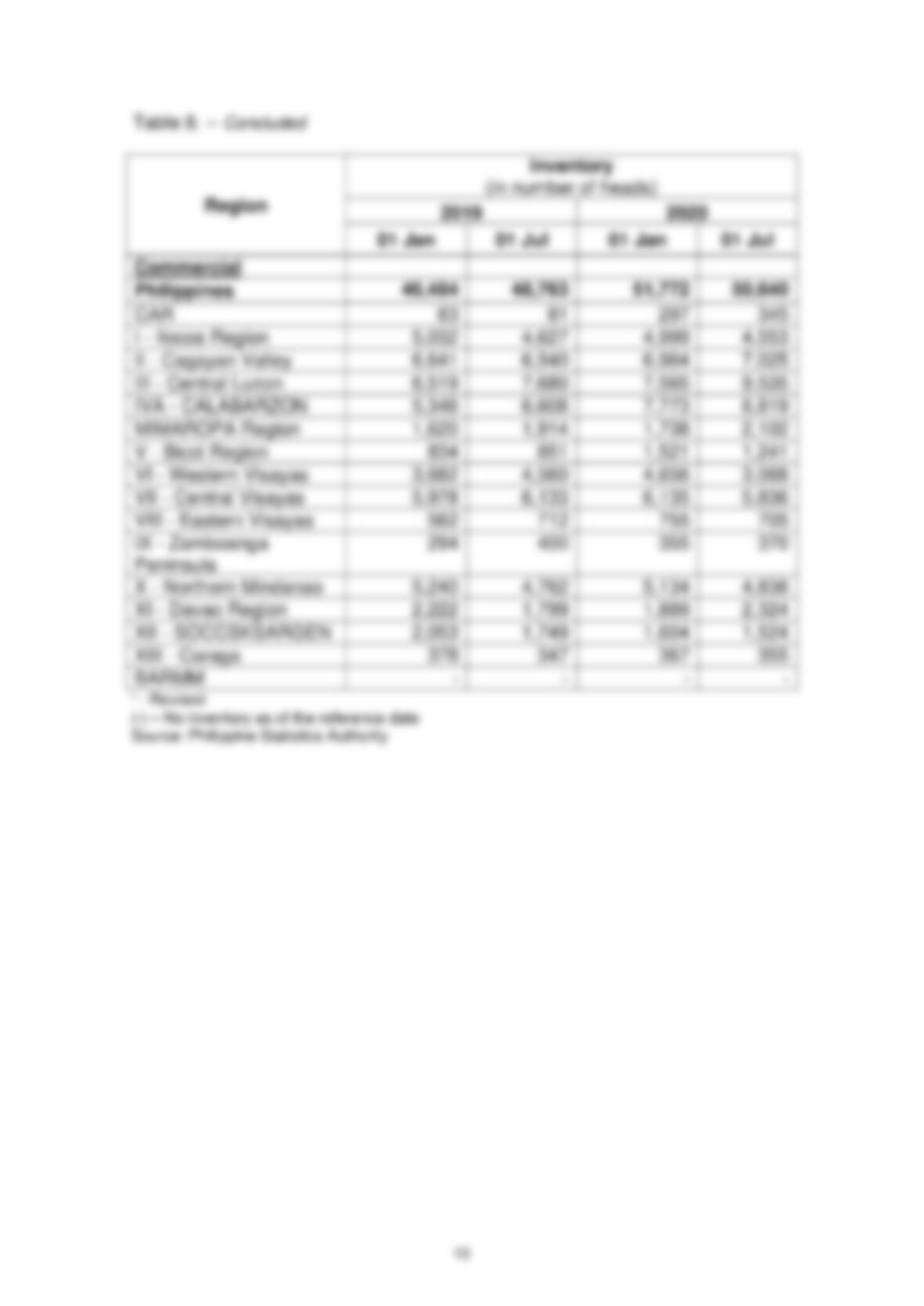
8 Inventory of Goat by Farm Type and Region
Philippines: as of 01 January and 01 July 2019-2020p 12
vi
TECHNICAL NOTES
The data in this report are collected by the Philippine Statistics Authority (PSA) through
the two major surveys, namely:
1) Backyard Livestock and Poultry Survey (BLPS) which covers one of the four
replicate samples of the Palay Production Survey (PPS) and Corn Production
Survey (CPS). BLPS consists of 15,865 sample households in 1,560 sample
barangays nationwide; and
2) Commercial Livestock and Poultry Survey (CLPS) which covers 434 goat farms
as of January 2020.
Both surveys are conducted simultaneously every quarter in all provinces.
Another activity that supplements the statistical requirements of the livestock and
poultry subsector is the Compilation of Data from Slaughterhouses and Poultry
Dressing Plants (CDSPDP). This covers around 1,324 licensed to operate meat
establishments (AAA and AA) and Locally Registered Meat Establishments (LRMEs)
nationwide. It is undertaken in coordination with the National Meat Inspection Service
(NMIS) and Local Government Units (LGUs).
Concepts and Definitions
Commercial farm – a farm or establishment/enterprise that raises livestock and
poultry animals. Moreover, it must satisfy at least one of the following criteria:
• Tending at least 21 heads of adult and zero head of young;
• Tending at least 41 heads of young adult; or
• Tending at least 10 heads of adult and 22 heads of young.
All livestock and poultry raisers that did not satisfy the above criteria were considered
as Backyard Farm.
Deaths/Losses refer to the number of animals that died due to pests, diseases, and
calamities.
Farmgate price refers to the price received by raisers for their produce at the location
of farm. Thus, the marketing costs such as the transport and other marketing cost (if
any) incurred in selling the produce is not included in the farmgate prices.
Inventory refers to the actual number of domesticated animals present in the farm as
of a specific reference date.
Imports refer to the number of live animals originating from foreign country, i.e., live
breeders and Feeders and meat importation compiled by the Trade Statistics Division
(TSD) of PSA from the copies of Import Entry and Internal Revenue Declaration
collected from the Bureau of Customs (BOC).
Locally Registered Meat Establishment (LRME) includes slaughterhouses, meat
processing plants, meat cutting plants, and cold storages that are allowed to operate
by the city/municipal government but are not accredited by the NMIS.
Retail price refers to the price at which retailers sell their goods or commodities to
consumers in the marketplace. It is expressed in peso per kilogram.
Slaughterhouse (SH) refers to the premises that are approved and registered by the
TECHNICAL NOTES — Concluded
NOTES—Continued