Cultures in Global Business
LEARNING CULTURES IN GLOBAL BUSINESS
Kenneth Grant
Understanding the Importance of Culture in Global Business
Interna”onal Business – MGT 606
Instructor Mr. Kwong Tam
Fort Hays State University
Fall 2015
September 27, 2015
1

Cultures in Global Business
Abstract
The word culture is a nebulous term, yet has many descriptions. When regarding the global business
world, the talk My own definition is that culture is our collective experience as a society, and its impact on our reaction
and decision-making relative to every-day facts and circumstances.
Why is cross-cultural competence critical to your professional future and the viability of your company? It’s
omnipresent in every business interaction and strategic decision. According to a May 2006 Accenture study,
optimizing this process through training can increase productivity by 30 percent. For example, if a company’s director
of marketing embarks on a campaign demonstrating how speedy its service is, when the underlying cultural
motivation of the international customer is almost completely focused on customer service, the value proposition
consists of selling ice in the wintertime — there’s plenty of it, and it was never wanted to begin with.
It is not feasible to be an expert on all the world’s cultures. It is possible, however, to incorporate a cross-cultural
framework that improves cross-cultural understanding and interactions. One such framework, the Business Model of
Intercultural Analysis [BMIA™], uses the following six “comprehension lenses” to examine enterprise-wide cross
cultural challenges: cultural themes, communication, group dynamics, ‘glocalization,’ process engineering, and time
orientation. Let us examine some examples of American executives interacting with Chinese executives to illustrate
how a few of these comprehension lenses impact business.
2

Cultures in Global Business
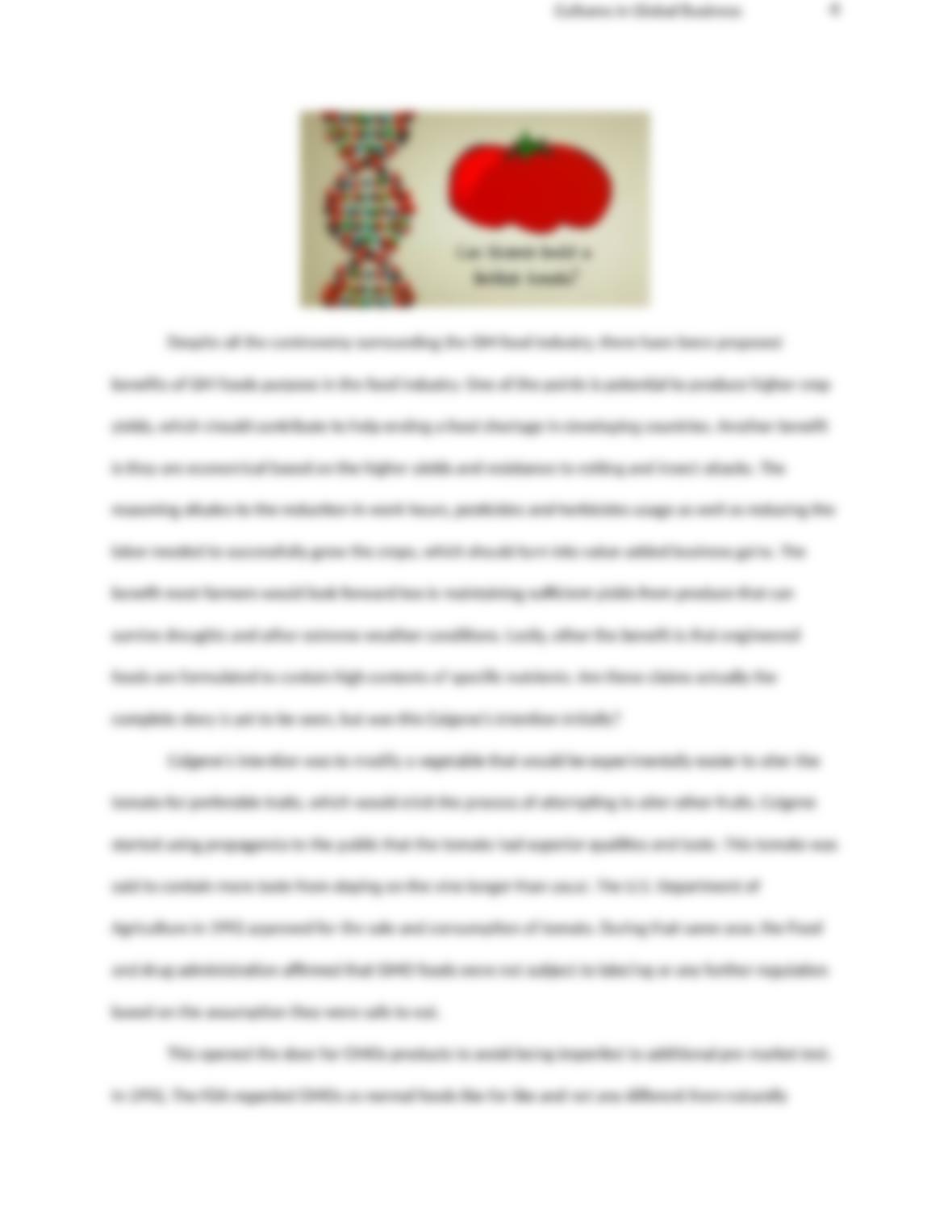
The 2rst recorded field tests of GMOs in the US are assumed to be on tomatoes and tobacco in the late
1980s, but tes“ng could have been as early as the 1970s. A not-for- pro2t group called The Na“onal
Academy of Sciences (NAS) determined that the outcomes of the trials did not pose any serious
environmental or human health hazards. During this same period, other GMO milestones were reached
with the incep”on of the “Flavr Savr” tomato (Panse & Arnold, 2012). There was dis“nct reasoning for
3