Editor-in-Chief
Sushil
Chair, Strategic Management Group
Department of Management Studies
Indian Institute of Technology Delhi
Hauz Khas, New Delhi-110016
e-mail : giftjournal@giftsociety.org
Tel : 91-11-26591167
Fax : 91-11-26862620
Global Journal of
Flexible Systems Management
ISSN 0972-2696
(Quarterly Journal of Global Institute of
Flexible Systems Management)
Subscription and Advertising
For subscription or giving advertisements either write to Production Manager, giftjourn@l c/o Jay Dee Services Inc.Jay Dee Services Inc.
Jay Dee Services Inc.Jay Dee Services Inc.
Jay Dee Services Inc., 1893, 1st Floor,
Udai Chand Marg, Kotla Mubarakpur, New Delhi-110003 or use ‘subscription’ button at the site www.giftsociety.org, or use e-mail
giftjournal@giftsociety.org.
Subscription Rates (yearly for 4 issues including postage). Payments to be made in favour of “giftjournal ” payable at New Delhi.
Within India Overseas
Institutions/Corporates Rs 4,500 US$ 200
Individuals Rs 900 US$ 50
Advertisement Rates
Full page Rs 25,000 US$ 1,000
Copyright © 2002, Global Institute of Flexible Systems Management
The Journal or any part thereof may not be reproduced in any form without the prior written permission of the publisher.
All data, views, opinions etc. being published are the sole responsibility of authors. Neither the publisher nor the editors are in anyway responsi-
ble for them.
Published by Global Institute of Flexible Systems Management
www.giftsociety.org
giftjourn@l
Printed by Jay Dee Services IncJay Dee Services Inc
Jay Dee Services IncJay Dee Services Inc
Jay Dee Services Inc..
..
., New Delhi.
Mobile : 9810247997, Ph. : 011-26042537
Editorial Board
Rakesh Kumar Agrawal
School of Management
University of Western Sydney
Sydney, Australia
Ali Dastmalchian
Dean, Faculty of Business
University of Victoria
Victoria, Canada
M.C. Jackson
Director of the Business School
University of Hull, UK
Editor-in-Chief,
Systems Research and
Behavioral Science
Jatinder N.D. (Jeet) Gupta
Eminent Scholar and Chairperson
Department of Accounting &
Information Systems
College of Administrative Science
The University of Alabama in
Huntsville, USA
Associate Editor, Decision Sciences
Anthony Michell
Visiting Prof. (Strategy & Global Mgt.)
School of Public Policy and
Management, KDI, Korea
H. Paul
Professor and Dean
School of Management
Asian Institute of Technology
Pathumthani, Thailand
Daniel Rouach
Professor
School of Management
ESCP-EAP, Paris, France
Kulwant Singh
Head, Department of
Management & Organization
Faculty of Business Admn.
National University of Singapore
Chief Editor,
Asia Pacific Journal of Management
Members
A.K. Agrawal
CEO
Autometers Alliance Ltd., Noida
Rajat K. Baisya
Head, Dept. of Management Studies
IIT, Delhi
P.K. Jain
Dept. of Management Studies
IIT, Delhi
K.M. Mital
General Manager (HRM)
EIL, New Delhi
Shyam Sethi
Vice President
Whirpool of India Ltd., New Delhi
Sanjay K. Singh
Editorial Coordinator-Higher Education
Addison Wesley Longman (Singapore)
Delhi
Managing Committee
Deputy Editors
K. Momaya
Dept. of Management Studies
IIT, Delhi.
O.P. Sharma
Delhi College of Engineering,
Delhi
Regional Editor-North America Region
Prabir K. Bagchi
Dir.-Logistics & Operations Management
School of Business & Public Management
The George Washington University
Washington – DC, USA
Associate Editors
James H. Perry
The George Washington University
Washington – DC, USA
Susan White
The George Washington University
Washington – DC, USA
Srinivas Prasad
The George Washington University
Washington – DC, USA
Thomas Corsi
University of Maryland-College Park, USA
Herbert Kotzab
Copenhagen Business School
Denmark
Tage Skjoett-Larsen
Copenhagen Business School
Denmark
Helge Virum
Norwegian School of Management
Nanua Singh
Professor and Director of Integrated
Product Development Laboratory,
Wayne State University, USA
Associate Editor-in-Chief
International Journal of Robotics and CIM
Editor : Product and Process Development
Kathryn E. Stecke
The University of Texas at Dallas
School of Management
Richardson, USA
Editor-in-Chief
Intl. Journal of Flexible Mfg. Systems
Ushio Sumita
Professor
Graduate School of International Management
International University of Japan, Japan
Shashi Ullal
Ex. Vice-Chairman
Hughes Escorts Communications Limited
Gurgaon, India
Henk W. Volberda
Professor of Strategic Management &
Business Policy
Rotterdam School of Management
Erasmus University, The Netherlands
Global Journal of
Flexible Systems Management
giftjourn@l
ISSN 0972-2696 Vol. 3 No. 4, December 2002
Contents
Editorial iii
Research Papers
Understanding Flexibility in Supply Chains :
A Conceptual Framework and Models 1
K. S. Rao and S. Wadhwa
Managing Change for Competitiveness 13
Rajiv Kumar Garg and T. P. Singh
Sustainable Competitive Advantage with Core Competence : A Review 23
Anjana Kak and Sushil
Dispute Prone Contract Clauses – A Basis for Operational Flexibility
in Contract Administration 39
K. Chandrashekhar Iyer, Satyanarayana N. Kalidindi and L. S. Ganesh
giftjourn@l
Global Journal of
Flexible Systems Management
2002, Vol. 3, No. 4, pp iii
Editorial
The trajectory of
technological growth is cycle
of myth–reality–myth.
It wasn’t long ago that the
myths of telephone,
radio, and television
(originating mostly
in science fictions)
metamorphosed
into realities.
What we witness today in
abundance is almost similar
looking instruments called
cellphones being used
on a scale never observed
before, thus annihilating
time and space.
Human body is precious
and it has the highest
evolutionary value because
of unique brain and
spinal nerves.
Human body is the most
flexible machine in existence
on the earth till now
© 2002, Global Institute of
Flexible Systems Management
The ‘Myth–Reality–Myth’ Syndrome
Around 1600 AD, Giornado Bruno was burnt alive on stakes on the charges of heresy
because he had the ‘temerity’ to profess the ideas based on Coprenicus’s view of the Universe,
which at that point of time, appeared to be a ‘myth’; the ‘reality’ of those times being that the
Earth was the centre of the Universe and, therefore, stationary! And the Church of this time
took upon itself the role of a prolocutor for any and every matter, including the astronomical
and the scientific knowledge.
But gradually, the ‘myths’ propounded by Copernicus and Galileo, advocating the existence
of an open Universe, of which the Earth was but a small part, shattered the then prevalent
‘truth’ of a closed Universe created and maintained in motion by God! This is one classical
example of a ‘myth’ shattering an established ‘truth’ and becoming a reality in due course of
time.
However, a closer look at history of mankind and technological advancements (both are
closely intertwined anyway) reveals that the two are mutually sustaining and that the growth
trajectory of both is a cycle of myth–reality–myth. For example, it wasn’t long that the myths
of telephone, radio, and television (mostly originating in science fictions) metamorphosed into
realities, but the latest advancements in the information technology are stark landmarks
epitomising this never ending itinerary.
Many of us (and this includes the author too) may be recollecting the TV serial Startrack
aired some 25 years ago wherein the characters carried ‘phones’ they could use anytime and
anywhere. Although it appeared as a fictional myth at that time but what we witness today in
abundance is almost similar looking instruments called cellphones being used on a scale never
observed before, thus annihilating both: the time and space. And the human mind is the precursor
and the ultimate impeller of this cycle of progress.
But this is not to suggest that the human body has been a recluse in this journey. On the
contrary, the human body is precious and it has the highest evolutionary value because of
unique brain and spinal nerves; no other living form is so equipped. The mind is the wielder of
muscles. As the force of a hammer depends on the energy applied, the power expressed by the
human’s bodily instrument depends upon his will and courage because the body is literally
manufactured and sustained by mind and it is through this synergetic arrangement that the man
has been able to conceive, design, and operate space and time annihilators.
But the duo of human mind and the instrument of body is the ultimate primogenitor of
all that is stated above. And it does not need much sagacity to appreciate that flexibility is the
vehicle carrying all these, since the human body is the most flexible machine in existence on
the Earth till now. All other shades of flexibility we witness in the management of systems,
machines, organisations, practices, and technologies etc. are concomitant with the inherent
flexibility in the human thoughts and actions.
But would this myth–reality–myth syndrome continue forever? Would there be a time
when the human and technological evolution have conquered the highest peak? We have no
answers.
O.P. Sharma
Deputy Editor

1
© 2002, Global Institute of
Flexible Systems Management
Understanding Flexibility in Supply Chains:
A Conceptual Framework and Models
K. S. Rao
Research Scholar
Indian Institute of Technology Delhi
Hauz Khas, New Delhi, India
S. Wadhwa
Professor
Indian Institute of Technology Delhi
Hauz Khas, New Delhi, India
Abstract
This paper presents the results of a conceptual study and literature review aimed at understanding flexibility in the context of
supply chains. The study indicated that several types of feasible in supply chains. Identification and exploitation of flexibilities
of these flexibility types is important for enhancing the competitive performance of supply chains. Practicing managers would
benefit from understanding the nature of flexibility in supply chains and how it can be exploited to meet the customer requirements.
Towards this, the paper proposes a conceptual framework and conceptual models that could help researchers and practitioners
to understand supply chain flexibility in a more intuitive manner. The approach adopted is to systematically explore the underlying
concepts of flexibility in the internal chains (manufacturing systems) and to extend them into the domain of external chains
(supply chains). The proposed conceptual framework is based on resource-transformation-process-product interdependencies and,
using this, various types of flexibility possible in supply chains have been identified. These flexibility types are discussed in
relation to the manufacturing systems and the ideas are extended to the domain of supply chains. The paper is motivated by the
view of Wadhwa and Browne (1989) where flexibility is seen as a means to provide alternative options for the flow of entities
(material, resources, information etc) through various interacting processes in any system.
Keywords : flexibility, manufacturing systems, supply chains, conceptual framework
giftjourn@l
Global Journal of
Flexible Systems Management
2002, Vol. 3, No. 4, pp 1-12
Introduction
The concept of supply chain was introduced in early 1980s
and ever since it has been receiving increasing attention
from both practitioners as well as researchers (Ulrika Persson,
1997). The dictionary meaning of a chain represents a series
of connected things. In the case of a supply chain, the term
chain is used as a metaphor to represent a series of
connected business entities. This view has been widely
supported in the literature. For instance, Svenssion (2002)
views the supply chain as a network of organizations that
are involved, through upstream and downstream linkages,
in different processes and activities that produce value in
the form of products and services in the hands of the
ultimate consumer. Similarly, Jan van Dorp (2002) views a
supply chain as a network consisting of two or more
enterprises which are each for itself and not a constituent
of one or more of other enterprises, or which are separated
by market forces. Nigel (1998) observes that the supply
chain consists of the links between a firm and its suppliers,
through to its distribution organization and on to its
customers. Similar views are expressed by number of other
authors. One question that follows this observation would
be what is it that chains the entities in a supply chain. In
our view, it is the materials, product(s)/family of products/
services, and the information that flow through these entities
which chains them as a supply chain. This view is also
widely supported in the literature. For instance, Milgate
(2001) observes that supply chains include all activities
associated to the flow and transformation of goods from the
raw material through the end customer. Towill (1996) and
Gunasekaran et al. (2001) cite a definition of supply chain
as a system whose constituent parts include material
suppliers, production facilities, distribution services, and
customers linked together via the feedforward flow of
materials and the feedback flow of information.
Similarly, Perry and Sohal (1999) cite a definition of
supply chain management as the integration of business
processes from end user through original suppliers that
provide products, services and information that add value
for customers. Cox (1999) describes the current orthodoxy
in supply chain management thinking as a way of thinking
that is devoted to discovering tools and techniques that
provide for increased operational effectiveness and efficiency
throughout the delivery channels that must be created
internally and externally to support and supply existing
corporate product and service offerings to customers. Walters
and Lancaster (2000) view supply chain management as the
management of the interface relationships among key
stakeholders and enterprise functions that occur in the
maximization of value creation which is driven by customer
needs satisfaction and facilitated by efficient logistics
management. Lau and Lee (2000) observe that the supply
chain concept is based on the formation of a value chain
network consisting of individual functional entities
committed to provide resources and information to achieve
the objectives of efficient management of suppliers as well
as the flow of parts. Chandra and Kumar (2000) define
Framework
and
Models
2
giftjourn@l
Towill (1996) and Gunasekaran et al. (2001) cite a
definition of supply chain as a system whose
constituent parts include material suppliers,
production facilities, distribution services, and
customers linked together via the feedforward flow
of materials and the feedback flow of information.
K.S. Rao and S. Wadhwa
supply chain as a network (group) of entities (members)
formed to solve a common logistics problem. Alshawi (2001)
observes that the supply chain takes an integrated approach
to logistics management. It covers the flow of goods from
the suppliers through manufacturing and distribution chains
to end consumer.
The above observations indicate that a supply chain is
a way of looking at a group of entities from materials,
services, logistics and information flow perspective.
Therefore, the concept of supply chain is generic in nature
and can be applied in several contexts. Two such contexts
are the case of internal and external chains. When the entities
of a supply chain are inside the organizational boundary, it
is called an internal chain and when the entities are owned
by multiple organizations, it is called an external chain.
From this perspective, a manufacturing system can be viewed
as a kind of internal supply chain and the commonly used
word ‘supply chain’ can be viewed as an external supply
chain. The conceptual framework proposed in this paper is
based on certain underlying commonalties between the
internal and external chains. It may be noted that internal
and external supply chains we are looking at are the
elements at different levels of aggregation. In both chains,
a set of products that flow through are the supply chain,
chains these entities to form the supply chain and each of
the products that flows through the supply chain is
associated with a process comprising of a sequence of process
steps. In some cases, it may be possible to interchange the
sequence of performing these process steps without affecting
the process (for example,
sequencing flexibility as in
the case of manufacturing
systems). Each of the process
steps may require one or
more resources to complete
the process step and in this
process they consume certain
time and cost and add certain value. In both the internal as
well as the external chains, each of the resource may be
characterized in terms of their ability to perform different
process steps, also called the process capabilities. Some of
the resources may have overlapped process capabilities.
Under such circumstances, certain process steps can be
performed using alternative resources (for example, routing
flexibility as in the case of manufacturing systems). Finally,
in both types of chains, the existence of flexibility
(sequencing flexibility, routing flexibility) increases the
control complexity and the associated information/decision
flows. Thus the functioning of both types of chains and the
underlying flexibility concepts remains the same. One such
commonality explored in this paper is the product-
transformation-process-resource interactions, as discussed in
the next section. Based on this we have proposed the
conceptual framework and models for understanding
flexibility in supply chains.
It is interesting to note that the notion of a chain reflects
two aspects: first, it comprises of a certain number of links
connected to each other and second, the relationship
between these links is inherently flexible, i.e. flexibility is
an inherent property of a chain. Probably the chain is the
best possible combination of connectivity and flexibility.
This idea motivated our study on the supply chain
flexibility. While the concept of flexibility is well developed
in the manufacturing domain (internal chains), in the domain
of supply chains (external chains), this concept needs to be
enriched both at conceptual as well as operational levels.
This paper is a step in the former direction as it proposes a
conceptual framework and conceptual models that could help
researchers and practitioners to understand supply chain
flexibility in a more intuitive manner. The approach adopted
is to systematically explore the underlying concepts of
flexibility in the internal chains (manufacturing systems) and
to extend them to the domain of external chains (supply
chains). Accordingly, the paper is organized into three parts:
Part-1 presents the key notions underlying the proposed
conceptual framework in the form of a series of propositions;
Part-2 presents multiple views of the proposed conceptual
model to emphasize its generic nature and its applicability
in several contexts; and part-3 presents various conceptual
models to represent some possible types of flexibility in the
supply chains.
Part-1: The Conceptual Framework
and the Underlying Key Notions
As discussed above, the proposed conceptual framework of
supply chain flexibility is based on the interdependencies
between products, transformations, processes, and resources
flowing in a supply chain.
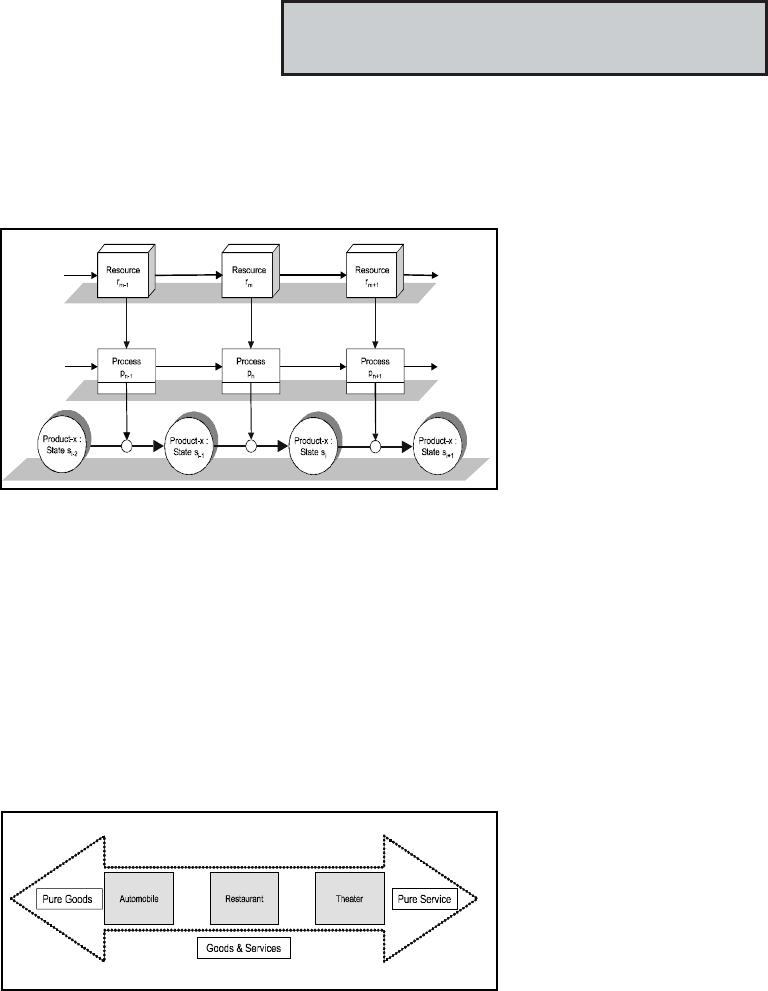
This idea is depicted in
Figure-1. The key notions
of the proposed framework,
viz. products, transforma-
tions, processes, and
resources are well known in
the domain of internal
chains (manufacturing systems). However, to provide greater
clarity, we discuss these underlying notions in this part of
the paper with the help of a series of propositions. The
propositions are very generic in nature and commonly
known. The objective is to discuss the key notions in a
known domain (internal chains) and clarify their intended
meaning in the new domain (external chains). The
discussions will be leading towards identification of
flexibility.
Why do Manufacturing Systems and Supply Chains Exist?
Proposition-1:
Manufacturing systems and supply chains
exist to meet the perceived market demand for products.
Manufacturing systems and supply chains are a set of
interdependent entities that exist to meet the perceived
market demand for products. Boubekri (2001) observes that
supply chain management involves operations that deal with
how the customer orders are processed through the system
and ultimately filled. The purpose of a manufacturing system
is to manufacture products in the required quantity and
quality at a minimum cost. The purpose of a supply chains
3
© 2002, Global Institute of
Flexible Systems Management
Understanding Flexibility in Supply Chains: A Conceptual Framework and Models
is to ensure that these products are distributed in time and
space so that the right products are available at the right
place, at the right time and at the lowest possible cost. Thus,
the realization of products and their distribution to meet the
market demands is the main purpose of manufacturing
systems and supply chains. Then the next question would
be to examine how products are realized.
How are Products Realized?
Preposition-2:
Products are realized from materials through
a series of transformations in their states, brought about by
performing certain processes on
them, with the help of certain
resources, and in this process,
certain time, cost and effort are
consumed.
This is the core idea depicted in the conceptual
framework shown in Figure-1. In the context of this
framework, the key notions of product, transformation,
process, and resource may be interpreted as follows.
The concept of supply chain is generic in
nature and can be applied in several contexts.
Figure 1 : A Conceptual Framework of a Supply Chain
What is a Product?
Lemma 2.1:
A product is anything that can be sold to a
market and that might satisfy a want or need. It is a bundle
of physical, service, and symbolic attributes designed to
enhance buyers’ want satisfaction.
Lemma-2.2:
Products include goods (the tangible
components of a product) and services (the intangible
components of a product). All the real life products can
be placed on a goods-services continuum, as shown in
Figure-2.
Figure 2: Goods-Services Continuum
In this paper, we are mainly concerned with the tangible
components of a product, i.e. goods flowing through the
supply chain. The next important notion is the
transformation.
What is a Transformation?
Lemma 2.3:
A transformation is something that happens to
the product when it undergoes a process.
The idea of transformation refers to something that
happens to a product, as it passes through a manufacturing
system or a supply chain. In the case of manufacturing
systems, transformations involve changing the form and
dimensions of the materials as they pass through various
manufacturing processes. In the case of a supply chain, some
examples of transformations may include: (a) after a
conventional manufacturing
process a raw material gets
transformed into a semi-finished
or a finished product, (b) after
assembly, two or more products join to form one or more
new products, (c) after disassembly, one product may get
separated into two or more products, (d) after packaging, a
product may get transformed into a form that is more suitable
for distribution, (e) after storage, there will be a change in
the temporal position (the product moves in time) of the
product, (f) after transportation, there will be change in the
spatial position (the product moves in space) of the product,
(g) after aggregation, the product will move from a smaller
lot to a bigger lot, (h) after disaggregating, the product will
move from a bigger lot to a smaller lot.
Lemma 2.4 :
Transformation of materials into products
require a set of partially ordered transformations
Transformation of materials into products requires a set
of partially ordered transformations to be carried out on the
materials. This set of transformations is something that
guides the development of process plans or process maps
discussed subsequently. The size of the transformation set
may vary, depending upon the kind of process and
transformation. For instance, in the case of operations such
as punching, stamping etc., the transformation set may
include only one transformation. On the other hand, the
transformation set for a complex machined component may
include several transformations. These transformations will
have to be performed in a particular order or sequence,
which may be interchangeable under some circumstances.
This will give rise to an important type of flexibility called
sequencing flexibility which is discussed below.
Lemma 2.5:
Under some circumstances it is possible to alter
the order/sequence in which the transformations are to be
performed to transform materials into products.
The idea of an order or sequence is important to
understand a type of flexibility called the sequencing
flexibility in manufacturing systems. Sequencing Flexibility
refers to the possibility of interchanging the order in which
the required transformations are performed on a product.
This sequence is generally represented through the process
plan, which is an abstract form of transformation sequence
in the process plane. In general, each type of product can
be associated with many sequences of transformations as
determined by the technological constraints in realizing the
4
giftjourn@l
Manufacturing systems and supply chains are a set
of interdependent entities that exist to meet the
perceived market demand for products.
product type. However, in most of the cases, a single process
plan is followed as a matter of convenience or due to an
established practice. Depending upon the design of the
product, it is possible to alter the sequence of
transformations to be performed. This gives rise to the
sequencing flexibility. The importance of the sequencing
flexibility lies in the fact that this can be built into the
product design, thereby avoiding much costlier option of
building flexibility into the manufacturing systems.
The potential of sequencing flexibility in enhancing the
manufacturing system performance has been recognized by
the researchers and efforts have been made to understand the
underlying mechanisms with a view to exploit this type of
flexibility. For instance, Rachamadugu et al. (1990) studied
the effects of sequencing flexibility on the performance of
various scheduling rules in environments such as job shops
and flexible manufacturing systems. They have found that
relative differences in performance of various scheduling
rules diminish and the relative rankings change as
sequencing flexibility increases. They have noted that since
sequencing flexibility is product specific, it exists in
conventional manufacturing systems as well as in flexible
manufacturing systems. In the past, organizational control
issues and the high cost of information systems precluded
the exploitation of sequencing flexibility even when it was
available in the product structure. However, recent advances
in information technology and the declining cost of
information systems make it
possible to use sequencing
flexibility at the operational
level. They further noted
that if the benefits of
sequencing flexibility in
terms of reduced flow times and inventories are sufficiently
great, this has implications for designing products in such a
way as to maximize the potential sequencing flexibility in
manufacturing the products. Rachamadugu and Schriber
(1991) proposed an approach for modeling of perfect
sequencing flexibility in a scheduling environment.
Benjaafar and Ramakrishna (1996) introduced several
representation and measurement schemes for sequencing
flexibility and studied the relationship between sequencing
flexibility and system performance under a variety of design
assumptions and operating conditions. Wadhwa and Rao
(2000) discussed about the determinants for process
sequence in the context of Process Concurrency. They
observed that, two processes ‘A’ & ‘B’ are carried out
sequentially due to any of the following reasons: (a) done
as a matter of established practice, habit or for convenience,
(b) due to functional boundaries, (c) ‘B’ requires certain
information from ‘A’, (d) ‘B’ requires certain decision from
‘A’, (e) ‘B’ requires certain materials from ‘A’, (f) ‘B’ requires
certain resource(s) which are currently being used by ‘A’, or
(g) there is a need for synchronization of certain event(s) of
‘A’ & ‘B’, which may result in certain lead-lag precedence
relationships between ‘A’ & ‘B’
In the case of a supply chains, the process sequence may
be mainly as a result of information and material
dependencies. The information in the form of customer
orders flows upstream through the chain and materials in the
form of products flows downstream through the chain.
Under some circumstances, it may be possible to alter the
sequence in which the information and materials flow. This
will give rise to certain types of flexibility in supply chains.
Whatever may be sequence, every transformation requires
one or more processes to be performed. Hence, the next
question to be addresses would be to understand what a
process is.
What is a Process?
Lemma 2.6:
A process is any operation through which a
set of inputs go through one or more steps resulting in a
more valuable set of outputs.
A process can be viewed as a series of interrelated
operations, which add value to its inputs resulting in outputs
that are more valuable. A process comprises of a set of
partially ordered steps intended to achieve the desired
output. These steps may be called operations. Sometimes
these steps are also referred to as processes themselves, and
a process is viewed as a set of partially ordered processes.
It is important to note that alternative processes can
substitute processes.
Lemma 2.7:
Under some circumstances a process can be
substituted by an alternative
process with or without
some kind of penalty in
terms of time, cost and
effort.
This idea is important to
understand certain types of flexibility. For instance, Benjaafar
and Ramakrishna (1996) used this idea to describe certain
types of flexibility originating from the product designs.
They observed that the mechanisms that enable flexibility
can be traced to specific physical and logical characteristics
of a manufacturing system and suggested that flexibility in
a manufacturing system can be classified as being either
product related or process related. They further observed
that, in general, three types of flexibility could be associated
with the manufacturing of a product. The first, operation
flexibility, relates to the possibility of performing an
operation on more than one machine. The second,
sequencing flexibility, refers to the possibility of
interchanging the sequence in which required manufacturing
operations are performed. The third, processing flexibility,
which is determined by the possibility of producing the
same manufacturing feature with alternative operations, or
sequences of operations. Lemma 2.5 proposed above refers
to the above-mentioned sequencing flexibility.
Whatever may be the type of process, every
process requires one or more resources to perform it.
Hence the next important question is to understand what a
resource is.
K.S. Rao and S. Wadhwa
5
© 2002, Global Institute of
Flexible Systems Management
It is useful to extend the idea of flexibility from a
manufacturing domain (internal chains) to the supply
chain domain (external chains).
emphasize the applicability of the framework to a wide
variety of contexts.
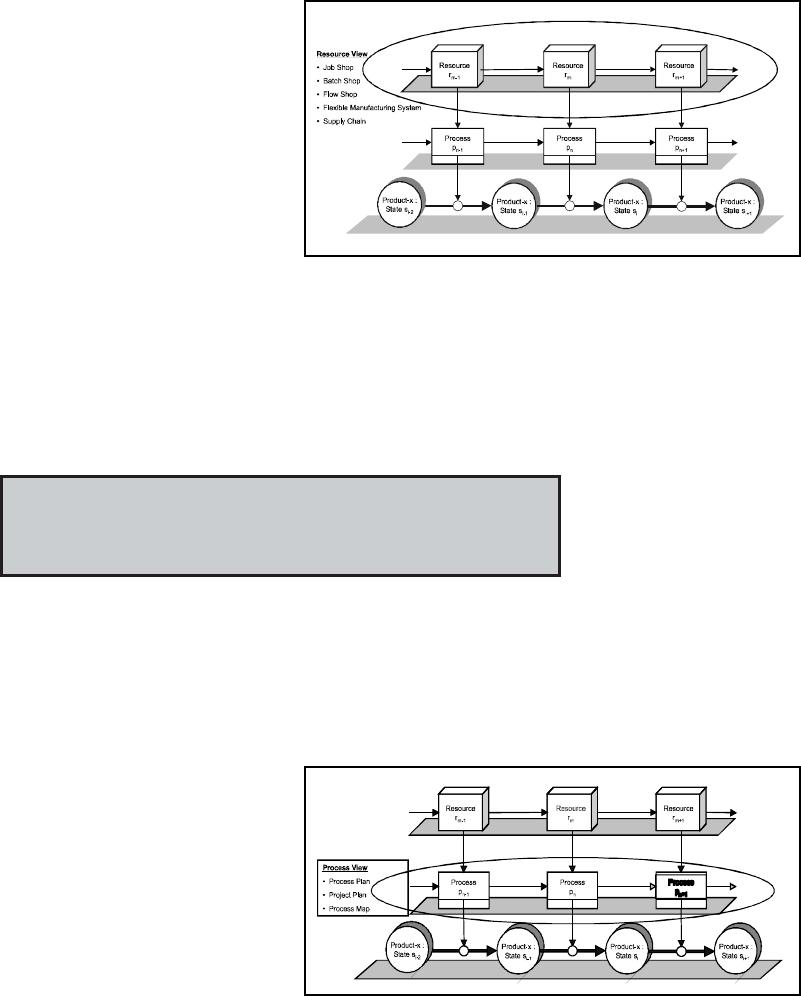
The Resource View
Figure-3 presents the resource view of the framework. In
the resource view, any system is visualized as a set of
interconnected resources through which the products flow.
Typical examples of resource view are various types of
manufacturing systems such as, flow shop, batch shop, job
shop, and flexible manufacturing system, and the
conventional supply chain also is a kind of resource view.
The resource view is more useful to represent situations
where same the processes are repeatedly performed by the
the same resources. Hence, it is commonly used in
manufacturing and supply chain environments.
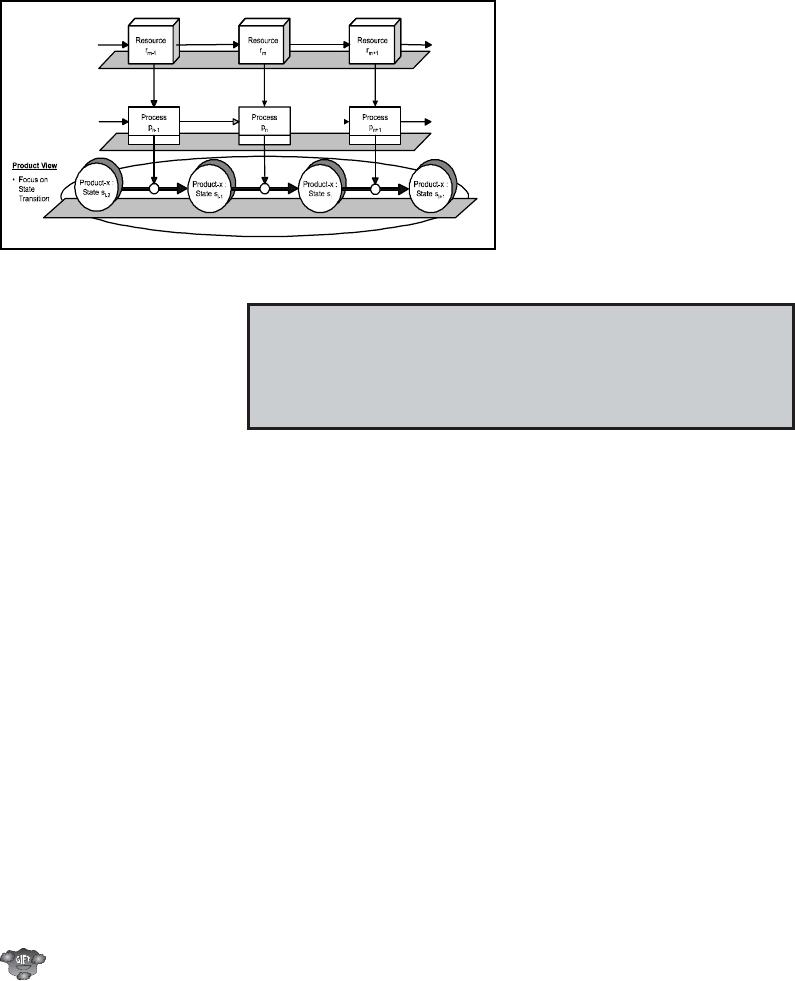
The Process View
Figure-4 presents the process view of the framework. In the
process view, any system is visualized as a set of
interconnected processes through which the products flow.
Typical examples of process view are process plan, project
plan and process map. The process view is more useful in
process-focused systems.
For instance, in the case of
project management, each
project has a unique start
and a unique end and all
the intermediate process are mapped with the help of a
project plan. The case of one-of-a-kind manufacturing is also
similar with a unique process plan. Recently there has been
considerable focus on process mapping and process
improvement. The business process re-engineering, the
continuous process improvement, are some of the initiatives
in this direction. In a supply chain environment, process
Figure 4: The Process View of the Conceptual Framework
Understanding Flexibility in Supply Chains: A Conceptual Framework and Models
What is a Resource?
Lemma 2.8:
A resource is a means to perform a process on
a product.
In the context of this paper, we propose to view a
resource as a means to perform a process on a product. Each
resource will have certain capabilities to perform these
processes. These capabilities are sometimes referred to
as process capability. The term process capability is
often used in a statistical sense to represent the relationship
between the allowed and actual spread of a controlled
process. In the context of this paper, we use the term
process capability to represent the ability of a resource to
perform operations required for one or more processes.
Process capability is a key idea behind resource related
flexibility.
A process requires one or more resources to perform the
required operations. The converse also may be true. A
resource may be able to perform operations required for one
or more processes. It follows from this that resources with
overlapped/identical process capabilities will be able to
substitute for each other.
Under some circumstances it is possible to substitute a
resource with one or more alternative resources, to perform
a given process.
This idea is key to understand resource related flexibility.
In general, when there are two or more resources with their
process capabilities overlapped, they give rise to a type of
flexibility called the routing flexibility in manufacturing
systems. Routing flexibility of a manufacturing system is its
ability to produce a part by alternative routes through
the system. In the case of supply chain an analogous
situation can be found with multiple suppliers, multiple
manufacturers, multiple modes of transportation, etc. This
gives rise to a type of flexibility where the materials will
flow through alternative
channels. Several such ideas
from manufacturing domain
can be extended into the
domain of supply chains.
Some directions for this could be found in literature. For
instance Milgate (2001) observed that each supplier in a
supply chain is similar to a machine processing in a
production system. This paper intends it is useful to extend
the idea of flexibility from a manufacturing domain (internal
chains) to the supply chain domain (external chains).
Wadhwa and Rao (2002) have suggested this important
insight along with the need to explicitly model
simultaneously the chain elements of the supply chain along
with those of the manufacturing system (internal chain). The
proposed conceptual framework is a step in this direction.
Part-2: Multiple Views of
the Conceptual Framework
The conceptual framework proposed above can be viewed
from multiple perspectives to understand different aspects
of the manufacturing systems and supply chains. Three
important views are: the Resource the View, the Process
View and the Transformation View. These three views further
Figure 3: Resource View of the Conceptual Framework
6
giftjourn@l
With the growing turbulence in the business
environment and competition shifting to the supply
chain level, the supply chain flexibility is emerging
as one of the key competitive priorities for the future.
view is useful for the overall improvement of the supply
chain efficiency and effectiveness. In the context of this
paper, we have used process view to identify various
flexibility types originating from the process improvement.
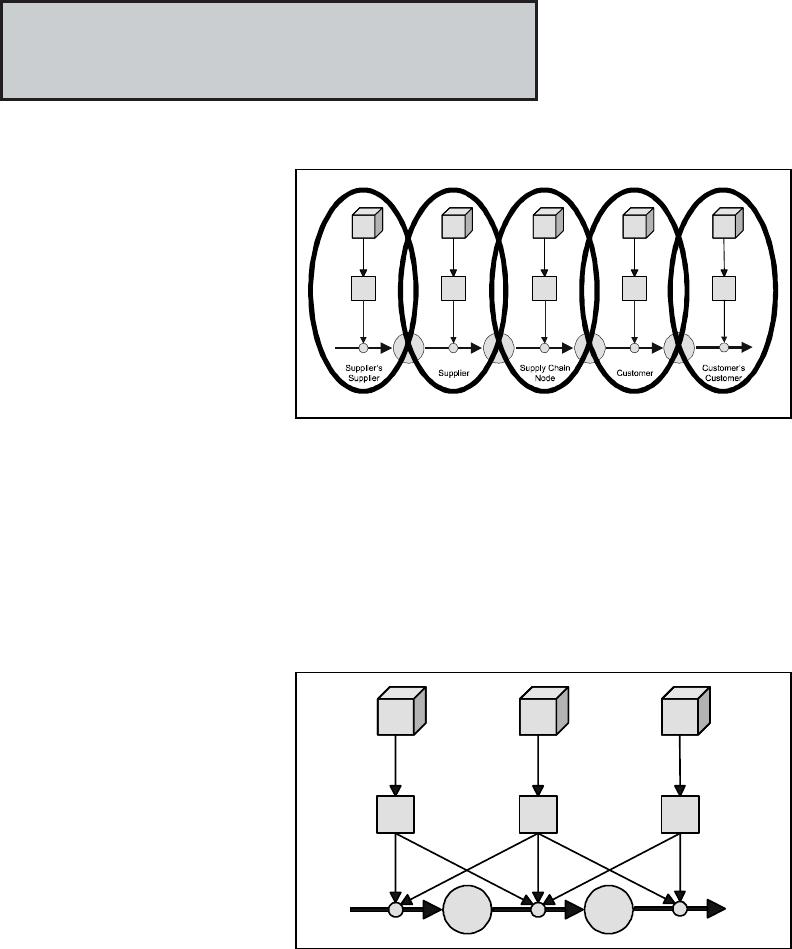
The Transformation View
Figure-5 presents the transformation view of the framework.
In transformation view the focus will be on the state
transition of the materials from one state to another as they
pass through different processes at different resources. The
transformation view is the most fundamental view based on
which the process view is developed. In the domain of
discrete part manufacturing, this is called methods
engineering, where specialized manufacturing engineers
study the product designs and develop a transformation view
and the corresponding resource view for manufacturing of
the products. Understanding the transformation view is
useful in identifying the opportunities for improvement in
the process.
Figure 5: The Transformation View of Conceptual Framework
Thus we talk about the
same system with different
names and notation in
different views. Whatever
may be the view, the
underlying structure and
mechanisms may remain the same. This idea motivated us
to develop the proposed conceptual framework for flexibility
in supply chains, as discussed below:
Part-3: Understanding Flexibility
in the Supply Chains
With the growing turbulence in the business environment
and competition shifting to the supply chain level, the
supply chain flexibility is emerging as one of the key
competitive priorities for the future. Developing a core
competence in this area is expected to have a long-term
impact on the supply chain competitiveness and business
performance. Realizing this fact, recently a number of
authors have started discussing flexibility from a supply
chain perspective. For example, Koste and Malhotra (1999),
while presenting a perspective on research opportunities in
manufacturing flexibility, emphasized that the presence or
absence of flexibility in supply chains and its relationship
with performance should be explored and the effect of
supply chain integration on the development of flexibility
in supply chains should be examined. They observed that,
the competitive priorities of the supply chain might impact
flexibility, as efficient supply chains may emphasize certain
flexibility dimensions, while responsive supply chains focus
on the other. An understanding of these differences, if any,
would enhance the management of supply chains. Vickery
et al. (1999) view supply chain flexibility to encompass
those flexibilities that directly impact a firm’s customers (i.e.,
flexibilities that add value in the customer’s eyes) and are
the shared responsibilities of two or more functions along
the supply chain, whether internal (e.g., marketing,
manufacturing) or external (e.g., suppliers, channel members)
to the firm. They defined five supply chain flexibilities viz.,
production flexibility (customization), volume flexibility,
new product introduction (launch flexibility), widespread
distribution (access flexibility) and responsiveness to target
markets. Adrian (2001) views supply-chain flexibility as the
ability to restructure the system quickly and inexpensively.
He observes that after the Sept. 11 terrorist attacks on the
USA, many businesses were forced to wonder just how
vulnerable their supply chains are to unforeseen disruptions.
These unforeseen events can all have devastating effects on
manufacturing and distribution operations and result in
millions of lost dollars. He argues that the business must
bulletproof their operations by building in supply-chain
flexibility. Duclos et al. (2001) propose a conceptual model
of supply chain flexibility and identified six components
of the supply chain flexibility, viz., production flexibility,
market flexibility, logistics flexibility, supply flexibility,
organizational flexibility, and information systems
flexibility. They observe that as the basis of competition
is extending to supply chains and time becoming
increasingly important, supply chain flexibility will be a
critical issue for
competitiveness. They argue
that if manufacturing
flexibility improves
performance, supply chain
flexibility, which would
include the manufacturing flexibility of firms within the
supply chain, should further improve performance when
measured across the entire supply chain. Another closely
related work to supply chain flexibility is in the domain of
lean and agile supply chains (Naylor et al. 1999, Mason et
al. 2000, Christopher and Towill 2000).
The supply chain flexibility will manifest in the nature
and type of supply chains. Hence there is a close
relationship between the supply chain flexibility and its
typology. For instance, Belussi and Arcangeli (1998)
propose a typology of networks for flexible and
evolutionary firms based on two dimensions: on one axis
the operational flexibility (retractility and reversibility) is
measured; on the other, static and dynamic (capability-
building) forms of learning are bared. Based on this, they
proposed three types of networks: those where static learning
occurs, those with adaptive learning, and those characterized
by creative learning. They observed that these emerging new
organizational forms allow for more coordination among
quasi-independent actors, and, at the same time, more
flexibility and autonomy in planning, production, and
K.S. Rao and S. Wadhwa
7
© 2002, Global Institute of
Flexible Systems Management
Under some circumstances, it may be possible to
alter the sequence in which the information and
materials flow, towards supply chain benefits.
distribution, may represent the evolutionary genotype of a
new phase of development induced by the application of
new technologies. Similarly, Pfohl and Buse (2000) propose
a typology of production networks. They identified four
types of networks viz., strategic network, virtual enterprise,
regional network and operative network. The strategic
networks are guided by a large core firm, whereas the virtual
enterprise is a temporary project to exploit a particular
business opportunity. Regional networks are formed by small
highly specialized firms situated in spatial proximity and
the operative networks use pooled resources they can access
quickly at a short notice. They defined inter-firm network
as a complex arrangement of reciprocal, cooperative rather
than competitive, relationships between legally independent
but economically interdependent firms, with potential to
achieve both efficiency and flexibility at the same time due
to loose coupling. They observed that the supply chain
concept in its traditional
form does not sufficiently
address all relevant aspects
of the organization of
logistics in production
networks, and the potential for improvements which can
result from (a) horizontal relationships (two suppliers
cooperate in fulfilling logistics requirements e.g they bundle
their delivery volume or one of the suppliers acts as
logistical service provider for the other supplier) (b) lateral
relationships (a supplier supplies to one customer and at the
same time supplies to another supplier of that customer) (c)
circular relationships (in which the customer at the same
time acts as a supplier to his supplier) or (d) general
reciprocal dependencies (the performance of a supplier
depends directly on the activities of other suppliers: the
customer might change his production plan because of
delivery problems of one supplier which in turn can result
in problems for other suppliers). Some of the flexibility types
proposed in this paper address the above issues.
The first two parts of the paper presented the conceptual
framework and the key notions of products, transformations,
processes and resources. Flexibility originates from the
interdependencies of these four elements. Several examples
can be found from the domain of manufacturing. For
example, the ability to interchange the sequence of
transformations will give raise to sequencing flexibility, the
ability to perform a given transformation using more than
one type of process, or the ability to perform a given process
type using more than one type of resource, or having
multiple resources of the same type, will give raise to
routing flexibility. In a similar way, the supply chain
flexibility may be considered as having originated from the
interdependencies among products, transformations,
processes and resources. Based on this idea, we identify
several possible models for supply chain flexibility as
described below.
The transformations that happen to materials as they pass
through a supply chain may include ‘being procured as a
raw material’, ‘being transformed into a finished product’,
‘being moved in space’, ‘being moved in time’, ‘being
distributed to an intermediary’ and ‘being delivered to the
end customer’. The corresponding process types are called
as ‘raw material supply’, ‘manufacturing’, ‘transportation’,
‘storage’, ‘distribution’ and ‘retailing’, respectively. The
resource types that perform these processes are called ‘raw
material suppliers’, ‘manufacturers’, ‘transporters’,
‘warehouses’, ‘distributors’ and ‘retailers’. In general, a given
type of transformation requires a particular type of process
to be performed by a particular type of resource. Having
alternatives in these interdependencies will give raise to
flexibility. Some such scenarios are discussed below.
Case-1 Traditional Supply Chain
Figure-6 depicts the representation of a traditional supply
chain using the proposed conceptual framework. It can be
seen that each state transition of the material is associated
with one process and one resource. In the case of
manufacturing systems, this
kind of a chain represents the
flow shops and transfer lines.
This structure also represents
many of the traditional
supply chains based on single products. These types of
chains may have limited or no flexibility.
Case-2 Supply Chain with Process Based Flexibility
Figure-7 depicts the representation of supply chain with
process based flexibility using the proposed conceptual
framework. It can be seen that each state transition of the
material is associated with more than one process and thus
with more than one resource. In the case of manufacturing
systems, this kind of chain represents the flow shop with
Figure 6: Traditional Supply Chain with Limited Flexibility
Figure 7: Supply Chain with Process based Flexibility
Understanding Flexibility in Supply Chains: A Conceptual Framework and Models
8
giftjourn@l
flexible operations and flexible processing as defined by
Benjafaar and Ramakrishnan (1996). This structure also
represents some situations of the traditional supply chains
based on single products. For instance, this may represent
a situation where a product is delivered to the end customer
by both the retailer as well as distributor.
Case-3 Supply Chain with Resource Based Flexibility
Figure-8 depicts the representation of supply chain with
resource based flexibility using the above defined
conceptual framework. It can be seen that each state
transition of the material is associated with one process but
with more than one resource.
In the case of manufacturing
systems, this kind of chain
represents the idea of machine
flexibility as defined by
Browne et.al. (1984). This
structure also represents some of the traditional supply
chains based on single products. For instance, this may
represent a situation where a manufacturer performs both
manufacturing as well as distribution, or a warehousing
company handles both the storage as well as transportation.
Case-4 Supply Chain with Process as well as Resource
Based Flexibility
Figure-9 depicts the representation of Supply Chain with
both process as well as resource based flexibility, using the
above defined conceptual framework. It can be seen that
each state transition of the material is associated with more
than one type of process as well as more than one type of
resource. This kind of flexibility will be a combination of
Case-2 and Case-3, mentioned above.
Figure 8 : Supply Chain with Resource Based Flexibility
Case-5 Supply Chain with Process as well as Product
Based Flexibility
In the area of supply chain flexibility, one of the important
concepts found to be useful is the concept of chaining. This
concept is concerned with the ability of a plant to
manufacture more than one product at the same time. The
concept of ‘chaining’ has been introduced by Jordan and
Graves (1995) as an effective flexibility strategy. They
define a chain as a group of products or plants which are
all connected, directly or indirectly by product assignment
decisions. In terms of graph theory, a chain is a connected
graph. Within a chain, a path can be traced from any product
or plant to any other product
or plant via the product
assignment links. No product
in a chain is built by a plant
from outside the chain; no
plant in a chain builds a
product outside that chain. Figure.10 shows three different
configuration for 6-product, 6-plant chain, as discussed by
Tomlin (2000).
Figure 9 : Supply Chain with Process as well as
Resource based Flexibility
In Figure-10, the circles represent products and the
squares represent plants/machines. The graph indicates the
allocation of products to the plants. In the case of
specialisation, each plant manufactures only one type of
product and hence there is no flexibility. The condition of
chaining introduces certain amount of flexibility without
much investment, but still captures most of the benefits of
the total flexibility. Sheikhzadeh et al. (1998) extended the
idea of chaining to study the operational performance of
machine sharing configurations involving flexibility and
chaining. They observed that chaining captures most of the
benefits of total flexibility. In our opinion, this idea can
be extended to the supply chains and this will give rise to
certain product-based flexibility.
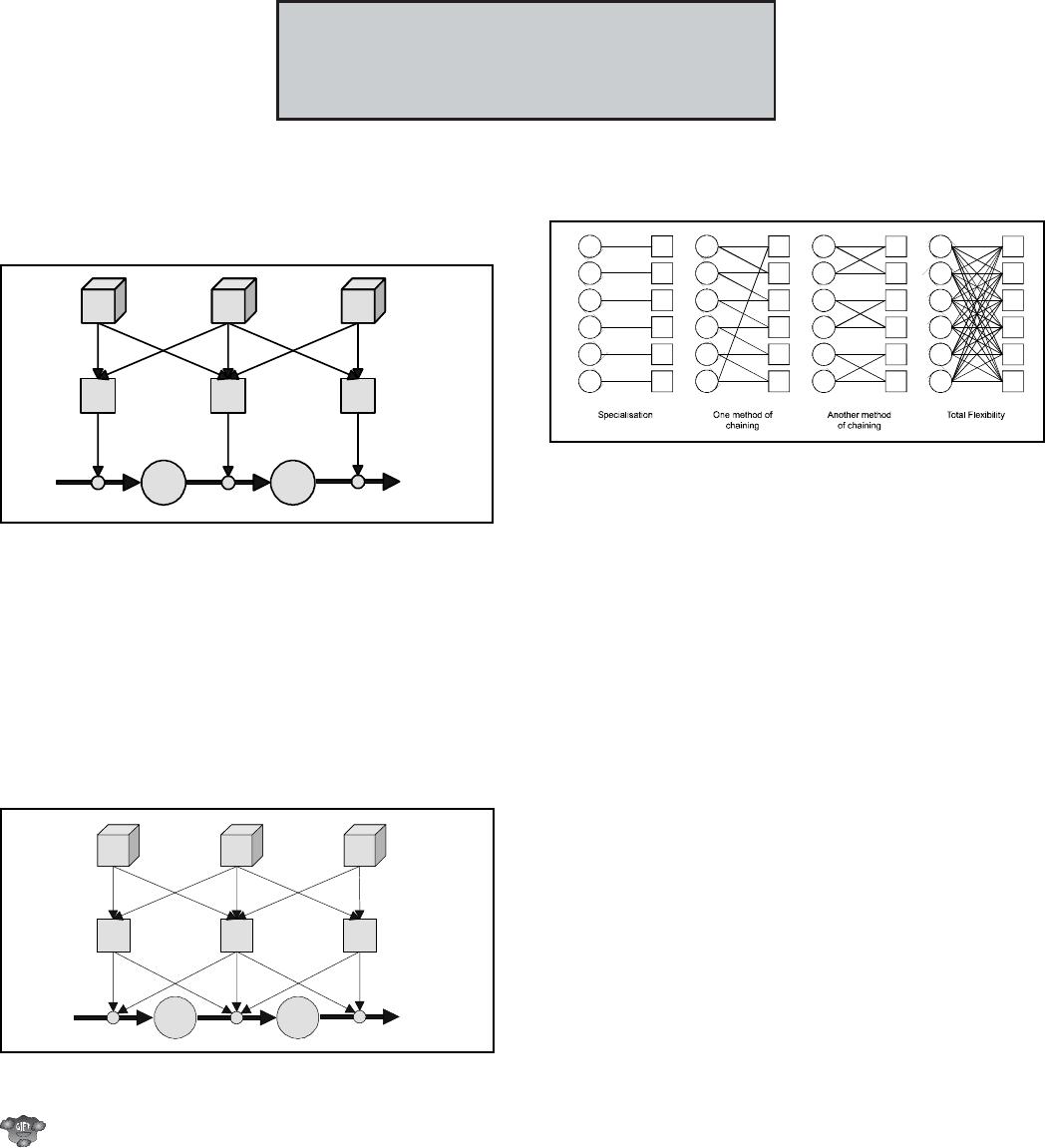
Figure-11 depicts the representation of supply chain with
product based flexibility at process level, using the above
defined conceptual framework. It can be seen that the state
transitions of two products may share common processes and
thus the common resources. This kind of a supply chain
represents the job shop environment in a manufacturing
system where multiple products share common processes and
resources. It is also common in supply chains dealing with
multiple products. For instance, a wholesaler or a retailer
dealing with more than one type of product will perform
the same type of processes on all the product types.
K.S. Rao and S. Wadhwa
Whatever may be the type of process, every
process requires one or more resources to
perform it. Thus routing flexibility concept can
be applied to supply chain processes
Figure 10 : The Concept of Chaining
9
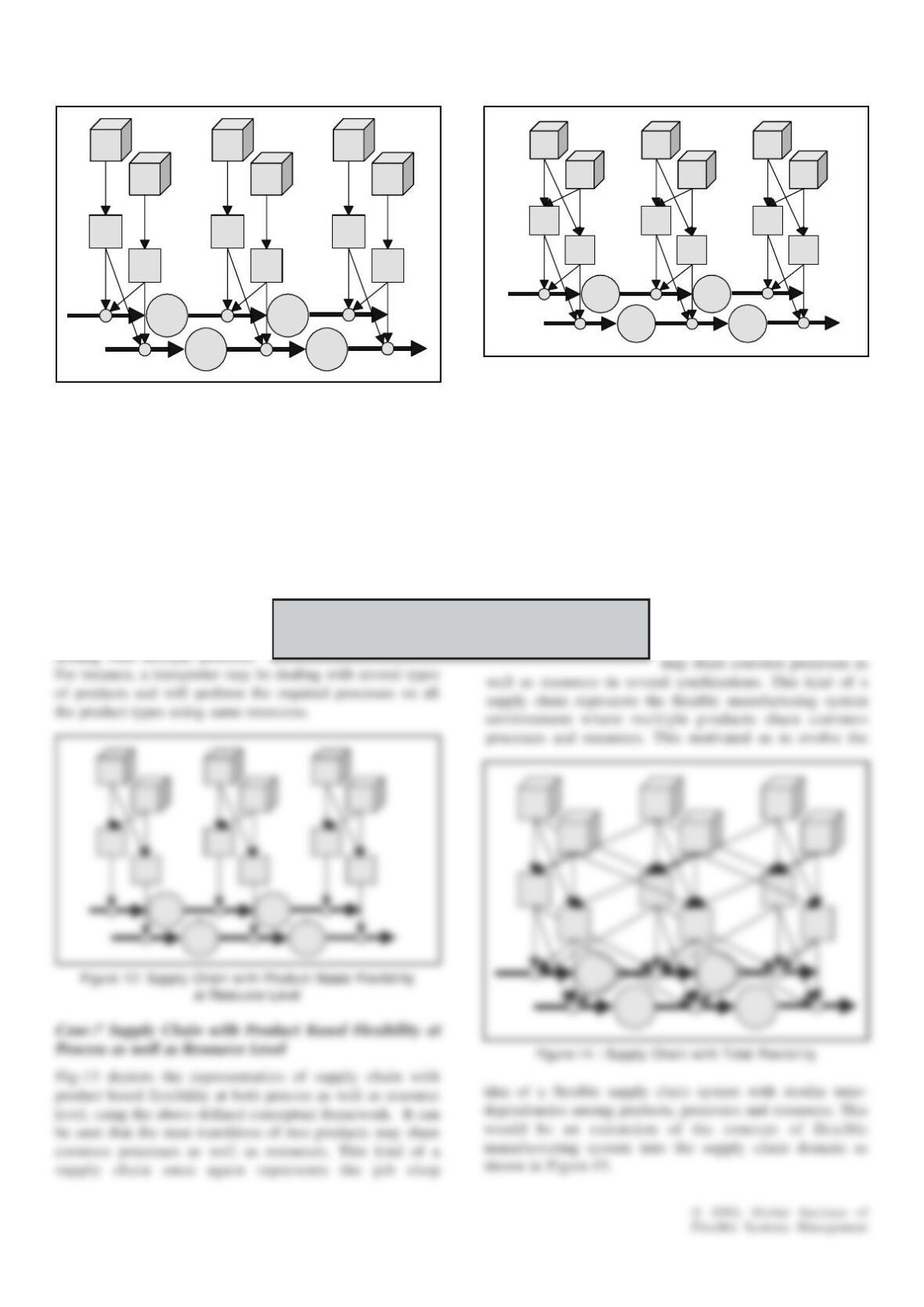
Case-6 Supply Chain with Product Based Flexibility at
Resource Level
Figure-12 depicts the representation of supply chain with
product based flexibility at resource level, using the above
defined conceptual framework. It can be seen that the state
transitions of two products may share common resources
through respective processes. This kind of a supply chain
represents the job shop environment in a manufacturing
system where multiple products
share common resources. It is
also common in supply chains
Figure 11 : Supply Chain with Product Based Flexibility
at Process Level
Different types of flexibility can be mapped
to the supply chain domain.
Understanding Flexibility in Supply Chains: A Conceptual Framework and Models
Figure-13: Supply Chain with Product Based Flexibility at
Process as well as Resource Level
environment in a manufacturing system where multiple
products share common resources. It is also common in
supply chains dealing with multiple products. This may be
considered as a combination of flexibility types mentioned
at Case-5 and Case-6 above.
Case-8 – Supply Chain with Total Flexibility
Fig-14 depicts the representation of supply chain with
total flexibility at product, process as well as resource
level, using the above defined
conceptual framework. It
can be seen that the state
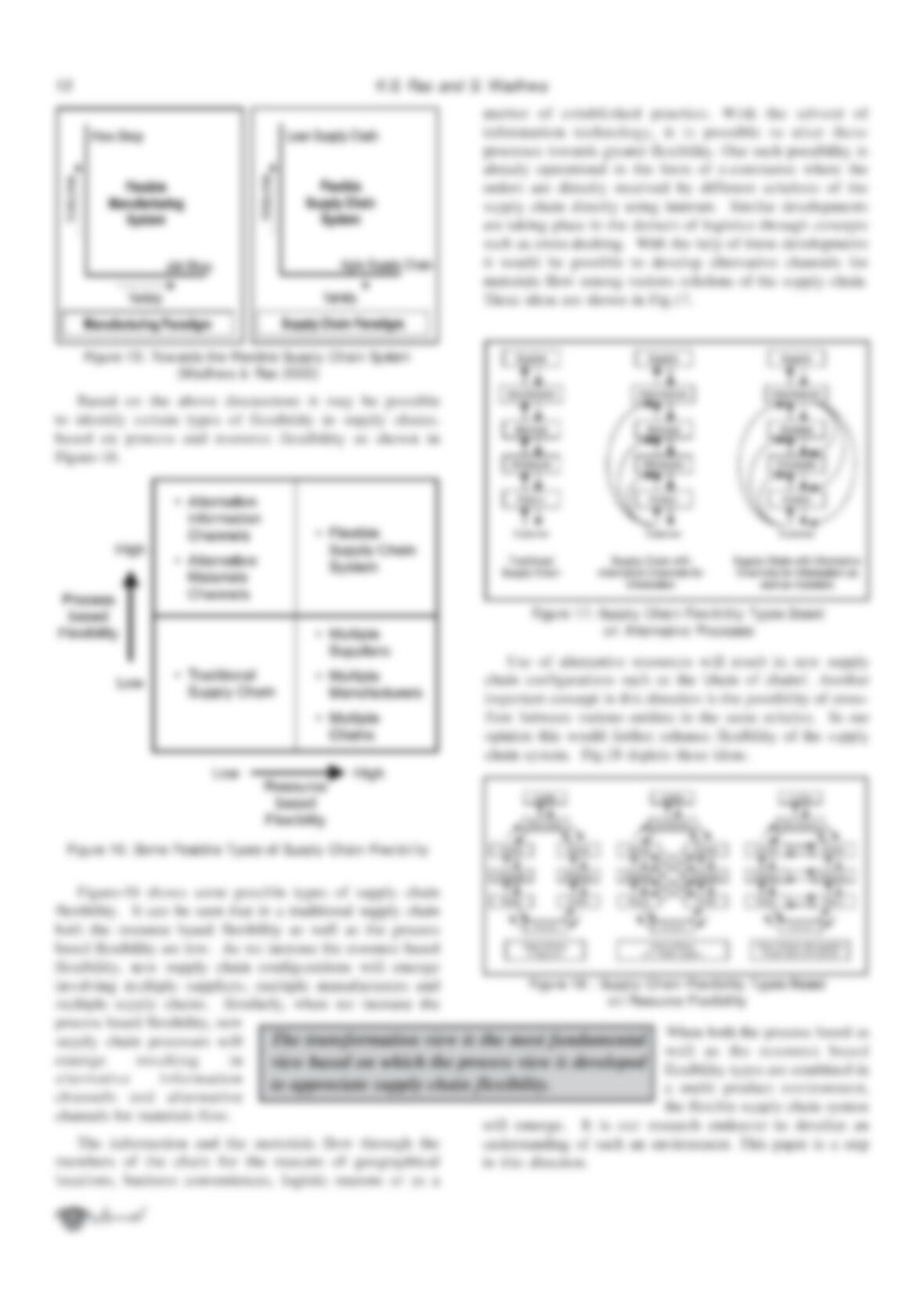
transitions of two products