Bachelor of Business (Hons)
GLOBAL FINANCIAL MANAGEMENT
(FIN304)
SEPTEMBER 2021 SEMESTER
ASSIGNMENT (INDIVIDUAL)
Due Date: 9 December 2021
Weightage: 15%

Assignment Questions
(Individual Assignment)
CASE STUDY
KiKos and the South Korean Won
That possibility arises from a fundamental tenet of international law that is not written down
in any law book: In extremis, the locals win.
—“Bad Trades, Except in Korea,” by Floyd Norris, The New York Times, April 2,
2009
[Please refer to Eiteman, Multinational Business Finance 15ed. Chapter 7 Mini Case for
the detail of the Cases]
Summary of the cases:
• South Korean exporters in 2006, 2007, and into 2008 were not particularly happy with
exchange rate trends.
• The South Korean won (KRW) had been appreciating, slowly but steadily, for years
against the U.S. dollar. This was a major problem for Korean manufacturers, as much
of their sales was exports to buyers paying in U.S. dollars.
• As the dollar continued to weaken, each dollar resulted in fewer and fewer Korean
won—and nearly all of their costs were in Korean won.
• Korean banks, in an effort to service these hedging needs, became the sale and
promotion of Knock-In Knock-Out option agreements (KiKos).
• Many South Korean manufacturers had suffered falling margins on sales for years.
Already operating in highly competitive markets, the appreciation of the won had cut
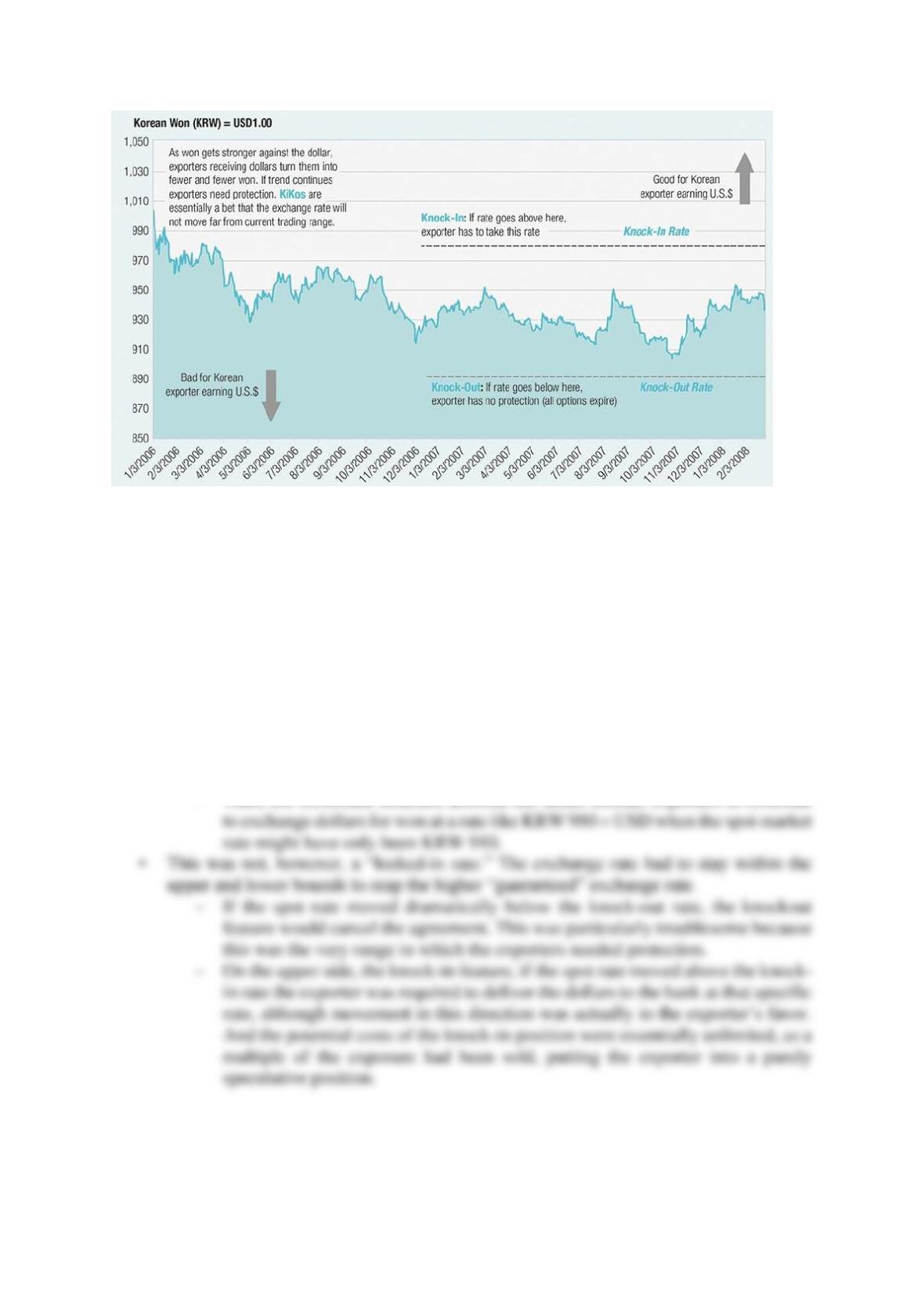
further and further into their margins after currency settlement. As seen in Exhibit A,
the won had traded in a narrow range for years. But that was little comfort as the
difference between KRW1,000 and KRW 930 to the dollar was a big chunk of margin.
• South Korean banks had started promoting KiKos as a way of managing this currency
risk. The Knock-In Knock-Out (KiKo) was a complex option structure, which
combined the sale of call options on the KRW (the knock-in component) and the
purchase of put options on the USD (the knock-out component).
• These structures then established the trading range seen in Exhibit A that the banks and
exporters believed that the won would stay within. In one case the bank salesman told
a Korean manufacturer “we are 99% sure that the Korean won will continue to stay
within this trading range for the year.”
• But that was not the entirety of the KiKo structure. The bottom of the range, essentially
a protective put on the dollar, assured the exporter of being able to sell dollars at a set
rate if the won did indeed continue to appreciate.
• This strike rate was set close-in to the current market and was therefore quite expensive.
In order to finance that purchase the sale of calls on the knock-in rate was a multiple
(sometimes call the turbo feature) meaning that the exporter sold call options on a
multiple, sometimes two or three times, the amount of the currency exposure. The
exporters were “over–hedged.”
• This multiple yielded higher earnings on the call options that financed the purchased
puts and provided added funds to be contributed to the final KiKo feature.
– This final feature was that the KiKo assured the exporter a single “better-than-
market-rate” on the exchange of dollars for won as long as the exchange rate
stayed within the bounds.