Globalisation and doing business globally are significant issues for contemporary
organisations. Define what is meant by Global Business. Identify the stages in the
phase model of globalisation and explain the strengths and weaknesses inherent
in each.
Essay
In the current era of technological advancement and globalisation, global business
has become a significant topic for organisations growth and development. Global
business is the expansion of business in global platform seeking to deliver
services globally and locally by the coordination of the communication and
information technology. It constitutes of business transactions which are carried
out across the borders to fulfil the needs of an individual, company and
organisations. (Czinkota, Ronkainen, & Moffett, 2004, p. 4). Culture, technology,
strategy and manpower are the cornerstones of a global business along with the
significance of leadership and the business environment. In the current scenario the
global business motive and strategy is not only limited to economic growth but also
the expansion of cultural exchange, corporate social responsibility and networking.
Various forms of global business are adopted by the companies. How an
organisation establishes itself as a global business is different in every case as
there are various forms of global business.
When expanding business in an international territory an organisation may align
with different methods depending in their business strategy, concept as well as
size. These forms of global business which are significantly different to each other.
The different sequences of global business have their own merits and demerits
and a business need to analyse which one better suits them. These forms are
highlighted in detail below;
Exporting:
Exporting is the expansion of business abroad by selling their goods or services to
the international customers may it be directly or through distributors. It is the basic
and common way of global business as a company’s first step in globalisation.
Companies export their goods and services to other countries which makes their
product global without any need of a foreign branch. There is less dependent on
the home markets along with elevation of brand popularity.(Xie, Z. & Li, J. J Int Bus
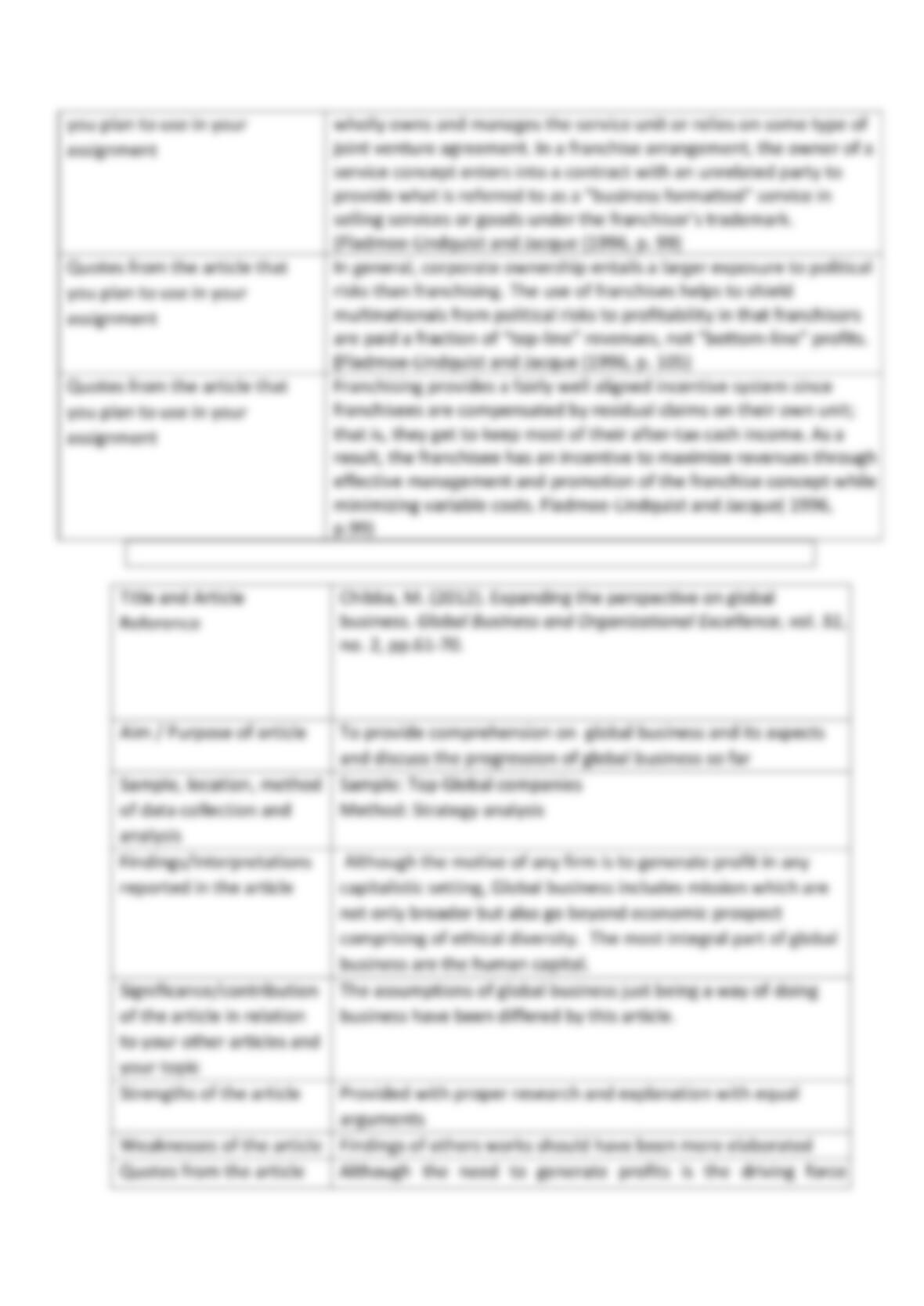
Stud (2018) 49: 222. https://doi.org/10.1057/s41267-017-0118-4)
Exporting provides a better control in market research as well as production
decision with optimal range of customers.
However in order for a firm to involve in exporting there can be high cost
associated with transportation along with trade barriers. Trade barriers could be
tariff and non-tariff which influence the production cost for instance imposing of
direct taxes, subsidies and customs classification. The increase in the production
cost makes these product more expensive.
Cooperative contracts;
The most convenient way to enter into a global business without huge financial
commitments are through cooperative contracts. It is set of contracts with foreign
business where rights to the product or brand name is given to them. It may be in
the form of licensing or franchising.
Licensing:
Licensing is the process where a company provides rights to a foreign business to
sell the company’s product or have their name for exchange of which they pay
royalties. Companies license their product rights to overseas companies which in
turn gives them profit as well as promotes the brand image. Licensing helps to
expand one’s business without expanding the location or moving abroad. Different
companies license their goods and services to create customer satisfaction in
other countries as well as expand market scope. It helps company get more profit
without increasing investment costs. It helps to avoid tariff and non-tariff barriers.
However licensing may result in licensor giving up control over the overall quality