Germany
Course: BUSI2701B
Professor: Christopher Atkins
2
EXECUTIVE SUMMARY
This report was commissioned to do an analysis of Germany and make a recommendation as to
whether or not to a large Canadian company should expand its foreign operations in Germany.
The country was analyzed based on its Macro Environment – country description, Political
situation and stability, Legislation, Economic conditions and Cultural issues, as well as on its
Factor Endowments. The findings show that Germany has an overall stable and healthy economy
with excellent advanced factors of production – especially in regards to productivity and
innovation. With new ties to Canada, through CETA, legislation will be easier to deal with. The
country also has a similar culture and stable politics. The risks of falling GDP and low FDI do
not outweigh the benefits and FDI should soon increase with Germany’s new agreements with
Canada and is soon to do a similar deal with the US. It is recommended that foreign operations
be expanded into Germany. Operations should proceed cautiously with wages that are stagnant in
Germany and try to provide a fair wage to encourage further training and enhance the economy.
COUNTRY’S MACRO ENVIRONMENT
Country Description: Germany is a highly developed and wealthy OECD country [33] and is
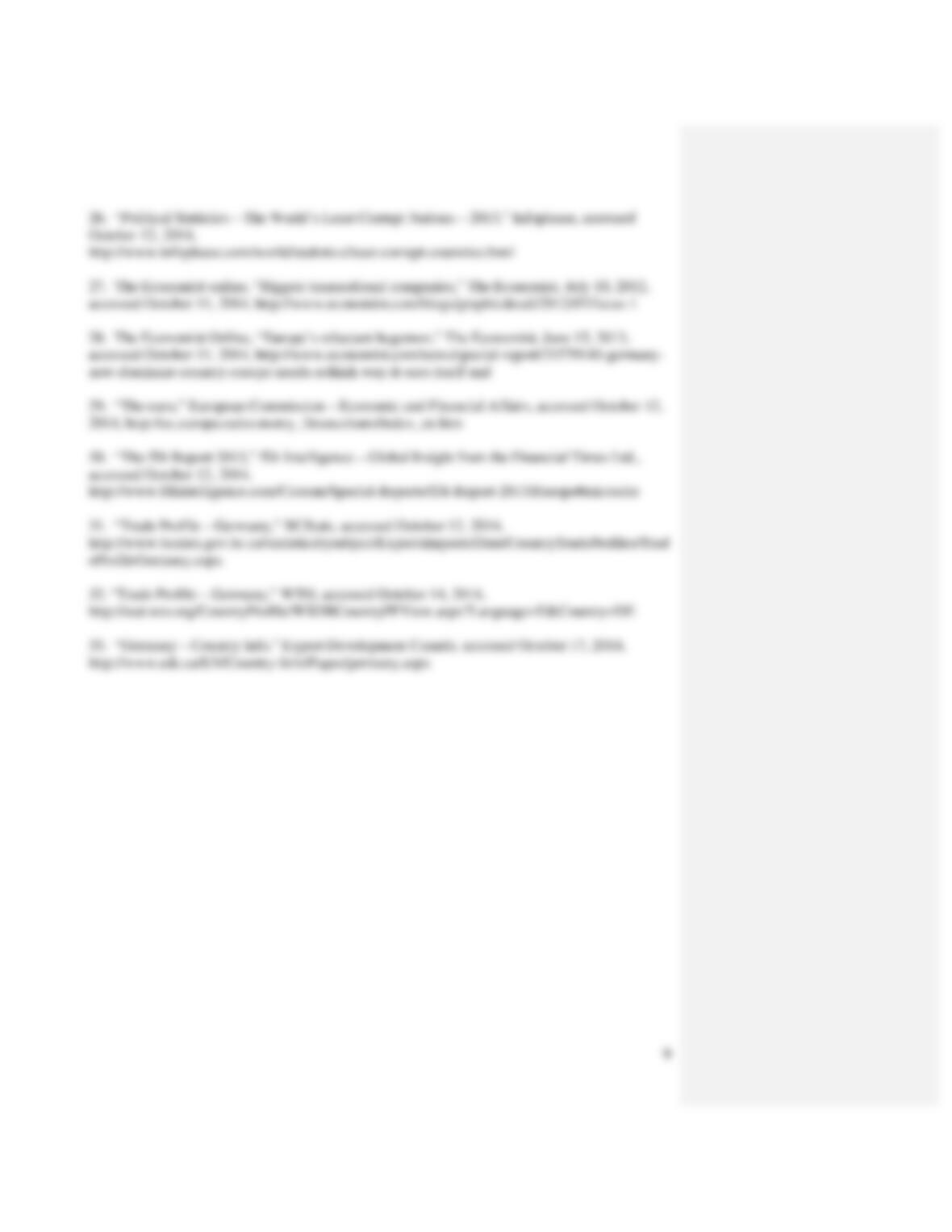
the fifth largest economy in the world in terms of PPP [17]. Its GDP/capita in terms of PPP has
been on an upward growth trend since 1985 and was just below Canada’s in 2012 (Appendix 1).
However, neglect has led to infrastructure that is crumbling (including highways and bridges)
[25]. Their top industries include: steel, coal, cement, chemicals, machinery, vehicles, machine
tools, electronics, food and beverages, shipbuilding, and textiles [17]. Germany is a member of
the EU, have strong global relationships, and have just signed a CETA pact with Canada. Foreign
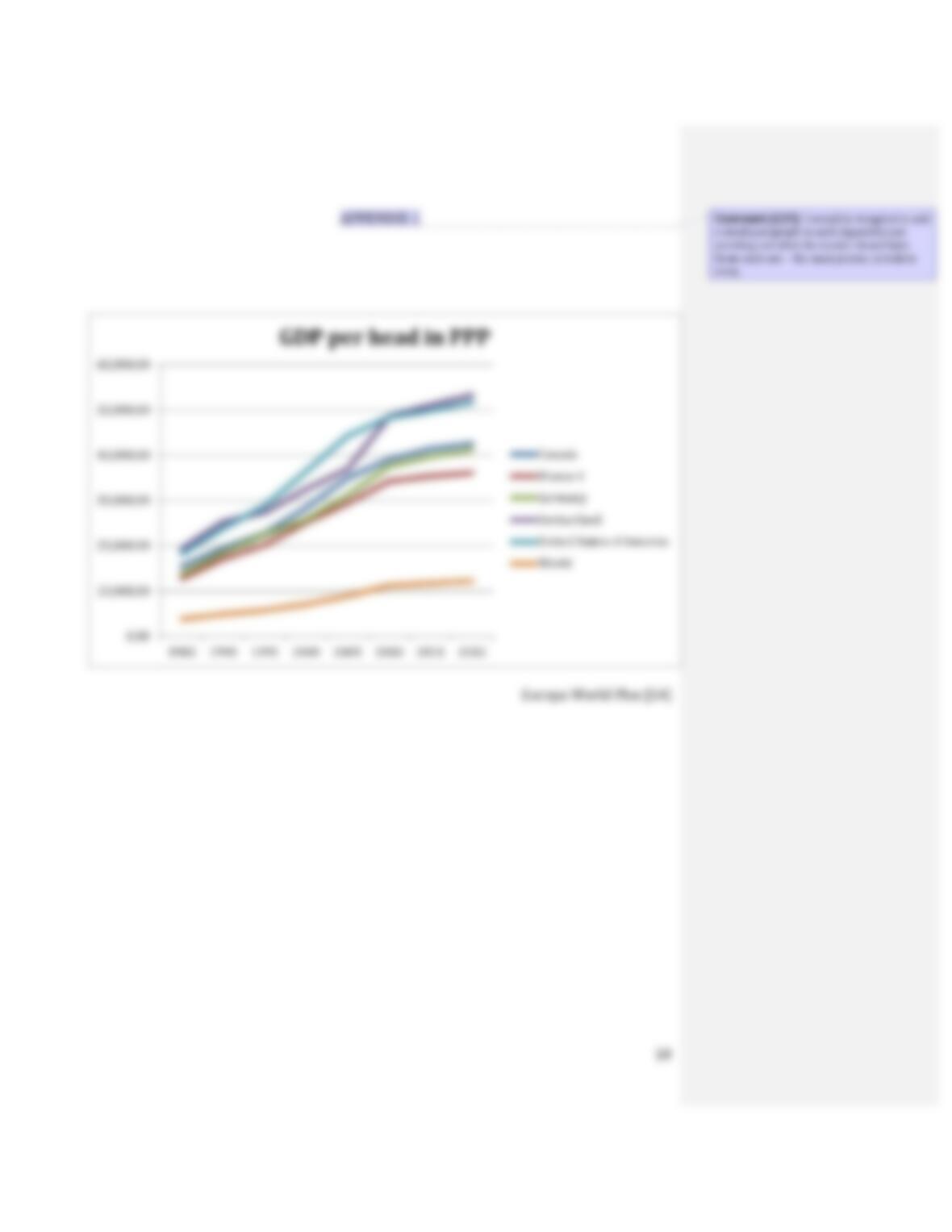
Direct Investment took a dip in 2008 and has been decreasing since 2011 (Appendix 2). The
latter was due to the Eurozone Crisis [30]. Four of the twenty largest transnational companies are
German – Volkswagen, Siemens, Deutsche Telecom and E.ON [27]. Germany is also one of the
Comment [C1]:
Clear use of headings,
matched to the rubric. Not essential but
makes the report very clear and easy to
follow.
Comment [C2]:
This is an Introduction and
could be omitted in a short report, especially
one commissioned by the principal reader. It
would give more space to deal with the
substantive content.
Comment [C3]:
Good reasoning. A few
important reasons are summarized here
Comment [C4]: I would put the main
recommendation first in the executive
summary, and then the reasoning. Has more
imopact that way and tells the reader what
he/she wants to know first
Comment [C5]: And risks are included. Not
perfect but a good executive summary
Comment [C6]: Very minor point, but it is
normal for references to appear in order so
the first one should be # 1, etc.
Comment [C7]: Recent growth figure
would make this even better.
Comment [C8]: Comparison to something
that makes sense to the reader – good.
Comment [C9]: Minor point, Germany is an
entity and should be singular so “has” not
“have”
Comment [C10]: Good point – puts the
economy in context
3
world’s least corrupt nations according to Transparency International. With a CPI of, they are
12
th
on the list and only 2 behind Canada [26]. The main type of corruption present is bribery in
relation to winning public contracts in the private sector [12].
Political Situation and Stability: Germany has a democratic government. It operates in a
parliamentary fashion and emphasizes protection of individual liberty and division of powers
[17]. It is known for the stability of its politics. During the financial and economic crises since
2008, Germany remained strong while many countries in that continent were in political turmoil
[5]. Germany is working towards integration among members of the EU and sees its ties with the
United States, as well as membership in NATO as important to maintain [17].
Legislation: Germany’s highest tariffs are on agricultural goods at 13.7 while the average tariff
on all goods is 5.2 [32]. Germany has one of the least restrictive regulatory processes in regards
to FDI [11], though it can restrict non-residents from taking over domestic companies, real estate,
vessels, securities etc. It has the most restrictive antitrust legislation of the G-7 countries. It also
has one of the most significant competition policies but never uses it to block FDI as it is limited
enough by informal trade barriers [11]. Subsidies in Germany come from both the Federal
Government and the Lander. There is concern from experts and economists due to the fact that
certain industries – such as coal and steel – are dependent on subsidies. The subsidies are higher
now, after unification [20]. Low productivity and efforts to avoid unemployment in East
Germany are the primary motivators. Intellectual property protection is amply covered by the
GRUR. It has been devoted to protecting intellectual property since 1891 and internationalized
its association and established a position for international affairs in 2004 [1].
Economic Conditions: Germany has a mixed economic system that allows for private freedoms
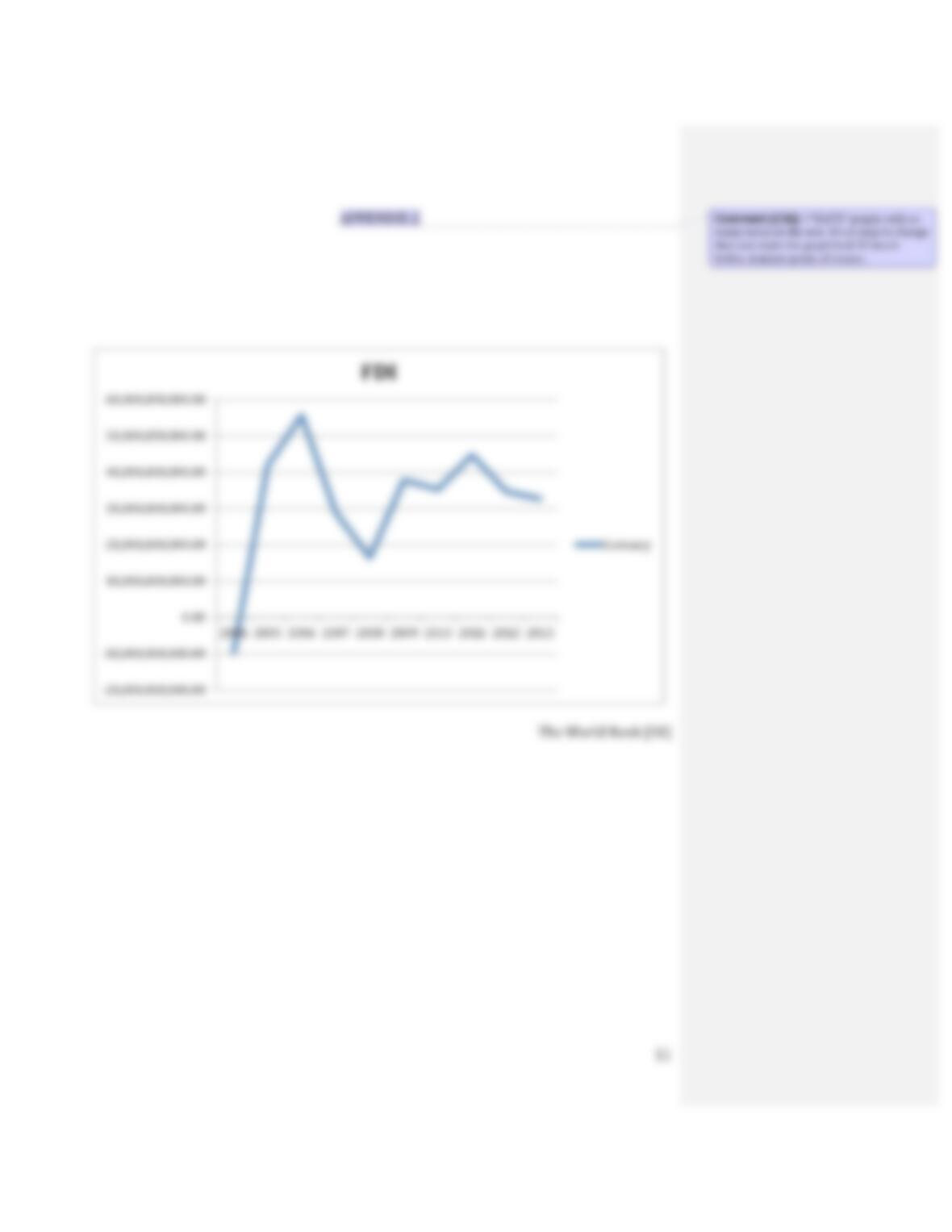
while also having centralized economic planning and government regulation [17]. GDP growth,
however, has been on a downward trend since 2010 (Appendix 3). At the same time, the value of
Comment [C11]:
Missing data point.
Comment [C12]: Good, but could have
made better with an example – Siemens is
probably the best known.
Comment [C13]:
This is well done. I think
mentioning the continuing integration of the
East (25 years later) would be good. Does it
have a bicameral or unicameral system, how
many representatives are in parliament, who
is the president and who the chancellor
could also be included, but not essential. You
could also mention the relationship between
the state and the Lander, comparing to
Canada’s provinces.
Comment [C14]: 13.7%! However, I like
that you state the average and the peak
value. Again, you could compare this to
Canada’s – not for every fact but with some
to bring it to life, and especially where there
is a difference one way or the other.
Comment [C15]:
Minor point, but
“restrictive antitrust” sounds like a bad thing
whereas it is actually good. You could say
“pro-competitive”. Given the reference is a
long report, it would be a real help to quote
the relevant page number (85 in this case)
Comment [C16]:
This is the first time you
mention unification, assuming that everyone
knows about it, which may be reasonable,
but you had a chance to mention it in the
earlier section on political environment.
Comment [C17]: What is GRUR? You
should expand an acronym the forst time
you use one so we all know what it is.
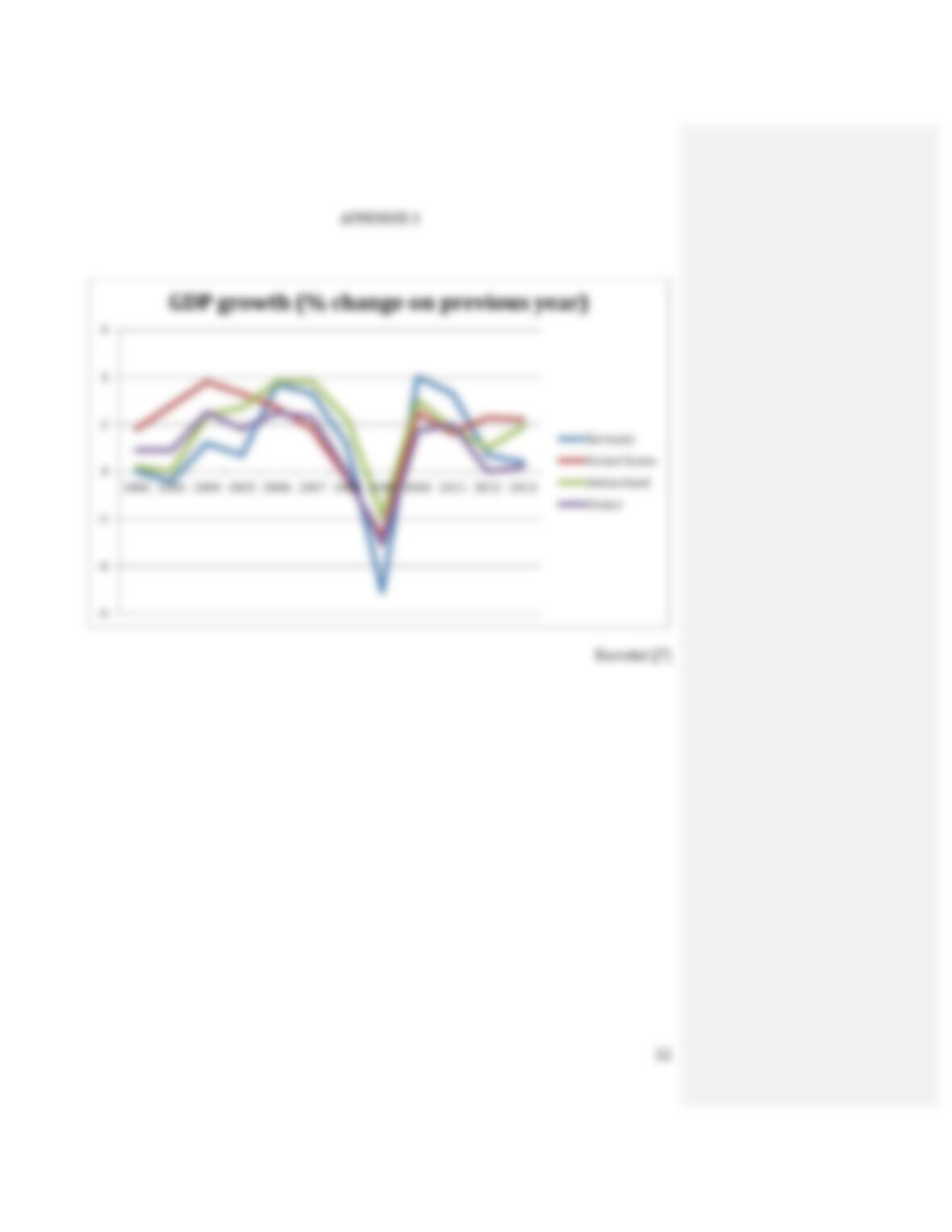
the Euro has also been falling in 2014 (Appendix 4). The Euro is seen to link most of the
European countries together and is known to be relatively stable and to contribute to low inflation
[29]. Philippe Legrain, however thinks that Germany has an economic mirage – weak
productivity gains, falling investments, ageing demographics and deficient growth all point to a
dysfunctional economy [25]. An article in The Economist also brings up concerns over the euro
crisis, German’s fears of inflation and Germany’s reluctance to lead that are concerning [28].
Cultural Issues: Germans may come across as a bit more reserved and may take longer to warm
up, but overall, their communication patterns are similar to Canada’s. When you meet someone
for the first time, you are to address them with the ‘polite’ form of their name. There is also the
Comment [C18]: Who is this guy? “Philippe
Legrain, an economist from the London
School of Economics”…
Comment [C19]: Good – showing an
alternative view from the positive one. Could
have been slightly better written, but
acceptable.
Comment [C20]: Only one reference in the
whole of this section. It mostly fits with what
I know about Germany but it would be better
with more citation support.
Comment [C21]: Might be worth stating
what that is “Herr Doctor Atkins”, or