Discussion on
GENSET:1989; REAL OPTION
Seminar in Finance
2604491
Academic Year 2012-2013
Department of Banking and Finance
Faculty of Commerce and Accountancy
Chulalongkorn University
Members of group 9
Ms. Thanapan Kriengkomol ID: 524 27855 26
Ms. Nopparat Chansawang ID: 524 28077 26
Ms. Paphawee Khunarongnunthakul ID: 524 28214 26
Ms. Prachanant Chittaksa ID: 524 28237 26
Ms. Parinda Satitamsutee ID: 524 28243 26
Ms. Phattraporn Jirapattananan ID: 524 28724 26
Ms. Satiranun Luangtep ID: 524 29164 26
Ms. Sudarat Wangsatja ID: 524 29273 26
Executive Summary
Parscal Brandys, a 30-year old international venture capitalist, and Marc Vasseur, a
scientist who expert in molecular biology, have an idea to start a Biotechnology company.
They are planning to start up the company, Genset, by combining the management and
venture capital skill of Brandys and scientific knowledge of Vasseur. However, both
Brandys and Vasseur have to convince and guarantee the success of Genset to the venture
capital firm to invest.
Since, the French economy was slow growth and low industrial investment in the
mid-1980s, the French government had a policy to stimulate the economy that made
France to be a leader in biotechnology by the end of 1990s. However, there are some
barriers to start a biotechnology firm in French such as the difficulty of raising capital in
France, less expertise in management, patents limitation etc. Although, it had some
obstructions, the venture capital industry in France grew quickly in the late 1980s.
Therefore, in 1989, Genset,a biotechnology company is founded by Pascal Brandys who
had an extensive business experience and Marc Vasseur who was a professor molecular
biology. As a startup company, Genset have to make a decision on their capital funding.
There are many advantages and disadvantages on difference options. As for Genset, there
are limitations to raise capital in the public markets (IPO) and are not able to secure a bank
loan or complete a debt offering. However, we considered that Brandys and Vasseur should
raise their capital from the Sofinnova venture capital company. It is known as the first
venture company and one of the most established venture capital companies in France.
Different from most other France venture capital companies, it was seeking to fund
early-stage companies. This seems to be the best choice for a small and unstable startup
company in Europe, like Genset.
As we said above, Biotechnology business is hard to raise fund because it is prohibitively
expensive, so every decision on strategies is very important. Genset has 3 strategies which
are short term, medium term and long term. Their strategy for long term is like a real
option that is right but not an obligation to invest in the future. A Real option is more
beneficial for making the strategy decision because real option allows more flexibility.
They have chances to consider other factors and postpone to the appropriated time.
Our group calculated the value of Genset in 2 conditions. First are the short and medium
term strategies, phase 1 and 2, which are Oligonucleotides and Diagnostics project by
using NPV. Second, we calculated the value of long term strategy, phase 3 or Therapeutics
project, by using an option pricing because phase 3 is an option for venture capital firm to
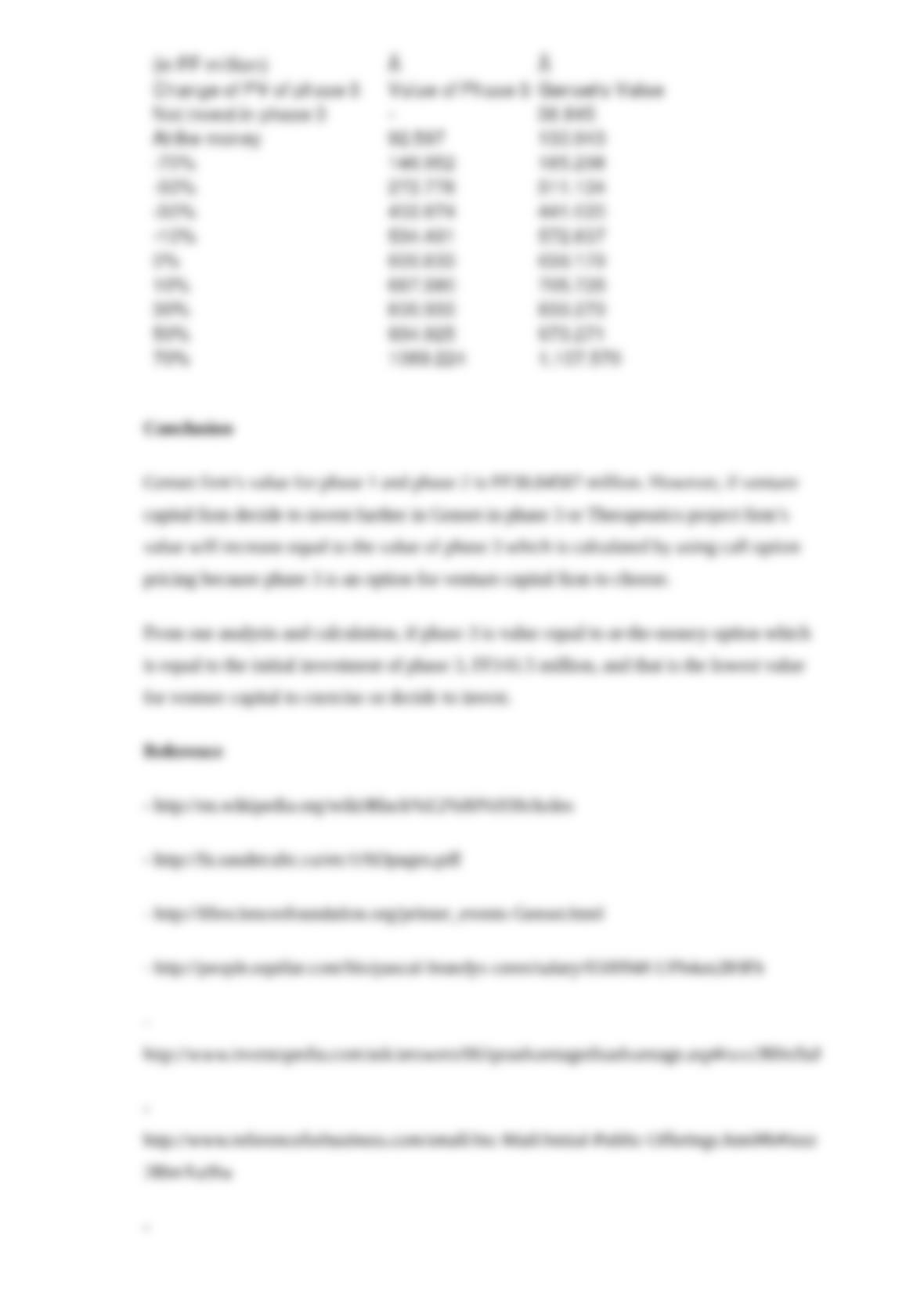
make a decision whether to invest or not. We get the value of phase 1 and 2 at FF38.845
million and the value of phase 3 at FF677.25 million. So, the value of Genset will be
FF535.67 million if the venture capital firm decides to invest in phase 3.
If the value of Genset in the future is similar to the forecasting, deciding to doing business
with Genset in phase 1 and 2 and further in phase 3 will be a very worth investment.
GENSET’S BACKGROUND
All over the mid-1980s, The French economy had been characterized by slow growth and
industrial investment. The French government planned to stimulate the economy and make

France to be a leader in biotechnology by the end of 1990s. One of France’s biggest
competitive advantages in the biology area was the availability of world-class research and
scientists. Moreover, the government supported private funding of research-focused
companies by yielding tax credits to individuals who invested in them.
However, there are some barriers to start a biotechnology firm in French as following;
The difficulty of raising capital in France: Raising money for Biotech Company in
France would be difficult. A biotechnology firm in French has been perceived as a
European company. Generally, the financial market has been less receptive to biotech
companies in Europe.
Less expertise in management: It is hard to find a biotechnology company in French that
has the availability of experienced management. Moreover, it is difficult to find French
nationals who knew the intricacies of patent, licensing, and business development. French
scientist did not spend extensive time abroad, few technical managers had international
experience, and significant numbers of senior government officials and corporate
managers were fluent only in French.
No major presence in developing therapeutics in the market: Just a few French biotech
firms develop therapeutics, but none had a major presence in the market. French scientists
more considered about commercial application. The scientists, who were more interest in
Nobel Prize than in creating products and profits, usually start the biotechnology
companies.
Patents limitation: The major issue is the extent of patent protection and the significance
of the patents in the field of genomics. Since there are some uncertainty around the issue,
particularly what will be patentable or not and what will be the extent of the claims granted