Gemba Walk: Where the Real Work Happens
Insanity is doing the same thing over and over again and expecting different results. From
such a perspective, most of the contemporary managers seem to be insane.
Why? Because we cannot expect different results from a team by sitting in the corner office
and only attending KPI meetings. Instead, we need to see where the real work happens. we
need to do Gemba walks.
The Gemba walk is an essential part of the Lean management philosophy (which is a
method of managing and organising work with the aim of improving a company’s
performance, particularly the quality and profitability of its production processes.) Its initial
purpose is to allow managers and leaders to observe the actual work process, engage with
employees, gain knowledge about the work process, and explore opportunities for
continuous improvement.
What Is a Gemba Walk Actually?
The term “Gemba” comes from Japanese, and it means “the real place”. In Lean
management, “Gemba” is the most important place for a team as it is the place where the
real work happens.
Quite simply, for rock bands, the “Gemba” is the recording studio. For Formula 1 teams, the
“Gemba” is wherever the car is. For manufacturers, it’s the factory floor and so on. In other
words, it is where the real work happens, so you can observe and analyze it.
The Gemba walk is a concept developed by Taiichi Ohno, who is often considered the father
of Just-in-time production.
By developing such a concept, Ohno offers a real opportunity for executives to leave their
daily routine, see where the real work happens, and build relationships with workers based
on mutual trust.
There are 3 important elements of this lean manufacturing tool:
1. Go and see. The main idea of the Gemba walk is for managers and leaders on every
level to take regular walks around the facilities and to be involved in finding wasteful
activities.
2. Ask why. A Gemba walk‘s main objective is to explore the value stream in detail and
locate its problematic parts through active communication.
3. Respect people. Keep in mind that a Gemba walk is not a “boss walk”. Pointing
fingers and blaming people is exactly what you don’t have to do. You are not there to
judge and review results. You are there to collaborate with the team and find
problems together. Trying to focus on finding the weak spots of the process, not of
the people.
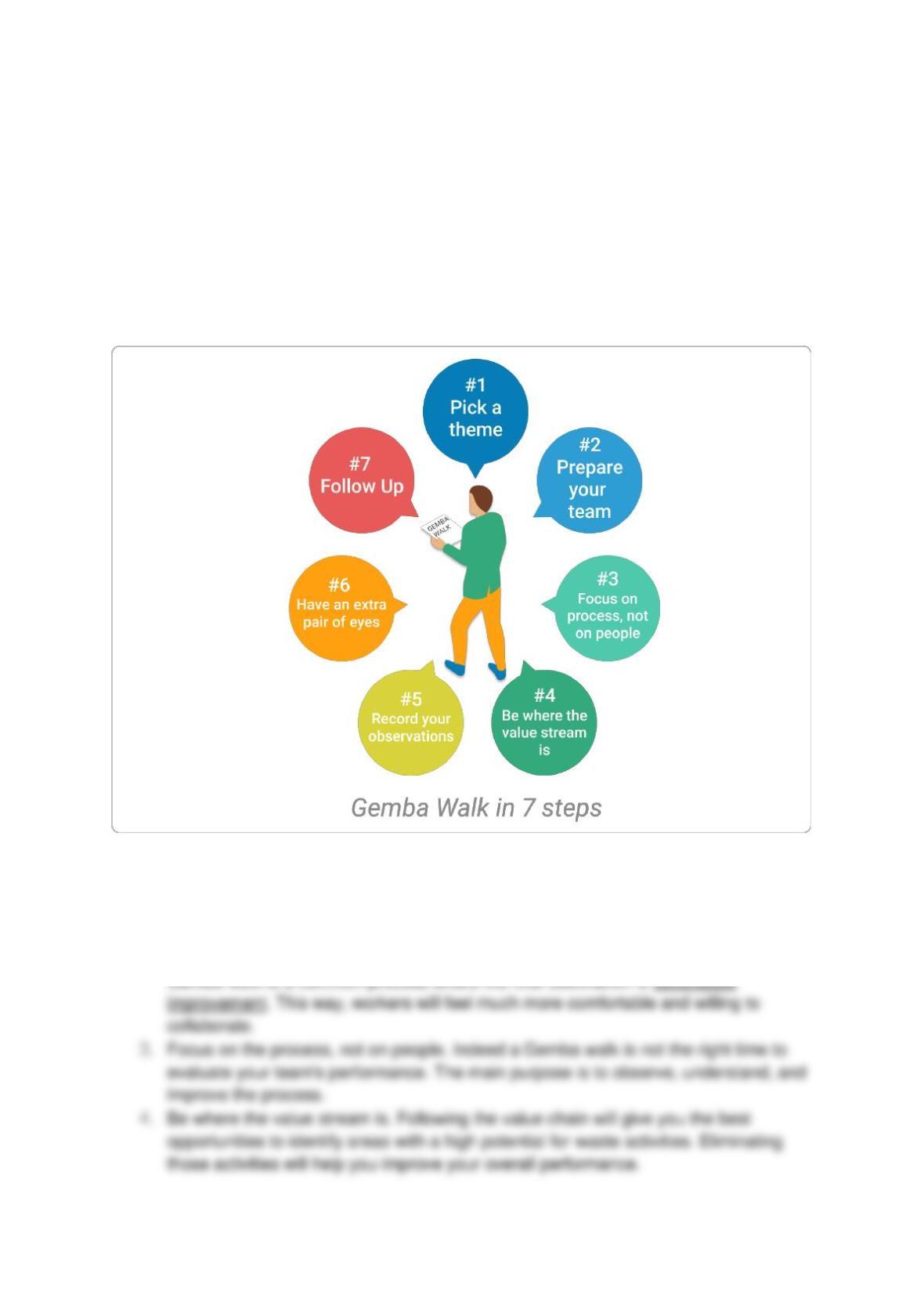
7 Steps to Follow When You Go to Gemba
1. Pick a theme. This will help you focus all your efforts and be effective. There are
different themes to explore, such as productivity, cost efficiency, safety and etc.
2. Prepare your team. The team that will be observed should be prepared for what is
going to happen. All team members need to have a clear understanding that the