Gehryism: American Architectural History and the Cultural Authority of Art
Dell Upton
University of Virginia
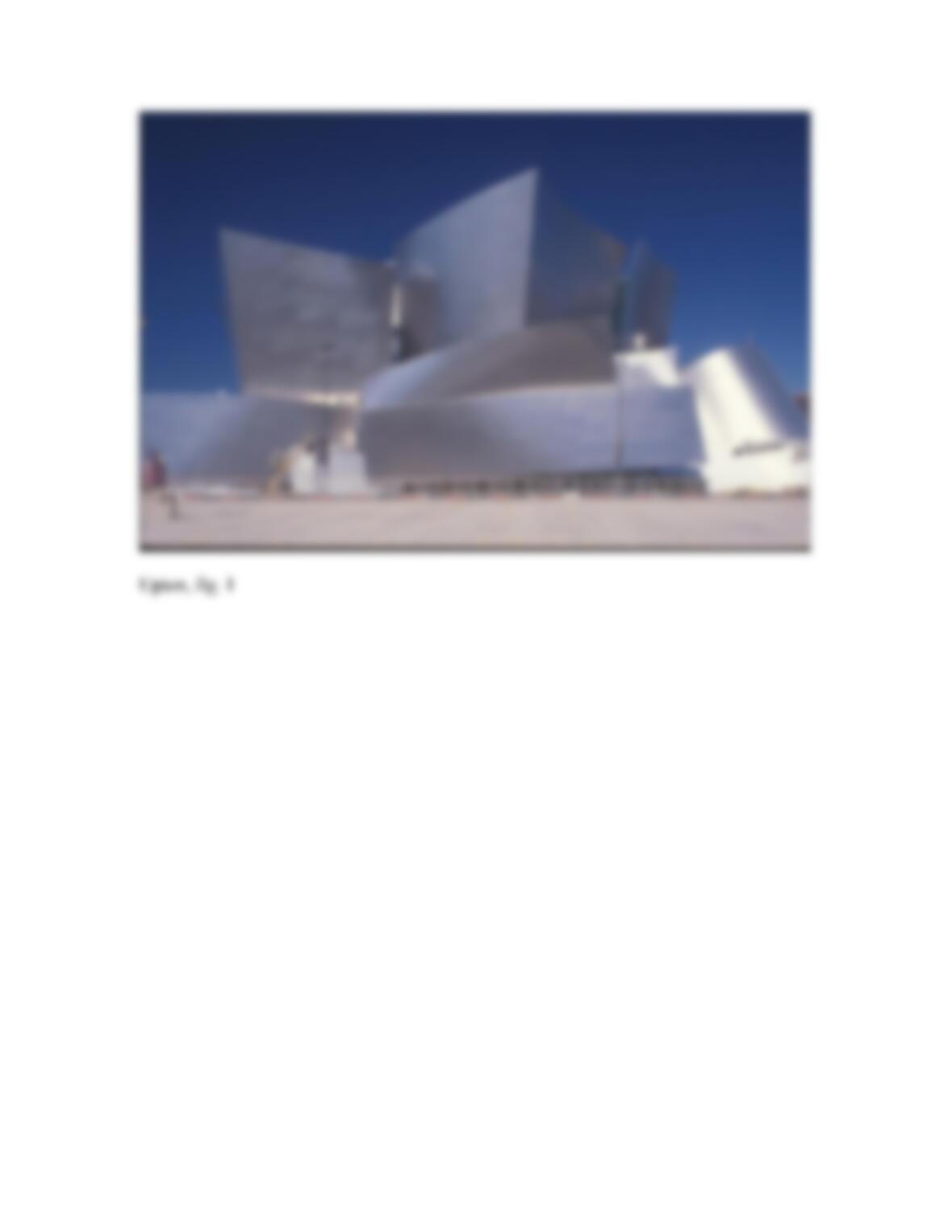
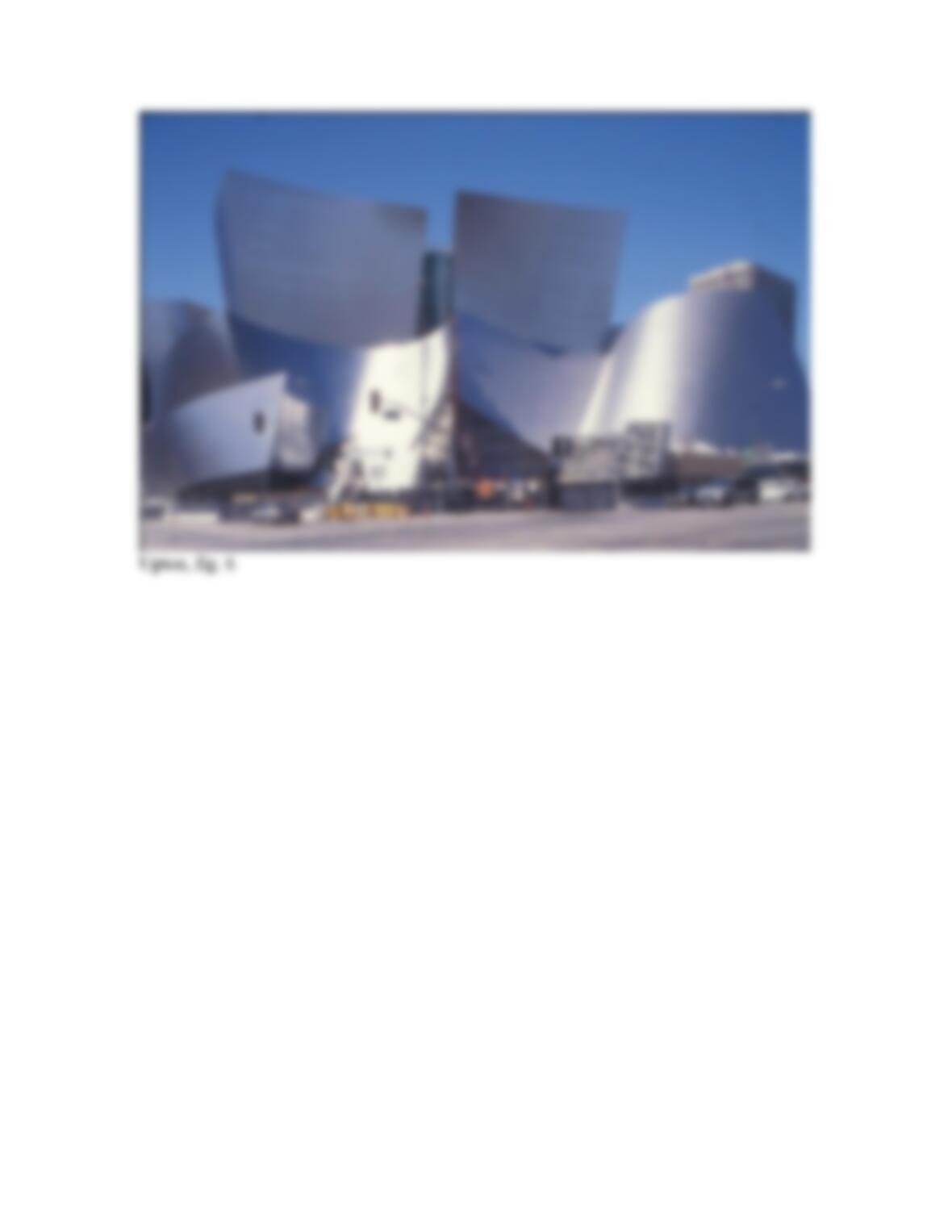
Late in 2004 the Music Center of Los Angeles County announced that part of the
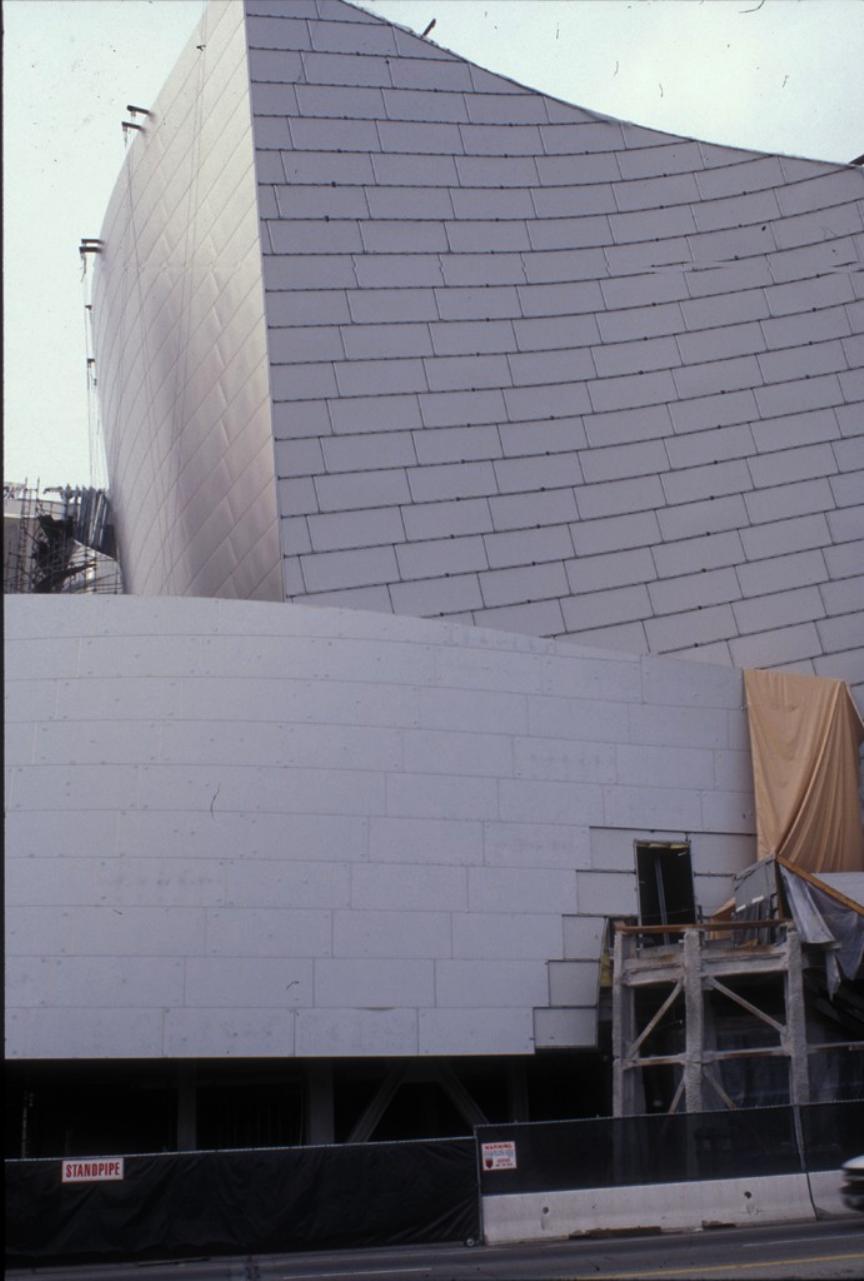
highly polished stainless-steel exterior of its Walt Disney Concert Hall would be
sandpapered to dull its finish (fig. 1). The curved surface of one section of the building
projected a focused “beam” that blinded passing drivers while other portions of the
cladding raised the ambient temperature on the adjacent sidewalk to 140 degrees on hot
days, it was capable of inflicting a sunburn on people standing on the opposite side of the
street, and it overwhelmed the air-conditioning units in nearby apartments. “You
couldn’t even see, and then the furniture could get really hot,” reported one apartment
dweller. “We feel like ants under a magnifying glass,” complained a worker in a nearby
city office building. The Music Center of Los Angeles County agreed to pay $90,000 of
the cost of modifying the $274-million structure and hoped the city would pick up the
remaining $15,000 to $20,000.1
The remarkable aspect of this story is not that the building needed to be altered –
as one Los Angeles architect pointed out, such post-completion modifications are routine
1Robin Pogrebin, “Gehry Would Blast Glare Off Los Angeles Showpiece,” New York Times, Dec. 2, 2004,
pp. B1, B10; Natasha Lee and Jack Leonard, “Disney Concert Hall to Lose Some Luster,” Los Angeles
Times, Mar. 1, 2005, www.latimes.com/news/local/la-030105disney_lat,0,5171623.story?coll=la-home-
headlines, downloaded Mar. 12, 2005; Natasha Lee and Jack Leonard, “Hit the Dimmer, Disney Hall Is
Told,” Los Angeles Times, Mar. 2, 2005, latimes.com/news/printedition/la-me-
disney2mar02,1,4940788.story, downloaded Mar. 4, 2005; “In the Glare of Disney Hall,” New York Times,
Feb. 25, 2004, p. B2; “Plan Underway to Reduce Disney Concert Hall’s Glare,” San Francisco Chronicle,
at sfgate.com/cgi-bin/article.cgi?file=/n/a/2005/03/01/state/n165901S33.DTL, downloaded Mar. 2, 2005.
Thanks to Greg Hise for calling my attention to the Los Angeles Times articles. For an officially sponsored
history of the hall’s design and construction, see Richard Koshalek, Dana Hutt, Carol McMichael Reese,
Michael Webb, and Esa-Pekka Salonen, Symphony: Frank Gehry’s Walt Disney Concert Hall (New York:
Whitney Museum of American Art/Abrams, 2003) I have drawn most of my data from Martin Filler,
“Victory at Bunker Hill,” New York Review of Books, 50 no. 16 (Oct. 23, 2003): 55-57, 60; and from
Koshalek et al., Symphony.
© Dell Upton. Not for quotation without permission.

Upton – HarvardFinal.doc – 10/19/2005 – 2
in major building projects – but that the entire discussion and reportage of the Disney
Concert Hall, including this recent development, centered around one man: architect
Frank O. Gehry. From the beginning, the project advanced, stalled, and advanced again
on the basis of Gehry’s changing reputation. When the commission was first awarded in
the late 1980s, some Los Angeles Philharmonic backers wondered why it had not been
given to a more prestigious architect. By the time the Disney Hall’s doors opened in
October 2003, Gehry had achieved international stardom, owing largely to the critical and
popular success of the Guggenheim Museum in Bilbao, Spain, which the New York
Times’ hyper-excitable critic Herbert Muschamp sanctified as a “miracle”. The year of
Bilbao’s debut, 1997, also witnessed the completion of Los Angeles’ other long-running,
megamillion-dollar arts complex, the Getty Center. At the Getty opening some guests
were overheard wondering why Gehry had not been given that commission rather than
Richard Meier. (The answer, of course, is that in the 1980s when the Getty project was
launched Meier was a bigger star than Gehry.) In that same year, the once-stalled Disney
Concert Hall was redesigned and began to move once more toward completion.2
Not surprisingly, the Disney Hall’s glare problem was also charged to Gehry’s
account. As the Society of Architectural Historians’ executive secretary Pauline Saliga
told the Los Angeles Times’s reporters, this was not the first such problem with a Gehry
project. He had been forced to alter a building in Cleveland whose curved surfaces
2Lee and Leonard, “Hit the Dimmer”; Herbert Muschamp, “The Miracle in Bilbao,” New York Times
Magazine, Sept. 7, 1997, pp. 54-59, 72, 82, posted online at http://www.jya.com/bilbao.htm, downloaded
Mar. 12, 2005; Koshalek, et al., Symphony, pp. 53-55.

Upton – HarvardFinal.doc – 10/19/2005 – 3
dumped snow and ice onto the sidewalk below it. But “Even great architects make
mistakes with materials and designs,” she noted.3
From the beginning the saga of the Disney Hall has been cast in the language of
art. Just before the Disney Hall finally opened, the critic Martin Filler hailed it in the
New York Review of Books as Gehry’s “masterpiece” – not quite a miracle, but probably
good enough for most mortals. The Angelenos interviewed by the Los Angeles Times
accepted the Disney Hall as art. Those who liked it evoked the cultural authority of art to
defend the building’s design and to resist demands for practical changes. The surface
alteration would be “like putting more hair on the Mona Lisa,” according to one
neighbor. “An artist’s work should stay an artist’s work.” A tourist agreed: “Let [those
bothered by the glare] get shades. I think it’s very interesting. It’s very different. I
would leave it as it is.”4 Those who disliked the building used its practical defects to
undermine art’s authority: their emphasis on the costs of construction as well as the
structure’s environmental problems implied that at best art-architecture is impractical and
disconnected from the real world and ordinary human beings. At worst it is a pretentious
fraud.
The assumption that the most ambitious American architecture is art is rarely
questioned. As we “reconceptualize” the history of the built environment in North
America, the Walt Disney Concert Hall’s reflective surface can also serve as a mirror for
thinking about how radically the category of art has changed for, as anthropologists since
3Lee and Leonard, “Hit the Dimmer.” The New York Times listed technical problems with a number of
other Gehry buildings, as well (Pogrebin, Gehry Would Blast Glare,” pp. B1, B10).
4Filler, “Victory at Bunker Hill,” pp. 55-57, 60; Lee and Leonard, “Hit the Dimmer.” Filler actually
thought the Disney better than Bilbao.

Upton – HarvardFinal.doc – 10/19/2005 – 4
Franz Boas have understood, art is a “historically determined” or contingent category.
Not until the nineteenth century did something like the modern definition of art take firm
hold in the English language and the word’s meaning remains malleable and
indeterminate.5 In the American context it has constantly changed with the position of
architecture and the building industry in the economy and with the evolving self-
definition and sociological position of architects and their partisans.
The first half of this essay sketches the roots and uses of the concept of art in the
twentieth-century historiography of American architecture, as historians and architects
sought to find a distinctively American – meaning United States – expression at a time of
cultural and political flux. This historiographical tradition dominated American
architectural history until the 1970s. In the second half, I turn to some aspects of the
intellectual history of recent decades that have challenged the older paradigm, raising
questions about the usefulness of the art model for historians and, paradoxically, giving
the concept of art-architecture a renewed but transformed hold in popular culture.
I
As some Americans began to be trained in Europe and as a growing architectural
profession sought to consolidate its position in the American society and economy,
American architects in the second half of the nineteenth century began to promote
architecture as a fine art. Art was the unifying metaphor of the self-proclaimed American
Renaissance, a loose coalition of aesthetically conservative architects, artists, and
decorative artists in the closing decades of the nineteenth century. The American
5For a brief etymology of the concept of art, see Raymond Williams, Keywords: A Vocabulary of Culture
and Society (rev. ed.; New York: Oxford University Press, 1983), pp. 40-42.

Upton – HarvardFinal.doc – 10/19/2005 – 5
Renaissance sculptor Augustus St. Gaudens is reputed to have pronounced a planning
session for the World’s Columbian Exposition of 1893 “the greatest meeting of artists
since the fifteenth century.” Architects who were not part of this coterie also saw
themselves as artists. Mariana Griswold Van Rensselaer, Henry Hobson Richardson’s
first biographer, devoted two chapters to the architect’s “characteristics as an artist,”
while both Louis Sullivan and his erstwhile employee Frank Lloyd Wright cultivated
artistic personae in their writings, and in Wright’s case in his dress and demeanor.6
Despite the conservatives’ allegiance to the Renaissance, all of these architects
espoused Romantic notions of architecture’s art. As Fiske Kimball and George Harold
Edgell noted in their 1918 History of Architecture, “The part of spiritual influences and
spontaneous creation in the formation of styles is now emphasized, to balance the one-
sided affirmation, by nineteenth-century writers, of the influence of material
environment.” Like William Wordsworth’s poet, the architect was “endowed with more
lively sensibility, more enthusiasm and tenderness, . . . a greater knowledge of human
nature, and a more comprehensive soul, than are supposed to be common among
mankind.” Sullivan, in particular, defined an architect as “a poet who uses not words but
building materials as a medium of expression.” The architect suffered the “unreachable
and unescapable” isolation that was the fate of all human beings, but in it forged “an
6Alan Gowans, Images of American Living: Four Centuries of Architecture and Furniture as Cultural
Expression (Philadelphia: J. B. Lippincott, 1964), pp. 356, 414; Mary N. Woods, From Craft to
Profession: The Practice of Architecture in Nineteenth-Century America (Berkeley: University of
California Press, 1999), pp. 102-12; Richard Guy Wilson, Dianne H. Pilgrim, and Richard N. Murray, The
American Renaissance: 1876-1917 (New York: Brooklyn Museum and Pantheon Books, 1979), p. 12;
Mariana Griswold Van Rensselaer, Henry Hobson Richardson and His Works (New York: Dover, 1969
[1888]), pp. 111-22; Reyner Banham, A Critic Writes: Essays by Reyner Banham, ed. Mary Banham, Paul
Barker, Sutherland Lyall, and Cedric Price (Berkeley: University of California Press, 1996), p. 140. At a
1986 symposium at Stanford University, Banham claimed that Frank Lloyd Wright had adopted his
signature cape and beret at the urging of Arts-and-Crafts popularizer Elbert Hubbard, who told Wright that
if he wanted to be accepted as an artist he had to look like one.

Upton – HarvardFinal.doc – 10/19/2005 – 6
identity, a soul – unreachable, inscrutable; the ultimate reality.” The architect’s more
expansive soul lent his designs “a subjective or spiritual human quality which shall make
them live for other humans.” This was the mark of a true architect, setting him apart
from all other participants in the building trades. Sullivan saw himself as the
architectural counterpart of the multitude-embracing Walt Whitman, to whom he wrote a
fan letter and enclosed his own prose-poem “Inspiration.”7
This discussion remained internal to architecture until the first decades of the
twentieth century when it moved into a broader public realm, largely through the efforts
of two men who helped to popularize the art of architecture and to claim for it a broader
significance in American culture. One, Talbot F. Hamlin, was an architect who taught
architectural history in Columbia University’s School of Architecture, as his father had
before him. In his first book, The Enjoyment of Architecture, Hamlin announced that
“The days are swiftly passing when to the normal American art was valued as something
distinctly secondary to the practical matters of life.”8 Americans were becoming attuned
7Fiske Kimball and George Harold Edgell, A History of Architecture (New York: Harper & Brothers,
1918), p. xxi; William Wordsworth, “Preface to the Second Edition of Lyrical Ballads” [1800], in
Anthology of Romanticism, ed. Ernest Bernbaum (3d ed., rev. and enl.; New York: Ronald Press, 1948), p.
304; Wilson, Pilgrim, and Murray, American Renaissance, pp. 39-55; Hugh Morrison, Louis Sullivan,
Prophet of American Architecture (New York: Norton, 1962 [1935], pp. xvii, 255-56; Lauren S.
Weingarden, Louis Sullivan: The Banks (Cambridge: MIT Press, 1987), pp. 15-17; David Van Zanten,
Sullivan’s City: The Meaning of Ornament for Louis Sullivan (New York: Norton, 2000), p. 7; Louis H.
Sullivan, Kindergarten Chats and Other Writings (New York: Dover, 1979 [1918]), pp. 137-40; Robert
Twombly, Louis Sullivan: His Life and Work (New York: Viking, 1986), pp. 214-15. I use the male
pronoun intentionally, since women have largely been excluded from the architectural profession until
recently, and even now are underrepresented in it when compared with their presence in the population at
large.
8Richard Plunz, “Reflections on Ware, Hamlin, McKim, and the Politics of History on the Cusp of
Historicism,” in The History of Architecture in American Schools of Architecture, 1865-1975, ed.
Gwendolyn Wright and Janet Parks (New York: Temple Hoyne Buell Center for the Study of American
Architecture and Princeton Architectural Press, 1990), pp. 57-58; Kenneth Frampton, “Slouching Toward
Modernity: Talbot Faulkner Hamlin and the Architecture of the New Deal,” in The Making of an Architect,
1881-1981: Columbia University in the City of New York, ed. Richard Oliver (New York: Rizzoli, 1981),
pp. 149-65; Talbot Faulkner Hamlin, The Enjoyment of Architecture (New York: Charles Scribner’s, 1924

Upton – HarvardFinal.doc – 10/19/2005 – 7
to the arts, but strangely not to architecture. Hamlin sought to convince them that it was
worth their while to learn to understand the building arts. Ten years after the first edition
of The Enjoyment of Architecture appeared, Hamlin published The American Spirit in
Architecture, a brief, heavily illustrated survey, followed by his two most renowned
historical works, Greek Revival Architecture in America and the Pulitzer Prize-winning
biography Benjamin Henry Latrobe.9 At about the time Hamlin was establishing his
reputation, a non-architect began to weigh in on American architecture. Lewis Mumford
began as a literary critic but turned to architecture in Sticks and Stones (1924) and again
in The Brown Decades (1931). He continued to write about architectural and urban
issues, usually as a critic, for the remainder of his long life.10
Both men first turned to United States architectural history at a time when the
field’s canon was coalescing at the confluence of disparate popular, architectural, and
scholarly streams. Early-twentieth-century historians of American architecture searched
the buildings of the founding years of the Anglo-American colonies, of the decades
following political independence, and of the years around 1900 for architectural evidence
of a distinctive American culture. Their quest should be understood in the light of
[1916]), p. 3. After several reprintings, Hamlin reworked this text and republished it as Architecture: An
Art for All Men (New York: Columbia University Press, 1947).
9Talbot Faulkner Hamlin, The American Spirit in Architecture (The Pageant of America) (New Haven:
Yale University Press, 1926); Talbot Hamlin, Greek Revival Architecture in America, Being an Account of
Important Trends in American Architecture and American Life prior to the War between the States
(London: Oxford University Press, 1944); Talbot F. Hamlin, Benjamin Henry Latrobe (New York: Oxford
University Press, 1955). Hamlin also published a general history, Architecture Through the Ages (New
York: G. P. Putnam’s Sons, 1940), and a study of modern architecture, Forms and Functions of Twentieth-
Century Architecture (4 vols.; New York: Columbia University Press, 1952).
10Lewis Mumford, Sticks and Stones: A Study of American Architecture and Civilization, 2d rev. ed. (New
York: Dover, 1955 [1924]); Lewis Mumford, The Brown Decades: A Study of the Arts in America 1865-
1895, 2d rev. ed. (New York: Dover, 1971 [1931]); Robert Wojtowicz, Lewis Mumford and American
Modernism: Eutopian Theories for Architecture and Urban Planning (Cambridge: Cambridge University
Press, 1998), pp. 43-73.

Upton – HarvardFinal.doc – 10/19/2005 – 8
contemporary fears for the future of American democracy in a rapidly growing,
increasingly fragmented society. “What is the public? If there is a public, what are the
obstacles in the way of its recognizing and articulating itself? Is the public a myth?”
asked John Dewey. His solution to unifying the democratic public was to improve
“communication”: “signs and symbols without which shared experience is possible.”11
For Hamlin and Mumford architecture, deeply connected to American culture,
society, and economics, could provide those signs and symbols. Hamlin proclaimed the
best architecture to be “a perfect expression of the time in which it was built, not only of
that time’s artistic skill, but also, if it is interpreted correctly, of its religion, its
government, even its economic and political theories.” That is, the architect is the
medium through which culture achieves expressive form, which for Hamlin meant
primarily visual style. In common with contemporaries, he saw the naturalization of
classical architecture in the first half of the nineteenth century as the birth of an American
style. As an architect, though, Hamlin defined architecture’s role in terms of professional
goals and concerns, even when writing for a lay audience. Architecture has a “two-fold
character . . . for the attempt of the architect to produce a building which shall perform its
work in the most efficient possible manner determines many points of the building’s
general shape, and his desire to create a thing of beauty compels him to treat this shape in
the most beautiful possible way, and to decorate it with the loveliest forms at his
command.” In short, architectural design is a search for beautiful solutions to practical
11John Dewey, The Public and Its Problems (Athens: Swallow Press, Ohio University Press, 1991 [1927]),
pp. 123, 142.

Upton – HarvardFinal.doc – 10/19/2005 – 9
problems. Hamlin assured his readers that this combination of social function and visual
beauty made architecture “the greatest and most real of all the arts.”12
In Mumford’s account, architects are more active cultural agents. Yes,
architecture is deeply embedded in American society, even more deeply than Hamlin
claimed. Mumford saw architecture, landscape design, painting, and literature as aspects
of a common enterprise: the exploration and articulation of an American ethos. But
architects and artists can not be content simply to reflect cultural currents. Art should
grapple consciously and strenuously with the essence of Americanness, at once voicing it
and shaping it. Mumford thought the writers of the antebellum years – the same period
covered by Hamlin’s Greek Revival Architecture in America – had accepted this
obligation, but that artists and architects had not done so until the late nineteenth century.
The Brown Decades was written, he said, to rectify his own failure to see this clearly
enough when writing Sticks and Stones. Mumford’s architectural heroes were H. H.
Richardson, who “almost single-handed created out of a confusion which was actually
worse than a mere void the beginnings of a new architecture,” and, almost inevitably,
Louis Sullivan. Mumford accepted at face value Sullivan’s self-assessment, offered in
Kindergarten Chats and Autobiography of an Idea, and, in a judgment repeated endlessly
by historians for forty years, declared Sullivan to be “the first American architect to think
12Hamlin, Enjoyment of Architecture, pp. 3, 14-15, 300, 304, 6-7. On style as “cultural consensus,” an idea
Hamlin inherited from his father, see Plunz, “Reflections on Ware, Hamlin, McKim and the Politics of
History,” p. 57. “Each style is based upon some fundamental principle springing from its surrounding
civilization, which undergoes successive developments until it either reaches perfection or its possibilities
are exhausted, after which a period of decline usually sets in” (A. D. F. Hamlin, A Text-Book of the History
of Architecture [New York: Longmans, Green, 1897], p. xxii.).

Upton – HarvardFinal.doc – 10/19/2005 – 10
consciously of his relations with civilization.”13 Although Mumford cast the architect as
a kind of cultural visionary, he had relatively little to say about particular buildings,
preferring to analyze architects’ published writings or the ethos that appeared to animate
their entire bodies of work.
If architects such as Richardson and Sullivan were able to see their task and to
create a new, American architecture, Mumford thought, his own role as historian and
critic was to convey their lessons to contemporary America by recovering and promoting
a “usable past” that its literary and visual artists could draw on to reinvigorate American
culture. He inherited this theme of civic engagement and artistic salvation most directly
from the British urban and social theorist Patrick Geddes and the literary critic Van Wyck
Brooks, but civic renewal through the arts had also been a theme of the “brown decades”
that Mumford celebrated in 1931. In addition, Mumford emphasized the capacity of the
arts for personal renewal of both artist and audience: artistic expression gave voice not
only to broad sociocultural values, but also to a democratic selfhood that found
fulfillment in communal engagement.14
For Mumford and Hamlin, then, architecture in the United States had become a
spiritually authentic art, an embodiment of truth – perhaps poetic truth in Sullivan’s sense
13Mumford, Brown Decades, pp. v-vii, 51, 74. Hamlin also believed that the contemporary literature of
“the Cambridge of Emerson and . . . the paintings of Morse and Inman” went hand-in-hand with Greek
Revival architecture in asserting American cultural independence (Greek Revival Architecture in America,
p. 48).
14Casey Nelson Blake, Beloved Community: The Cultural Criticism of Randolph Bourne, Van Wyck
Brooks, Waldo Frank, and Lewis Mumford (Chapel Hill: University of North Carolina Press, 1990), pp. 3-
4, 190-228; Robert Wojtowicz, “Lewis Mumford: The Architectural Critic as Historian,” in The
Architectural Historian in America: A Symposium in Celebration of the Fiftieth Anniversary of the
Founding of the Society of Architectural Historians, ed. Elisabeth Blair MacDougall (Studies in the History
of Art 35) (Washington: National Gallery of Art, 1990), pp. 237-38. Mumford’s notion of democratic
self-realization echoes themes found both in Sullivan’s writings and in Dewey’s (Sullivan, Kindergarten
Chats, p. 97; Dewey, Public and Its Problems, pp. 148, 150, 154).

Upton – HarvardFinal.doc – 10/19/2005 – 11
– about the American experience. Its creators were amanuenses of American culture in
Hamlin’s case or, more strongly in Mumford’s, its logos. To the extent that it addressed
this prophetic role, architecture was one with the other arts. To the extent that it did so
successfully, it acquired cultural authority in addition to its utilitarian qualities. Both
men, that is, envisioned architecture as a social art in its creation and in its obligation to
improve the quality of life in the United States. Mumford declared that architecture
“must stand or fall by its collective achievement. ‘Individuality’ cannot be the
foundation of a common rule.” Rather, “the collective habits and purposes of the
community are determinants of form.” Early in his career this meant visual expression,
but in his later years, educated by modernist urban and social concerns and particularly
by the tutelage of Catherine Bauer, architecture’s socialness implied that “the architect
has a social responsibility and that the individual building must be related to its site, to its
landscape, to the neighborhood and city of which it is a part.”15
II
I offer Hamlin and Mumford not as the founders of “schools” but as people who
articulated conceptions of American architecture as art and social expression that
dominated the historical literature between the 1920s and the 1970s. These are the ideas
that have been “reconceptualized” in the past generation. Two intersecting, often tangled
threads lead from their work through the historians of the next two generations. We
15Mumford, Sticks and Stones, p. 70; Lewis Mumford, “A Backward Glance,” in Roots of Contemporary
American Architecture: A Series of Thirty-Seven Essays Dating from the Mid-Nineteenth Century to the
Present, ed. Lewis Mumford (2d ed., New York: Dover, 1972 [1959]), pp. 23-24; Gwendolyn Wright, “A
Partnership: Catherine Bauer and William Wurster,” in An Everyday Modernism: The Houses of William
Wurster, ed. Marc Treib (San Francisco: San Francisco Museum of Modern Art and Berkeley: University
of California Press, 1994), p. 188; Mumford, “Backward Glance,” p. 24. In Hamlin’s view the social
qualities of architecture were similarly manifested by its address of communal needs (Hamlin,
Architecture: An Art for All Men, pp. 226-27).
Upton – HarvardFinal.doc – 10/19/2005 – 12
might call the Hamlin thread the inward-looking, or professionally oriented, thread. It
acknowledges the connections among architecture, society, economy, and ideas, but it
focuses on the problems that architects set for themselves – on formal and conceptual
issues unique to architecture. Mumford’s thread is outward-looking, or culturally
oriented: he was more interested in architecture’s public role than in architects’
conversations with one another.16
While one might assign individual historians to one camp or another, it is more
interesting to observe the way the Hamlin and Mumford threads became entwined. For
example, Vincent Scully’s classic The Shingle Style and the Stick Style: Architectural
Theory and Design from Downing to the Origins of Wright chronicled the work of a
small group of art-architects who changed the development of domestic architecture at
the end of the nineteenth century. Although Scully defined his subject in Mumfordian