ECON3160: Game Theory
Instructor: He Wei
A First-Price Sealed-Bid Auction
•Suppose there are two bidders, i=1,2.
•The bidders’ valuations v1and v2for a good are
independently and uniformly distributed on [0,1].
•Bidders submit their bids b1and b2simultane-
ously.
•The higher bidder wins the good and pays her
bidding price; the other bidder pays nothing.
•In the case that b1=b2, the winner is determined
by a flip of a coin.
1
Formulation of a static Bayesian game
G={A1,A
2;T1,T
2;P1,P
2;u1,u
2}:
•A1=A2=[0,1)(bidsbi2Ai).
•T1=T2=[0,1] (valuations vi2Ti).
•Pi(vj)istheuniformdistributionon[0,1].
•For any vi2Ti,playeri’s payo↵is
ui(b1,b
2;vi)=
8
>
>
>
>
>
>
>
>
>
>
<
>
>
>
>
>
>
>
>
>
>
:
vibiif bi>b
j;
vibi
2if bi=bj;
0ifbi<b
j.
•Player i’s strategy is a function bi(vi)from[0,1]
into [0,1).
2

(b1(v1),b
2(v2)) is a Bayesian Nash equilibrium if for
each vi2[0,1], bi=bi(vi) maximizes
Evjui(bi,b
j(vj); vi)
=(vibi)Prob{bi>b
j(vj)}
+1
2(vibi)Prob{bi=bj(vj)}.
•Prob{bi>b
j(vj)}is the probability that player i
wins the auction.
•Prob{bi=bj(vj)}is the probability that player i
submits the same bid with player j.
3
There may be many Bayesian Nash equilibria of the
game. For simplicity, we only look for equilibria in
the form of linear functions:
b1(v1)=a1+c1v1,b
2(v2)=a2+c2v2,
where ai0, ci>0andai<1, i=1,2.
— The determination of Bayesian Nash equilibrium
is reduced to the determination of ai,c
i(i=1,2).
—Weconfinethesearchforequilibriatolinear
functions. However, this is not a restriction on the
strategy space, which is still the set of all functions
bi:[0,1] ![0,1). This means that an equilib-
rium must be better than all functions bi:[0,1] !
[0,1).
4
Rationale of assumptions:
•ai0 reflects the fact that bids cannot be nega-
tive;
•ci>0 implies high bids for high valuation.
•If ai1, then, together with ci>0, it follows
that bi(vi)>v
i,8vi2[0,1], (bi(vi)1>
vi,8vi2[0,1), and bi(vi)1+ci>v
iif
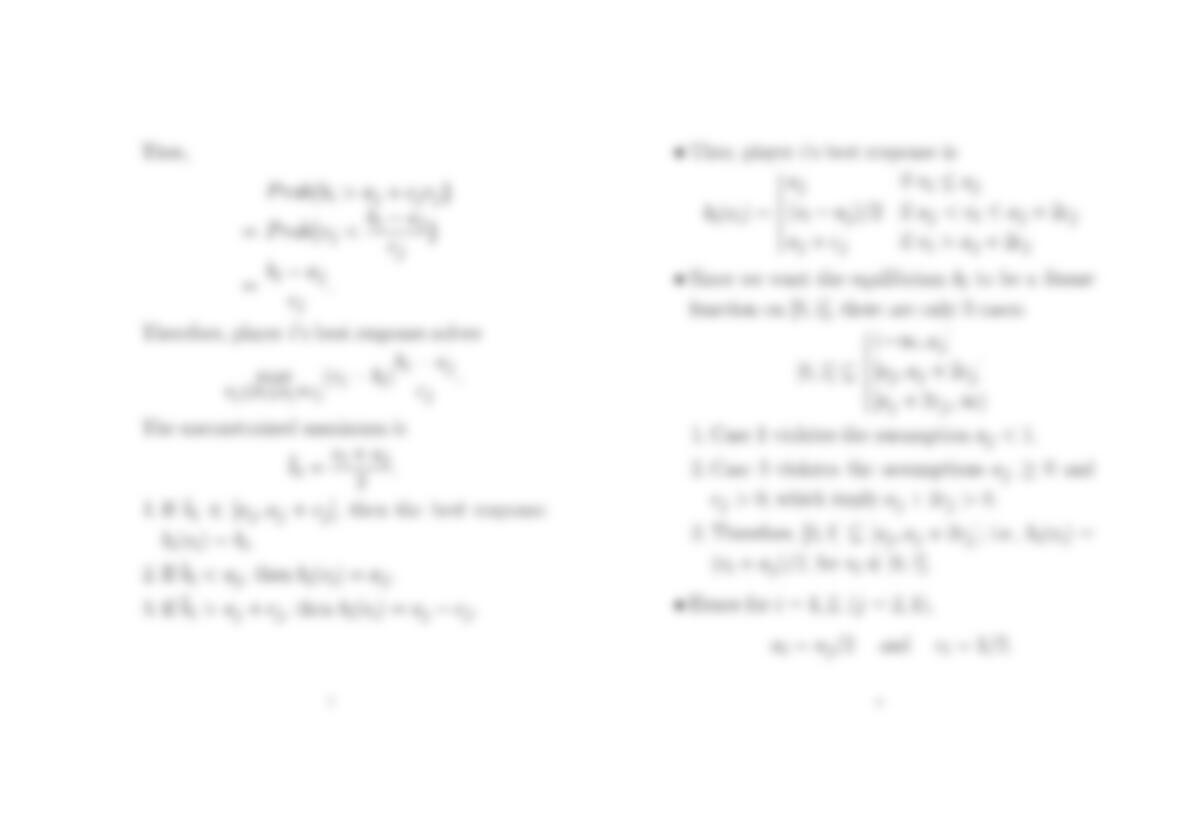
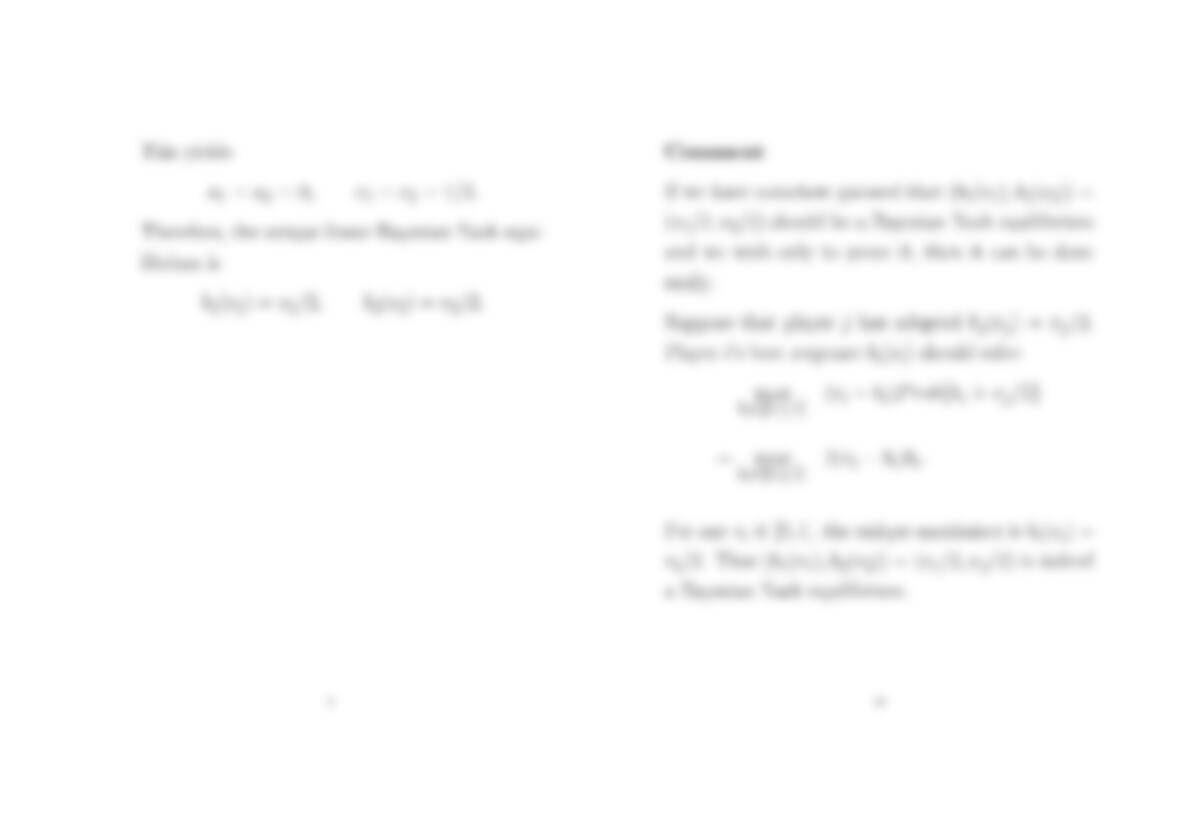
Suppose that player jadopts a linear strategy (with
cj>0).
•Then,
Pr(bi=aj+cjvj)=Pr(vj=biaj
cj
)=0.
•Thus, for any given vi2[0,1], player i’s best
response bi(vi) maximizes