ECON3160: Game Theory
Instructor: He Wei
Static Games of Incomplete Information
Consider the following bargaining game:
1. Suppose that a seller wants to sell a product to a
buyer. The valuation for the product is v,which
may take values of 2, 6, and 10, each with a prob-
ability of 1/3.
2. The buyer knows the value of v, while the seller
does not know vbut only knows its distribution.
3. The seller o↵ers a price pto the buyer, and in
the meantime, the buyer decides at what prices
he wants to buy the product.
4. If trade occurs and the price of the product is p,
then the seller obtains p, while the buyer obtains
vp.
1
Comments:
•So far we have learned games of complete in-
formation; i.e.,eachplayer’spayo↵function is
known among all the players.
•By contrast, in a game of incomplete informa-
tion, at least one player is uncertain about an-
other player’s payo↵function.
•Games of incomplete information are also called
Bayesian games.
2

Cournot competition under asymmetric in-
formation
Consider the Cournot duopoly model, except
•Firm 1’s cost function is c1(q1)=cq1.
•Firm 2’s cost function is
c2(q2)=8
>
>
>
<
>
>
>
:
cHq2,with probability ✓,
cLq2,with probability 1 ✓,
where cL<c
Hare low cost and high cost, and
0✓1.
•The information is asymmetric.
•Firm 1’s cost function is known by both.
•However, firm 2’s cost function is only completely
known by itself. Firm 1 knows only the marginal
cost of firm 2 to be cHwith probability ✓,and
cLwith probability 1 ✓.
3
Solution
•The two firms simultaneously choose
(q⇤
1,q
⇤
2(cH),q
⇤
2(cL)).
•q⇤
2(cH) solves
max
q2[aq⇤
1q2cH]q2
and q⇤
2(cL) solves
max
q2[aq⇤
1q2cL]q2.
•Firm 1 should maximize its expected profit; i.e.,
q⇤
1maximizes
✓[aq1q⇤
2(cH)c]q1+(1✓)[aq1q⇤
2(cL)c]q1.
•It is easy to obtain
q⇤
2(cH)=aq⇤
1cH
2
q⇤
2(cL)=aq⇤
1cL
2
q⇤
1=✓[aq⇤
2(cH)c]+(1✓)[aq⇤
2(cL)c]
2.
4

Substituting q⇤
2(cH)andq⇤
2(cL)intotheabove,we
obtain
q⇤
1=1
4[a2c+q⇤
1+✓cH+(1✓)cL].
Thus, the equilibrium of the game is
q⇤
1=a2c+✓cH+(1✓)cL
3,
q⇤
2(cH)=a2cH+c
3+1✓
6(cHcL),
q⇤
2(cL)=a2cL+c
3✓
6(cHcL).
5
Remark:
•In the Cournot model with complete information,
if firms 1 and 2’s costs are (c, c0)(firm1knows
the cost c0of firm 2), then firm 2 should produce
a2c0+c
3.
•In the case of asymmetric information, firm 2 pro-
duces (more)
a2cH+c
3+1✓
6(cHcL)
than in the game of complete information when
the cost is high (cH), and produces (less)
a2cL+c
3✓
6(cHcL)
when the cost is low.
6
•In the above example, firm 2 has two payo↵func-
tions:
⇡2(q1,q
2;cL)=[(aq1q2)cL]q2,
⇡2(q1,q
2;cH)=[(aq1q2)cH]q2.
•Firm 1 has only one payo↵function
⇡1(q1,q
2;c)=Eq2[(aq1q2)c]q1.
Static Bayesian games and Bayesian Nash
equilibrium
•Consider a general static Bayesian games.
•Let player i’s possible payo↵functions be
ui(a1,…,a
n;ti),
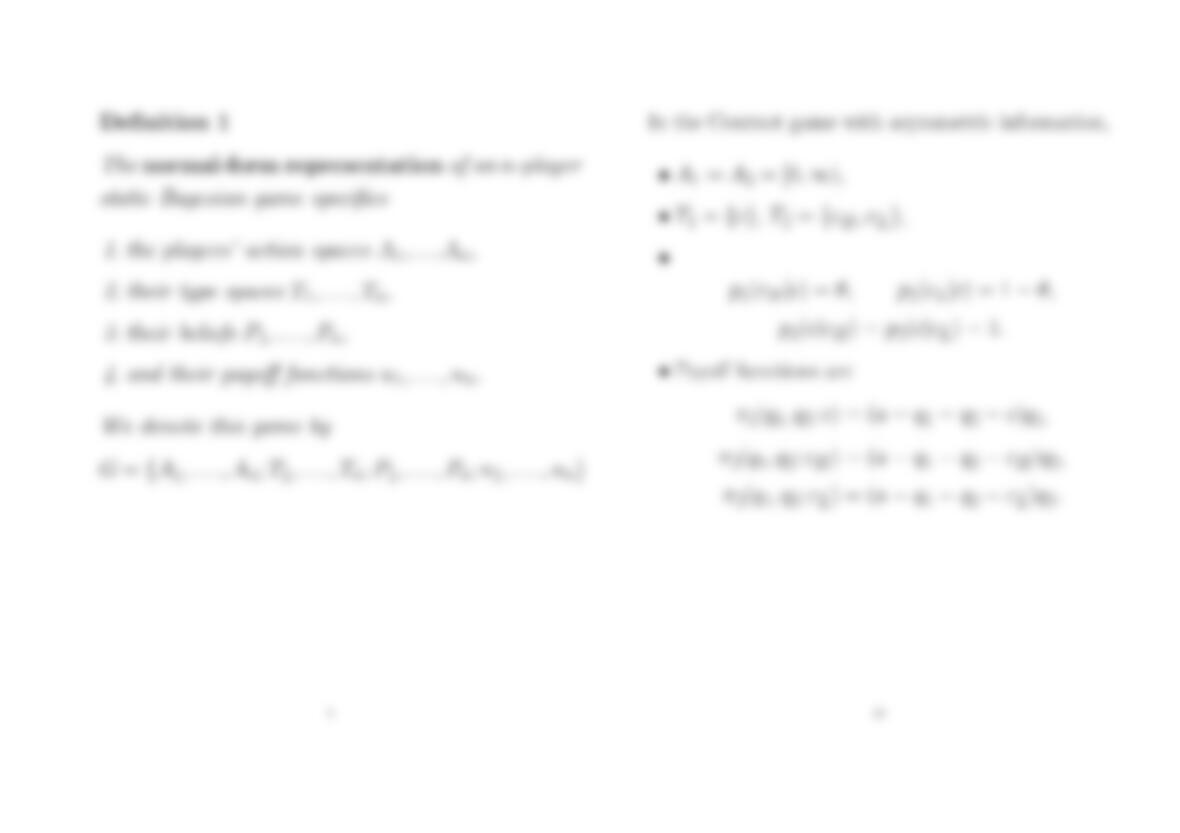
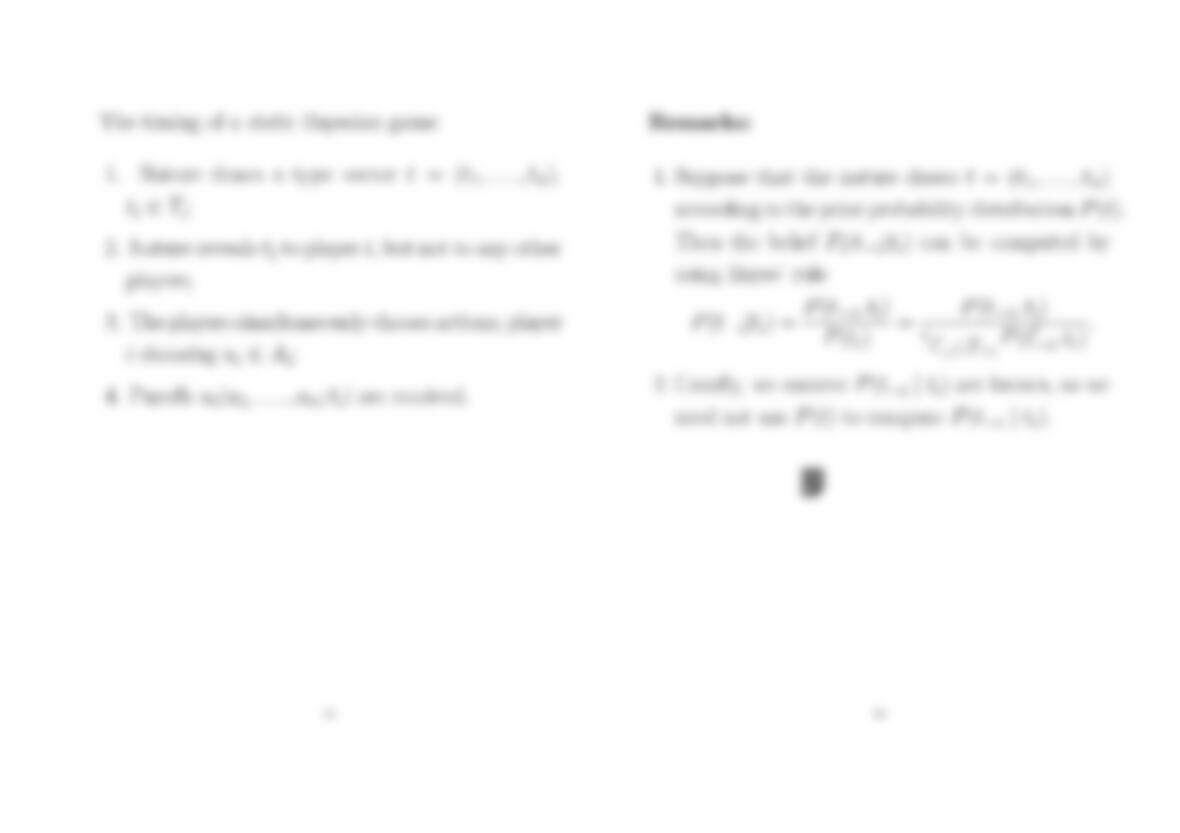
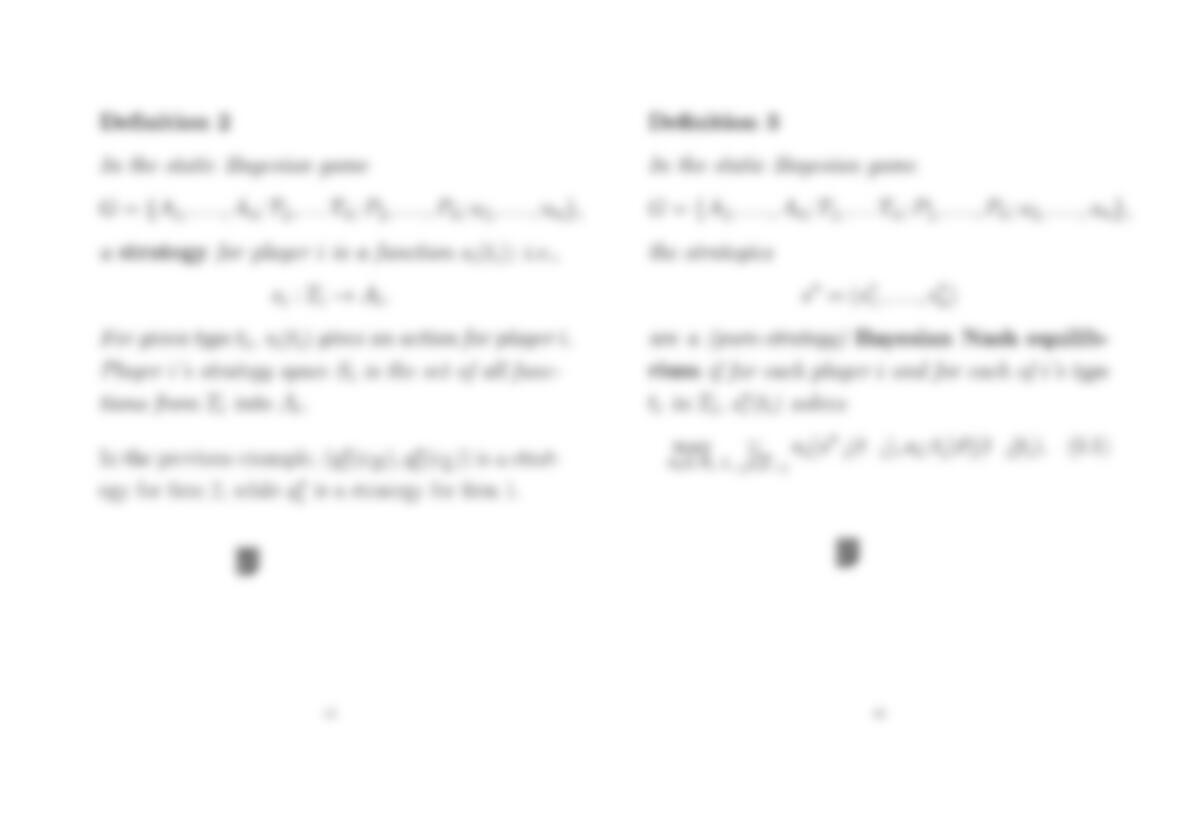
where ti2Tiis called player i’s type.