ECON3160: Game Theory
Instructor: He Wei
Sequential Bargaining
Players 1 and 2 are bargaining over one dollar. They
discount payo↵sreceivedaperiodlaterbyafactor
with 0 <<1.
The three-period bargaining game:
•In the first period,
(1a) player 1 proposes a number s1(1) for himself
and s2(1) for player 2.
(1b) Player 2 either accepts the o↵er to end the
game, or rejects the o↵er to continue the game.
•In the second period,
(2a) player 2 proposes s1(2) for player 1 and
s2(2) for himself.
1
(2b) Player 1 either accepts the o↵er to end the
game or rejects the o↵er to continue the game.
•In the third period, player 1 receives a share s
of the dollar, leaving (1 s)toplayer2,where
the settlement (s, 1s)with0<s<1isgiven
exogenously.
The present value of payo↵to player iis t1si(t)if
the bargaining is ended in period t(letting s1(3) = s
and s2(3) = 1 s).
2

Backward-induction
In general, in period t,s1(t)ands2(t)areo↵ered to
players 1 and 2. The o↵ers satisfy
s1(t)0,s
2(t)0,s
1(t)+s2(t)=1.
Claim: In any period t,playeri’s best strategy is
to o↵er sj(t)=sj(t+1)toplayerjand player j
will accept the o↵er.
3
Proof. If player i’s o↵er in period tis rejcted, the
players receive (s1(t+1),s
2(t+1))inperiodt+1,
which is (s1(t+1),s
2(t+1))in periodt.Thus,i’s
o↵er in period twill be accepted by jif and only if
sj(t)sj(t+1).
Now, i’s choices are:
(1)sj(t)=sj(t+1),(2)sj(t)<sj(t+1).
If (1), then jwill accept the o↵er and iwill receive
1sj(t+1)=1+si(t+1).
If (2), then jwill reject the o↵er and iwill receive
si(t+1).
Since 1 0, (1) is better than (2), ishould o↵er
sj(t)=sj(t+1)tojand jwill accept it.
4
The backward-induction outcome
1. In the second period, player 2 is at the move (i=
2andj=1). Becausethepayo↵to player 1 in
period 3 is s,bytheClaimplayer2willo↵er
s1(2) = s
to player 1, and thus
s2(2) = 1 s
to himself.
2. In the first period, player 1 will o↵er
(1 s)
to player 2 and
1(1 s)
to himself, and player 2 will accept the o↵er.
Then, the game ends.
5
The backward-induction outcome of the three-period
bargaining game:
Player 1 o↵ers the settlement
8
>
>
>
>
<
>
>
>
>
:
1(1 s)toplayer1
(1 s)toplayer2
.
Player 2 will accept the o↵er. Then the game ends.
6
The infinite-horizon bargaining game:
1. This game is the same as the three-period bar-
gaining game except that the exogenous settle-
ment in step (3) is replaced by an infinite se-
quence of steps (3a), (3b), (4a), (4b) and so on.
2. Bargaining continues until one player accepts an
o↵er.
3. The present value of payo↵to player iis t1si(t)
if the bargaining is settled in period t.
7
An insight: The game beginning in period 3 is
identical to the game beginning in period 1, because
it is an infinitely repeated game.
•Let shbe the highest payo↵player 1 can receive
in any backward-induction outcome of the game
as a whole.
•We can also regard shas the third-period payo↵
for player 1. Then the result of the three-period
bargaining game says that, using shas the ex-
ogenous settlement s,
f(sh)=1+2sh
is a payo↵for player 1 in period 1. Hence f(sh)
sh, since shis also the maximum payo↵in period
1.
•Because any first-period payo↵for player 1 can be
represented in the form of f(s) with some third-
8
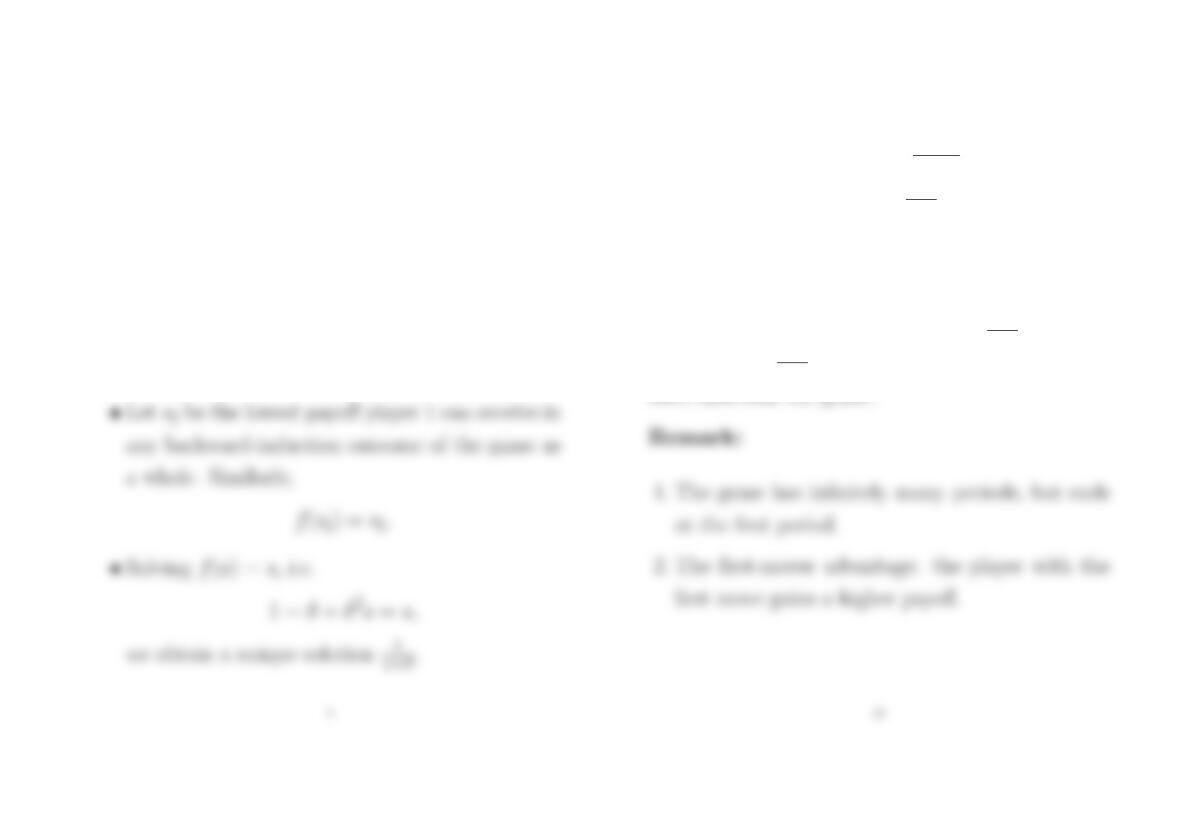
period payo↵s(as we see in the three-period bar-
gaining game), there exists a number s3such that
sh=f(s3).
•Because f(s) is an increasing function of sand
s3sh,
sh=f(s3)f(sh).
•Therefore,
f(sh)=sh.
•Therefore
sh=sl=1
1+,
which implies that s⇤=1
1+is the unique out-
come of backward-induction of the game.
Backward-induction outcome:
In the first period, player 1 o↵ers s⇤=1
1+to himself
and 1 s⇤=
1+to player 2. Player 2 accepts the