www.pwc.com/transport
Shifting
patterns
PwC’s future
in sight series
The future of
the logistics
industry

2 Shifting patterns
The trick to seeing the future…
is knowing where to look for it.
PwC’s future in sight series brings
together our insights and perspectives
on the disruptive forces we believe
will have a transformative impact
on the future.
www.pwc.com/futureinsight
Contents
Executive summary 2
Introduction 3
Disruption and uncertainty 5
Changing customer expectations 5
Technological breakthroughs 6
New entrants to the industry 8
Redefining collaboration 9
Logistics scenarios 11
1. Sharing the PI(e) 12
2. Start-up, shake-up 13
3. Complex competition 14
4. Scale matters 15
Leading through uncertainty 16
Learn more 17

The future of the logistics industry 3
Executive summary
Like most other industries, transportation and logistics (T&L) is
currently confronting immense change; and like all change, this brings
both risk and opportunity. New technology, new market entrants, new
customer expectations, and new business models. There are many ways
the sector could develop to meet these challenges, some evolutionary,
others more revolutionary. In this paper we discuss four key areas of
disruption logistics companies need to focus on now, and explore some
possible futures of the industry.
Four areas of disruption
Customer expectations are increasing
greatly. Both individuals and businesses
expect to get goods faster, more flexibly,
and – in the case of consumers – at low
or no delivery cost. Manufacturing is
becoming more and more customised,
which is good for customers but hard
work for the logistics industry. Add it
all up and the sector is under acute and
growing pressure to deliver a better
service at an ever lower cost.
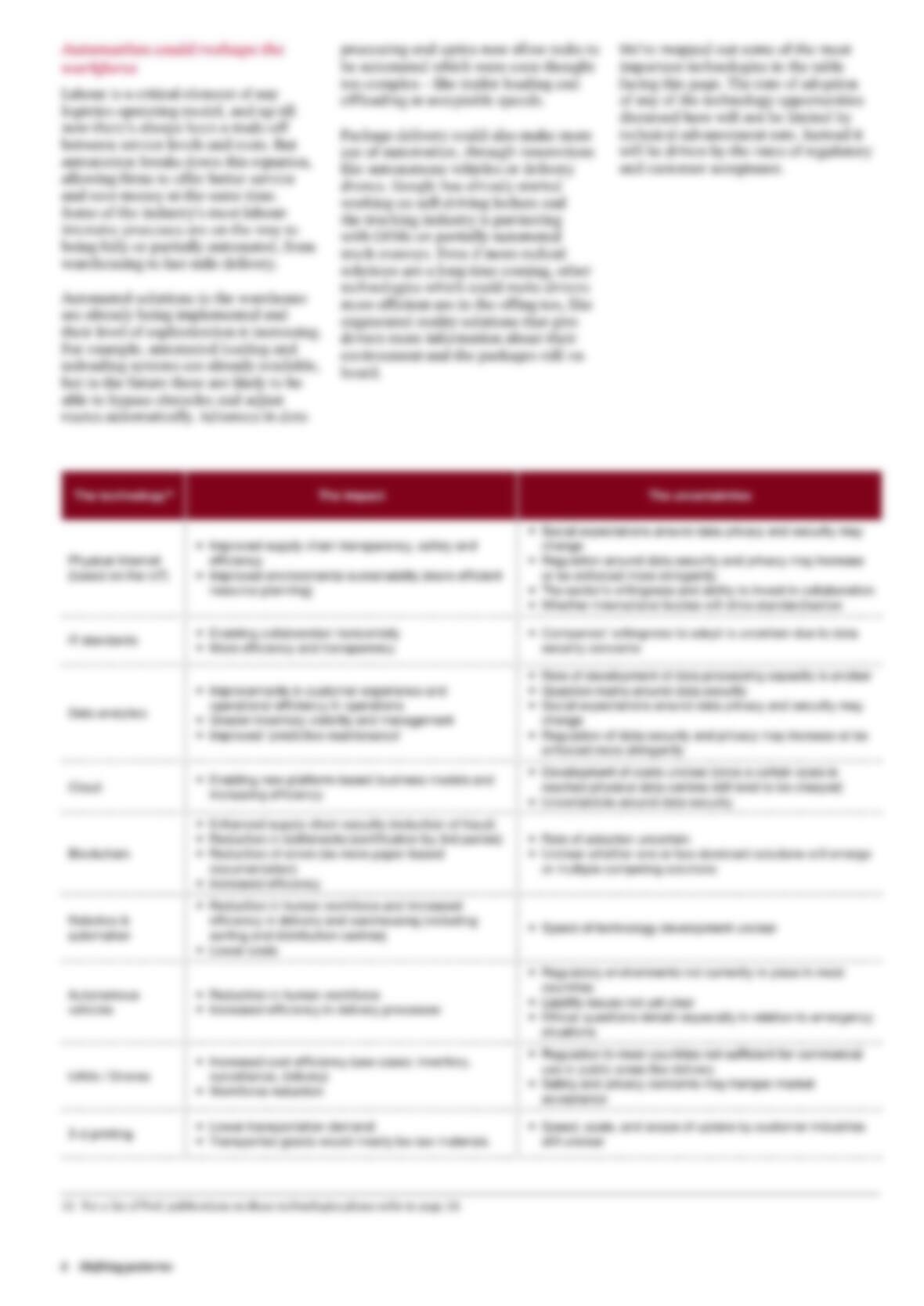
It can only hope to do this by making
maximum and intelligent use of
technology, from data analytics, to
automation, to the ‘Physical Internet’.
This promises lower costs, improved
efficiency, and the opportunity to make
genuine breakthroughs in the way the
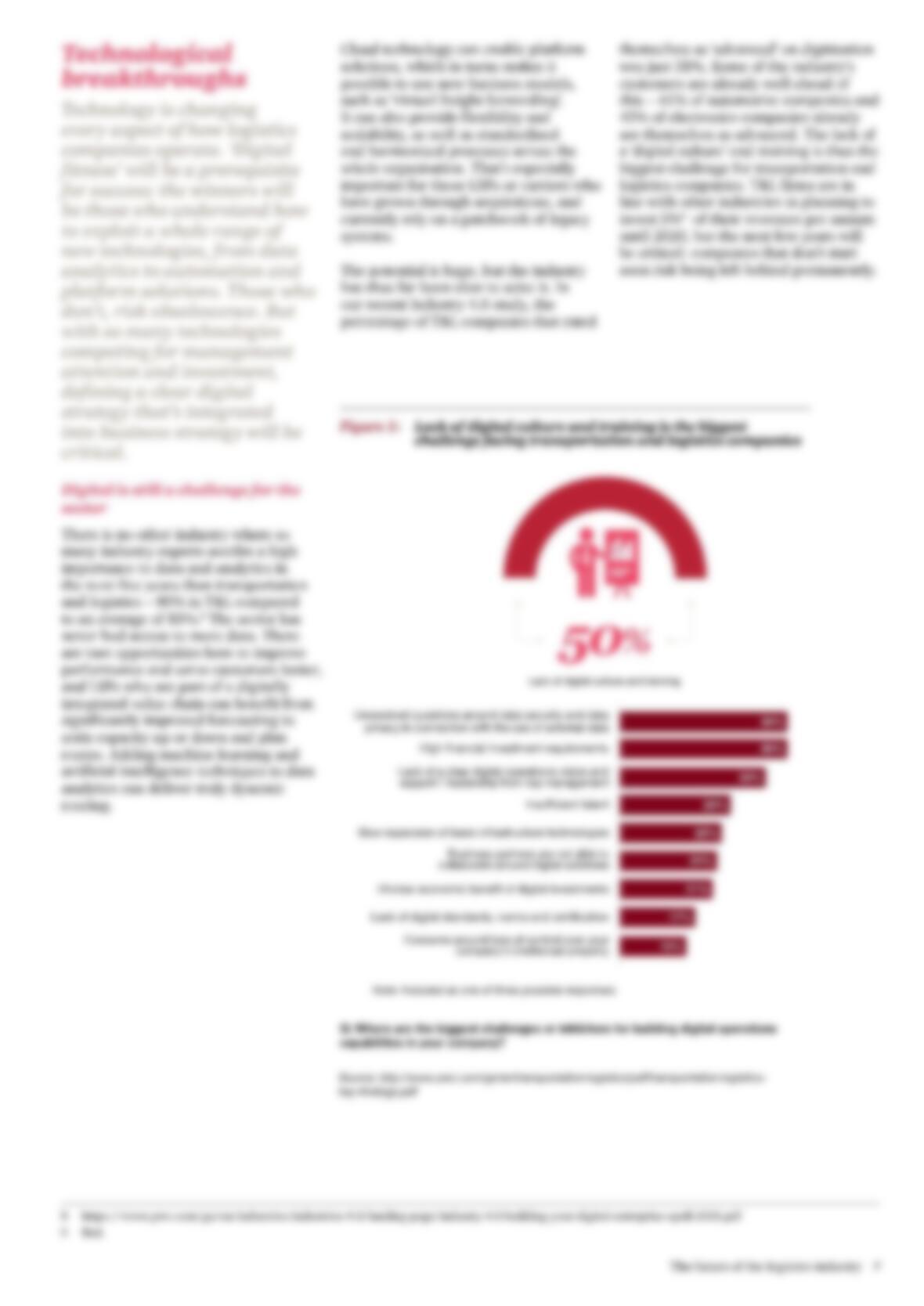
industry works. But ‘digital fitness’
is a challenge for the sector, which is
currently lagging many of its customers
in this respect. Attracting the right skills
is one issue, but developing the right
strategy is even more crucial.
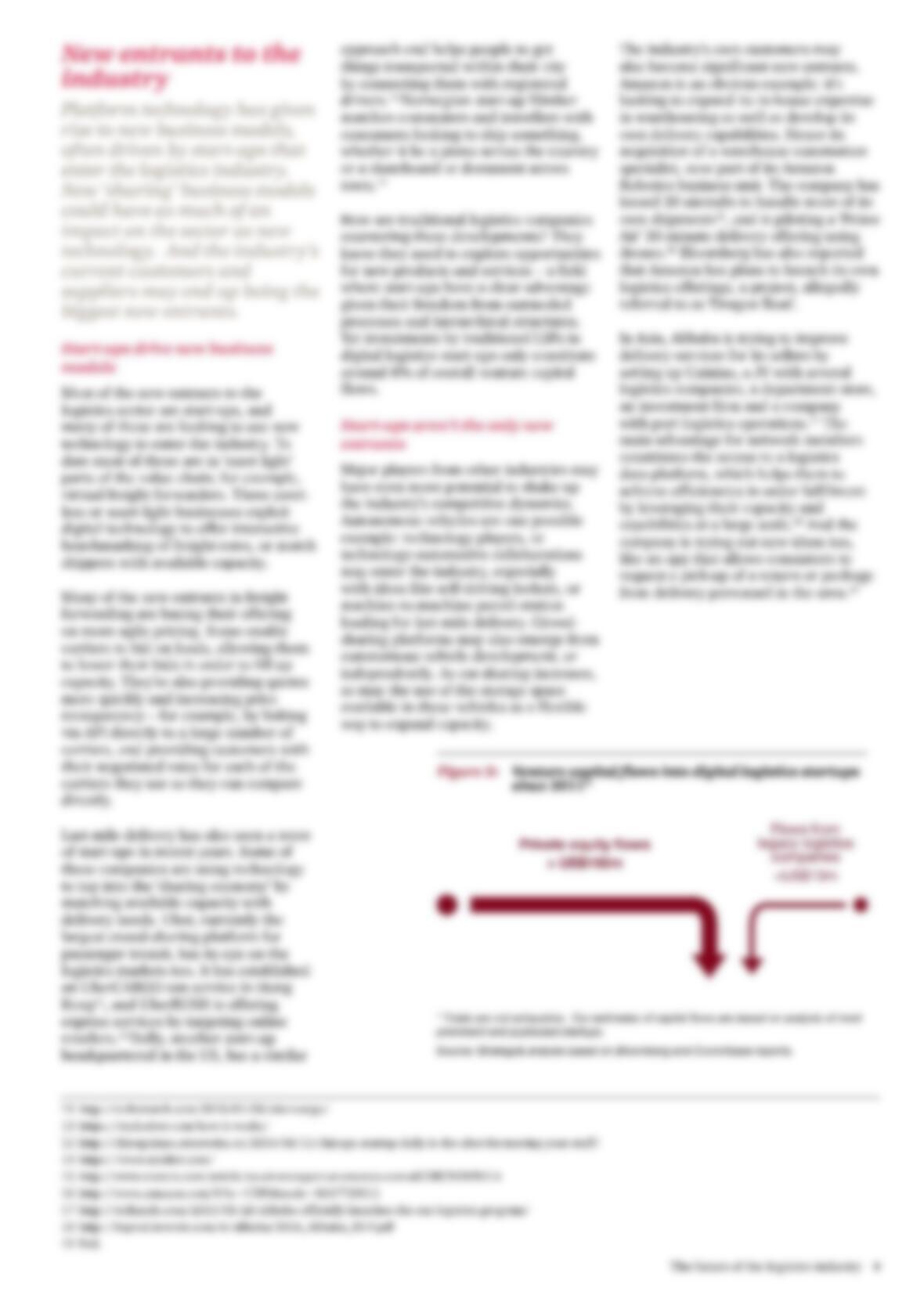
An increasingly competitive
environment is another big factor in the
mix. Some of the sector’s own customers
are starting up logistics operations of
their own, and new entrants to the
industry are finding ways to carve out
the more lucrative elements of the value
chain by exploiting digital technology or
new ‘sharing’ business models, and they
don’t have asset-heavy balance sheets or
cumbersome existing systems weighing
them down.
‘Sharing’ is a big story for logistics
now – from Uber-style approaches
to last-mile delivery, to more formal
JVs and partnerships at corporate
level, the whole sector is redefining
collaboration. But much of this
is hampered by inconsistencies
in everything like shipment sizes,
processes or IT systems. The Physical
Internet promises great things for the
sector, coming along with increased
standardisation in logistics operations.
Possible futures
What will the logistics marketplace look
like in five to ten years? That’s still a
very open question. We took a closer
look at how some of the key disruptions
facing the industry may interact. The
future scenarios we explore involve
combinations of these four factors,
weighted according to how important
specific trends become:
Sharing the PI(e): the dominant
theme in this scenario is the growth of
collaborative working, which allows the
current market leaders to retain their
dominance. This could for example see
a greater use of ‘Physical Internet’ (or
‘PI’) solutions, based on a move towards
more standardised shipment sizes,
labelling and systems.
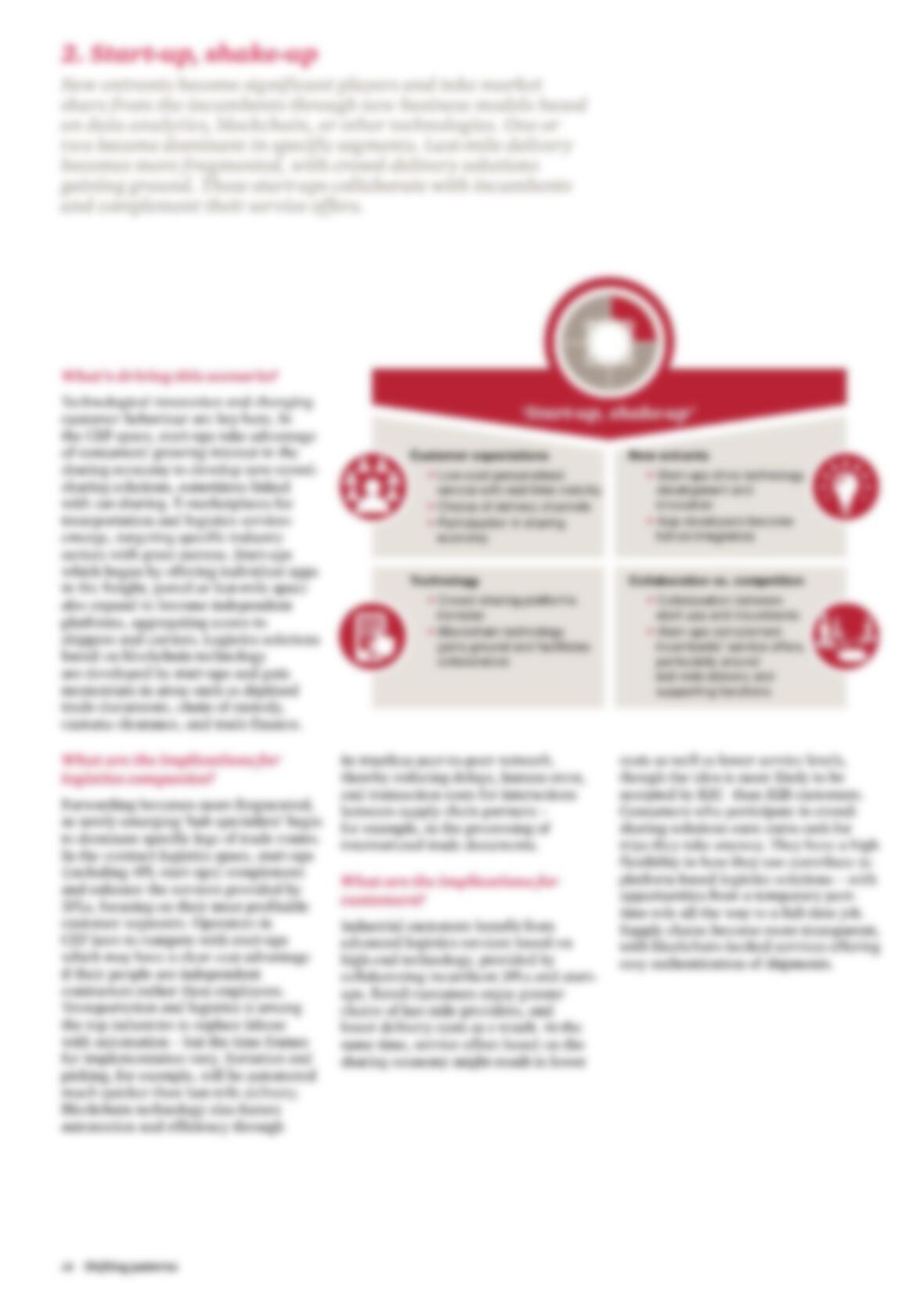
Start-up, shake up: in this scenario
new entrants in the form of start-
ups make a bigger impact. The most
challenging and costly last mile of
delivery, in particular, becomes more
fragmented, exploiting new technologies
like platform and crowd-sharing
solutions. These start-ups collaborate
with incumbents and complement their
service offers.
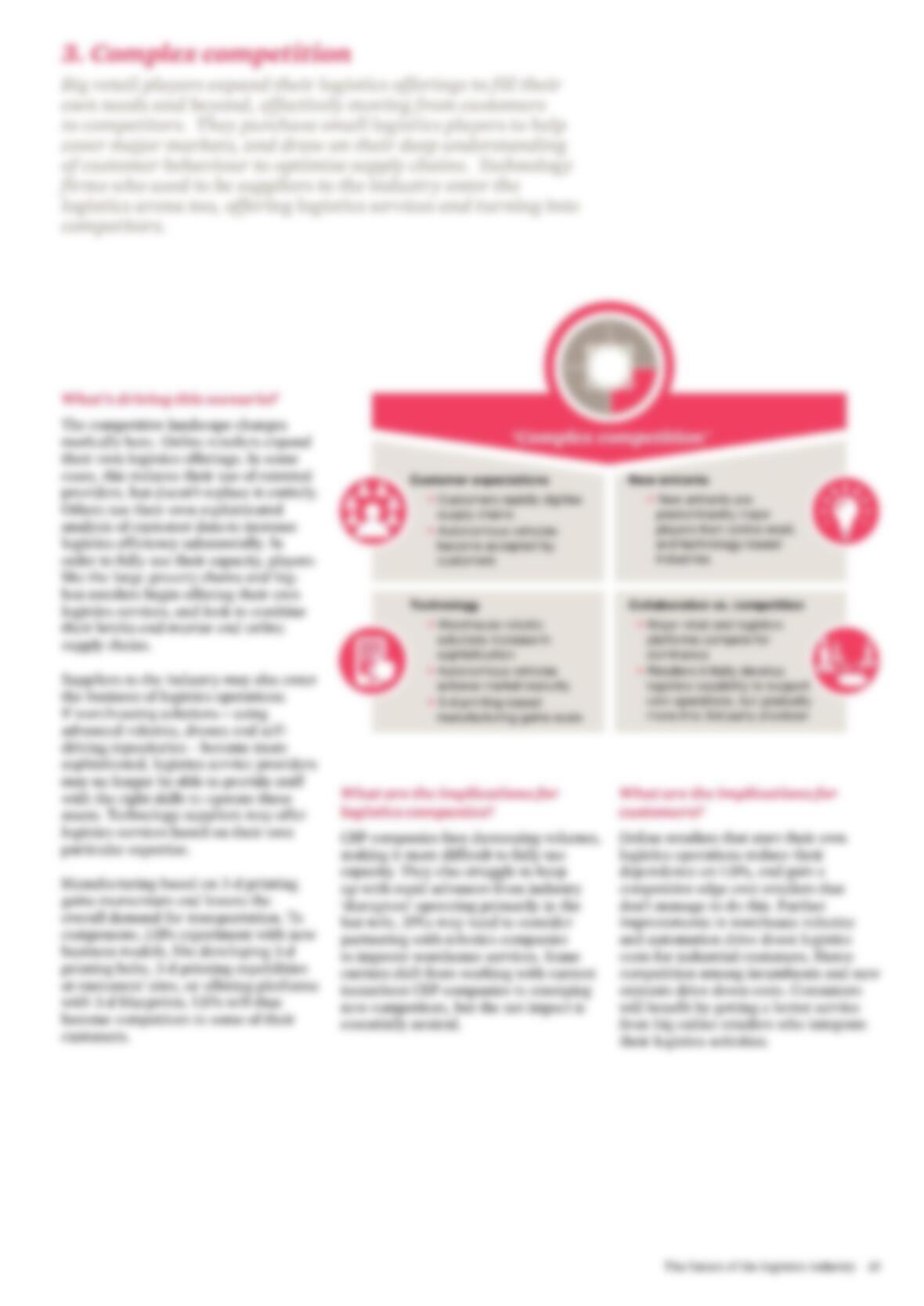
Complex competition: here the
competitive set evolves in a different
direction, as large industrial or retail
customers and suppliers become players
in the logistics market themselves, not
just managing their own logistics but
turning that expertise into a profitable
business model.
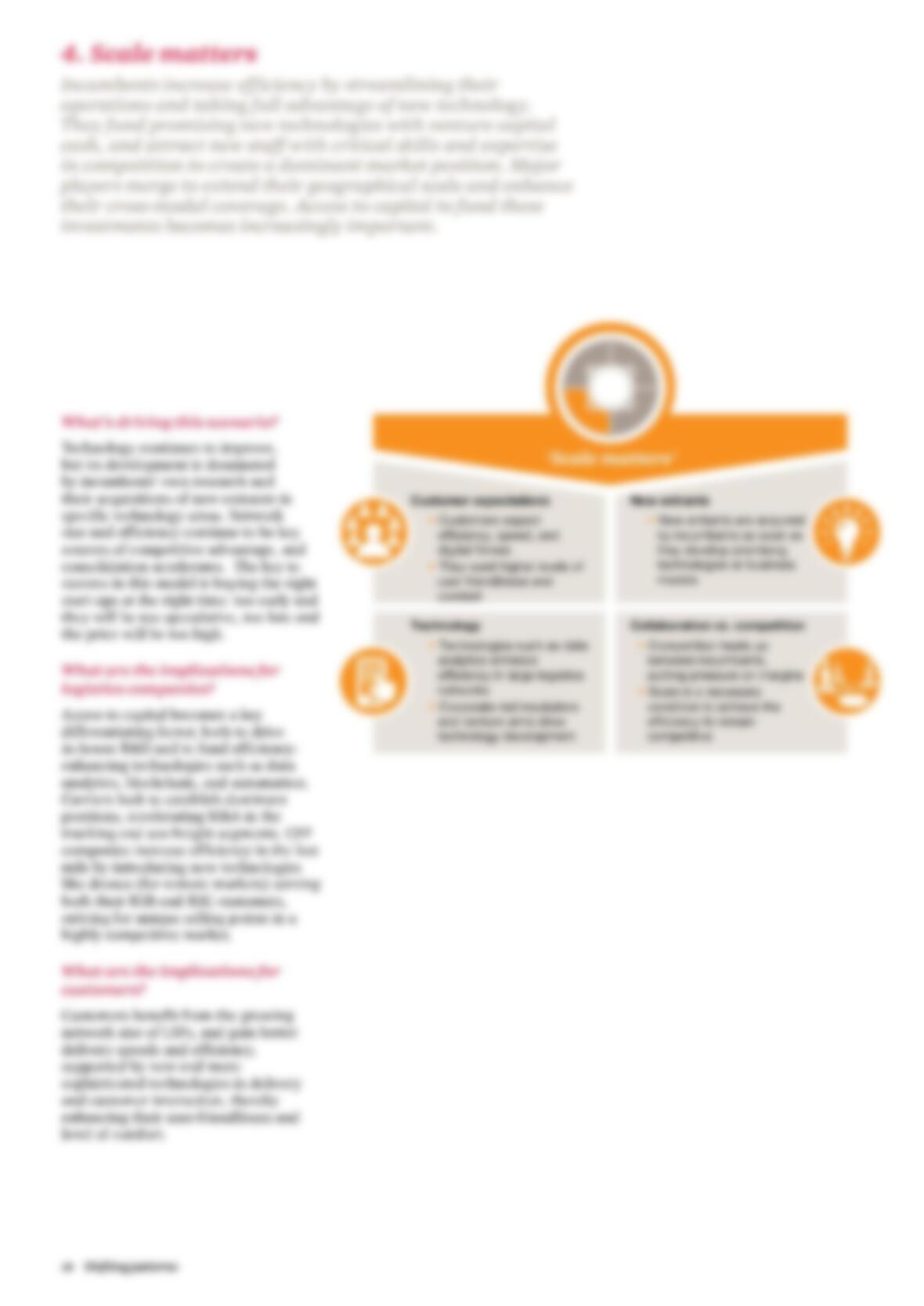
Scale matters: and finally, in this
scenario, the current market leaders
compete for a dominant market position
by acquiring smaller players, achieving
scale through consolidation, and
innovation through the acquisition of
smaller entrepreneurial start-ups.
We hope this paper will help you assess
the trends and developments most likely
to affect your own business, and start to
develop a strategy to ensure continued
profitability through this time of intense
change.

4 Shifting patterns
Introduction
Logistics companies are facing an era of unprecedented change
as digitisation takes hold and customer expectations evolve. New
technologies are enabling greater efficiency and more collaborative
operating models; they’re also re-shaping the marketplace in ways that
are only just beginning to become apparent. New entrants, whether they
be start-ups or the industry’s own customers and suppliers, are also
shaking up the sector.
The race is on to define the industry’s
future. And with an estimated US$4.6
trillion1 of revenues at stake, companies
can’t afford to sit back and watch; they
need to adapt to changing markets
proactively.
We’ve developed a transformation
framework to describe how megatrends2
affect a given industry, taking into
account the key disrupting forces
that create uncertainties for every
organisation in the sector. Based on
these uncertainties, we outline distinct
scenarios to explore possible futures
for the sector. This framework will help
you plan for this uncertain and volatile
future.3
For the logistics industry, we start
by taking a closer look at some of
the key disrupting factors: changing
customer expectations, technological
breakthroughs, new entrants to the
industry, and new ways to compete
or collaborate. These disruptions
have very different implications for
individual companies, depending on
which segments they operate in, their
type of ownership, and where they
are located. They also don’t exist in a
vacuum: in each case, the interactions
between them are equally, if not more,
important. Government intervention
and trade flows between regions and
territories are influencing the industry
too, but very much depend on national
politics and geography.
1 https://www.plunkettresearch.com/industries/transportation-supply-chain-logistics-industry-market-research/
Note: various estimates available, high variance, distinct approaches, difficult to measure given insourced and outsourced portions of the total market
2 https://www.pwc.com/us/en/faculty-resource/assets/symposium/2014-megatrends-overview.pdf
3 At PwC, we are analysing potential futures for various industry sectors and some papers are already published (see list on page 20).

Our four logistics scenarios for the
future of the industry are based
Together these logistics scenarios map
out a range of possibilities for the
• Complex competition: here the
competitive set evolves in a different
Defining ‘Logistics’ for this paper
There are a number of distinct business models in the industry, although they can
overlap, and individual companies may operate under more than one model. In this
paper, we consider logistics service providers (LSP), carriers, and courier / express /
parcel (CEP) companies. Postal operators, too, are relevant players in the context of
logistics and CEP.
Not only business models but profitability and margins differ considerably. In
contrast with other industries, profits in logistics are relatively low. Yet, within this
sector, EBIT margins generally range from -1% to 8%. While carriers find themselves
close to zero profit, sometimes even in the red, the large CEP companies end up
being the most profitable group, sometimes reaching double-digit profit margins.4
Customers in the logistics industry comprise of both B2B and B2C segments. The
major part of the total market can be linked to B2B transactions, with LSPs and
carriers accounting for the biggest portion of industry revenue. CEP represents a
smaller, but faster growing segment; and just about a third of CEP revenues can be
attributed to B2C.
Segment Business
Model
Customer
B2B
LSP Freight forwarders, 3rd and 4th party
logistics service providers
Manufacturers,
wholesalers, and retailers
Carriers Trucking, rail freight, sea freight and
air freight companies
LSPs
CEP Courier / Express / Parcel companies Retailers, manufacturers,
and other companies
B2C CEP Courier / Express / Parcel companies Private consumers