Chapter
0
Foundation
s of
planning
Work smarter not
harder
The way to
excellence
Learning objectives
Ahmed Wagieh
Viber -whatsapp 01006373703 — Private Number 01000572207

A- Nature of planning:
Definition >> It is a primary management function that involves defining the
organization’s goals, establishing strategies for achieving those goals, and developing plans to
integrate and coordinate work activities.
Types >>
1. formal planning :
specific goals covering a specific time period , These goals are written and shared with
organizational members to reduce ambiguity and create a common understanding about
what needs to be done.
2. In formal planning :
General goals or specific goals for part of the organization only & not written.
B- Purposes of planning:
There are four purposes / reasons :
1. Planning provides direction to managers and non-managers alike.
2. Planning reduces uncertainty.
3. Planning minimizes waste and redundancy.
4. Planning sets the goals or standards used in controlling.
C- Planning and performance:
We conclude that :
1. Formal planning is associated with positive financial results ( higher profits & higher return
on assets ).
2. The quality of planning and implementation affect performance more than the extent of
planning.
3. The external environment can reduce the impact of planning on performance.
4. The planning-performance relationship seems to be in1uenced by the planning time
frame.
1- Goals (objectives ) :
Are desired outcomes or targets for individuals, groups, or entire organizations.
They guide management decisions and form performance evaluation criterion.
Types of Goals:
There are two types of goals:
1- Financial goals
Are related to the expected internal financial performance of the organization.
2- Strategic goals
Are related to the performance of the firm relative to factors in its external environment
(e.g., competitors).
1
Part one: Planning
What Is
Planning?
Why Do Managers
plan? Plan?
Relationship /
conclusion
Part Two: Elements of planning
Goals
Plans
How Do
Manage
rs plan?
2- Plans :
Are documents that outline how goals are going to be met.
They describe how resources are to be allocated, establish activity schedules and include other
necessary actions to accomplish the goals.
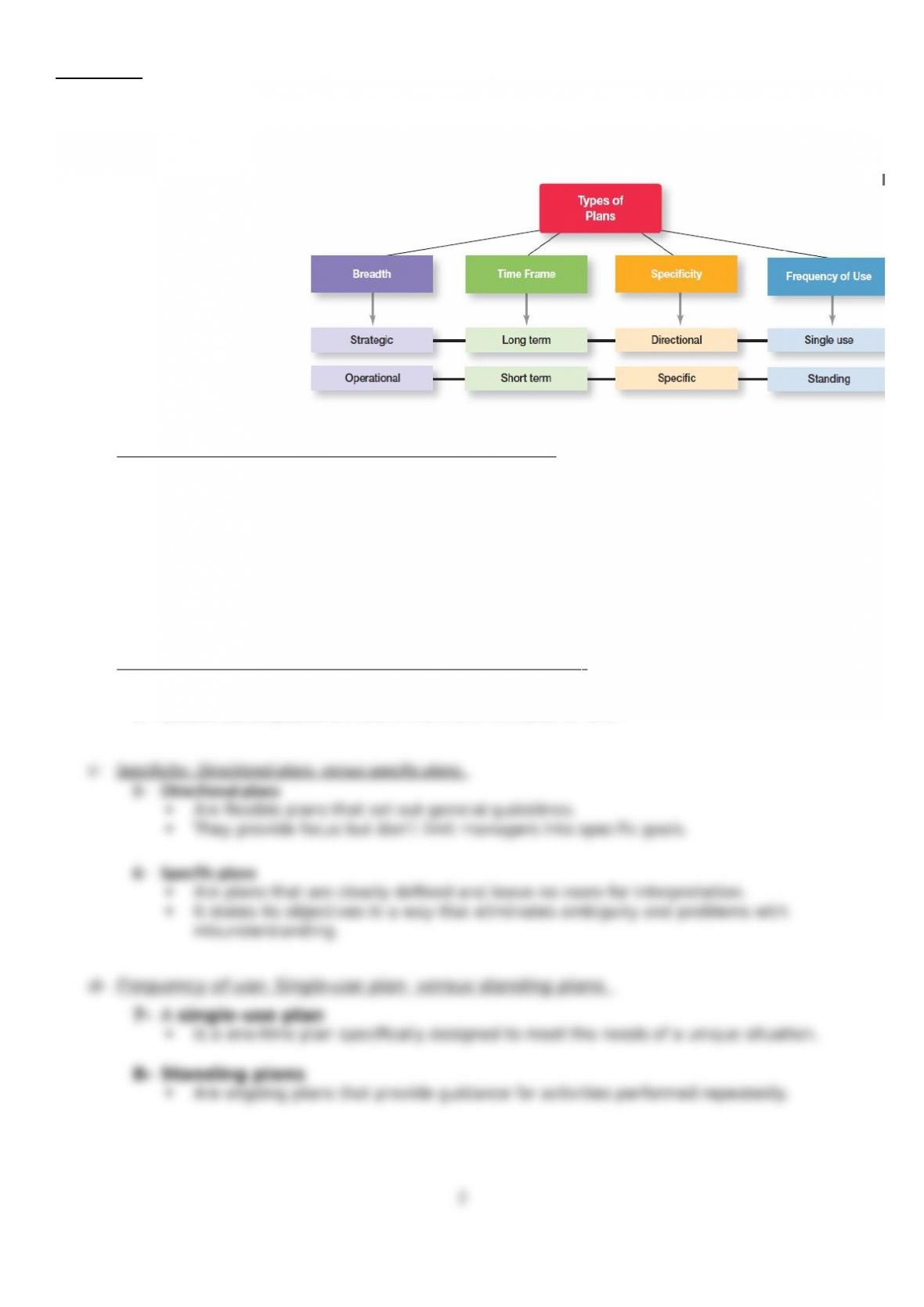
Types of Plans:
There are eight types of plans classified into four groups
a- Breadth: Strategic plans versus operational plans.
1- Strategic plans
cover long-term periods
Are plans that apply to the entire organization, establish the organization’s overall
goals, and seek to position the organization in terms of its environment.
2- Operational plans
cover short-term periods
Are plans that specify the details of how the overall goals are to be achieved.
b- Time frame: long-term plans versus short-term plans.
3- Long-term plans are plans with a time frame beyond three years.
4- Short-term plans are plans that cover one year or less.
Part Three :
Se+ng goals & developing plans
1 –Goals
5
6