Chapter 4
Adjustments, Financial Statements, and
Financial Results
ANSWERS TO QUESTIONS
1. Adjusting entries are made at the end of the accounting period to record all
revenues and expenses that have not been recorded but belong in the current
period. These adjustments also ensure that the related accounts on the balance
sheet and income statement are up-to-date and complete.
2. (a) The time period assumption states that the long life of a company can be
divided into shorter time periods. Adjustments are required by GAAP to
ensure that a company’s financial statements include all the transactions of
the given time period.
(b) The revenue recognition principle states that revenues should be recorded
when earned. Adjustments assist in recording revenues during the period in
which they are earned, rather than when cash is received.
(c) The expense recognition or “matching” principle states that expenses are
recorded when incurred to generate revenues. Adjustments ensure that the
expenses incurred during a particular period are, in fact, recorded during that
period.
3. The two different types of adjusting journal entries are:
(1) Deferral adjustments:
(a) Revenues — previously recorded liabilities that need to be adjusted at the
end of the period to reflect earned revenues (e.g., unearned revenue must be
adjusted for the portion of sales revenues earned in the current period).
(b) Expenses– previously recorded assets that need to be adjusted at the end
of the period to reflect incurred expenses (e.g., prepaid insurance must be
adjusted for the portion of insurance expense incurred in the current period).
(2) Accrual adjustments:
(a) Revenues — revenues that have been earned by the end of the accounting
period, but will be collected in a future accounting period (e.g., recording
interest receivable for interest earned but not yet collected).
(b) Expenses — expenses that have been incurred by the end of the accounting
period, but will be paid in a future accounting period (e.g., recording an
accrued liability for utilities used during the period but which have not yet been
paid).
Fundamentals of Financial Accounting, 4/e 4- 1
© 2013 by McGraw-Hill Education. This is proprietary material solely for authorized instructor use. Not authorized for sale or distribution in any
manner. This document may not be copied, scanned, duplicated, forwarded, distributed, or posted on a website, in whole or part.
4. Adjusting entries have no effect on cash. For unearned revenues and
prepayments, cash was received or paid at some point in the past. For accruals,
cash will be received or paid in a future accounting period. At the time of the
adjusting entry, no cash is received or paid.
5. A contra-asset is an account related to an asset that is an offset or reduction to the
asset’s balance. Accumulated Depreciation is a contra-account to the equipment
and buildings accounts.
6. Depreciation expense is reported on the income statement. It indicates the amount
of depreciation for the current period. Accumulated depreciation is reported on the
balance sheet (as a contra-asset). It indicates the total depreciation, which has
accumulated from the date the asset was acquired to the date of the balance sheet.
7. An adjusted trial balance is a list of the individual accounts, usually in financial
statement order, with their adjusted debit or credit balances. It is used to provide a
check on the equality of the debits and credits.
8.
Assets = Liabilities + Stockholders’ Equity
De
c
31
Cash
Prepaid Rent 9,000
+9,000 =
Jan
31
Prepaid Rent 3,000 =Rent
Expense (+E) 3,000
Fe
b
28
Prepaid Rent 3,000
=
Rent
Expense (+E) 3,000
Ma
r
31
Prepaid Rent 3,000
=
Rent
Expense (+E) 3,000
9. Balance sheet accounts at January 31:
Prepaid rent $6,000
Income statement accounts for period ended January 31:
Rent expense $3,000
4- 2 Solutions Manual
© 2013 by McGraw-Hill Education. This is proprietary material solely for authorized instructor use. Not authorized for sale or distribution in any
manner. This document may not be copied, scanned, duplicated, forwarded, distributed, or posted on a website, in whole or part.

10.
12/31 dr Prepaid Rent (+A)………………………………………. 9,000
cr Cash (A)……………………………………………. 9,000
1/31 dr Rent Expense (+E, SE)…………………………….. 3,000
cr Prepaid Rent (A)………………………………… 3,000
2/28 dr Rent Expense (+E, SE)…………………………….. 3,000
cr Prepaid Rent (A)………………………………… 3,000
3/31 dr Rent Expense (+E, SE)…………………………….. 3,000
cr Prepaid Rent (A)………………………………… 3,000
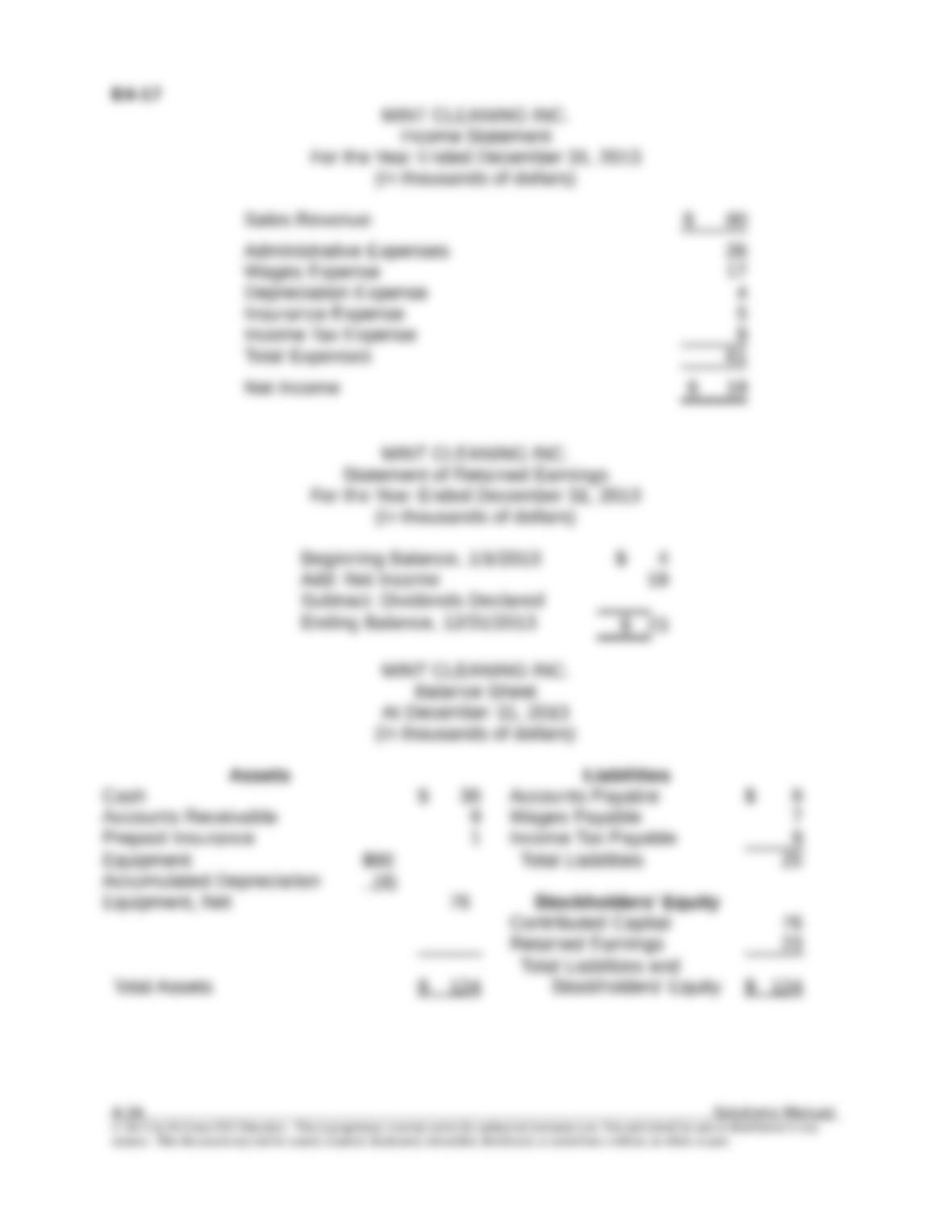
11. (a) Income statement: Revenues Expenses = Net Income
(b) Balance sheet: Assets = Liabilities + Stockholders’ Equity
(c) Statement of retained earnings: Beginning Retained Earnings + Net Income
Dividends Declared = Ending Retained Earnings
12. The net income from the income statement is included on the statement of retained
earnings to determine the ending retained earnings balance, which is then reported
on the balance sheet as a stockholders’ equity account.
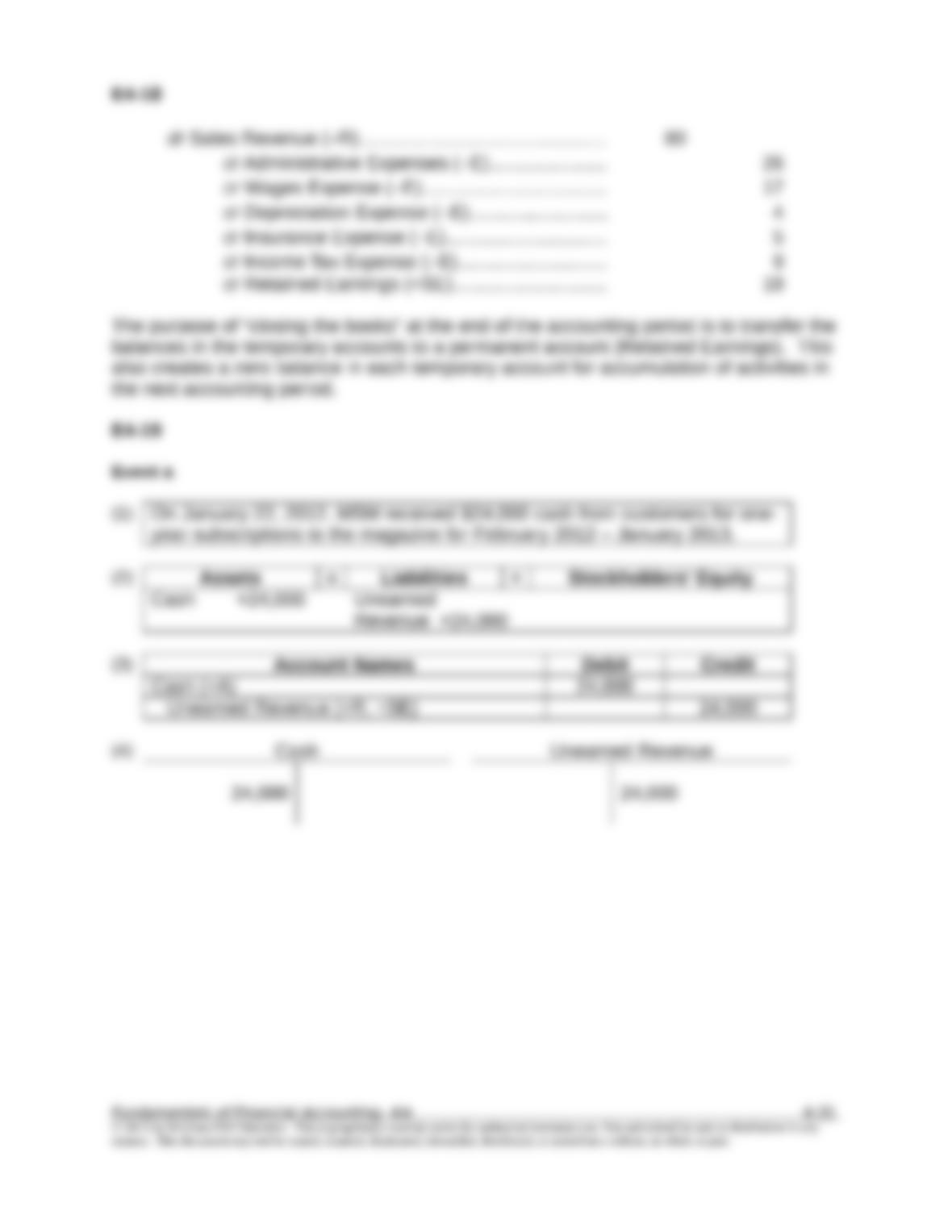
13. Closing journal entries are made at the end of the accounting period to transfer the
balances in the temporary accounts to retained earnings. The closing journal
entries reduce the revenue, expense, and dividends declared accounts to a zero
balance so that they can be used for the accumulation process during the next
period. Closing entries must be entered into the system through the journal and
posted to the ledger accounts to state properly the temporary and permanent
account balances (i.e., zero balances in the temporary accounts).
14. Permanent accounts are balance sheet accounts (for assets, liabilities, and
stockholders’ equity accounts). These accounts are not closed at the end of
each period.
Temporary accounts include all income statement accounts (for revenues and
expenses) and the Dividends Declared account. These accounts are used to
track results of only the current period, so they are closed (into Retained
Earnings) at the end of each year.
Fundamentals of Financial Accounting, 4/e 4- 3
© 2013 by McGraw-Hill Education. This is proprietary material solely for authorized instructor use. Not authorized for sale or distribution in any
manner. This document may not be copied, scanned, duplicated, forwarded, distributed, or posted on a website, in whole or part.

15. The income statement accounts are closed at the end of the accounting period
because, in effect, they are temporary sub-accounts to retained earnings (i.e., a
part of stockholders’ equity). They are used only for accumulation during the
accounting period. When the period ends, these accumulated accounts must be
transferred (closed) to retained earnings. The closing process serves:
(1) to correctly state retained earnings, and
(2) to clear out the balances of the temporary accounts for the year just ended, so
that these sub-accounts can be used again during the next period for
accumulation and classification purposes.
Balance sheet accounts are not closed at the end of the period because they
reflect permanent accumulated balances of assets, liabilities, and stockholders’
equity. Permanent accounts show the business’s financial position at the end of
the period and are the beginning amounts for the next period.
16. Dividends declared is a stockholders’ equity account that reduces the overall value
of stockholders’ equity. It functions as a temporary account that is closed to