Kennedy 1
Matthew William Kennedy
Professor Amy Scott
FD-501-CV01
18 March 2014
From Russia without Love
In the realm of current events, the situation in Ukraine is certainly in the spot light. It is
guaranteed to spark conversation from the casual news readers to world political leaders and
everyone in between. To say that we have a morbid fascination with real world conflict would be
an understatement. Though this situation is a very serious one and it is understandable why it is
at the focal point of the world. The state of affairs between Ukraine, Russia, and the rest of the
world has already generated significant economic effects and that will most likely not come to an
end anytime soon. Even after a viable “resolution” has been reached, there will be profound
consequences that will continue to resonate throughout the world.
The relevant history of the relationship between Ukraine and the Russia we know today
began with the final dismantling of the USSR. In 1991 Ukraine was granted its independence,
but was still subject to the effects of a communistic ideology and remained Russia’s “little
brother” (Evans 24). Those effects are hard to rid, especially when your culture has been
suppressed for more than 350 years. While the cultural healing process will be ongoing, the
strongest damage to the country has been felt economically. To add insult to injury “For years the
English-speaking world has gone on calling it “the Ukraine” as if it were still a region of Russia”
Kennedy 2
(Evans 25). Unfortunately, this does foreshadow that the escape from Russia’s cold grasp would
not be an easy endeavor.
Soviet and Eastern Bloc countries were at a fork in the road so to speak upon the final
collapse of the Soviet Union in the early 1990’s. The CEE-10 which was comprised of 10 Central
and Eastern European nations made a strong step towards the west by seeking admittance to the
European Union. “The rest, like Ukraine, moved much more slowly toward Western standards,
and some even settled under a new Russian umbrella.” (Hasset 8). The countries that took the
European Union route saw quick economic growth. Moving away from the inherent problems of
central planning at the heart of the USSR’s communism, some countries experienced rapid
development. Emerging countries do not necessarily have to be on the forefront of advancement,
but even following suit of other further developed countries can have a profound impact.
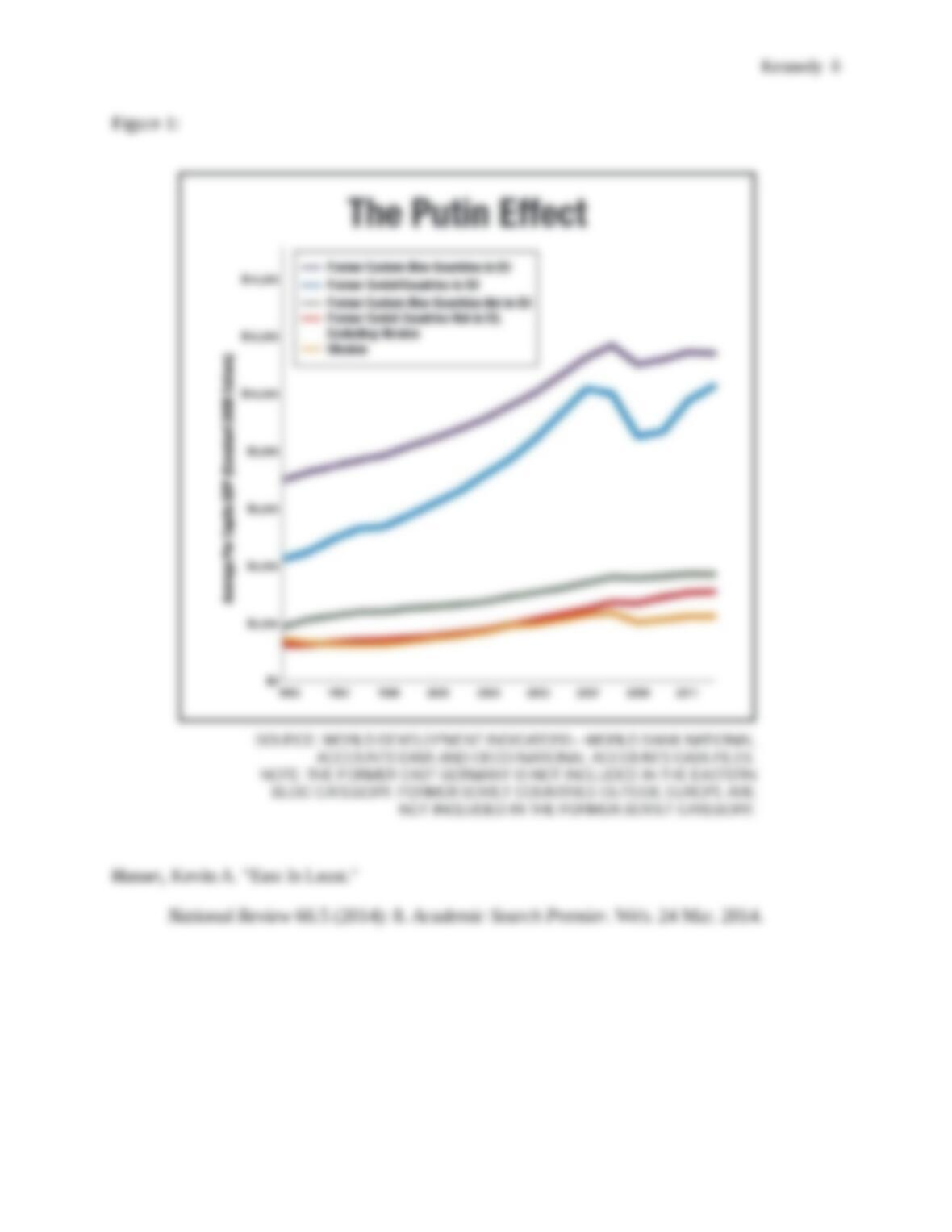
This was certainly true for former Eastern Bloc and Soviet countries that had joined the
European Union. These countries have experienced significant growth since the mid 1990’s in
Average Per Capita GPD in constant 2005 dollars. Within these countries Average Per Capita
GPD more than doubled their former Soviet counterparts (See Fig. 1). In comparison, “the
countries, like Ukraine, that failed to take that path have stagnated” (Hasset 8). The Ukraine
specifically has seen extremely low growth. This would only be compounded by the financial
crisis in 2008. The standard of living has barely increased since the fall of the USSR. This lack
of expendable income in a vast majority of citizens will further perpetuate economic instability
and poor growth. It is obvious that not following the same path as some of the other countries
into the European Union has had an incredibly negative impact. Though the push to join the EU
is still heavily supported and a driving reason for the situation we now find on every news outlet
across the globe.
Kennedy 3
While the economic situation has roots in the USSR, the current situation heavily stems
from Russian political influence. After Ukraine became “independent” the country sunk into
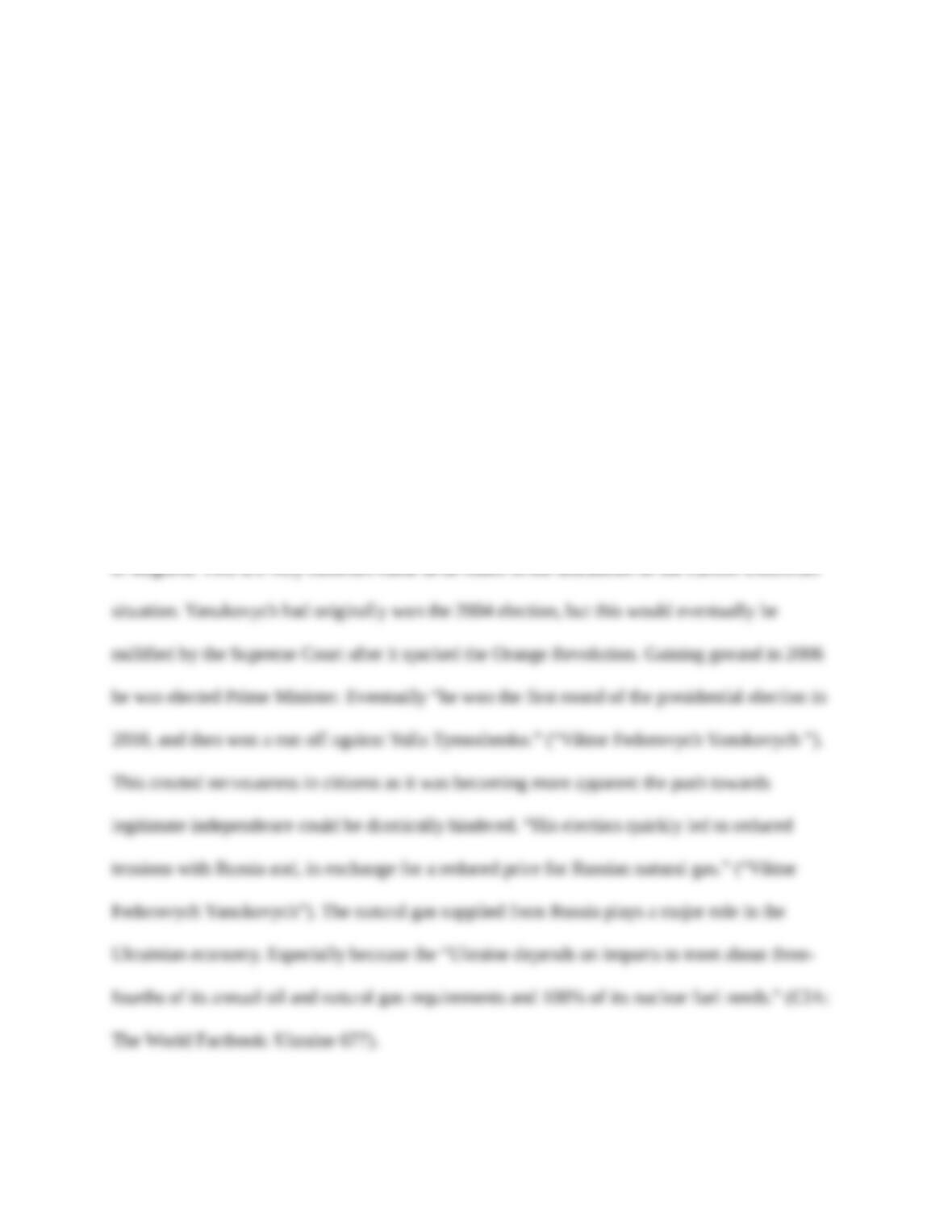
deep economic depression and saw a substantial decrease in gross domestic product. “Output by
1999 had fallen to less than 40% of the 1991 level.” (CIA: The World Factbook: Ukraine 677).
Ukraine did not show real GDP economic growth until the year 2000 (See Fig. 2). Even though
the country was still struggling, it was still a big player compared to other countries that did not
also did not seek joining the European Union. “After Russia, the Ukrainian republic was the
most important economic component of the former Soviet Union, producing about four times the
output of the next-ranking republic.” (CIA: The World Factbook: Ukraine 677).
Just like economic disparity, Ukraine is not unfamiliar to political protest. In late
November of 2004 the Orange Revolution began after the 2004 presidential election which was
widely held as corrupt. This would lead to a shift in parliament and short lived growth in real
GDP output in 2004. It was obvious something had to be done as economic growth remained
weak and inconsistent. “Ukrainian Government officials eliminated most tax and customs
privileges in a March 2005 budget law, bringing more economic activity out of Ukraine’s large
shadow economy, but more improvements are needed, including fighting corruption, developing
capital markets, and improving the legislative framework.” (CIA: The World Factbook: Ukraine
677). This was quite an undertaking for a country that had barely begun to show any signs of
economic sustainability. The need for indoctrination into the European Union looked more
necessary than ever. “…Although full integration was never a short-term prospect, European
integration, through the Association Agreement and the Deep and Comprehensive Free Trade
Area, offers considerable benefits to Ukraine.” (Connolly 541).
Kennedy 4
Tougher times were ahead as we approached the 2008 economic crisis. This recession
was felt all over the world and Ukraine was not an exception “The economy contracted nearly
15% in 2009, among the worst economic performances in the world.” (CIA: The World
Factbook: Ukraine 677). Such economic turmoil comes with a plethora of side effects, from
increased unemployment and stagnant wages to an increase in crime. Unemployment was at high
of 8.1% of the labor force for the working age group of 15 to 70 years (UNdata – Ukraine). The
recession within Ukraine during 2008-09 also would potentially jeopardize any movement
forward with admittance to the European Union. This would be compounded by the direction
the government and Ukrainian policy makers would soon be headed.
A leader of this directional change would be Viktor Yanukovych, a member of the Party