RESEARCH Open Access
Accuracy and precision of end-expiratory lung-
volume measurements by automated nitrogen
washout/washin technique in patients with acute
respiratory distress syndrome
Jean Dellamonica
1,2,9*
, Nicolas Lerolle
3,4
, Cyril Sargentini
4
, Gaetan Beduneau
5
, Fabiano Di Marco
6
, Alain Mercat
4
,
Jean-Christophe M Richard
5
, Jean-Luc Diehl
3
, Jordi Mancebo
7
, Jean-Jacques Rouby
8
, Qin Lu
8
, Gilles Bernardin
2
and
Laurent Brochard
1,9,10
Abstract
Introduction: End-expiratory lung volume (EELV) is decreased in acute respiratory distress syndrome (ARDS), and
bedside EELV measurement may help to set positive end-expiratory pressure (PEEP). Nitrogen washout/washin for
EELV measurement is available at the bedside, but assessments of accuracy and precision in real-life conditions are
scant. Our purpose was to (a) assess EELV measurement precision in ARDS patients at two PEEP levels (three pairs
of measurements), and (b) compare the changes (Δ) induced by PEEP for total EELV with the PEEP-induced
changes in lung volume above functional residual capacity measured with passive spirometry (ΔPEEP-volume). The
minimal predicted increase in lung volume was calculated from compliance at low PEEP and ΔPEEP to ensure the
validity of lung-volume changes.
Methods: Thirty-four patients with ARDS were prospectively included in five university-hospital intensive care units.
ΔEELV and ΔPEEP volumes were compared between 6 and 15 cm H
2
O of PEEP.
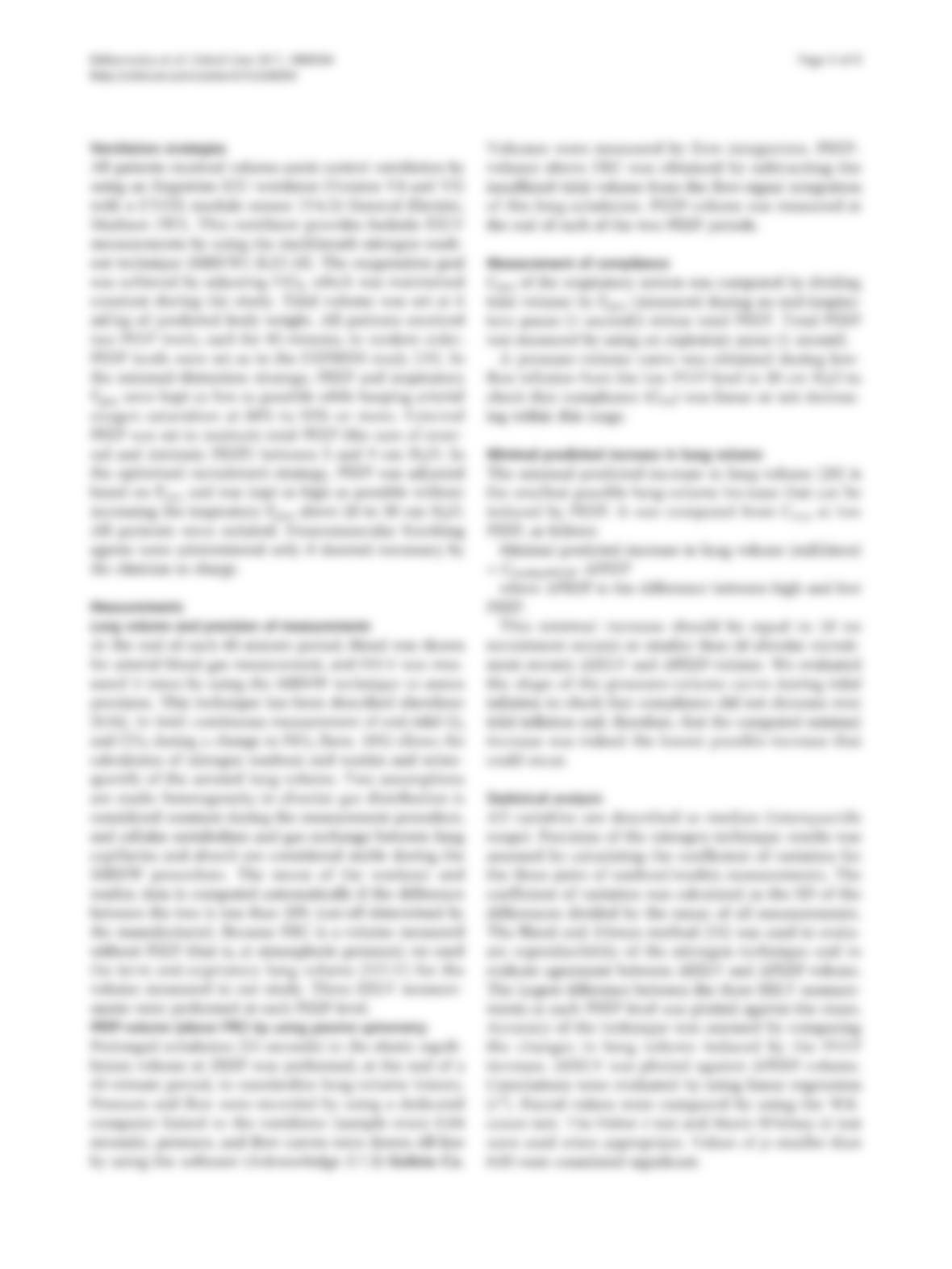
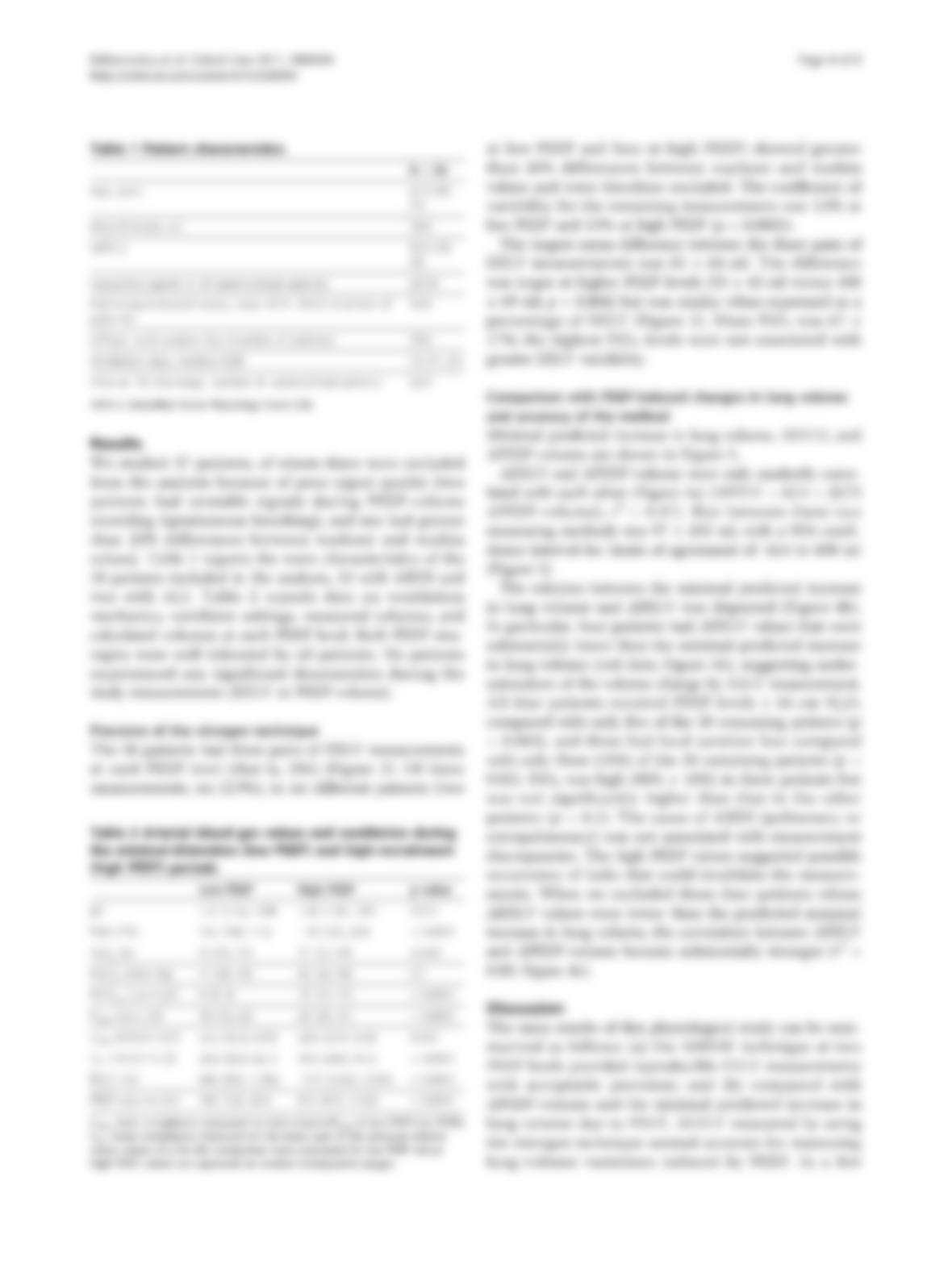
Results: After exclusion of three patients, variability of the nitrogen technique was less than 4%, and the largest
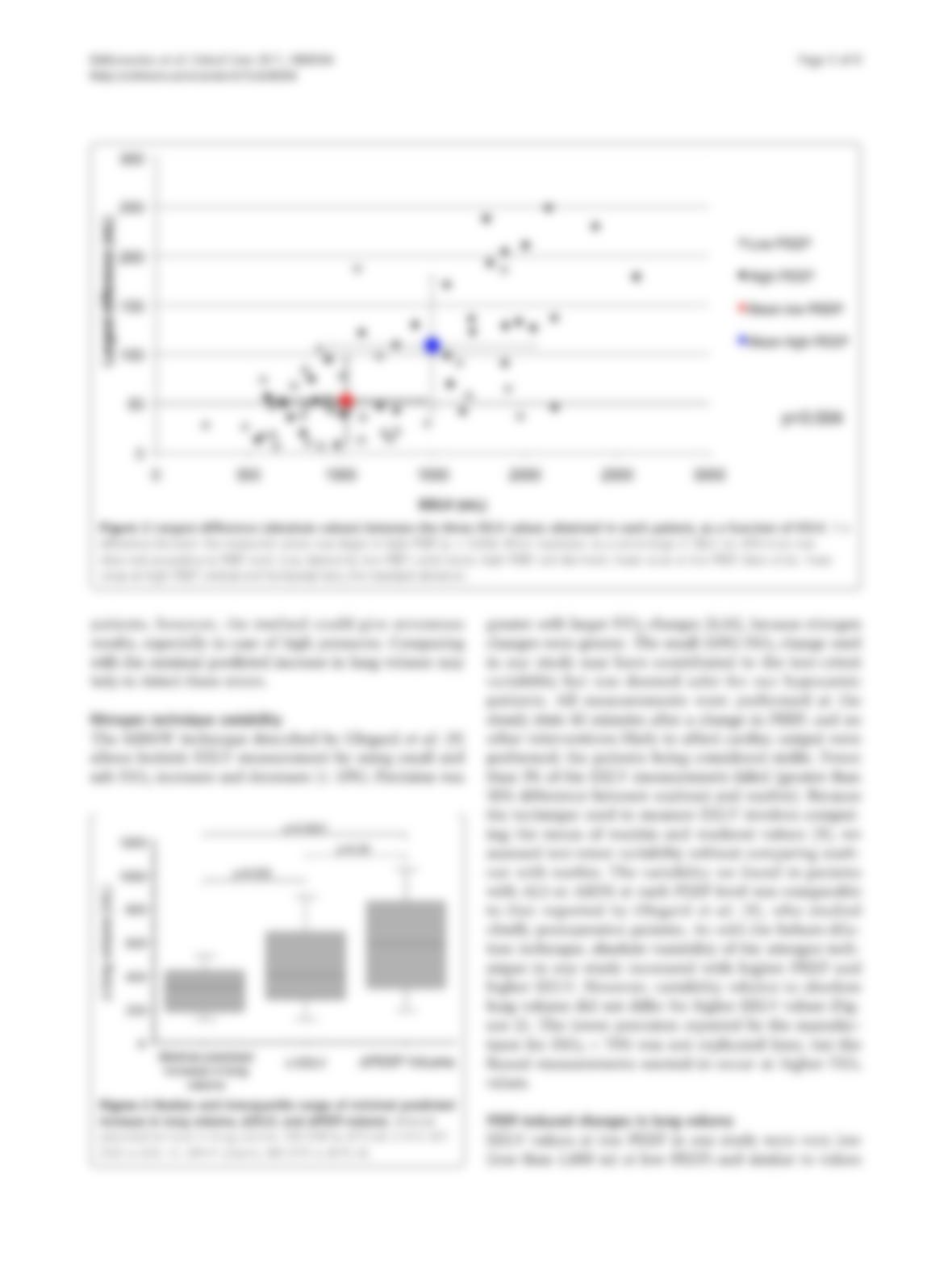
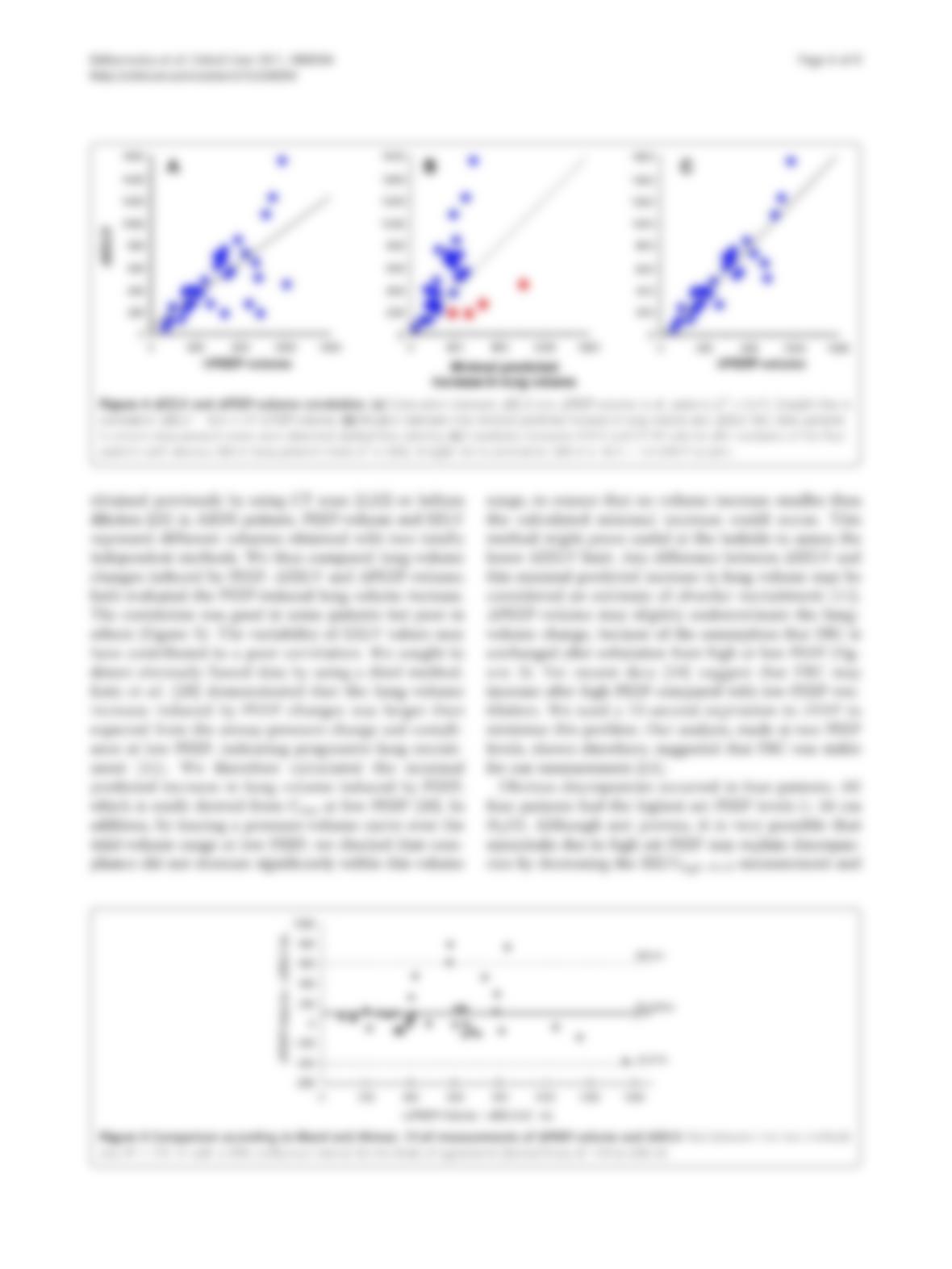
difference between measurements was 81 ± 64 ml. ΔEELV and ΔPEEP-volume were only weakly correlated (r
2
=
0.47); 95% confidence interval limits, -414 to 608 ml). In four patients with the highest PEEP (≥16 cm H
2
O), ΔEELV
was lower than the minimal predicted increase in lung volume, suggesting flawed measurements, possibly due to
leaks. Excluding those from the analysis markedly strengthened the correlation between ΔEELV and ΔPEEP volume
(r
2
= 0.80).
Conclusions: In most patients, the EELV technique has good reproducibility and accuracy, even at high PEEP. At
high pressures, its accuracy may be limited in case of leaks. The minimal predicted increase in lung volume may
help to check for accuracy.
Introduction
In acute lung injury (ALI) and acute respiratory distress
syndrome (ARDS), functional residual capacity (FRC) is
markedly decreased as a result of numerous factors,
including alveolar collapse, pulmonary edema with
alveolar flooding, supine position, sedation-induced
diaphragm inactivity, and cardiac enlargement [1-5].
Measuring FRC (or end-expiratory lung volume [EELV]
when PEEP is applied) might help to measure the aera-
ted lung available for ventilation and to better monitor
the effects of ventilation strategies. Reproducible mea-
surement techniques that can be used at the bedside are
needed to minimize overdistention and to determine
which patients may benefit from recruitment strategies.
Repeated CT scans and gas-dilution techniques are two
validated methods of lung-volume measurement but are
* Correspondence: jean.dellamonica@inserm.fr
1
Réanimation Médicale, AP-HP, Centre Hospitalier Albert Chenevier, Henri
Mondor, avenue Marechal de Lattre de Tassigny, Créteil, 94000, France
Full list of author information is available at the end of the article
Dellamonica et al.Critical Care 2011, 15:R294
http://ccforum.com/content/15/6/R294
© 2011 Dellamonica et al.; licensee BioMed Central Ltd. This is an open access article distributed under the terms of the Creative
Commons Attribution License (http://creativecommons.org/licenses/by/2.0), which permits unrestricted use, distribution, and
reproduction in any medium, provided the original work is properly cited.
so complex that their use has been confined to research
settings. Recently, washout/washin techniques using
oxygen [6,7] or nitrogen [8,9] have been made available
in ICU ventilators, allowing bedside EELV measurement.
A comparison of the nitrogen washout/washin EELV
measurement with helium dilution or CT scan had
shown good correlations in stable patients ventilated
with low-PEEP levels [8]. The limitations of the nitrogen
washout/washin technique for EELV measurement
under other conditions, such as high FiO
2
or high PEEP,
have not been fully investigated [10].
PEEP-induced changes in lung volume (referred to as
PEEP-volume) can also be assessed simply at the bed-
side by using passive spirometry. This accurate method
requires a long expiration to zero end-expiratory pres-
sure (ZEEP), where FRC is assumed to be reached.
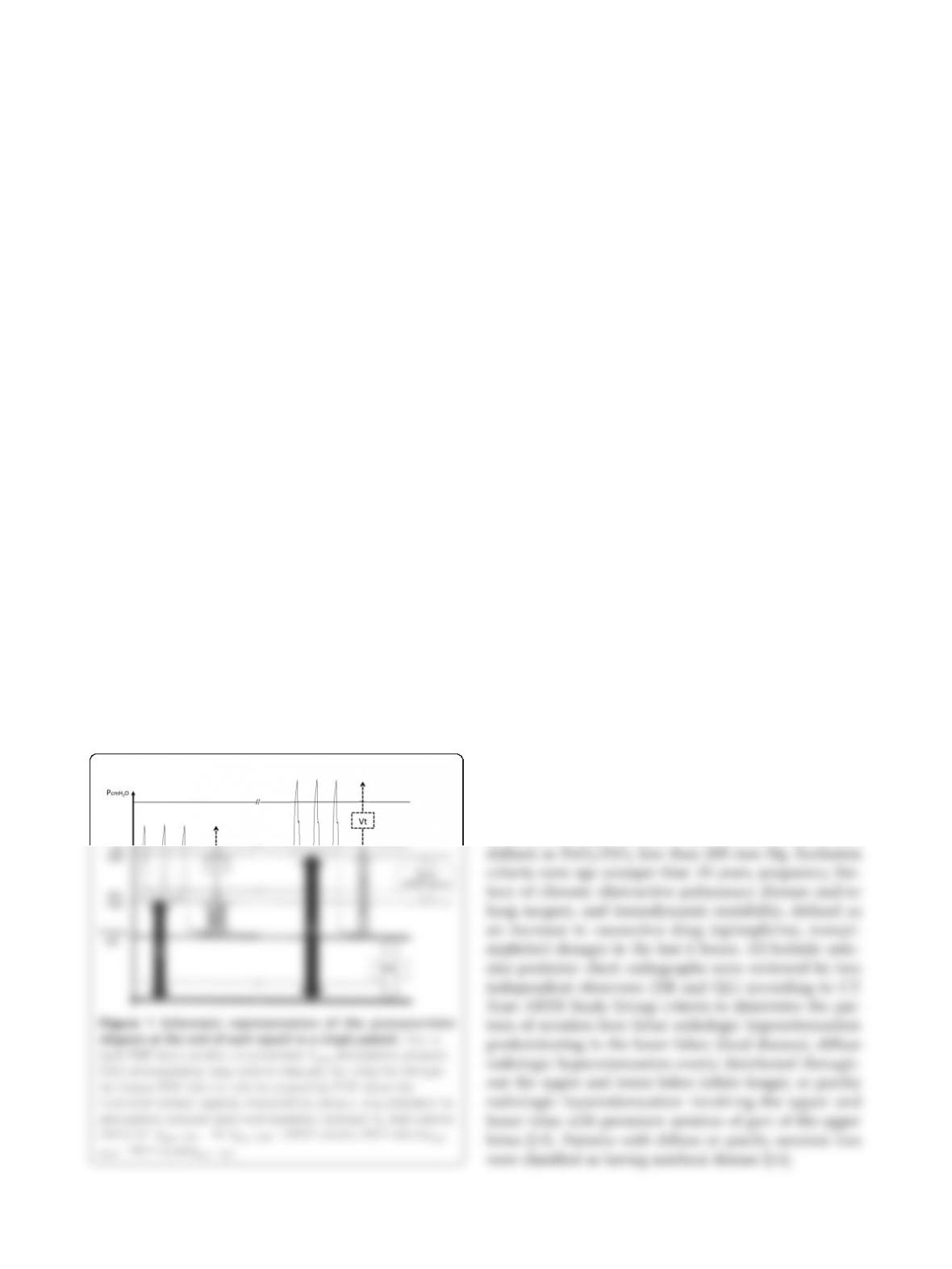
When considering the changes induced by two different
levels of PEEP in a given patient, the difference in EELV
(that is, ΔEELV = EELV
high PEEP
-EELV
low PEEP
) should
theoretically be similar to the difference in ΔPEEP-
volume (PEEP-volume
high PEEP
– PEEP-volume
low PEEP
),
assuming that the FRC has not been modified by the
PEEP changes (see Figure 1).
We designed a multicenter study with the primary
objective of investigating the precision (reproducibility)
of the nitrogen washout/washin technique for EELV
measurement in patients with ALI/ARDS at two PEEP
levels, including a high level, with a small variation in
oxygen concentration (10%). Our secondary objective
was to evaluate the accuracy of the technique by
comparing PEEP-induced changes (Δ)inlungvolume
with the nitrogen technique or the PEEP-volume above
the FRC measured with passive spirometry. As PEEP-
volume is relatively easy to measure accurately with a
calibrated pneumotachograph, it may therefore be con-
sidered a “gold standard.”Because we expected possible
discrepancies between the two techniques, we also com-
pared the measured changes in lung volume (ΔEELV
and ΔPEEP-volume) with the minimal predicted
increase in lung volume, computed from static compli-
ance (C
stat
) at low PEEP and ΔPEEP. The minimal pre-
dicted increase in lung volume was considered the
smallest-volume increase that can occur. We have also
used this method to evaluate alveolar recruitment, as
described elsewhere [11].
Material and methods
This was a multicenter study performed in five French
medical intensive care units at the Henri Mondor Uni-
versity Hospital in Créteil, European Georges Pompidou
University Hospital in Paris, Angers University Hospital
in Angers, l’Archet 1 University Hospital in Nice, and
Charles Nicolle University Hospital in Rouen. In compli-
ance with French legislation, the institutional review
board of the Henri Mondor University Hospital
approved the protocol for all centers and waived the
need for informed consent, as PEEP optimization was
considered part of standard care. The patients or next
of kin received information about the study.
Dellamonica et al.Critical Care 2011, 15:R294
http://ccforum.com/content/15/6/R294
Page 2 of 8