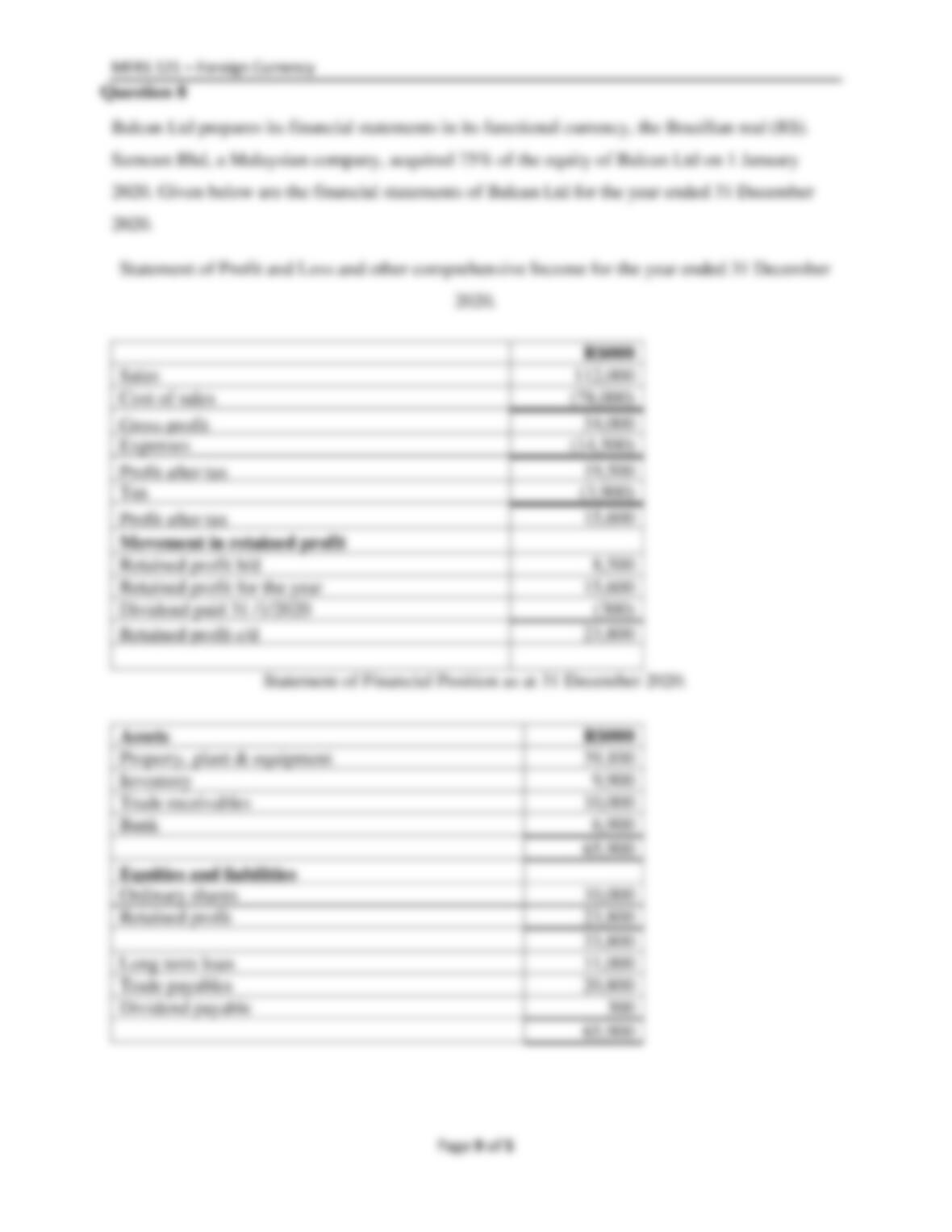
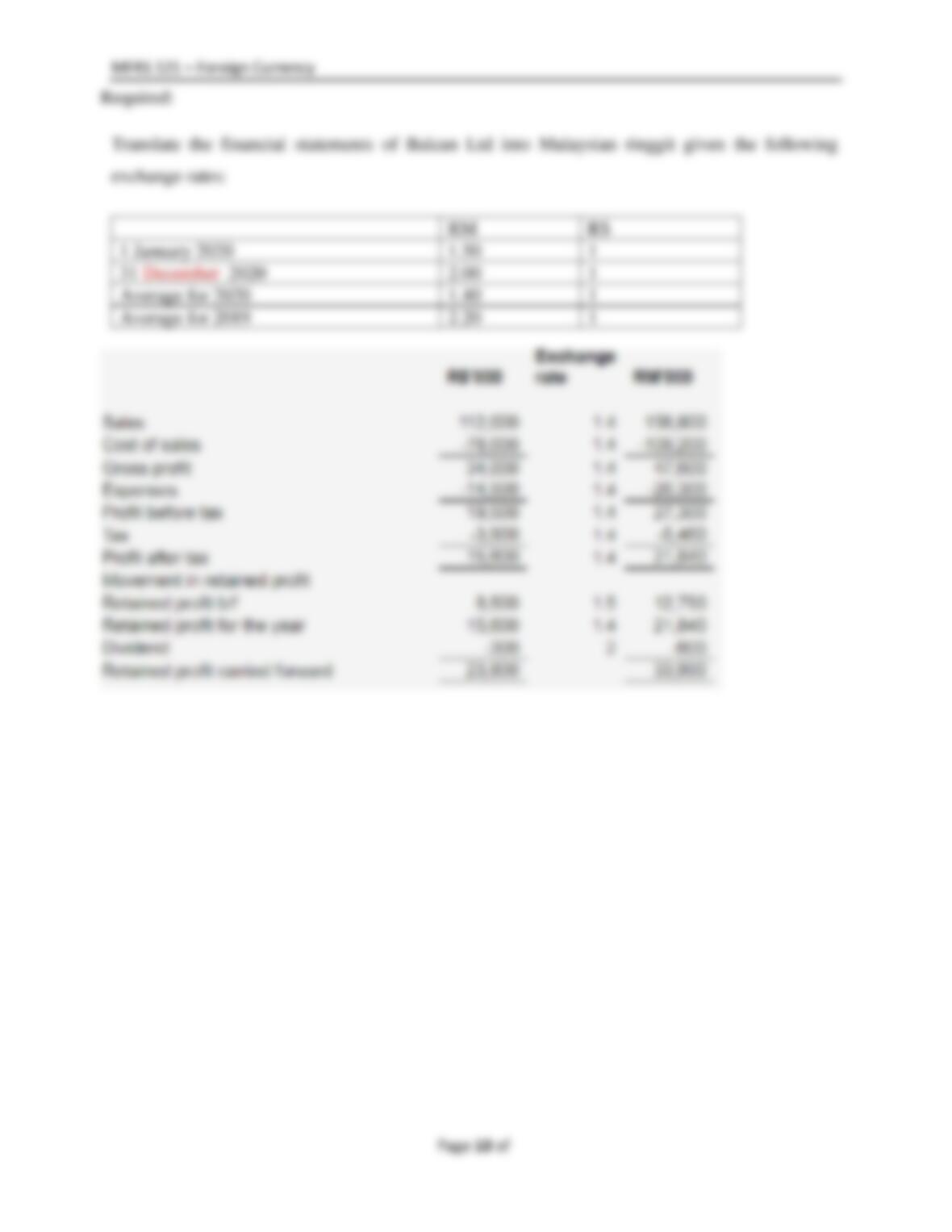
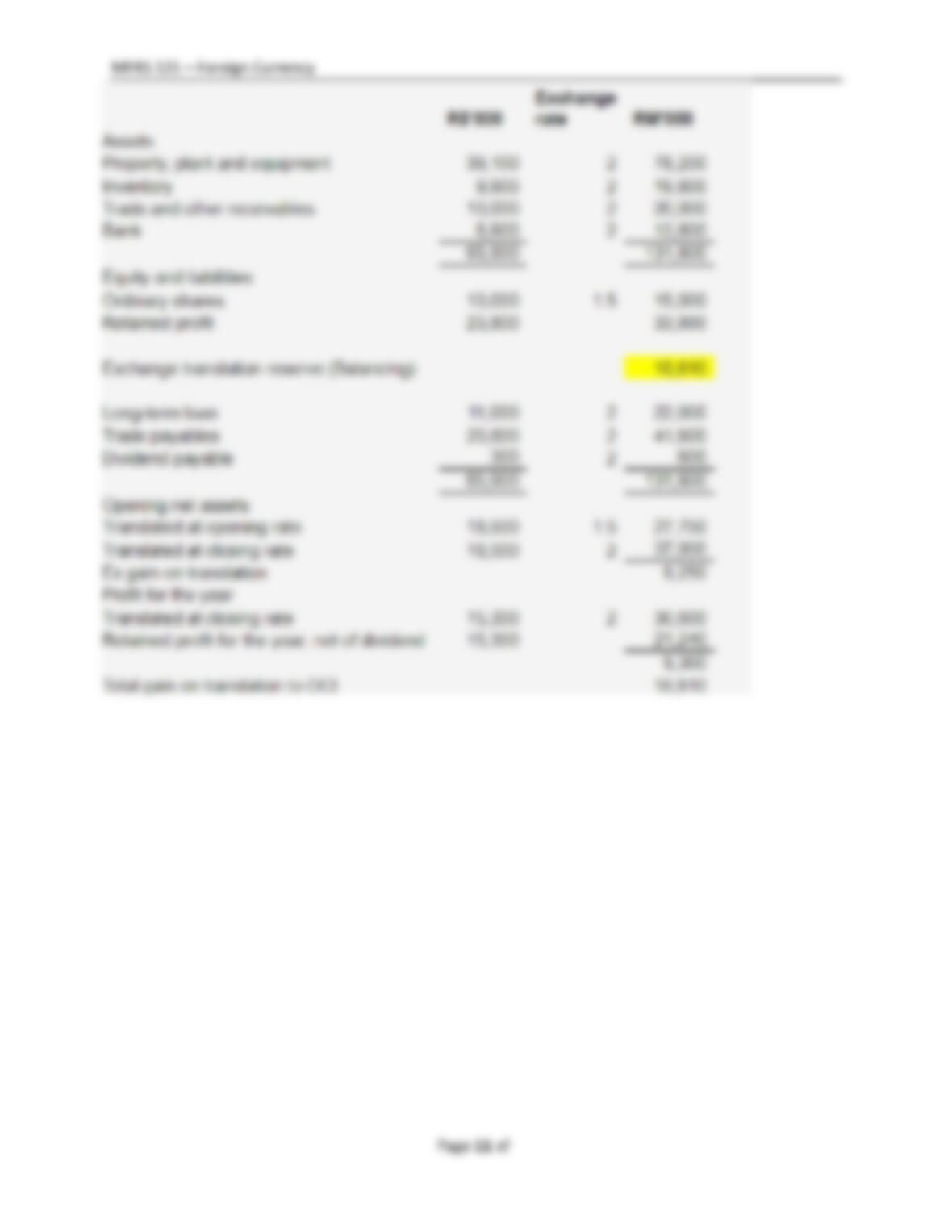
MFRS 121 – Foreign Currency
Page 1 of 5
NOTE: Q1-2 will not come out in final
Question 1
Wandrah Bhd is a multinational company located in Malaysia. It imports its material for
production from various ASEAN member countries. It sends its products to Indonesia for
assembly and reimports them back to Malaysia for worldwide distribution. All sales and
purchases are denominated in USD. It employees, however are paid in RM.
Explain what would be the functional currency for Wandrah Bhd.
Answer:
The functional currency for Wandrah Bhd could be Malaysian Ringgit, as the operational cost
are paid in this currency. Moreover, the products after assembly are reimported back to Malaysia
for worldwide distribution. In this case, the foreign operation is an extension of the Malaysian
reporting entity.
Though sales and purchases are denominated in the US dollar, it is assumed that the competitive
forces and regulations in Malaysia determine the sales price of the products. And if cash
collected from the sale of the products are remitted to Wandrah Bhd, then the functional currency
should be Malaysian Ringgit.
In situations where the functional currency is not so obvious because the indicators are mixed,
the management is required to use its judgement to determine the functional currency that most
faithfully represents the economic effects of the underlying transactions, events and conditions.
The management, however, has to give priority to the primary indicators before considering
other factors.
Question 2
Keluli Bhd is wholly- owned subsidiary of Estperth PLC, an Australian company. Keluli Bhd’s
principal activity is to produce chips for assemply by Estperth in Australia. All raw materials are
supplied by Estperth Plc. Keluli Bhd is not allowed to sell the computer chips to any other
company. The functional currency of Estperth is the Australian dollar.
Explain what would be the functional curreny for Keluli Bhd.

MFRS 121 – Foreign Currency
Page 2 of 5
Answer:
The functional currency for Keluli Bhd should be Australian dollar, as its principal activity is to
produce computer chips for assembly by Estperth Plc in Australia. Moreover, all raw materials
are supplied by Estperth Plc. Furthermore, Keluli Bhd is not allowed to sell the computer chip to
any other company. Thus, the degree of autonomy is with Estperth Plc.
Question 3
Gajus Berhad, whose functional currency is the Malaysian ringgit, borrowed BN$8,000,000 from
a bank in Brunei on 1 July 2020. The loan is repayable in full on 1 March 2021. Gajus Berhads
financial year ends on 31 December.
Spot rates are as follows:
1 July 2020 BN$1 = RM 2.00
31 December 2020 BN$1 = RM2.25
Required:
a) Explain how Gajus Berhad should recognise the loan.
Answer:
The loan is recognized as liability (foreign loan) , initially recognized at spot rate which
is the date the loan is received. Then, any outstanding loan is retranslated based on
closing rate existing at the end of reporting date. The exchange differences are recognized
in the P&L.
b) Prepare the journal entry to record the loan on 1 July 2020 and 31 December 2020.
Answer:
Dr Unrealized loss RM2,000,000
Cr Foreign Loan RM2,000,000
c) Explain the treatment of the difference on exchange.
Answer:
The exchange loss of RM2 million from translation of the loan (liability) is recognized in

MFRS 121 – Foreign Currency
Page 3 of 5
the P&L.
MFRS 121 – Foreign Currency
Question 4
Darusan Bhd has the Malaysian Ringgit as its functional currency and 31 December as it
financial year. On 1 February x5, it buys a building in Kuwait for KWD7,000,000 cash. The
useful life of the building is estimated to be 10 years. Darusan Bhd uses the cost model for all its
property, plant and equipment and straight line method for depreciation. A full year’s
depreciation is charged in the year of purchase and none in the year of disposal/
The spot exchange rates are as follows:
1 February x5 KWD1 = RM13.20
31 December x5 KWD1 = RM13.25
Required:
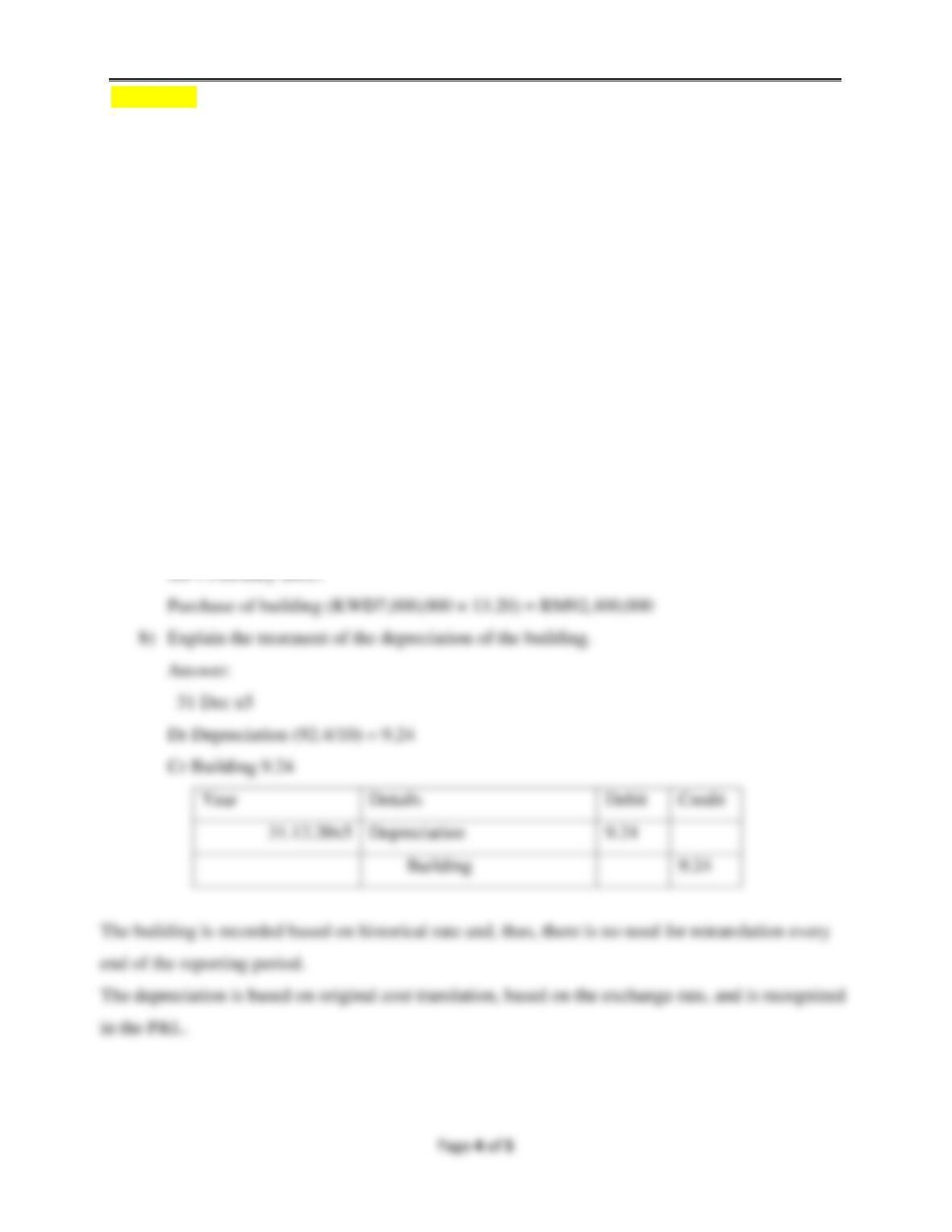
a) Show how you would recognised the building on 1 February x5 and 31 December x5 in
the books of Darusan.
Answer: