8-
1
CHAPTER 8
FLEXIBLE BUDGETS, OVERHEAD COST VARIANCES, AND
MANAGEMENT CONTROL
8-23 Variable manufacturing overhead variance analysis. The Sourdough Bread Company
bakes baguettes for distribution to upscale grocery stores. The company has two direct-cost
categories: direct materials and direct manufacturing labor. Variable manufacturing overhead is
allocated to products on the basis of standard direct manufacturing labor-hours. Following is
some budget data for the Sourdough Bread Company:
Direct manufacturing labor use
0.02 hours per baguette
Variable manufacturing overhead
$10.00 per direct manufacturing labor-hour
The Sourdough Bread Company provides the following additional data for the year ended
December 31, 2017:
Planned (budgeted) output
3,100,000 baguettes
Actual production
2,600,000 baguettes
Direct manufacturing labor
46,800 hours
Actual variable manufacturing overhead
$617,760
Required:
1. What is the denominator level used for allocating variable manufacturing overhead? (That is,
for how many direct manufacturing labor-hours is Sourdough Bread budgeting?)
2. Prepare a variance analysis of variable manufacturing overhead. Use Exhibit 8-4 (page 304)
for –reference.
3. Discuss the variances you have calculated and give possible explanations for them.
SOLUTION
(30 min.) Variable manufacturing overhead variance analysis.
1. Denominator level = (3,100,000 × 0.02 hours) = 62,000 hours
2.
Actual
Results
Flexible
Budget Amounts
1. Output units (baguettes)
2,600,000
2,600,000
2. Direct manufacturing labor-hours
46,800
52,000a
3. Labor-hours per output unit (2 1)
0.018
0.020
4. Variable manuf. overhead (MOH) costs
$617,760
$520,000
5. Variable MOH per labor-hour (4 2)
$13.20
$10
8-
2
6. Variable MOH per output unit (4 1)
$0.238
$0.200
a2,600,000 baguettes
0.02 hours per baguette = 52,000 hours
Variable Manufacturing Overhead Variance Analysis for Sourdough Bread Company for 2017:
Actual Costs
Incurred
Actual Input Qty.
× Actual Rate
(1)
Actual Input Qty.
× Budgeted Rate
(2)
Flexible Budget:
Budgeted Input Qty.
Allowed for
Actual Output
× Budgeted Rate
(3)
Allocated:
Budgeted Input Qty.
Allowed for
Actual Output
× Budgeted Rate
(4)
(46,800 × $13.20)
$617,760
(46,800 × $10)
$468,000
(52,000 × $10)
$520,000
(52,000 × $10)
$520,000
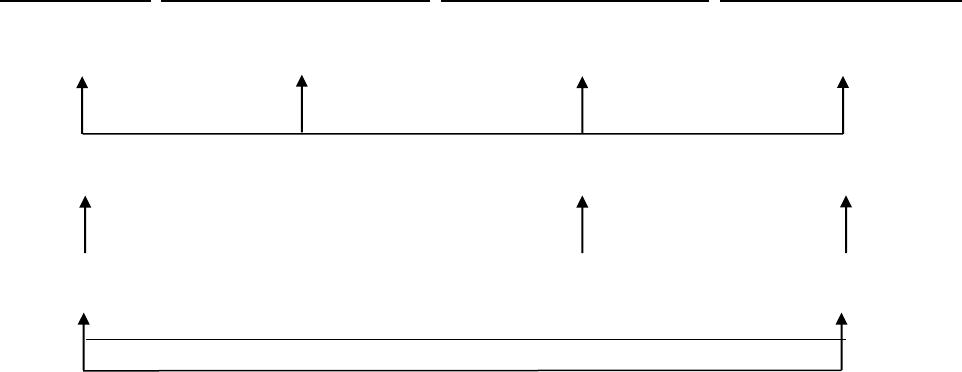
3. Spending variance of $149,760 U. It is unfavorable because variable manufacturing
overhead was 32% higher than planned. A possible explanation could be an increase in energy
rates relative to the rate per standard labor-hour assumed in the flexible budget.
Efficiency variance of $52,000 F. It is favorable because the actual number of direct
manufacturing labor-hours required was lower than the number of hours in the flexible budget.
Labor was more efficient in producing baguettes than management had anticipated in the budget.
This could occur because of improved morale in the company, which could result from an
increase in wages or an improvement in the compensation scheme.
Flexible-budget variance of $97,760 U. It is unfavorable because the favorable efficiency
variance was not sufficient to compensate for the large unfavorable spending variance.
8-24 Fixed manufacturing overhead variance analysis (continuation of 8-23). The
Sourdough Bread Company also allocates fixed manufacturing overhead to products on the basis
of standard direct manufacturing labor-hours. For 2017, fixed manufacturing overhead was
budgeted at $3.00 per direct manufacturing labor-hour. Actual fixed manufacturing overhead
incurred during the year was $294,000.
Required:
1. Prepare a variance analysis of fixed manufacturing overhead cost. Use Exhibit 8-4 (page 304)
as a guide.
2. Is fixed overhead underallocated or overallocated? By what amount?
3. Comment on your results. Discuss the variances and explain what may be driving them.
SOLUTION
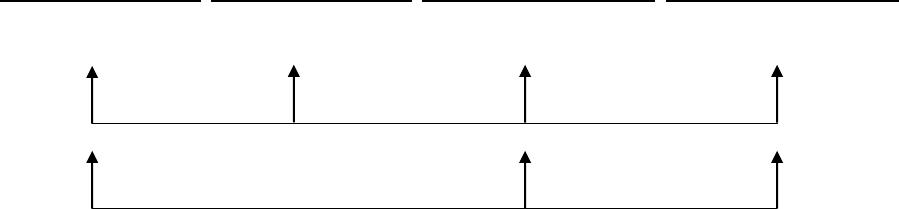
$149,760 U
Spending variance
$52,000 F
Efficiency variance
Never a variance
$97,760 U
Flexible-budget variance
Never a variance
8-
3
(30 min.) Fixed manufacturing overhead variance analysis (continuation of 8-23).
1. Budgeted standard direct manufacturing labor used = 0.02 per baguette
Budgeted output = 3,100,000 baguettes
Budgeted standard direct manufacturing labor-hours
= 3,100,000 × 0.02
= 62,000 hours
Budgeted fixed manufacturing overhead costs
= 62,000 × $3.00 per hour
= $186,000
Actual output = 2,600,000 baguettes
Allocated fixed manufacturing overhead
= 2,600,000 × 0.02 × $3
= $156,000
Fixed Manufacturing Overhead Variance Analysis for Sourdough Bread Company for 2017
Actual Costs
Incurred
(1)
Same Budgeted
Lump Sum
(as in Static Budget)
Regardless of
Output Level
(2)
Flexible Budget:
Same Budgeted
Lump Sum
(as in Static Budget)
Regardless of
Output Level
(3)
Allocated:
Budgeted Input Qty.
Allowed for
Actual Output
× Budgeted Rate
(4)
$294,000
$186,000
$186,000
(2,600,000 × 0.02 × $3)
$156,000
2. The fixed manufacturing overhead is underallocated by $138,000.
3. The production-volume variance of $30,000 U captures the difference between the
budgeted 3,100,0000 baguettes and the lower actual 2,600,000 baguettes produced—the
fixed cost capacity not used. The spending variance of $108,000 unfavorable means that
the actual aggregate spending on fixed costs ($294,000) exceeds the budgeted amount
$108,000 U
Spending variance
Never a variance
$30,000 U
Production-volume
variance
$108,000 U
Flexible-budget variance
$30,000 U
Production-volume
variance
$138,000 U
Underallocated fixed overhead
(Total fixed overhead variance)
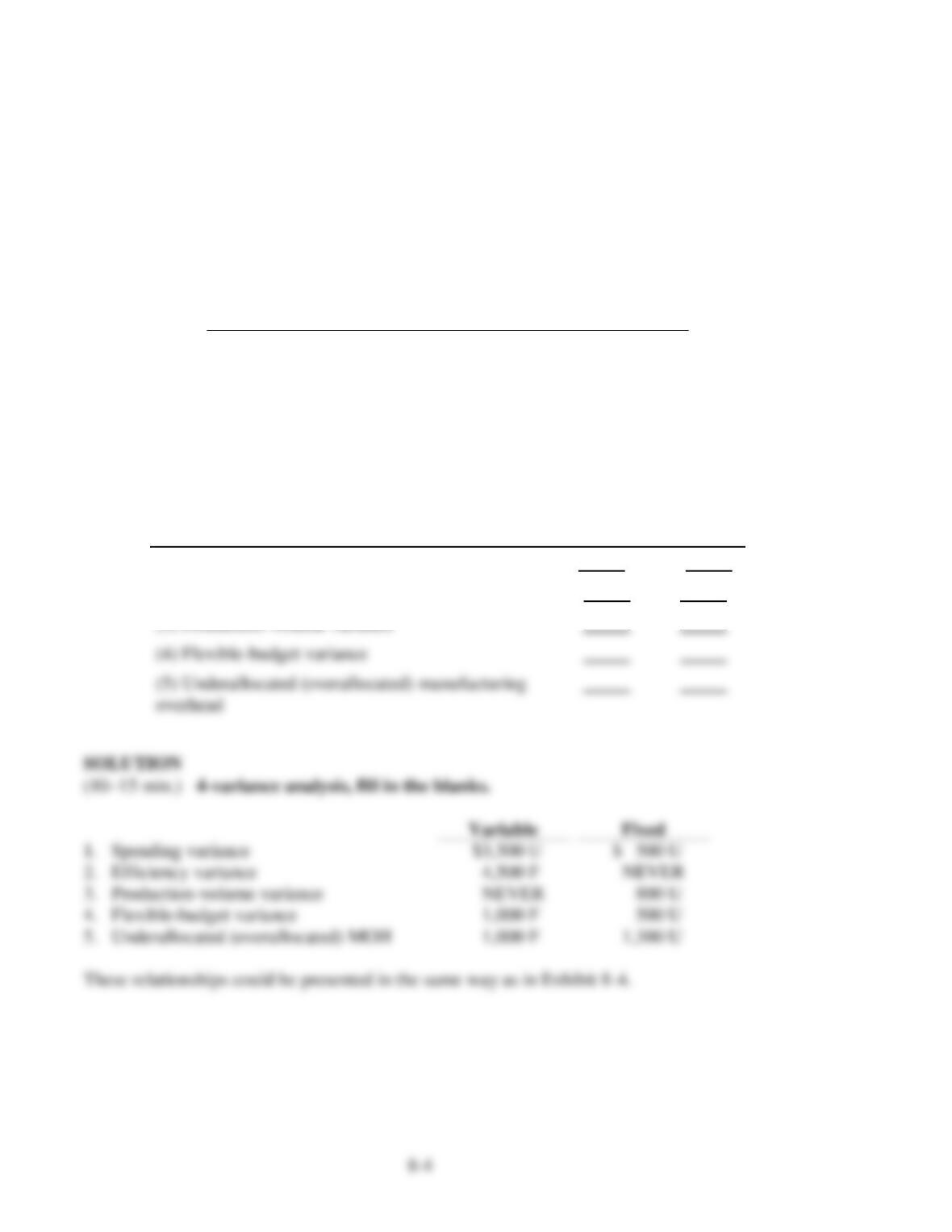
($186,000). For example, monthly leasing rates for baguette-making machines may have
increased above those in the budget for 2017.
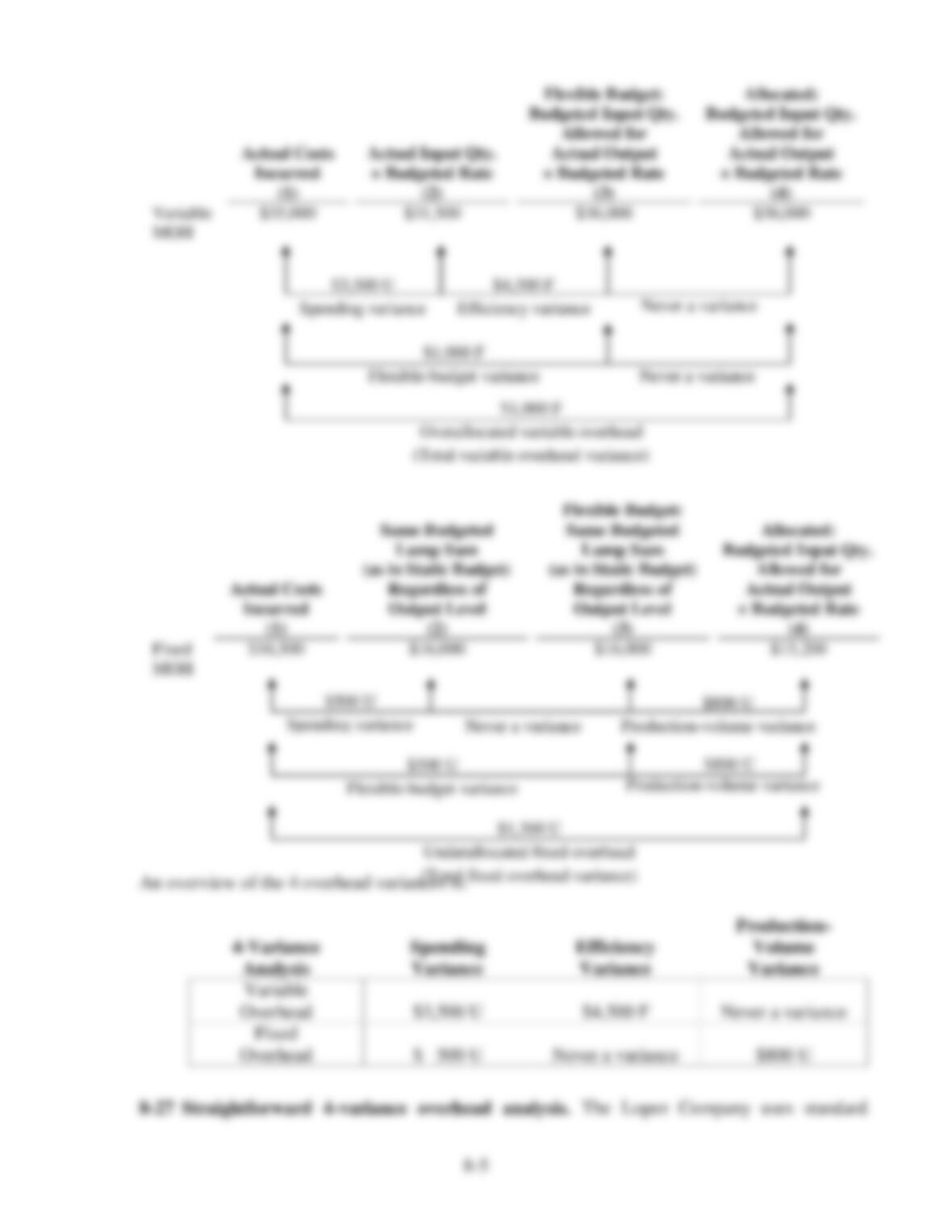
8-26 4-variance analysis, fill in the blanks. ProChem, Inc., produces chemicals for large
biotech companies. It has the following data for manufacturing overhead costs during August
2017:
Variable
Fixed
Actual costs incurred
$35,000
$16,500
Costs allocated to products
36,000
15,200
Flexible budget
––––––
16,000
Actual input × budgeted rate
31,500
––––––
Fill in the blanks. Use F for favorable and U for unfavorable:
Variable
Fixed
(1) Spending variance
$
$
(2) Efficiency variance
(3) Production-volume variance
(4) Flexible-budget variance
overhead
5. Underallocated (overallocated) MOH