A focused strategy can help colleges and universities reinvent
their industry and stop spending beyond their means
By Jeff Denneen and Tom Dretler
The fi nancially sustainable university
Copyright © 2012 Bain & Company, Inc. All rights reserved.
Jeff Denneen leads the Americas Higher Education practice for Bain & Company
and is a partner in the Atlanta offi ce. Tom Dretler is an executive in residence
with Sterling Partners and is board chair and co-founder of the Alliance for
Business Leadership.
The authors would like to thank Jeff Selingo for his contributions to the report.
Jeff Selingo frequently writes about higher education and is the author of the
forthcoming book College (Un)Bound: The Future of Higher Education and What
It Means for Students, due from Amazon Publishing/New Harvest in spring 2013.

The fi nancially sustainable university
1
Few industries in the United States have achieved
unquestioned global leadership as consistently and
effectively as our higher education system. US colleges
and universities are the cornerstone of our economic
prosperity and the key to realizing the American dream.
Thirty years of growth have confirmed the sector’s
leadership and vibrancy—the result of demographic
and economic factors combining to lift higher educa-
tion even higher.
Despite this success, talk of a higher education “bubble”
has reached a fever pitch in the last year. The numbers
are very familiar by now: Annual tuition increases several
times the rate of infl ation have become commonplace.
The volume of student loan debt has surpassed $1 trillion
and is now greater than credit card debt. Most college and
university presidents, as well as their boards, executive
teams and faculty members, are well aware that a host of
factors have made innovation and change necessary.
Still, at the majority of institutions, the pace of change is
slower than it needs to be. Plenty of hurdles exist, includ-
ing the belief that things will return to the way they always
were. (Note: They won’t.) But the biggest obstacle is more
fundamental: While leaders might have a sense of what
needs to be done, they may not know how to achieve the
required degree of change that will allow their institution
not just to survive, but also thrive with a focused strategy
and a sustainable fi nancial base.
Leading change is challenging in any organization. But
in higher education, it’s markedly more diffi cult. If the
stakes weren’t so high, incremental improvements might
be enough. But they aren’t, and that’s become abundantly
clear. Change is needed, and it’s needed now. What
follows is a road map for college and university presidents
and boards of trustees, explaining the scope and depth
of the situation, the key actions required and—most im-
portant—what it will take to succeed in leading change.
The liquidity crisis facing higher education
If you are the president of a college or university that is
not among the elites and does not have an endowment
in the billions, chances are cash is becoming increasingly
scarce—unless you’re among the most innovative.
The reason is simple: Approximately one-third of all
colleges and universities have fi nancial statements that
are signifi cantly weaker than they were several years
ago (s Figure 1).
On the balance sheet side, the equity ratio (equity as a per–
centage of assets) is down—sometimes way down.1 On the
income statement side, the expense ratio (expenses as a
percentage of revenue) is signifi cantly up.2 And, to make
matters worse, endowments have taken a major hit and are
not likely to see the type of year-over-year growth they were
accustomed to seeing in the decade before the recession.
The translation: Institutions have more liabilities, higher
debt service and increasing expense without the revenue
or the cash reserves to back them up.
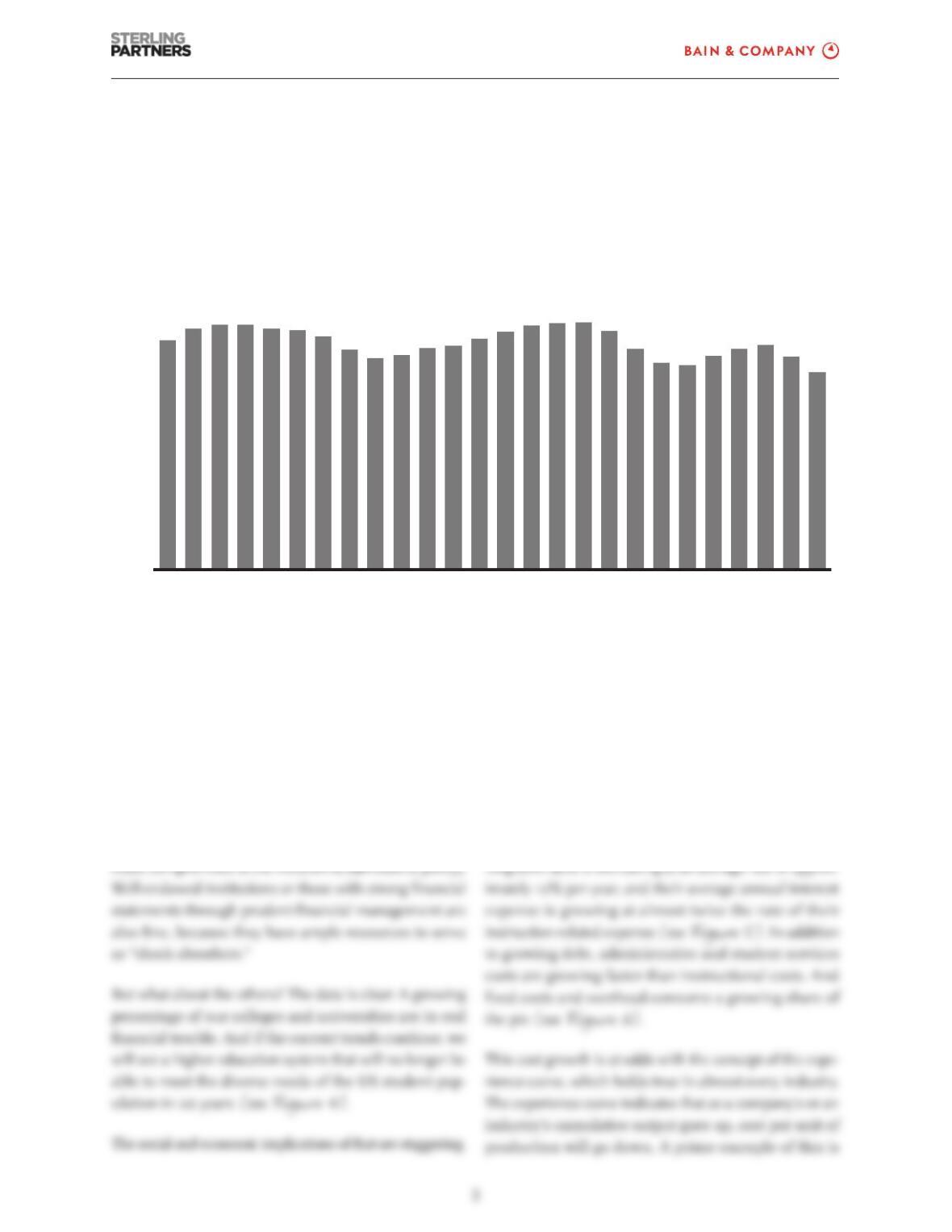
In the past, colleges and universities tackled this problem
by passing on additional costs to students and their
families, or by getting more support from state and
federal sources. Because those parties had the ability and
the willingness to pay, they did (s Figure 2). But the
recession has left families with stagnant incomes, sub-
stantially reduced home equity, smaller nest eggs and
anxiety about job security. Regardless of whether or not
families are willing to pay, they are no longer able to foot
the ever-increasing bill, and state and federal sources
can no longer make up the difference (s Figure 3).
Financial fade
Which schools are spending more than they
can afford? Explore the data in our interactive
graphic at www.thesustainableuniversity.com

2
The fi nancially sustainable university
Figure 1: Change in equity vs. expense ratios for US colleges and universities
Note: To see which schools are in each segment, go to www.thesustainableuniversity.com
Sources: Integrated Postsecondary Education Data System (IPEDS) 2006–2010; Bain & Company and Sterling Partners analysis
>5
0–5
<0
12% 9% 15%
13% 7% 9%
20% 7% 9%
<0 0–5 >5
Decrease in equity ratio (percentage points)
Increase in expense ratio (percentage points)
Figure 2: Higher education infl ation (2001–2010)
2001
23.2
$68,400
2010
37.7
$55,738
2002
26.9
$61,000
2003
28.6
$59,500
2004
30.3
$58,900
2005
31.5
$58,700
2006
31.5
$59,700
2007
29.7
$65,400
2008
33.2
$59,000
2009
35.8
$56,900
Average tuition as % of median earnings
0
10
20
30
40%
Median annual
earnings
Sources: US Bureau of Labor statistics (BLS); IPEDS; Bain & Company and Sterling Partners analysis
The fi nancially sustainable university
Figure 3: Educational appropriations per FTE, US (fi scal 1985–2010)
Educational appropriations per FTE (constant $)
Source: State Higher Education Executive Officers
1985
1986
1987
1988
1989
1990
1991
1992
1993
1994
1995
1996
1997
1998
1999
2000
2001
2002
2003
2004
2005
2006
2007
2008
2009
2010
0
2,000
4,000
6,000
8,000
10,000
Which institutions are at risk?
Presidents who want to give their institution a stress test
can simply refer to the list of questions provided in the
box on page 7 (s sidebar). From a fi nancial perspec-
tive, highly selective institutions don’t need to worry
because they possess pricing power (although they may
be concerned that their mission will suffer if they must
Reversing the “Law of More”
Much of the liquidity crisis facing higher education comes
from having succumbed to the “Law of More.” Many
institutions have operated on the assumption that the
more they build, spend, diversify and expand, the more
they will persist and prosper. But instead, the opposite has
happened: Institutions have become overleveraged. Their