Financial Markets and Institutions
Ninth Edition, Global Edition
Chapter 19
Banking Industry: Structure
and Competition
Copyright © 2018 Pearson Education, Ltd. All Rights Reserved.

Copyright © 2018 Pearson Education, Ltd. All Rights Reserved.
Chapter Preview (1 of 3)
In the U.S., about 6,000 commercial banks serving the
businesses and consumer’s needs. This puts the U.S. in a
class by itself. In most other developed nations, only a
handful of banks dominate the landscape.
But is this better?

Copyright © 2018 Pearson Education, Ltd. All Rights Reserved.
Chapter Preview (2 of 3)
Indeed there are many questions we can ask. Why did the
U.S. banking system develop this way? Does this mean
there is more competition? We try to answer these questions
in this chapter.

Copyright © 2018 Pearson Education, Ltd. All Rights Reserved.
Chapter Preview (3 of 3)
Topics include:
–Historical Development of the Banking System
–Financial Innovation and the Growth of the Shadow
Banking System
–Structure of the U.S. Banking Industry
–Bank Consolidation and Nationwide Banking
–Separation of Banking and Other Financial Service
Industries
–Thrift Industry
–International Banking

Copyright © 2018 Pearson Education, Ltd. All Rights Reserved.
Historical Development of the Banking
Industry (1 of 4)
•The modern commercial banking industry began when the
Bank of North America was chartered in Philadelphia in
1782.
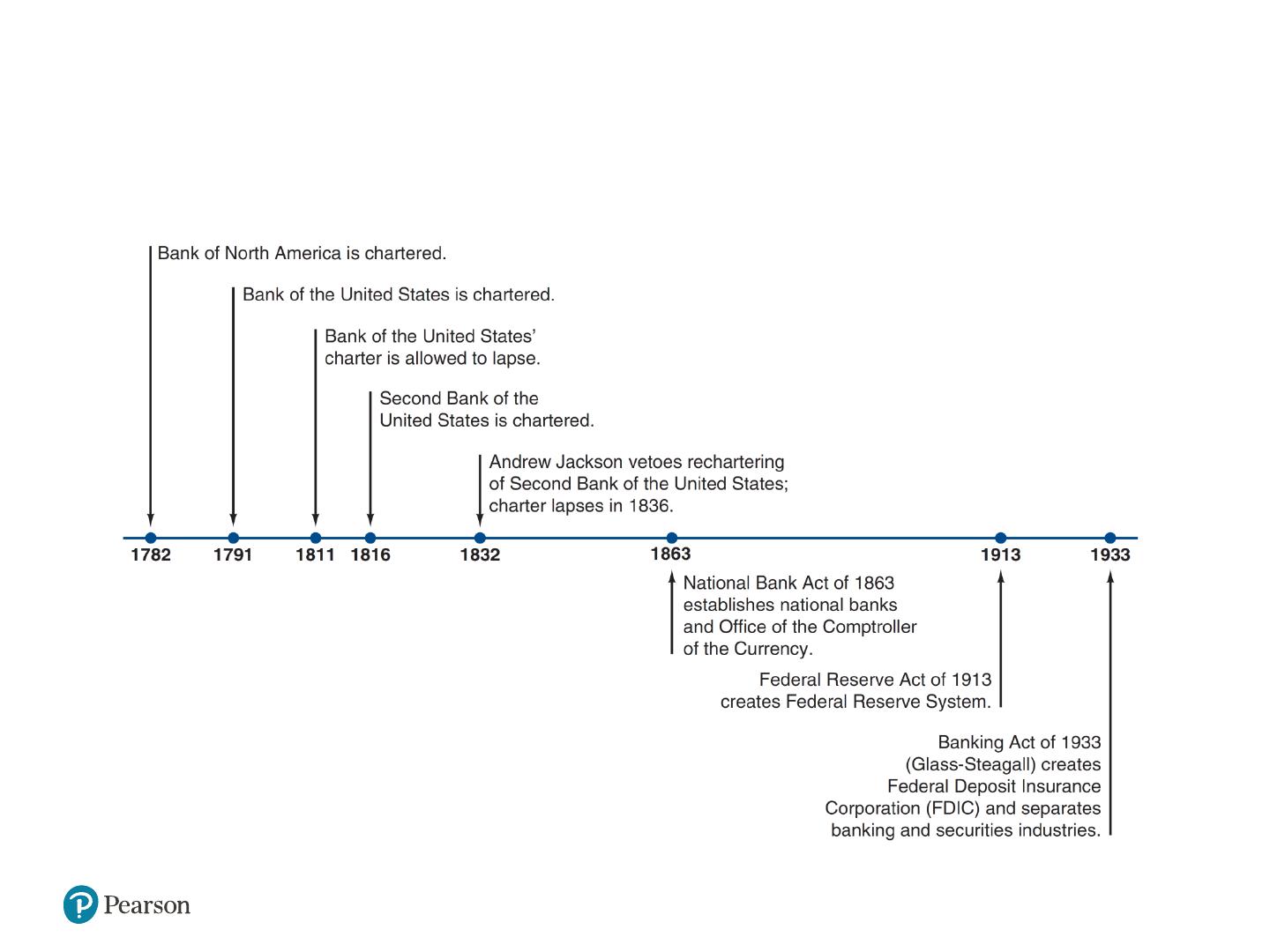
•The next slide provides a timeline of important dates in the
history of U.S. banking prior to WWII.
Copyright © 2018 Pearson Education, Ltd. All Rights Reserved.
Figure 19.1 Time Line of the Early History of Commercial
Banking in the United States

Copyright © 2018 Pearson Education, Ltd. All Rights Reserved.
Historical Development of the Banking
Industry (2 of 4)
•There are also some major events post–1933
–In 1999, Glass-Steagall was repealed. Commercial
banks now engaged again in securities activities.

Copyright © 2018 Pearson Education, Ltd. All Rights Reserved.
Historical Development of the Banking
Industry (3 of 4)
•The history had one other significant outcome: Multiple
Regulatory Agencies
1. Federal Reserve
2. FDIC
3. Office of the Comptroller of the Currency
4. State Banking Authorities

Copyright © 2018 Pearson Education, Ltd. All Rights Reserved.
Historical Development of the Banking
Industry (4 of 4)
•The U.S. Treasury has proposed legislation to centralize
the regulation of depository institutions under one
independent agency, but it hasn’t survived the scrutiny of
Congress.

Copyright © 2018 Pearson Education, Ltd. All Rights Reserved.
Financial Innovation and the Growth of the
Shadow Banking System
•In recent years the traditional banking business of making
loans that are funded by deposits has been in decline.
•Some of this business has been replaced by the shadow
banking system, in which bank lending has been
replaced by lending via the securities market.

Copyright © 2018 Pearson Education, Ltd. All Rights Reserved.
Financial Innovation (1 of 3)
•Innovation is result of search for profits. A change in the
financial environment will stimulate a search for new
products and ideas that are likely to increase the bottom
line.
•There are generally three types of changes we can
examine:
–Response to Changes in Demand Conditions
–Response to Changes in Supply Conditions
–Avoidance of Existing Regulation
Financial Innovation (2 of 3)
•Response to Changes in Demand Conditions
–Major change is huge increase in interest-rate risk
starting in 1960s
–Adjustable-Rate Mortgages are an example of the reply