[GROUP 2] Macroeconomic Essay
Describe the progress of the nancial crisis in US in 2008 and explain
the main causes of and eects of this crisis on the economy .
————o0o—–—–
I. Introduction:
II. Analysis:
1. The progress of the financial crisis:
2. The causes of the financial crisis:
3. The consequences of the financial crisis:
a. The effects on the real economy:
b. The effects on the financial system:
c. A lost decade in housing:
d. Income:
e. Stock Values:
f. Jobs:
4. The Policies and Responses:
a. U.S:
b. The World:
III. Conclusion:
————–o0o————-
I. Introduction:
Financial crisis is not an unfamiliar definition with the world of economic. We have to
accept its existence as an inevitable part of the Business Cycle. Economies over the world have
suffered plenty of financial crises in the last century and in the very first years of this one. From
the Great Depression (1930s) in U.S, the Secondary Banking Crisis (1970s) in U.K to the India
Crisis (1991) and the Asian Crisis (1997), there is no exception.
United States, the current biggest economy in the World, is recovering from, maybe, the
worst crisis since the 1930s Great Depression. A series of word such as housing bubble, real
estate price, subprime lending or easy credit conditions could be highlighted when U.S crisis is
mentioned. When the costs of it are still yet evaluated in U.S, the crisis has change the global
landscape of finance, which means The Global Recession.
This paper’s purposes are to consider the causes and consequences of the U.S financial
crisis in 2008 and to explore the efforts of the World trying to get out of the crisis.
II. Analysis:
1. The progress of the financial crisis:
Mainly focusing the period from 2007 to 2008, the U.S financial crisis was triggered
through 5 years, 2001 to 2006. In 2001, despite having withstood terrorist attack (11-9 event), the
U.S economy suffered a short-lived recession by the dotcom bubble and accounting scandals,
which directly affect the residents’ faith. To stimulate the consumption and escape from the
recession, the Federal Reserve (FED) had to lower their fund rate 11 times-from 6.5% in May
2000 to 1.75% in December 2001. In June 2003, the FED minimized the interest rate at 1%, the
lowest level in 45 years. Due to this alarming rate, the investment and consumption seemed easy
and no longer then, the economy faced to more serious problems, the “housing bubble”. An
increasing number of people who had no money and no job even were able to acquire easily
house by subprime mortgage loans. To the mid of 2006, in order to avoid an inflation, the FED
started raising rates at 5.25% (which remained unchanged to August 2007). The “housing
bubble”, at that time, hardly suffers from being broken due to illiquidity. From then on, the
financial crisis officially began to spread out the whole U.S economy.
At the end of 2007, the U.S financial banking system already experienced the worst crisis
since the Great Depression of 1930s. Hundreds of billions dollars have gone away and this crisis
seemed not to stop with unpredictably enormous results.
It became classified that financial banks were unable to cope with subprime crisis and the
phenomenon spread out of U.S to the whole world. The interbank had frozen immediately. Some
credit organization, including New Century Financial Corporation filed for bankruptcy. In
addition, the immediate withdrawal money from banks of borrowers also made it more serious.
As a consequence, more and more banks and corporation were on the verge of bankruptcy.
Therefore, central banks and government had started coming together to find the best solution to
this catastrophe.
The table below is the list of financial institutions that were badly affected in the crisis:
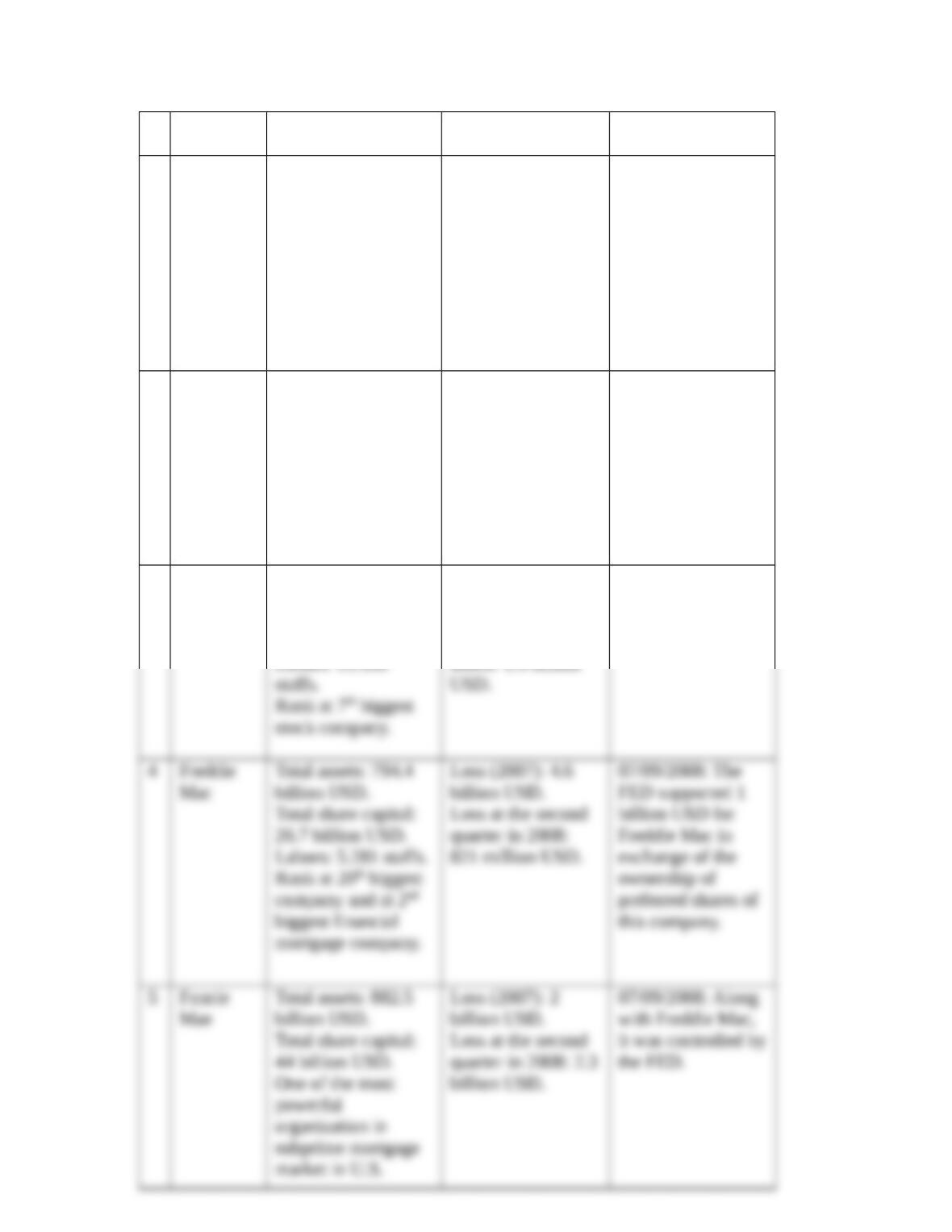
Corporati
ons
Scale Damages Solutions
1. Lehman
Brothers
Total assets: 639
billion USD.
Total share capital:
22490 billion USD.
Labors: 26200 staffs.
One of four biggest
investment banks in
U.S.
Bonds liability: 155
billion USD.
Stocks lose their
price over 90% on
15/09/2008.
15/09/2008: File
for bankruptcy.
It was the biggest
bankruptcy in U.S
history.
2. Merrill
Lynch
Total assets: 1002
billion USD.
Labors: 60000 staffs.
Rank at 32nd at
Global 2000.
Loss at the final
quarter in 2007:
9.83 billion USD.
Net loss at the first
quarter in 2008:
1.97 billion USD.
Loss at cost of
assets: 16.7 billion
USD.
Sold for Bank of
America (BoA) at
the price of 50
billion USD.
3. Bear
Stearns.
Total assets: 350.4
billion USD.
Total share capital:
66.7 billion USD.
Loss at the final
quarter in 2007:
859 million USD.
Loss at cost of
30/05/2008: Sold
for JP Morgan
Chase at the price
of 1.1 billion USD.