PAGE 1
10/16-1
FINANCIAL ACCOUNTING AND REPORTING
ACCOUNTING PROCESS
Steps in the Accounting Cycle – There are 9 basic steps in the accounting cycle, which includes 2
phases known as recording and summarizing.
RECORDING PHASE
1. Analyzing the transaction (business document)– This is where the accountant gathers
information from source documents and determines the impact of the transaction on the financial
position as represented by the equation “assets equals liabilities plus equity”.
2. Journalizing – This is the process of recording the transactions in the appropriate journals. A
journal is a chronological record of transactions also known as the book of original entry.
Although all transactions could be recorded in the general journal, it is more efficient to use
special journals in recording a large number of like transactions. Special journals that enterprises
usually use are:
1. Sales Journal – Only sales of merchandise on account are recorded.
2. Cash receipts journal – All types of cash receipts are recorded.
3. Purchase journal – Used to record all purchases on account (merchandise, equipment
and supplies).
4. Cash disbursement journal – All payments of cash for any purpose are recorded.
Type of journal entries according to form:
1. Simple journal entry – One which contains a single debit and a single credit element.
2. Compound journal entry – One which has two or more elements and often representing
two or more transactions.
Accounts are the storage units of accounting information and used to summarize changes in
assets, liabilities and equity including income and expenses. The following are a broad
classification of kinds of accounts:
1. Real account – Statement of financial position or so called permanent accounts. These
accounts are not closed and carryover to the next accounting period. (ex. Cash, AR and
PPE)
2. Nominal account – Income statement or temporary capital accounts. These accounts are
closed at the end of the accounting period. (ex. Sales and expenses)
3. Mixed account – A combination of real and nominal accounts. (ex. Prepaid expenses)
4. Clearing account – Holds temporarily certain information pending transfer to other ledger
accounts.
5. Controlling account – The general ledger account that summarizes the detailed information
in a subsidiary ledger.
6. Suspense account – Is an account that holds temporarily certain information pending for
disposition.
7. Reciprocal account – Has a counterpart in another book with in the entity or in another
ledger or another entity.
8. Principal account – An account that is independent or can stand alone.
9. Auxiliary account – An account that cannot stand alone and are technically neither assets,
liabilities nor income and expenses.
10. Summary account
3. Posting – It is the process of transferring data from the journal to the appropriate accounts in the
general ledger and subsidiary ledger. This process classifies all accounts that were recorded in
the journals.
Kinds of ledgers
1. General ledger – Includes all the accounts appearing on the financial statements.
2. Subsidiary ledgers – Affords additional detail in support of certain general ledger accounts.

PAGE 2
10/16-1
SUMMARIZING PHASE
4. Preparing the unadjusted trial balance – A list of general ledger accounts with their respective
debit or credit balance. The purpose of the unadjusted trial balance is to provide evidence that
the total debits in the general ledger equal the total credits and prepares the accounts for
adjustments.
5. Preparing adjusting entries – To take up accruals, expiration of prepayments and deferrals,
estimations and other events often not signaled by new source documents. Adjusting entries are
made at the end of each accounting period. The concepts involved behind adjusting entries are
ACCRUAL, MATCHING OF COSTS AGAINST REVENUE and ACCOUNTING PERIOD.
Typical Adjusting Entries classified according to timing of cash flow.
1. Prepayments and Deferrals – The cash flow precedes the revenue or the expense
recognition.
Prepaid Expenses
Asset Method Expense Method
Prepaid expense (asset) xx Expense xx
Cash xx Cash xx
Adjustment:
Expense xx Prepaid expense (asset) xx
Prepaid expense xx Expense xx
Deferred or Unearned Revenue
Liability Method Income Method
Cash xx Cash xx
Unearned Income (liab.) xx Income xx
Adjustment:
Unearned Income xx Income xx
Income xx Unearned Income (liab.) xx
2. Accruals – Income or expense recognition precedes the cash flow.
a. Accrued Income – Income earned but not yet received. A receivable is always debited
and income is recognized (credited)
b. Accrued expenses – Expenses incurred but not yet paid. An expense is recognized
(debited) and a liability is always credited.
3. Estimates – Adjusting entries that do not involve cash flows.
a. Doubtful accounts – The expense to be matched against credit sales.
b. Depreciation – Allocation of the cost of fixed assets as expense over its useful life
4. Ending inventory – An adjustment to set up the year-end physical count of the inventory.
This only applies if the PERIODIC INVENTORY SYSTEM IS USED.
6. Preparing the financial statements – The most important part of the summarizing phase, this is
where the processed information is communicated to external users.
Basic financial statements
a. Statement of financial position
b. Income statement or a statement of comprehensive income
c. Statement of changes in equity
d. Statement of cash flows
e. Notes and disclosures

PAGE 3
10/16-1
7. Preparing the closing entries – Recorded and posted for the purpose of closing all nominal or
temporary accounts to the income summary account and the resulting net income or loss is
afterwards closed to the capital or retained earnings account.
8. Preparing the post closing trial balance – A listing of general ledger accounts and their
balances after closing entries have been made. The post closing trial balance is the same with
the year-end statement of financial position, the only difference is that valuation accounts like
allowances for assets are found in the credit side instead of being deducted from the related
asset account.
9. Preparing reversing entries – The last and optional step in the accounting cycle. Reversing
entries are made at the beginning of the new accounting period to reverse certain adjusting
entries from the succeeding accounting period.
The purpose of reversing entries is a matter of convenience for accruals and consistency for the
adjustments in the following year for prepaid expenses and deferred income when the income
statement method was used to record the cash flow.
Once again, reversing entries will only apply to the following but remember that they are not
necessary and only optional:
1. Accrued income
2. Accrued expense
3. Prepaid expense, only if the expense method was used in recording the payment
4. Unearned income, only if the income method was used in recording the collection
Accrued Income Prepaid expense (Exp. Method)
12 mos. rental at 100 per month beginning
Nov. 1, 2016.
18 mos. rental at 100 per month beginning
Nov. 1, 2016
12/31/16 Adjustment: 11/1/2016
Rent Receivable 200 Rent Expense 1,800
Rent Income 200 Cash 1,800
1/1/2017 Reversing entry: 12/31/2016 Adjustment:
Rent Income 200 Prepaid Rent 1,600
Rent Receivable 200 Rent Expense 1,600
After the reversal, the rent receivable account
will have a balance of ZERO and the rent
income account will have a DEBIT balance of
200. Hence the collection of 1,200 will be
recorded as follows:
The adjustment under the expense method will
be for the unused portion or the prepayment of
1,600. If the asset method was used, the
adjustment would have been for 200 or the
portion for the expense.
10/31/2017 1/1/2017 Reversing entry:
Cash 1,200 Rent Expense 1,600
Rent Income 1,200 Prepaid Rent 1,600
After the reversing entry, the 1600 is once
again expensed and the 12/31/2017 adjusting
entry will be as follows:
Prepaid rent 400
Rent Expense 400
If the reversing entry was not prepared, the
adjustment would have been a debit to Rent
expense and credit to prepaid rent for 1,200
which is the adjustment used if the ASSET
METHOD was used.
END

PAGE 1
10/16-2
FINANCIAL ACCOUNTING AND REPORTING
The Conceptual Framework for Financial Reporting
PURPOSE AND STATUS OF THE FRAMEWORK
The IASB Framework for the Preparation and Presentation of Financial Statements describes the
basic concepts by which financial statements are prepared. The Framework serves as a guide to
the FRSC in developing accounting standards and as a guide to resolving accounting issues that
are not addressed directly in Philippine Accounting Standards or Philippine Financial Reporting
Standards or Interpretations. The purpose of the framework as outlined is to:
a) To assist the Board in the development of future IFRSs and in its review of existing
IFRSs
b) To assist the Board in promoting harmonisation of regulations, accounting standards
and procedures relating to the presentation of financial statements by providing a
basis for reducing the number of alternative accounting treatments permitted by
IFRSs
c) To assist national standard-setting bodies in developing national standards;
d) To assist preparers of financial statements in applying IFRSs and in dealing with
topics that have yet to form the subject of an IFRS
e) To assist auditors in forming an opinion on whether financial statements comply with
IFRSs
f) To assist users of financial statements in interpreting the information contained in
financial statements prepared in compliance with IFRSs
g) To provide those who are interested in the work of the IASB with information about
its approach to the formulation of IFRSs.
This Conceptual Framework is not an IFRS and hence does not define standards for any particular
measurement or disclosure issue.
Scope of the Framework:
The Objective of general purpose financial reporting;
Qualitative characteristics of financial information
Underlying assumption
The definition, recognition and measurement of the elements of the financial
statements
Concepts of capital and capital maintenance.
The Objective of Financial Reporting
The objective of general purpose financial reporting is to provide financial information about
the reporting entity that is useful to existing and potential investors, lenders and other
creditors in making decisions about providing resources to the entity. Those decisions
involve buying, selling or holding equity and debt instruments, and providing or settling
loans and other forms of credit.
General purpose financial reports provide information about the financial position of a
reporting entity, which is information about the entity’s economic resources and the claims
against the reporting entity. Financial reports also provide information about the effects of
transactions and other events that change reporting entity’s economic resources and
claims.
Financial performance reflected by accrual accounting
Accrual accounting depicts the effects of transactions and other events and circumstances on a
reporting entity’s economic resources and claims in the periods in which those effects occur, even
if the resulting cash receipts and payments occur in a different period.
Qualitative Characteristics of Useful Financial Information

PAGE 2
10/16-2
These characteristics are the attributes that make the information in financial statements
useful to investors, creditors, and others. The Framework identifies “fundamental” and
“enhancing” qualitative characteristics:
Fundamental Characteristics
Relevance – Information in financial statements is relevant when it is capable of making a
difference in the decisions made by the users.
Ingredients of relevance:
Predictive Value – Information can help users increase the likelihood of correctly predicting
or forecasting the outcome of certain events.
Feedback Value – Information can help users confirm or correct earlier expectations.
Note that the predictive and confirmatory roles of information are interrelated.
Materiality – Information is material if omitting it or misstating it could influence decisions that users make on the basis of
financial information about a specific reporting entity. In other words, materiality is an entity-specific aspect of relevance
based on the nature or magnitude, or both, of the items to which the information relates in the context of an individual
entity’s financial report.
Faithful Representation – Financial reports represent economic phenomena in words and
numbers. To be useful, financial information must not only represent relevant phenomena, but it
must also faithfully represent the phenomena that it purports to represent.
Ingredients of Faithful Representation
Complete – A complete depiction includes all information necessary for a user to
understand the phenomenon being depicted, including all necessary descriptions and
explanations.
Neutral – A neutral depiction is without bias in the selection or presentation of financial
information. A neutral depiction is not slanted, weighted, emphasised, de-emphasised or
otherwise manipulated to increase the probability that financial information will be received
favourably or unfavourably by users
Free from error means there are no errors or omissions in the description of the
phenomenon, and the process used to produce the reported information has been selected
and applied with no errors in the process.
Enhancing qualitative characteristics
Comparability, verifiability, timeliness and understandability are qualitative characteristics that
enhance the usefulness of information that is relevant and faithfully represented.
Comparability is the qualitative characteristic that enables users to identify and understand
similarities in, and differences among, items.
Verifiability – helps assure users that information faithfully represents the economic
phenomena it purports to represent. Verifiability means that different knowledgeable and
independent observers could reach consensus, although not necessarily complete
agreement, that a particular depiction is a faithful representation.
Timeliness – means having information available to decision-makers in time to be capable
of influencing their decisions.
Understandability – Classifying, characterising and presenting information clearly and
concisely makes it understandable.
The cost constraint on useful financial reporting
Cost is a pervasive constraint on the information that can be provided by financial reporting.
Reporting financial information imposes costs, and it is important that those costs are justified by
the benefits of reporting that information. There are several types of costs and benefits to consider.
Underlying Assumptions (Postulates)

PAGE 3
10/16-2
The Framework sets Going Concern as the only underlying assumption meaning, financial
statements presume that an enterprise will continue in operation indefinitely or, if that presumption
is not valid, disclosure and a different basis of reporting are required.
The new FRSC conceptual framework mentions going concern as the only underlying assumption
(previously Accrual was included). However, it is widely believed that inherent traits of the
financial statements are the basic assumptions of:
Accounting Entity. The business is separate from the owners, managers, and employees
who constitute the business. Therefore transactions of the said individuals should not be
included as transactions of the business.
Time Period. Financial reports are to be prepared for one year or a period of twelve
months.
Monetary unit. There are two aspects under this assumption
a. Quantifiability of the peso, meaning that the elements of the financial statements
should be stated under one unit of measure which is the Philippine Peso.
b. Stability of the peso, means that there is still an assumption that the purchasing power
of the peso is stable or constant and that instability is insignificant and therefore
ignored.
The Elements of Financial Statements
Financial statements portray the financial effects of transactions and other events by grouping
them into broad classes according to their economic characteristics. These broad classes are
termed the elements of financial statements.
The elements directly related to financial position and their definition according to the
framework are:
Asset- A resource controlled by the enterprise as a result of past events and from which
future economic benefits are expected to flow to the enterprise.
Liability- A present obligation of the enterprise arising from past events, the settlement of
which is expected to result in an outflow from the enterprise of resources embodying
economic benefits.
Equity- The residual interest in the assets of the enterprise after deducting all its liabilities.
The elements directly related to performance and their definition according to the framework
are:
Income- Increases in economic benefits during the accounting period in the form of inflows
or enhancements of assets or decreases of liabilities that result in increases in equity, other
than those relating to contributions from equity participants.
Expense- Decreases in economic benefits during the accounting period in the form of
outflows or depletions of assets or incurrence of liabilities that result in decreases in equity,
other than those relating to distributions to equity participants.
Recognition of the Elements of Financial Statements
Recognition is the process of incorporating in the financial statements an item that meets the
definition of an element and satisfies the following criteria for recognition:
It is probable that any future economic benefit associated with the item will flow to or
from the enterprise; and
The item’s cost or value can be measured with reliability.
Based on these general criteria:

PAGE 4
10/16-2
An asset is recognized in the statement of financial position when it is probable that the
future economic benefits will flow to the enterprise and the asset has a cost or value that
can be measured reliably.
A liability is recognized in the statement of financial position when it is probable that an
outflow of resources embodying economic benefits will result from the settlement of a
present obligation and the amount at which the settlement will take place can be measured
reliably.
Income is recognized in the when an increase in future economic benefits related to an
increase in an asset or a decrease of a liability has arisen that can be measured reliably.
This means, in effect, that recognition of income occurs simultaneously with the recognition
of increases in assets or decreases in liabilities
Expenses are recognized when a decrease in future economic benefits related to a
decrease in an asset or an increase of a liability has arisen that can be measured reliably.
This means, in effect, that recognition of expenses occurs simultaneously with the
recognition of an increase in liabilities or a decrease in assets.
Measurement of the Elements of Financial Statements
Measurement involves assigning monetary amounts at which the elements of the financial
statements are to be recognized and reported. The Framework acknowledges that a variety of
measurement bases are used today to different degrees and in varying combinations in financial
statements, including:
Historical cost
Current cost
Net realizable (settlement) value
Present value (discounted)
Historical cost is the measurement basis most commonly used today, but it is usually combined
with other measurement bases. The Framework does not include concepts or principles for
selecting which measurement basis should be used for particular elements of financial statements
or in particular circumstances. The qualitative characteristics do provide some guidance in this
matter.
Concepts of Capital
Financial concept of capital – capital is synonymous with net assets of the enterprise.
This is the concept of capital adopted by most enterprises. A financial concept of capital,
e.g. invested money or invested purchasing power, means capital is the net assets or
equity of the entity.
Physical concept of capital – capital is regarded as the productive capacity of the
enterprise based on, for example, units of output per day.
Concepts of Capital Maintenance
Financial capital maintenance – Under this concept, a profit is earned only if the financial
(or money) amount of the net assets at the end of the of the period exceeds the financial (or
money) amount of the net assets at the beginning of the period, after excluding any
distributions to, and contributions from, owners during the period.
Physical capital maintenance – Under this concept, a profit is earned only if the physical
productive capacity (or operating capability) of the enterprise (or the resources need to
achieve that capacity) at the end of the period exceeds the physical productive capacity at
the beginning of the period, after excluding any distributions to, and contributions from,
owners during the period.
– – END – –

PAGE 1
10/16-5
Presentation of Financial Statements (PAS 1)
Objective
Prescribe the basis for presentation of general purpose financial statements, to ensure
comparability both with the entity’s financial statements of previous periods and with the
financial statements of other entities.
Overall framework and responsibilities for the presentation of financial statements.
Guidelines for their structure and minimum requirements for the content of the financial
statements.
Standards for recognizing, measuring, and disclosing specific transactions are addressed in
other Standards and Interpretations.
Scope
Applies to all general purpose financial statements, that are based on Philippine Financial
Reporting Standards.
General purpose financial statements are those intended to serve users who do not have
the authority to demand financial reports tailored for their own needs.
Purpose of Financial Statements
The objective of general purpose financial statements is to provide information about the financial
position, financial performance, and cash flows of an entity that is useful to a wide range of users in
making economic decisions. To meet that objective, financial statements provide information about
an entity’s:
Assets.
Liabilities.
Equity.
Income and expenses, including gains and losses.
Other changes in equity.
Cash flows.
That information, along with other information in the notes, assists users of financial statements in
predicting the entity’s future cash flows and, in particular, their timing and certainty.
Components of Financial Statements – A complete set of financial statements comprises:
1) A statement of financial position as at the end of the period
2) A statement of comprehensive income for the period
3) A statement of changes in equity for the period
4) A statement of cash flows for the period
5) Notes, comprising a summary of significant accounting policies and other explanatory
information
6) A statement of financial position as at the beginning of the earliest comparative period
when an entity applies an accounting policy retrospectively or makes a retrospective
restatement of items in its financial statements, or when it reclassifies items in its
financial statements.
Overall Considerations for Statement Presentation
Fair Presentation and Compliance with PFRSs
The financial statements must “present fairly” the financial position, financial performance and cash
flows of an entity. Fair presentation requires the faithful representation of the effects of
transactions, other events, and conditions in accordance with the definitions and recognition
criteria for assets, liabilities, income and expenses set out in the Framework. The application of
PFRSs, with additional disclosure when necessary, is presumed to result in financial statements
that achieve a fair presentation.
PAS 1 requires that an entity whose financial statements comply with PFRSs make an explicit
and unreserved statement of such compliance in the notes. Financial statements shall not be
described as complying with PFRSs unless they comply with all the requirements of PFRSs.

PAGE 2
10/16-5
Inappropriate accounting policies are not rectified either by disclosure of the accounting policies
used or by notes or explanatory material.
PAS 1 acknowledges that, in extremely rare circumstances, management may conclude that
compliance with an PFRS requirement would be so misleading that it would conflict with the
objective of financial statements set out in the Framework. In such a case, the entity is required to
depart from the PFRS requirement, with detailed disclosure of the nature, reasons, and impact of
the departure.
Going Concern
An entity preparing PFRS financial statements is presumed to be a going concern. If management
has significant concerns about the entity’s ability to continue as a going concern, the uncertainties
must be disclosed. If management concludes that the entity is not a going concern, the financial
statements should not be prepared on a going concern basis, in which case PAS 1 requires a
series of disclosures.
Accrual Basis of Accounting
PAS 1 requires that an entity prepare its financial statements, except for cash flow information,
using the accrual basis of accounting.
Consistency of Presentation
The presentation and classification of items in the financial statements shall be retained from one
period to the next unless a change is justified either by a change in circumstances or a
requirement of a new PFRS.
Materiality and Aggregation
Each material class of similar items must be presented separately in the financial statements.
Dissimilar items may be aggregated only if they are individually immaterial.
Offsetting
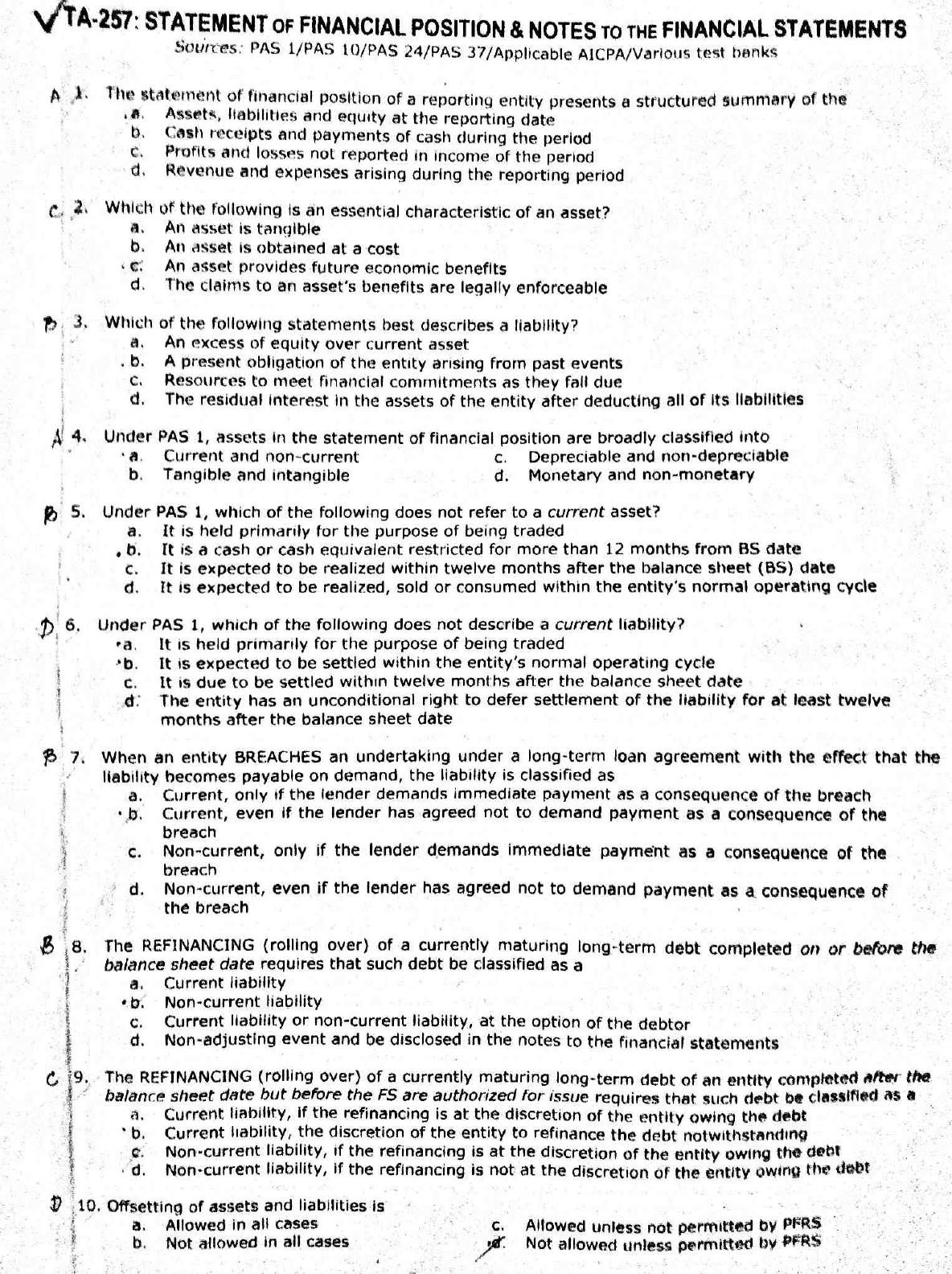
Assets and liabilities, and income and expenses, may not be offset unless required or permitted
by a Standard or an Interpretation.
Comparative Information
PAS 1 requires that comparative information shall be disclosed in respect of the previous period for
all amounts reported in the financial statements, both face of financial statements and notes,
unless another Standard requires otherwise. If comparative amounts are changed or reclassified,
various disclosures are required.
Frequency of Reporting
There is a presumption that financial statements will be prepared at least annually. If the annual
reporting period changes and financial statements are prepared for a different period, the
enterprise must disclose the reason for the change and a warning about problems of comparability.
Statement of Financial Position
Current/Noncurrent Distinction
An entity must normally present a classified statement of financial position, separating current and
noncurrent assets and liabilities. Only if a presentation based on liquidity provides information that
is reliable and more relevant may the current/noncurrent split be omitted.
Current assets
An entity shall classify an asset as current when:

PAGE 3
10/16-5
(a) It expects to realize the asset, or intends to sell or consume it, in its normal operating cycle
(b) It holds the asset primarily for the purpose of trading
(c) It expects to realize the asset within twelve months after the reporting period
(d) The asset is cash or a cash equivalent (as defined in IAS 7) unless the asset is restricted
from being exchanged or used to settle a liability for at least twelve months after the
reporting period.
An entity shall classify all other assets as non-current.
Normal Operating Cycle – The time between the acquisition of assets for processing and their
realization cash or cash equivalents. When the entity’s normal operating cycle is not clearly
identifiable, its duration is assumed to be twelve months.
Current liabilities
An entity shall classify a liability as current when:
(a) It expects to settle the liability in its normal operating cycle
(b) It holds the liability primarily for the purpose of trading
(c) The liability is due to be settled within twelve months after the reporting period
(d) The entity does not have an unconditional right to defer settlement of the liability for at least
twelve months after the reporting period
An entity shall classify all other liabilities as non-current.
Issues on Refinancing
An entity classifies its financial liabilities as current when they are due to be settled within
twelve months after the end of the reporting period, even if:
a. The original term was for a period longer than twelve months; and
b. The intention is supported by an agreement to refinance, or reschedule the payments, on
a long-term basis is completed after the end of the reporting period and completed
before the financial statements are authorized for issue.
If the entity has the discretion to refinance, or to roll over the obligation for at least twelve
months after the end of the reporting period under an existing loan facility, it classifies the
obligation as non-current, even if it would be due with in a shorter period.
Breach of a Loan Covenant
If a liability has become payable on demand because an entity has breached an undertaking
under a long-term loan agreement on or before the end of the reporting period, the liability is
current, even if the lender has agreed, after the end of the reporting period and before
the authorization of the financial statements for issue, not to demand payment as a
consequence of the breach. However, the liability is classified as non-current if the lender
agreed by the end of the reporting period to provide a period of grace ending at least 12
months after the end of the reporting period, within which the entity can rectify the breach and
during which the lender cannot demand immediate repayment.
Statement of comprehensive income
An entity shall present all items of income and expense recognized in a period:
(a) In a single statement of comprehensive income, or
(b) In two statements: a statement displaying components of profit or loss (separate income
statement) and a second statement beginning with profit or loss and displaying components
of other comprehensive income (statement of comprehensive income).
Components of Comprehensive Income
1. Profit and Loss – Income minus Expenses including Tax expense and any Income or Loss
from Discontinued Operations.

PAGE 4
10/16-5
2. Other Comprehensive income – Items of income and expenses including reclassification
adjustments (RA) that are not included in Profit and Loss as required by a standard or
interpretation. There are two types of OCI items, those that are reclassified to profit or loss
(RA) and those that are reclassified to Retained Earnings (RE). OCI includes the following
Unrealized gain or loss on equity investments measured at FVOCI (RE)
Unrealized gain or loss on debt investments measured at FVOCI (RA)
Unrealized gain or loss from derivative contracts designated as cash flow hedge (RA)
Revaluation Surplus (RE)
Remeasurement Gains and losses for defined benefit plans (RE)
Change in fair value arising from credit risk for financial liabilities measured at FVPL
(RE)
Translation gains and losses of foreign operations
Information to be presented in the statement of comprehensive income
As a minimum, the statement of comprehensive income shall include line items that present the
following amounts for the period:
(a) Revenue
(b) Finance costs
(c) Share of the profit or loss of associates and joint ventures accounted for using the equity
method
(d) Tax expense
(e) A single amount comprising the total of:
(i) The post-tax profit or loss of discontinued operations and
(ii) The post-tax gain or loss recognised on the measurement to fair value less costs to sell
or on the disposal of the assets or disposal group(s) constituting the discontinued
operation
(f) Profit or loss
(g) Each component of other comprehensive income classified by nature
(h) Share of the other comprehensive income of associates and joint ventures accounted for
using the equity method
(i) Total comprehensive income.
An entity shall disclose the following items in the statement of comprehensive income
as allocations of profit or loss for the period:
(a) Profit or loss for the period attributable to:
(i) Minority interest, and
(ii) Owners of the parent.
(b) Total comprehensive income for the period attributable to:
(i) Minority interest, and
(ii) Owners of the parent.
An entity shall present either an analysis of expenses using a classification based on either
the nature of expenses or their function with in the entity, whichever provides information
that is reliable and more relevant.
PAGE 5
a. Nature of expense method – Expenses are aggregated in the income statement
according to their nature and are not reallocated among various functions within the
entity.
Revenue X
Other income X
Changes in inventories of finished goods and work in
progress X
Raw materials and consumables used X
Employee benefit costs X
Depreciation and amortization X
Other expense X
Total expense (X)
Profit X
b. Function of expense or cost of sales method – Classifies expenses according to their
function as part of cost of sales or, for example, the cost of distribution or administrative
activities.
Revenue X
Cost of sales (X)
Gross profit X
Other income X
Distribution costs (X)
Administrative expenses (X)
Other expenses (X)