“The Impact of Dividend Policy on Shareholders wealth
in textile sector of Pakistan”.
Thesis Submitted to
In Partial fulfillment of the
Requirement for the Degree of
Master’s in Business Administration in Finance
By

1
DEDICATION
I dedicate my work to my family and my teachers. A special feeling of gratitude to my loving
parents and teachers whose words of encouragement rings in my ears. I am grateful to my
supervisor, who has been a constant source of knowledge and inspiration.

2
ACKNOWLEDGEMENT
Thanks to Almighty Allah Whose unending blessings enabled me to accomplish this gigantic
task. This dissertation could not have been completed without the time, effort, and support of a
number of people. Therefore, I wish to acknowledge the contributions of all of them.
I am grateful to my supervisors, since without her efforts and help I would never have been able
to complete my research, helping me in even the smallest details and helping me explore how
various theories are formulated and how it was applicable to my specific theory.
KASHIF JAVED

3
Contents
Abstract: ………………………………………………………………………………………………………………………. 6
Chapter # 1: ………………………………………………………………………………………………………………….. 7
Introduction ………………………………………………………………………………………………………………. 7
Background study: …………………………………………………………………………………………………….. 8
Scope of study: ……………………………………………………………………………………………………….. 8
Problem statement of study: ………………………………………………………………………………………. 9
Limitations of the research: ……………………………………………………………………………………… 10
Research questions: ………………………………………………………………………………………………….. 11
Research objectives: …………………………………………………………………………………………………. 11
Hypothesis of study: …………………………………………………………………………………………………. 11
Model: ……………………………………………………………………………………………………………………… 11
Chapter # 2: ………………………………………………………………………………………………………………… 13
Literature review: ……………………………………………………………………………………………………. 13
Chapter # 3: ………………………………………………………………………………………………………………… 23
Theoretical Frame Work: …………………………………………………………………………………………. 23
Model Explanation: ………………………………………………………………………………………………….. 23
VARIABLE DESCRIPTION: …………………………………………………………………………………… 24
Dependent variable: ……………………………………………………….. Error! Bookmark not defined.
Return on asset: ………………………………………………………….. Error! Bookmark not defined.
Independent variable: …………………………………………………….. Error! Bookmark not defined.
Return on equity: ………………………………………………………… Error! Bookmark not defined.
Liability: …………………………………………………………………….. Error! Bookmark not defined.
Deposits: …………………………………………………………………….. Error! Bookmark not defined.
Total expense: …………………………………………………………….. Error! Bookmark not defined.
Non-performing loans: ………………………………………………… Error! Bookmark not defined.
Cost of funds: ……………………………………………………………… Error! Bookmark not defined.
Administrative cost: ……………………………………………………. Error! Bookmark not defined.
Equation Explanation: ……………………………………………………………………………………………… 24
Chapter 04 ………………………………………………………………………………………………………………….. 33
Data and Methodology ………………………………………………………………………………………………… 33

4
4.1 Methodology ………………………………………………………………………………………………………. 33
4.1.1 Ontology & Epistemology ……………………………………. Error! Bookmark not defined.
4.1.2 Deductive Approach ……………………………………………. Error! Bookmark not defined.
4.1.3 Research Paradigm ……………………………………………… Error! Bookmark not defined.
4.1.3.1 Positivism Paradigm …………………………………………. Error! Bookmark not defined.
4.1.3.2 Interpretive Paradigm ………………………………………. Error! Bookmark not defined.
4.1.3.3 Pragmatism Paradigm ……………………………………… Error! Bookmark not defined.
4.1.3.4 Approach Taken ………………………………………………. Error! Bookmark not defined.
4.1.4 Research Methods……………………………………………….. Error! Bookmark not defined.
4.1.4.1 Qualitative Method …………………………………………… Error! Bookmark not defined.
4.1.4.2 Quantitative Method ………………………………………… Error! Bookmark not defined.
4.1.4.3 Methodological Approach Taken ………………………. Error! Bookmark not defined.
Data ……………………………………………………………………………….. Error! Bookmark not defined.
4.2.1 Primary source ……………………………………………………. Error! Bookmark not defined.
4.2.2 Secondary source ………………………………………………… Error! Bookmark not defined.
4.2.3 Tertiary source ……………………………………………………. Error! Bookmark not defined.
4.2.4 Source taken ……………………………………………………….. Error! Bookmark not defined.
4.2.5 Research instruments ………………………………………….. Error! Bookmark not defined.
Chapter # 5 …………………………………………………………………………………………………………………. 37
Results and Findings ………………………………………………………………………………………………… 37
Descriptive Statistics……………………………………………………………………………………………… 37
Interpretations:………………………………………………………………………………………………………… 37
Return on asset: ……………………………………………………………………………………………………. 37
Return on equity: ………………………………………………………………………………………………….. 37
Deposits: ………………………………………………………………………………………………………………. 38
Total expense: ………………………………………………………………………………………………………. 38
Non-performing loans: ………………………………………………………………………………………….. 38
Cost of funds: ……………………………………………………………………………………………………….. 39
Administrative cost: ……………………………………………………………………………………………… 39
1.2 Unit Root Tests……………………………………………………………………………………………. 39
Interpretations:………………………………………………………………. Error! Bookmark not defined.

5
Interpretations:………………………………………………………………. Error! Bookmark not defined.
Interpretations:………………………………………………………………. Error! Bookmark not defined.
Interpretations:………………………………………………………………. Error! Bookmark not defined.
Interpretations:………………………………………………………………. Error! Bookmark not defined.
Interpretations:………………………………………………………………. Error! Bookmark not defined.
Interpretations:………………………………………………………………. Error! Bookmark not defined.
Interpretation: ……………………………………………………………….. Error! Bookmark not defined.
Interpretation: ……………………………………………………………….. Error! Bookmark not defined.
Chapter # 6 ……………………………………………………………………….. Error! Bookmark not defined.
Summary, Conclusion and Recommendations …………………. Error! Bookmark not defined.
6.1 Summary ………………………………………………………………. Error! Bookmark not defined.
6.2 Conclusion …………………………………………………………….. Error! Bookmark not defined.
6.3 Recommendations ………………………………………………….. Error! Bookmark not defined.
References …………………………………………………………………………. Error! Bookmark not defined.

6
“The Impact of Dividend Policy on Shareholders Wealth in Textile
Sector of Pakistan”.
Abstract:
The impact of firm’s dividend policy on shareholders’ wealth is an unresolved issue and has
been subjected to many empirical discussions within the finance literatures. The objective of the
firm is to increase the wealth of its shareholders. The best dividend policy is the one that
increases shareholders wealth by the greatest amount. It is therefore necessary, to understand the
nature of the relationship between dividend and value of the firm. To the knowledge of the
researchers very few studies have attempted to observe the impact of dividend policy on
shareholders’ wealth in pakistan. In attempt to fill this research gap the present study was
initiated to find out the impact of dividend policy on shareholders’ wealth from textile industry
listed in KSE in Pakistan during the period from 2011/2015. Secondary data was collected from
Karachi stock exchange (KSE)The present study used unit root test,housemen test,fixed model
effect and descriptive statistics to evaluate the data collected from the twenty five companies
listed in the KSE. In addition the dividend policy has insignificant impact on share price of the
KSE. Outcomes of the study will be useful to the academicians, practitioners, policy makers and
investors for making suitable policy formulations for the companies. Further the companies are
able to decide a suitable polices in executing their financial decision without harming to the
market value of the shares.
Keywords: Dividend policy, Shareholders wealth, Earning per share (EPS), dividend yield
(DY), Dividend per Share (DPS) and Share price (SP)

7
Chapter # 1:
Introduction
Dividend policy is one of the most widely researched topics in the field of finance but the query
is that dividend policy affect shares price and it’s remain arguable among managers, policy
makers and researchers for many years. Dividend policy is imperative for investors, managers,
lenders and for other stakeholders. It is imperative for investors because investors contemplate
dividends not only the source of earning but also a method to assess company from investment
point of view. It is the method of assessing that the company is cash reproductive or not.
Choosing a suitable dividend policy is an important choice for the company because flexibility to
invest in future projects depends on the amount of dividends that they pay to their investors. If
company compensate more dividends then less funds available for future projects depends on the
amount of dividends that they pay to their shareholders. If company pay more dividends then few
reserves available for future projects. Lenders are also paying attention in the amount of dividend
that a company declares, as more amounts is compensated as dividend earnings and less amount
would be available to the company for servicing and recovery of their claims and finally it is
imperative for other stakeholders especially for claimholders to help them in reducing
organization cost. The basic objective of shareholder is to maximize their return and it might be
in the form of dividends or capital gain. Shareholders decision concerning the profit on
investment is effected by dividend policy of the company. Arnold (2008) describe the main aim
of dividend policy is to maximize shareholders’ wealth by maximizing their purchasing power.
So maximizing shareholders’ wealth rely on the dividend policy of the company because of this
shareholders would satisfy their purchasing and spending patterns.
There are some factors that companies examine to designing their dividend policies like firms’
profitability ratios, managerial and behavioral environment, readiness of the company etc.
Juma’h & Pacheco (2008) explained that management decision of dividend policy is effected by
managerial and behavioral environment in U.S. They describe that sometimes financially strong
companies do not pay dividend to shareholders and financially weak companies pay dividends to
shareholders. According to their point of view mostly dividend paying companies are commonly
larger in size, growth and profitability, in terms of liquidity ratio and in research and
developments as contrast to non-dividend paying companies. Ling, Mutalip, Shahrin, & Othman

8
(2008) studied the features of paying dividend companies of Malaysia. Results of their study
show that dividend compensating companies are more gainful, less risky and more developed in
their activities as compared to non-dividend compensating companies. And its results further
indicate that managers of Malayian companies understand the importance of compensating
dividends and they compensate dividends even if the companies are not earning profit.
The objective of this research is to see the effect of dividend policy on shareholders wealth of
textile industry of Pakistan. For this purpose different articles write down in Pakistan and
reviewed from abroad and dividend theories have been empirically tested of their effect on
shares price. There are mainly two schools of thoughts whose presented two different opinions
about dividend policy. One school of thought followed the opinion of Miller and Modigliani
(1961) and understands that dividend policy irrelevant although the second school of thought
followed the point of view of Gordon (1963) and understands that dividend policy relevant.
Since the half century passed, the question still remains i.e. whether dividend policy (DP) is
relevant or not. This problem yet exists, which theory the companies should apply for making
their dividend decisions.
Background study:
In the corporate finance, dividend policy (DP) is the key issue that the management has to deal
with analytically. Dividend policy involves the base question: whether the firm should disburse
all or some proportion of earning to shareholders; or should retain earned profits in business?
Firms adopt different dividend policies to answer this question. Dividends usually take form of
cash dividends or stock dividends. Cash dividend is the most common form of dividend. It is
directly transferred to shareholder’s account. Stock dividend is the additional shares issue by a
firm to its current shareholders. Additional shares are usually issued as a specific proportion to
shares owned. When a firm decides to distribute its earnings, then another question arises
concerning the proportion of earnings that should be distributed. It depends upon potential
investment opportunities. The remaining portion of earning after dividend distribution is known
as retained earnings. Managers are responsible for not only deciding the proportion of the
earnings required for investment, but also for considering the probable effects of such decisions
on stock prices (SP) (Bishop, Crapp, Faff, &Garray J.Twite, 2000). Management strives to adopt
such dividend policy that not only meet investment needs but also prevent negative effects on
share prices.

9
The research work on dividend policy (DP) started with the limited study of Lintner (1995). He
raised a query which is still crucial for managers’ “what choices made by managers do affect the
size, shape and timing of dividend payments?” The study answered the critical questions
regarding dividend policy, frequently asked by managers in 1950s. the questions resolved by
Linter (1956) are the following.
a) Whether dividend payments need to be altered or remained at current level?
b) Whether owners wish to receive static dividend payments, or they require revised
dividend payment along with earnings?
c) Whether younger or older investor dividend policy should attract?
Dividend Policy
Dividend policy (DP) is concerned with financial policies regarding paying cash dividend in the
present or paying an increased dividend at a later stage. Whether to issue dividends and what
amount, is determined mostly on the basis of the firm’s inappropriate earning (surplus cash) and
affect by the firms long-period income power. When excess cash exists and is not needed by the
company, then executive management is expected to pay out some or all of those excess incomes
in the form of cash dividends or to re-purchase through a share buyback method. According to
Weston and Brigham, “Dividend policy (DP) determines the division of incomes between
payments to investors and retained earnings (RE)”. Gitman, “The firm’s dividend policy (DP)
represents a plan of action to be followed whenever the dividend decision must be made”. The
MM hypothesis (Miller-Modigliani) Theory has advocated that dividends are of no compatibility
and effect on the valuation of a firm. On the other hand Walter and Gordon have prorogated that
investment policy and dividend policy (DP) of accompany are interlinked and affects the price of
shares of a firm. Hence, dividends suppose immense significance in deciding the value of a firm.
Factors Affecting Dividend Policy
The boards of directors (BOD) of a company have the individual right to announce dividend and
decide the quantum of dividend. In addition to legal restrictions, there are several factors
affecting the dividend policy (DP) of a company such as Preference of Shareholders, Current
Year’s incomes, Past Dividends (PD), Management Control Motive, Liquidity Position, Future
Financial Requirements, and Access to Capital Market, Contractual Restrictions, Taxation
Policy, Inflation, Stability of Earnings and Legal Restrictions.

10
Dividend Policy and Share Prices
Financial management (FM) having major three functions, one of them is dividend policy.
Financial management has to make an important decision on deciding the part of profits of
company to be distributed to shareholders and the part to be retained by it for future expansion
efforts. Dividend policy has to be formulated on the light of impact the decision about dividend
is likely to have on shareholders wealth. Dividend payment (DP) shall be determined such that it
leads to maximization of shareholders wealth. In case dividend payment (DP) does not lead to
maximization of shareholders wealth, then the company should rescind from paying dividend
and retain its earnings. However, financial experts have not expressed a unanimous view on this
issue.
Problem statement of study:
Dividend policy (DP) has been widely researched topic in the finance research field. As the
management’s chief objective is to maximize shareholder’s wealth, so it strive to achieve such
optimal dividend policy that positively influence a firm’s stock market value. On the other hand,
investors being risk avert, prefer a firm’s stock which is less volatile and has a dividend policy
with a stable dividend growth rate. However, some shareholders prefer dividend paying stocks,
and some do not. Managers are of the view that by adopting a particular dividend policy, share
price of stock can be minimized. Here, the question arises; does dividend policy really affect
shareholders wealth?
Furthermore, the implication of this theory depends upon particular market situation, size,
growth and several more factors. So the basic research question is:
“Whether there exists any relationship between dividend policy and shareholders wealth in
textile sector of Pakistan?”
Limitations of the research:
As all research works have some limitation in one way or the other, therefore, the fundamental
limitation of this research is that the study is based on secondary data. Further due to cost and
time constraints the researcher limits the study to dividend policy and selected sample also.
Research questions:
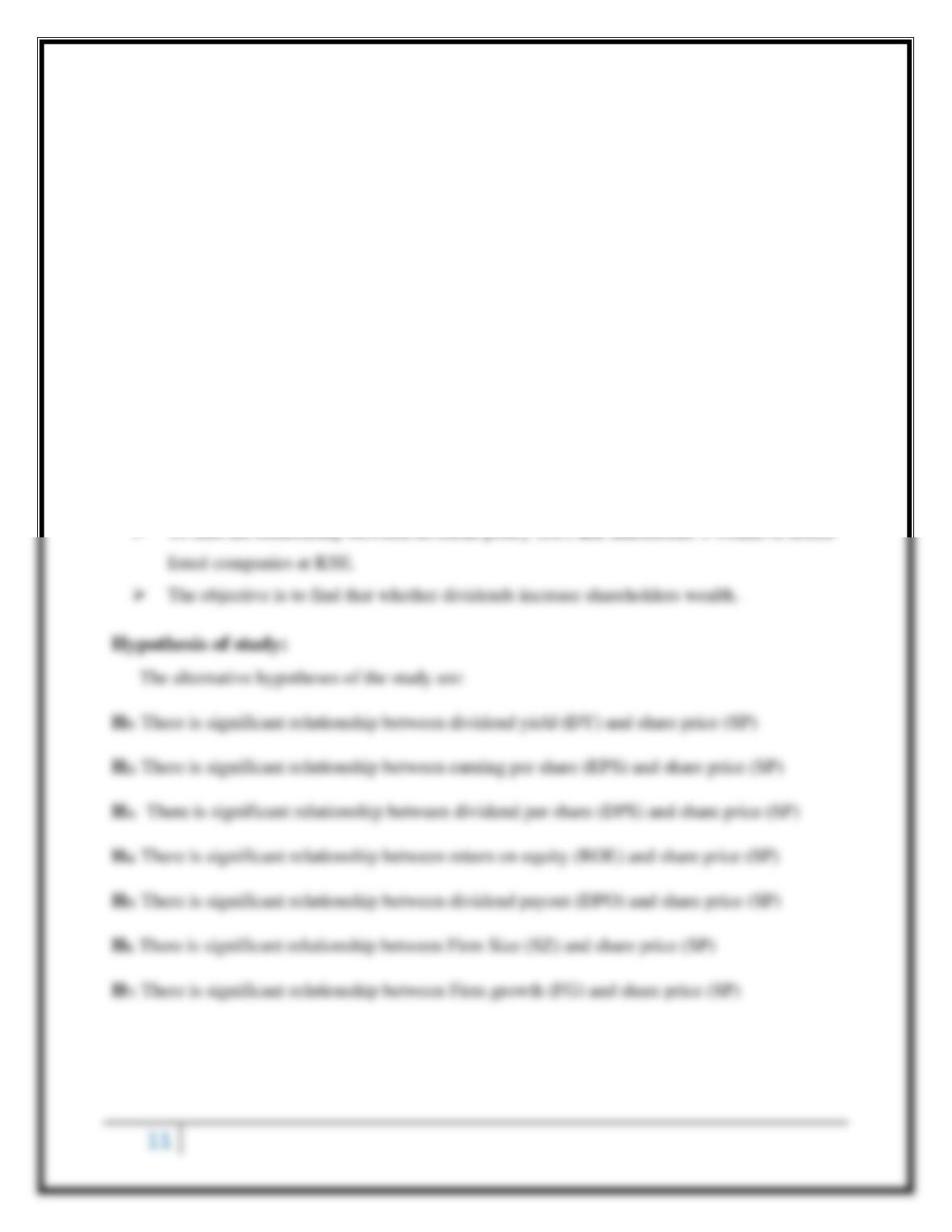
▪ What is the impact of dividend policy (DP) on shareholders wealth in textile sector of
Pakistan?
▪ Whether of control variables like firm size (SZ), firm growth (FG), earnings per share
(EPS) and return on equity (ROE) impact on textile Listed Companies at KSE?
▪ What is the relationship between dividend policy (DP) and shareholder’s wealth in textile
sector?
Research objectives:
➢ To analyze the impact of dividend policy on shareholder’s wealth on textile sector at
KSE.
➢ To identify internal factor such as earning per share (EPS), Firm Size (SZ), Firm growth
(FG) and return on equity (ROE) impact on share price (SP).