Chapter Twenty Six
Swaps
Chapter Outline
Introduction
Interest Rate Swaps
Realized Cash Flows on an Interest Rate Swap
Macrohedging with Swaps
Currency Swaps
Fixed-Fixed Currency Swaps
Fixed-Floating Currency Swaps
Credit Swaps
Total Return Swaps
Pure Credit Swaps
Swaps and Credit Risk Concerns
Summary
Appendix 26A: Pricing an Interest Rate Swap
Pricing a Swap: An Example
65
Solutions for End-of-Chapter Questions and Problems: Chapter Twenty Six
1. Explain the similarity between a swap and a forward contract.
A forward contract requires delivery or taking delivery of some commodity or security at some
specified time in the future at some price specified at the time of origination. In a swap, each
party promises to deliver and/or receive a pre-specified series of payments at specific intervals
over some specified time horizon. In this way, a swap can be considered to be the same as a
series of forward contracts.
2. Forward, futures, and option contracts had been used by FIs to hedge risk for many years
before swaps were invented. If FIs already had these hedging instruments, why do they
need swaps?
Although similar in many ways, the following distinguishing characteristics cause the
instruments to be differentiated:
(a) The swap can be viewed as a portfolio of forward contracts with different maturity dates.
Since cash flows on forward contracts are symmetric, the same can be said of swaps. This
is in contrast to options, whose cash flows are asymmetric (truncated either on the positive
or negative side depending upon the position).
(b) Options are marked to market continuously, swaps are marked to market at coupon
payment dates, and forward contracts are settled only upon delivery (at maturity).
Therefore, the credit risk exposure is greatest under a forward contract, where no third
party guarantor exists as in options (the options clearing corporation for exchange-traded
options) and swaps (the swap intermediary).
(c) The transactions cost is highest for the option (the nonrefundable option premium), next for
the swap (the swap intermediary’s fee), and finally for the forward (which has no up-front
payment).
(d) Swaps also have a longer maturity than any other instrument and provide an additional
opportunity for FIs to hedge longer term positions at lower cost. Moreover, since the
package of forward contracts mirrors debt instruments, the swap provided FIs with a hedge
instrument that is attractive and less costly than separate forward contracts.
(e) Finally, the introduction of a swap intermediary reduces the credit risk exposure and the
information and monitoring costs that are associated with a portfolio of individual forward
contracts.
3. Distinguish between a swap buyer and a swap seller? In which markets does each have the
comparative advantage?
The swap buyer makes the fixed-rate payments in an interest rate swap, and the swap seller
makes the variable-rate payments. This distinction occurs by convention. The notation in this
66
text refers to the comparative advantage party as that which makes the specific swap payment.
Thus, the buyer is said to have the comparative advantage in fixed-rate payments. Students will
note that some other authors refer to the comparative advantage in the markets in which the cash
financing occurs, which may not be the same market that would reduce the interest rate risk on
the balance sheet, and therefore the reason for the swap. Thus, in the example on page 623 in the
text, the money center bank raises money in the fixed-rate market, even though the loans are
variable-rate.
4. An insurance company owns $50 million of floating-rate bonds yielding LIBOR plus 1
percent. These loans are financed by $50 million of fixed-rate guaranteed investment
contracts (GICs) costing 10 percent. A finance company has $50 million of auto loans with
a fixed rate of 14 percent. The loans are financed by $50 million of CDs at a variable rate
of LIBOR plus 4 percent.
a. What is the risk exposure of the insurance company?
The insurance company (IC) is exposed to falling interest rates on the asset side of the
balance sheet.
b. What is the risk exposure of the finance company?
The finance company (FC) is exposed to rising interest rates on the liability side of the
balance sheet.
c. What would be the cash flow goals of each company if they were to enter into a swap
arrangement?
The IC wishes to convert the fixed-rate liabilities into variable-rate liabilities by swapping
the fixed-rate payments for variable-rate payments. The FC wishes to convert variable-rate
liabilities into fixed-rate liabilities by swapping the variable-rate payments for fixed-rate
payments.
d. Which company would be the buyer and which company would be the seller in the
swap?
The FC will make fixed-rate payments and therefore is the buyer in the swap. The IC will
make variable-rate payments and therefore is the seller in the swap.
e. Diagram the direction of the relevant cash flows for the swap arrangement.
Please see the diagram at the top of the next page. Note that the fixed-rate swap payments
from the finance company to the insurance company will offset the payments on the
fixed-rate liabilities that the insurance company has incurred. The reverse situation occurs
regarding the variable-rate swap payments from the insurance company to the finance
company. Depending on the rates negotiated and the maturities of the assets and liabilities,
67
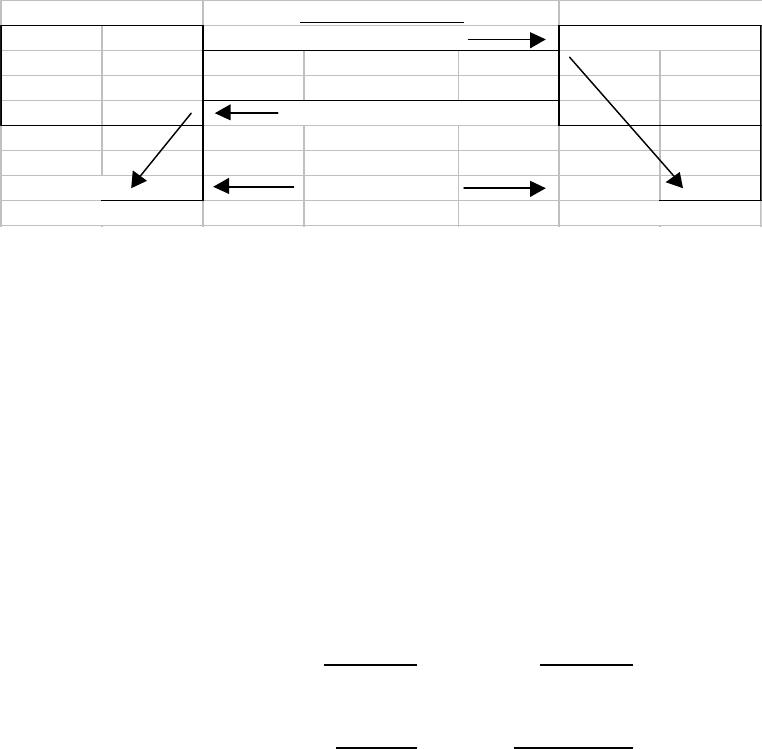
both companies now have durations much closer to zero on this portion of their respective
balance sheets.
Finance Company Insurance Company
Fixed-rate Fixed-rate swap payments Variable-rate assets
assets
Variable-rate swap payments
Cash
Variable-rate Financing Fixed-rate
liabilities @ L + 4% Markets liabilities @ 10%
Swap Cash Flows
Note to instructors: I find it very helpful to diagram the cash-market financing cash flows
when I present the material on swaps.
f. What are reasonable cash flow amounts, or relative interest rates, for each of the
payment streams?
Determining a set of reasonable interest rates involves an analysis of the benefits to each
firm. That is, does each firm pay lower interest rates than contractually obligated without
the swap? Clearly, the direction of the cash flows will help reduce interest rate risk.
One feasible swap is for the IC to pay the FC LIBOR + 2.5 percent, and for the FC to pay
the IC 12 percent. The net financing cost for each firm is given below.
Finance Insurance
Company Company
Cash market liability rate L + 4% 10.0%
Minus Swap-in rate -(L + 2.5%) -12.0%
Plus Swap-out rate + 12% +(L + 2.5%)
Net financing cost rate 13.5% L + 0.5%
Whether the two firms would negotiate these rates depends on the relative negotiating
power of each firm, and the alternative rates for each firm in the alternate markets. That is,
the fixed-rate liability market for the finance company and the variable-rate liability market
for the insurance company.
5. In a swap arrangement, the variable-rate swap cash flow streams often do not fully hedge
the variable-rate cash flow streams from the balance sheet due to basis risk.
a. What are the possible sources of basis risk in an interest rate swap?
First, the variable-rate index on the liabilities in the cash market may not match perfectly
the variable-rate index negotiated into the swap agreement. This source of basis risk is
similar to the cross-hedge risk in the use of futures contracts. Second, the premium over
68
the index in the cash-market variable-rate liability may change over time as credit (default)
risk conditions change.
b. How could the failure to achieve a perfect hedge be realized by the swap buyer?
Swap pricing normally is based on a fixed notional amount over the life of the swap. If the
fixed-rate asset portfolio of the buyer decreases over time, a fixed-notional amount swap
agreement may not reflect accurately the desired interest-rate risk goals of the buyer over
the life of the swap. This situation could occur as loans are amortized (repaid in the normal
context) or as prepayment rates change on either loans or bonds as macroeconomic
conditions change.
c. How could the failure to achieve a perfect hedge be realized by the swap seller?
The swap seller is subject to basis risk as discussed in part (a) above.
6. A commercial bank has $200 million of floating-rate loans yielding the T-bill rate plus 2
percent. These loans are financed by $200 million of fixed-rate deposits costing 9 percent.
A savings bank has $200 million of mortgages with a fixed rate of 13 percent. They are
financed by $200 million of CDs with a variable rate of the T-bill rate plus 3 percent.
a. Discuss the type of interest rate risk each FI faces.
The commercial bank is exposed to a decrease in rates that would lower interest income,
while the savings bank is exposed to an increase in rates that would increase interest
expense. In either case, profit performance would suffer.
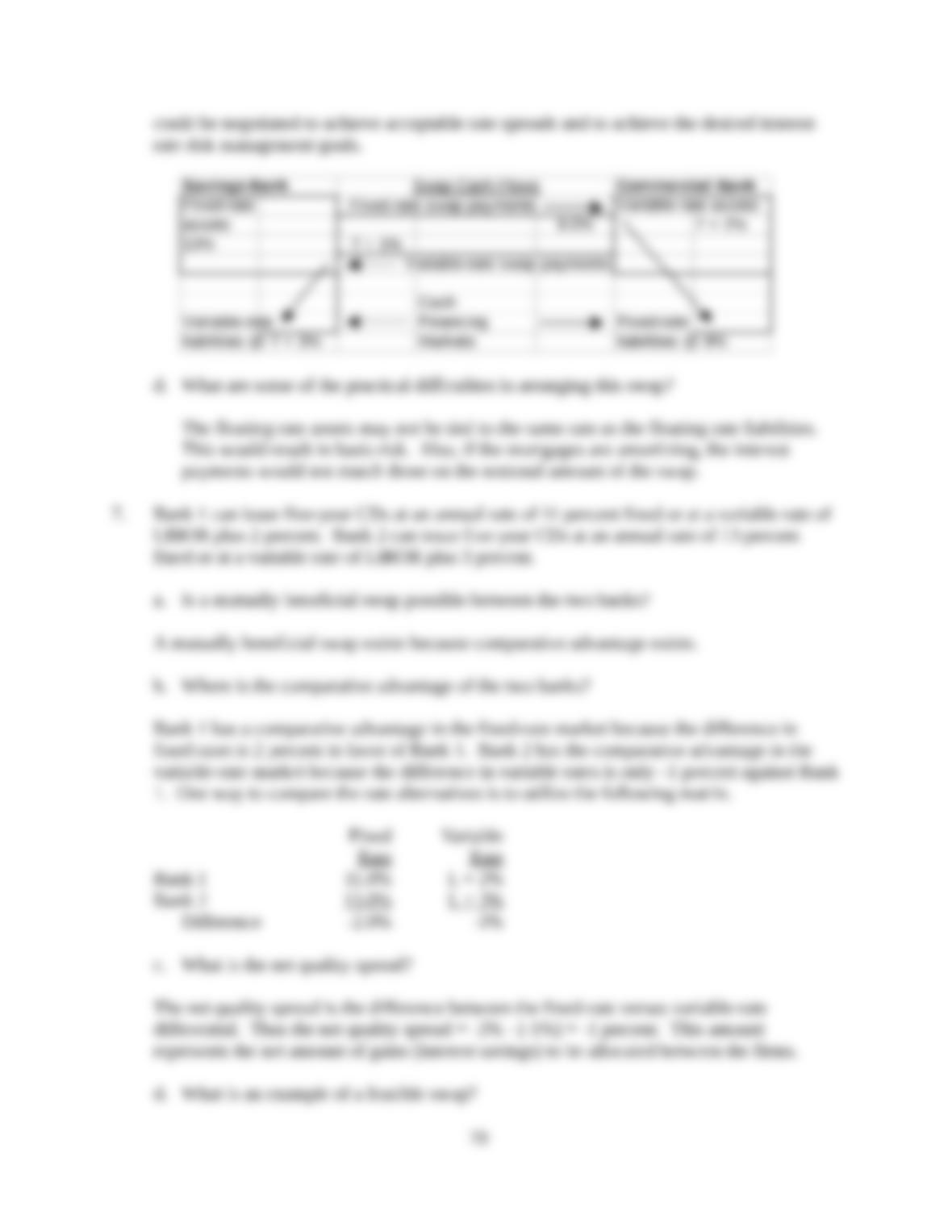
b. Propose a swap that would result in each FI having the same type of asset and liability
cash flows.
One feasible swap would be for the bank to send variable-rate payments of the T-bill rate +
1 percent (T + 1%) to the savings bank and to receive fixed-rate payments of 9 percent
from the savings bank.
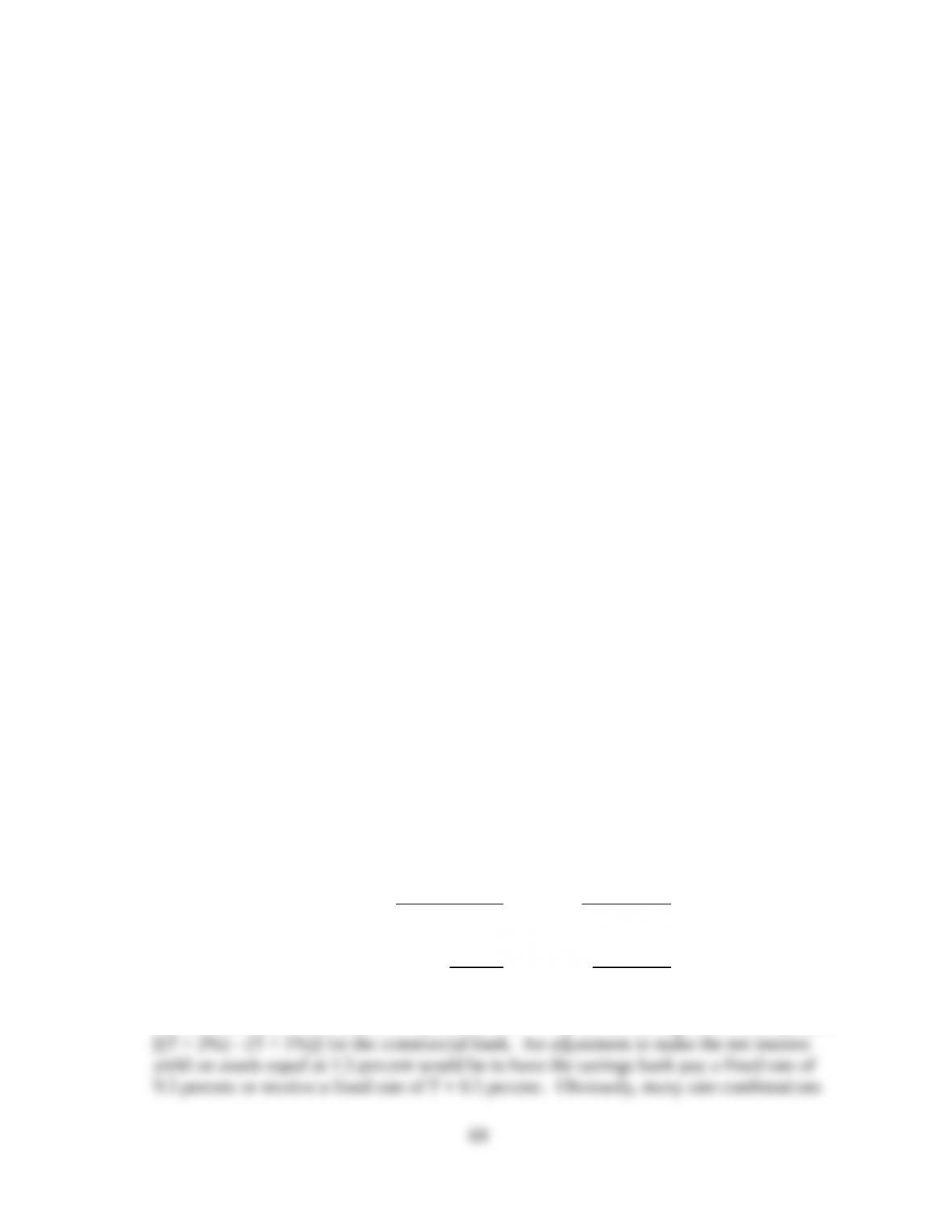
c. Show that this swap would be acceptable to both parties.
Savings Bank Com. Bank
Cash market liability rate T + 3% 9.0%
Minus Swap-in rate -(T + 1%) -9.0%
Plus Swap-out rate + 9% +(T + 1%)
Net financing cost rate 11.0% T + 1%
The net interest yield on assets is 2 percent (13% – 11%) for the savings bank and 1 percent
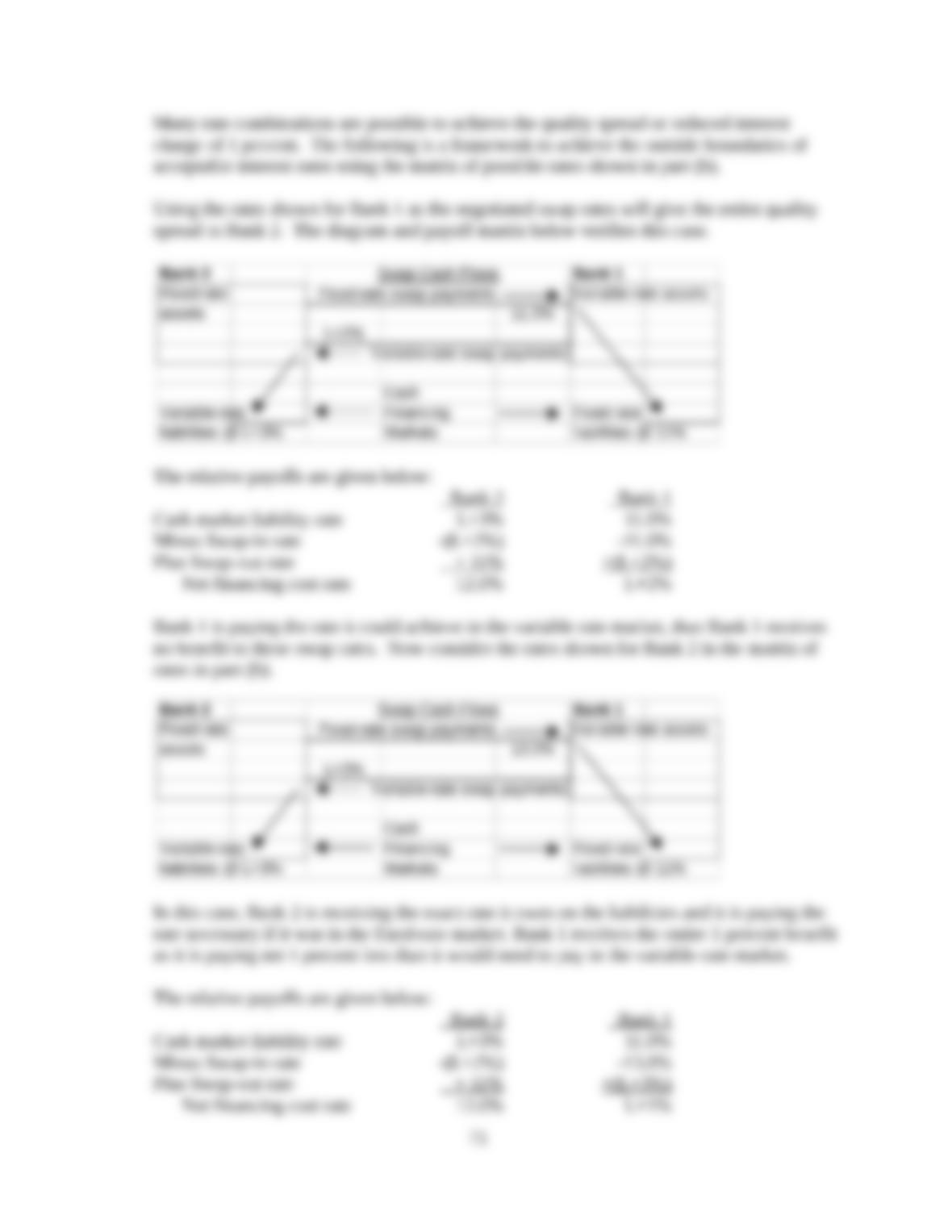
First Bank Second Bank
Fixed-rate Fixed-rate swap payments Variable-rate assets
assets 11.0%
P+0.5%
Variable-rate swap payments
Cash
Variable-rate Financing Fixed-rate
liabilities @ P+1% Markets liabilities @ 11%
Swap Cash Flows
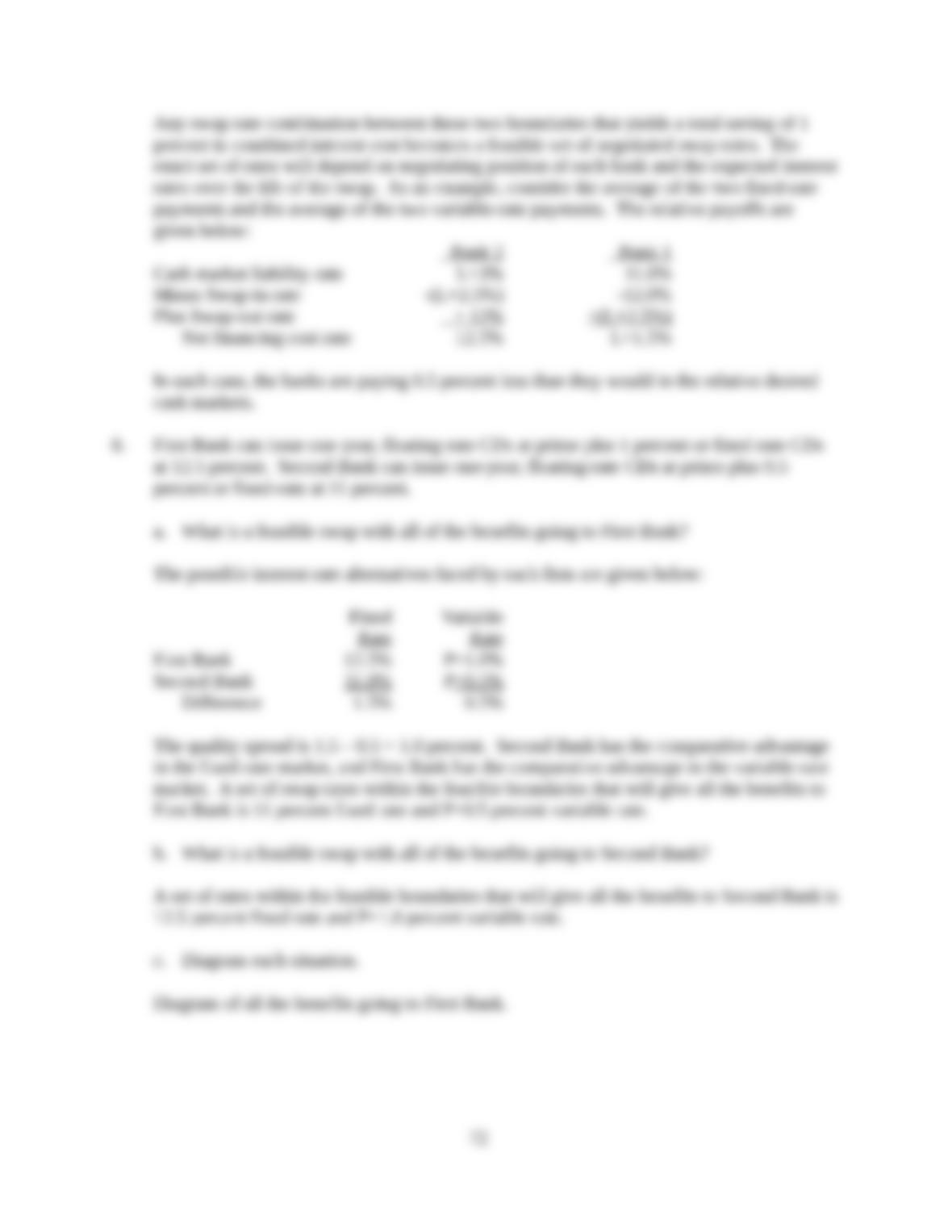
First Bank Second Bank
Fixed-rate Fixed-rate swap payments Variable-rate assets
assets 12.5%
P+1.0%
Variable-rate swap payments
Cash
Variable-rate Financing Fixed-rate
liabilities @ P+1% Markets liabilities @ 11%
Swap Cash Flows
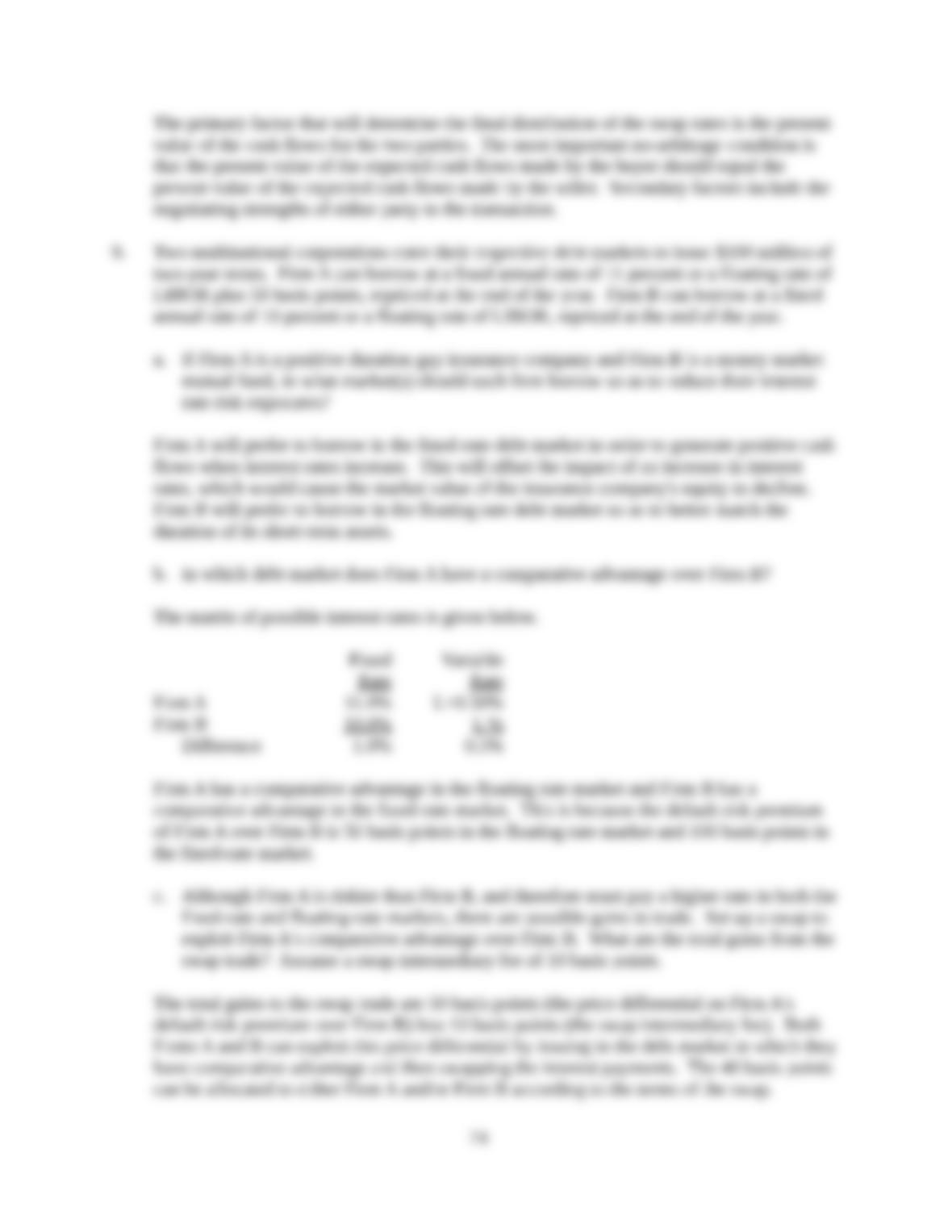
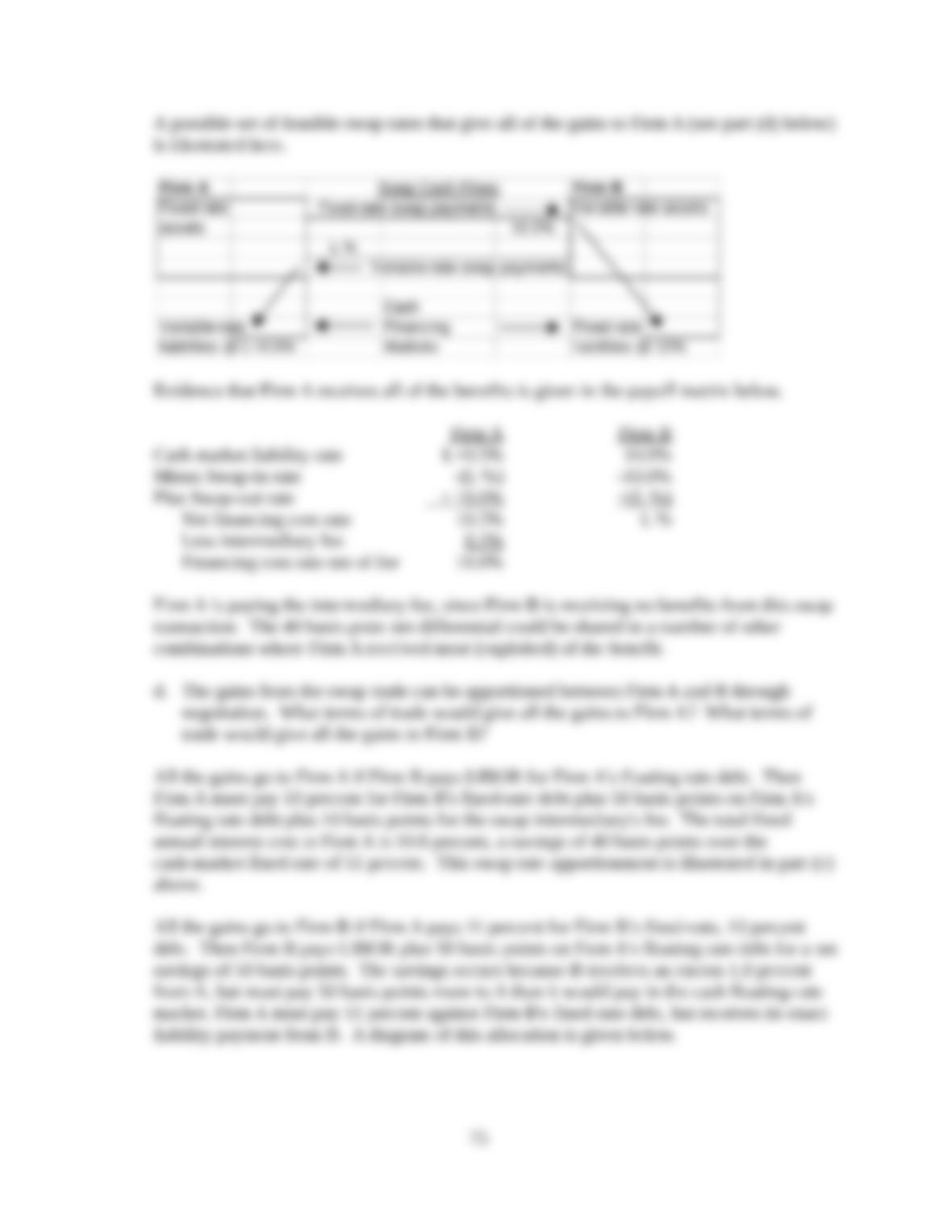
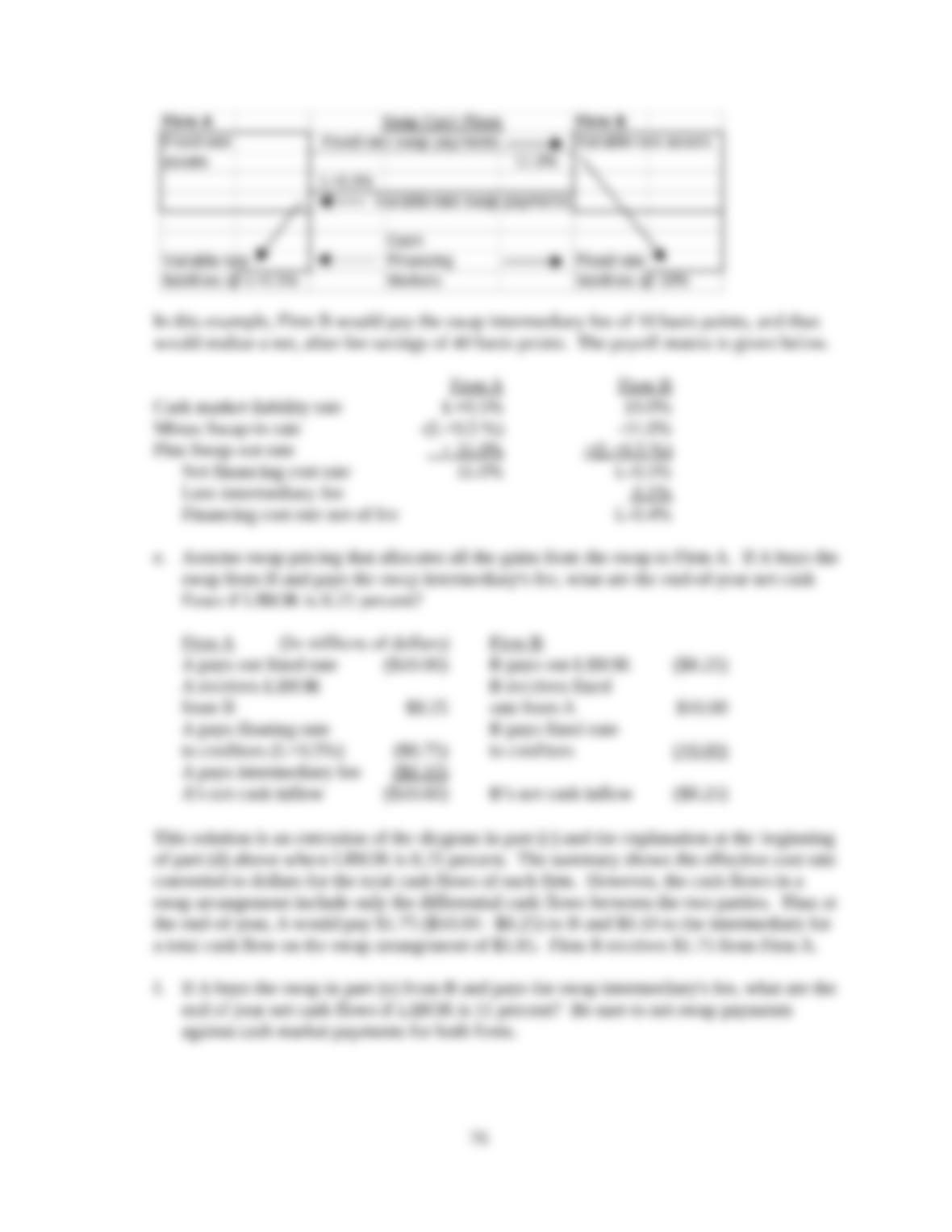
Firm A Firm B
Fixed-rate Fixed-rate swap payments Variable-rate assets
assets 11.0%
L+0.5%
Variable-rate swap payments
Cash
Variable-rate Financing Fixed-rate
liabilities @ L+0.5% Markets liabilities @ 10%
Swap Cash Flows