Attendance of board meetings and company performance:
Evidence from Taiwan
Hsin-I Chou
a
, Huimin Chung
b
, Xiangkang Yin
a,
⇑
a
La Trobe University, Australia
b
National Chiao Tung University, Taiwan
article info
Article history:
Received 19 February 2013
Accepted 15 July 2013
Available online 25 July 2013
JEL classification:
G34
Keywords:
Board meeting attendance
Family controlled firm
Ultimate shareholder
Firm performance
abstract
This paper empirically investigates board meeting attendance and its effects on the performance of Tai-
wanese listed corporations. Directors with higher qualifications attend board meetings more often by
themselves. The ownership of the largest shareholder of a company also has a positive effect on director’s
own meeting attendance. High meeting attendance by directors themselves can enhance a firm’s perfor-
mance but high attendance by their representatives has an adverse effect. Independence of directors or a
board is also positively associated with firm performance. These results largely hold even when the sam-
ple is decomposed to count for different ownership structures and director types.
Ó2013 Elsevier B.V. All rights reserved.
1. Introduction
The board of directors of a company has three main functions:
monitoring, advising and contracting. It has the legal authority to
ratify and monitor managerial initiatives, evaluate the perfor-
mance of top managers, and reward or penalize that performance
(Fama and Jensen, 1983a,b). The inside directors (executives of
the company) provide valuable information about a firm’s activi-
ties, while outside directors may provide both strategic input and
objectivity in evaluating the top executives’ decisions. Hence, it is
important to understand the behavior and work effort of directors
and the behavioral difference between different directors. One of
major duties of directors, especially for outside directors, is to at-
tend board meetings because board meeting is the main vehicle
for directors to collect information, make decisions and monitor
the management (Adams and Ferreira, 2008). Moreover, it is quite
difficult to measure director work effort completely and directly in
empirical studies. A straightforward way to partially identify direc-
tor behavior and work effort is to investigate their board meeting
attendance (Chou et al., 2010), which is the focus of this paper.
Existing empirical studies of board member activities are con-
centrated on board meeting attendance by outside directors and
most studies are restricted to US companies. However, the data
of board meeting attendance by the directors of US firms are not
precise because the available data source only records whether a
director attends more than 75% board meetings or not (e.g., Adams
and Ferreira, 2008, 2012; Lawler and Finegold, 2006). This paper
intends to overcome this shortcoming of the existing empirical lit-
erature by using a more comprehensive data set of board meeting
attendance of Taiwanese companies. In contrast to the US compa-
nies, companies listed in the Taiwan Stock Exchange must provide
detailed information of board meeting attendance of all directors
in their annual reports. It includes board meetings attended by
directors themselves and attended by the representatives autho-
rized by a director. With this more accurate information, we can
have a closer look on board member activities. Particularly, we
can empirically test the determinants of board meeting attendance
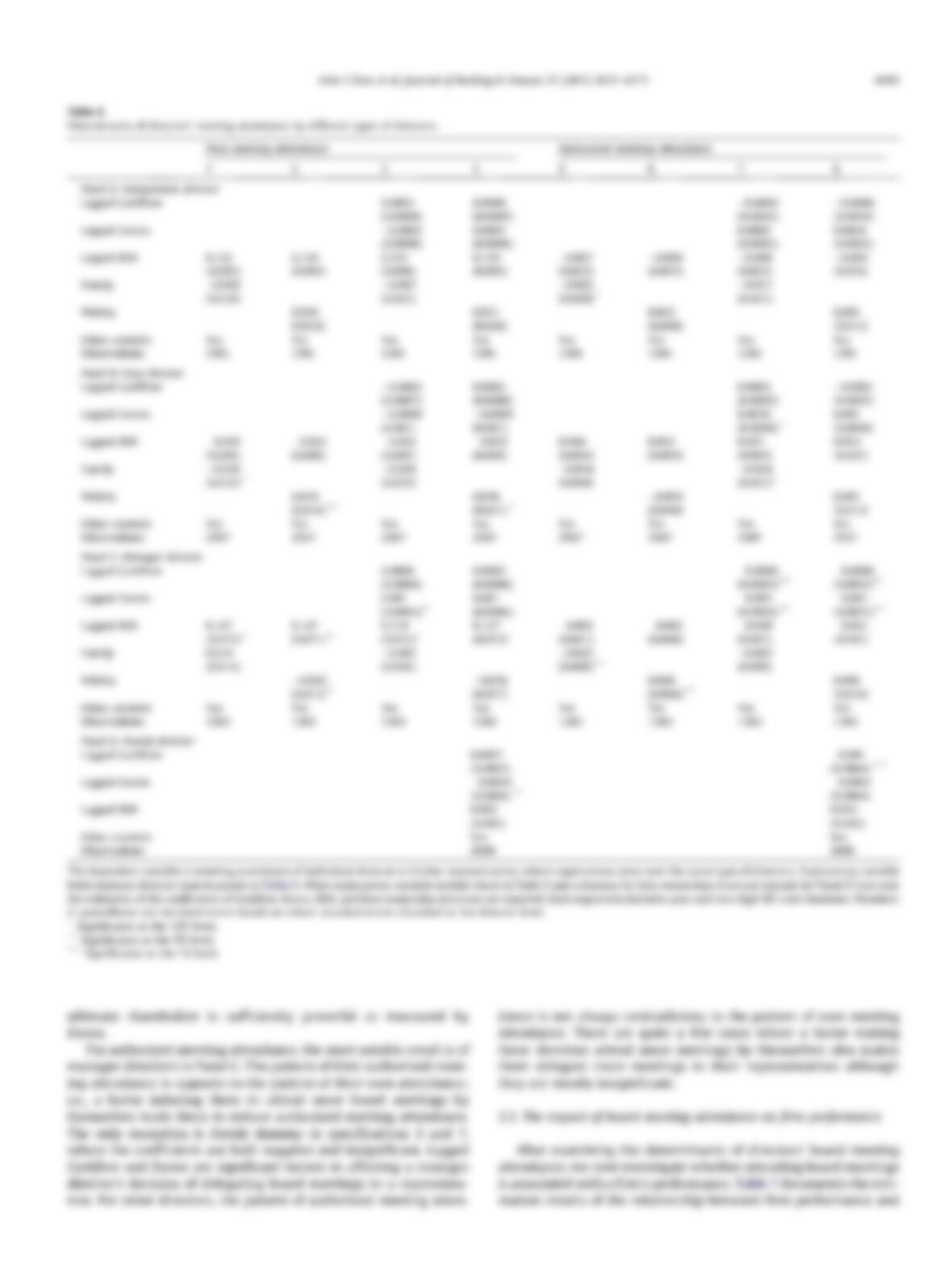
with considerable accuracy. It is found that manager directors at-
tend much more board meetings by themselves than outside direc-
tors (inducting both independent and gray directors), while the
attendance of family directors is between them.
1
Gray and family
directors are also more likely to authorize a representative to attend
board meetings on their behalf than other directors.
0378-4266/$ – see front matter Ó2013 Elsevier B.V. All rights reserved.
http://dx.doi.org/10.1016/j.jbankfin.2013.07.028
⇑
Corresponding author. Address: Department of Finance, La Trobe Business
School, La Trobe University, Bundoora, Victoria 3086, Australia. Tel.: +61 3 9479
2312; fax: +61 3 9479 1654.
E-mail address: x.yin@latrobe.edu.au (X. Yin).
1
Directors coming from the controlling family of a company are called family
directors in this paper. Furthermore, directors affiliated with the ultimate shareholder
in terms of family relation or business relation are called ultimate directors. The
details of firm and director classifications are given in the next section.
Journal of Banking & Finance 37 (2013) 4157–4171
Contents lists available at ScienceDirect
Journal of Banking & Finance
journal homepage: www.elsevier.com/locate/jbf

Another new feature of our database is that it contains compre-
hensive information of the qualification of each director. We in-
clude three proxies for the quality of a director in our analysis
and find that all three measures are positively and significantly re-
lated to directors’ own meeting attendance but negatively related
to meeting attendance by their representatives. A more capable
director seems more involving and is keener to play the director
role by him/herself rather than to delegate the job to his/her repre-
sentative. We also find that directors attend more board meetings
by themselves and delegate fewer to their representatives if the
largest shareholder of the firm has a greater proportion of cash
flow rights. For other determinants of meeting attendance by
directors themselves, our findings are consistent with the existing
literature. Moreover, a determinant usually generates opposite ef-
fects on a director’s own meeting attendance and authorized meet-
ing attendance.
As an innovation, this study further explores work effort, or
more specifically board meeting attendance, of various types of
directors under different ownership structures. Concentrated own-
erships in the forms of companies with a controlling family and/or
a controlling ultimate shareholder are quite common in East Asia
(e.g., Claessens et al., 2000; Claessens and Fan, 2002). To our
knowledge, there is no literature to examine how directors play
their roles differently due to ownership variation. According to
the reality of the Taiwanese economy, this study considers five
types of ownership structures. Our attention is on the contrast be-
tween widely dispersed firms and family/ultimate shareholder
controlled firms. Both independent and gray directors tend to at-
tend more meetings by themselves if they seat on the board of a
widely dispersed firm but fewer meetings if they are on the board
of a family firm, although not all of these results are statistically
significant. On the other hand, manager directors attend fewer
board meetings if they are employed by a widely dispersed firm
or by a firm with less divergence between the ultimate share-
holder’s voting rights and cash flow rights. But this divergence
makes family directors more likely reduce their own meeting
attendance.
Whether the directors of a company properly play their moni-
toring, advising and contract roles is ultimately testified by
whether their work improving the company’s performance. With
the relatively accurate information of board meeting attendance
in our database, we can directly test the impact of directors’ meet-
ing attendance on firm performance. To our knowledge, this is the
first in the literature to quantitatively examine this relation.
2
Our
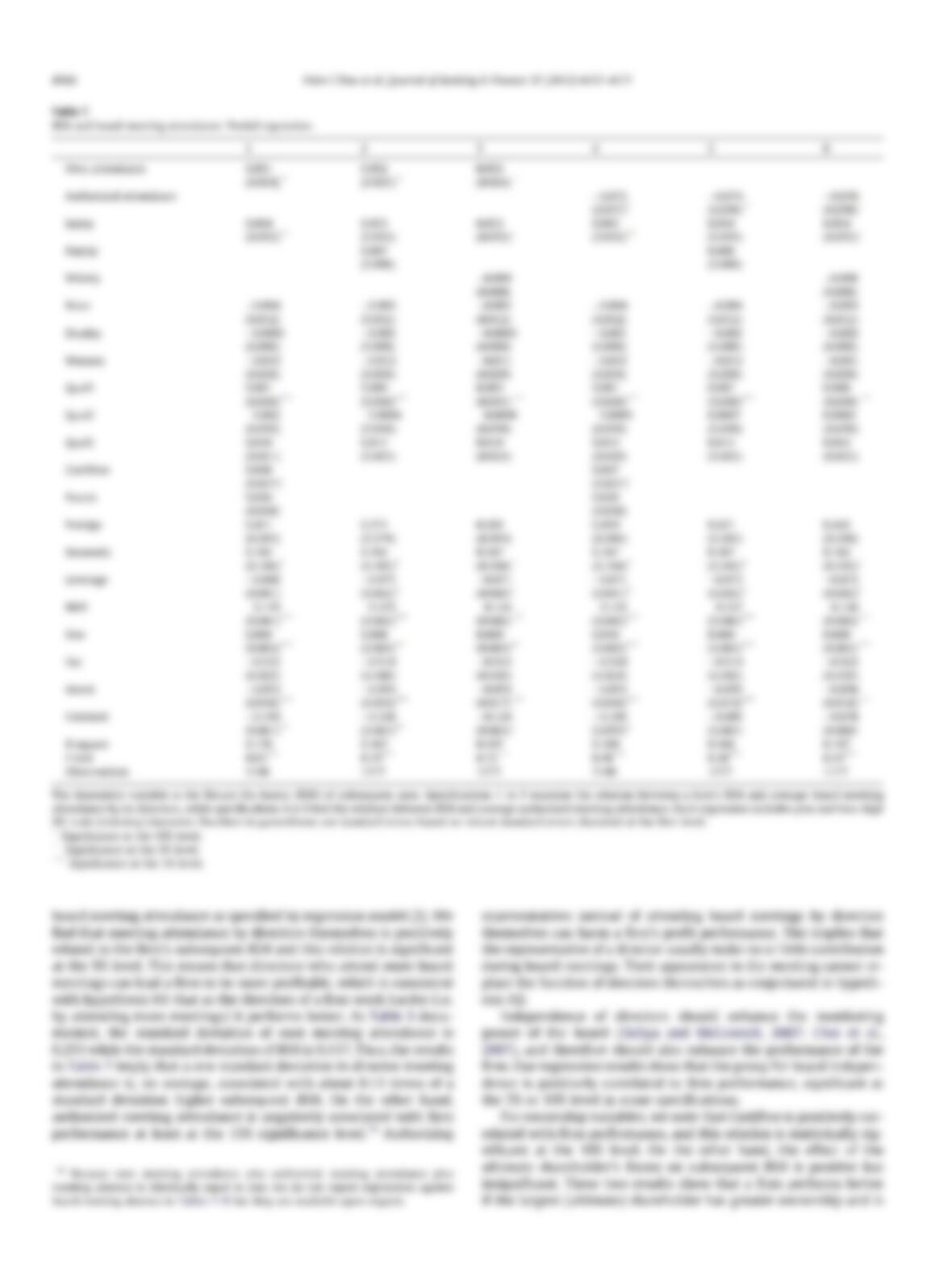
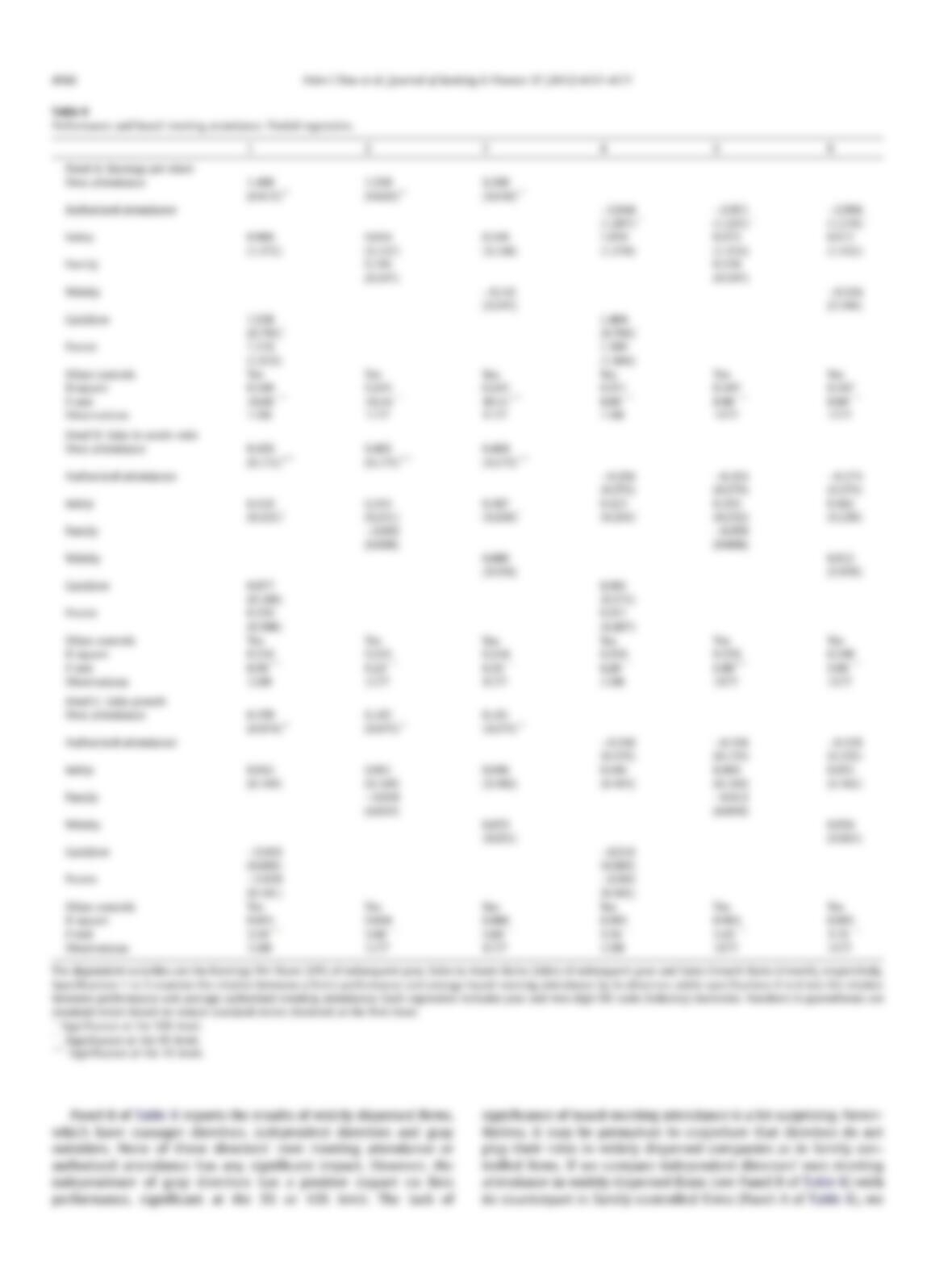
findings indicate that the frequency of board meetings attended by
directors themselves has a positive and significant effect on a firm’s
profitability. However, the authorized meeting attendance is nega-
tively correlated with performance. This negative effect is statisti-
cally significant and economically comparable to the positive effect
of directors’ own attendance.
While the typical agency problem of a widely dispersed firm is
the conflict of interest between managers and shareholders, the
main agency problem of a firm with concentrated ownership is
the conflict of interest between controlling shareholders and
minority shareholders. We study the director’s role in resolving
these agency problems and improving performance by consider-
ing further the attendance of board meetings by different types
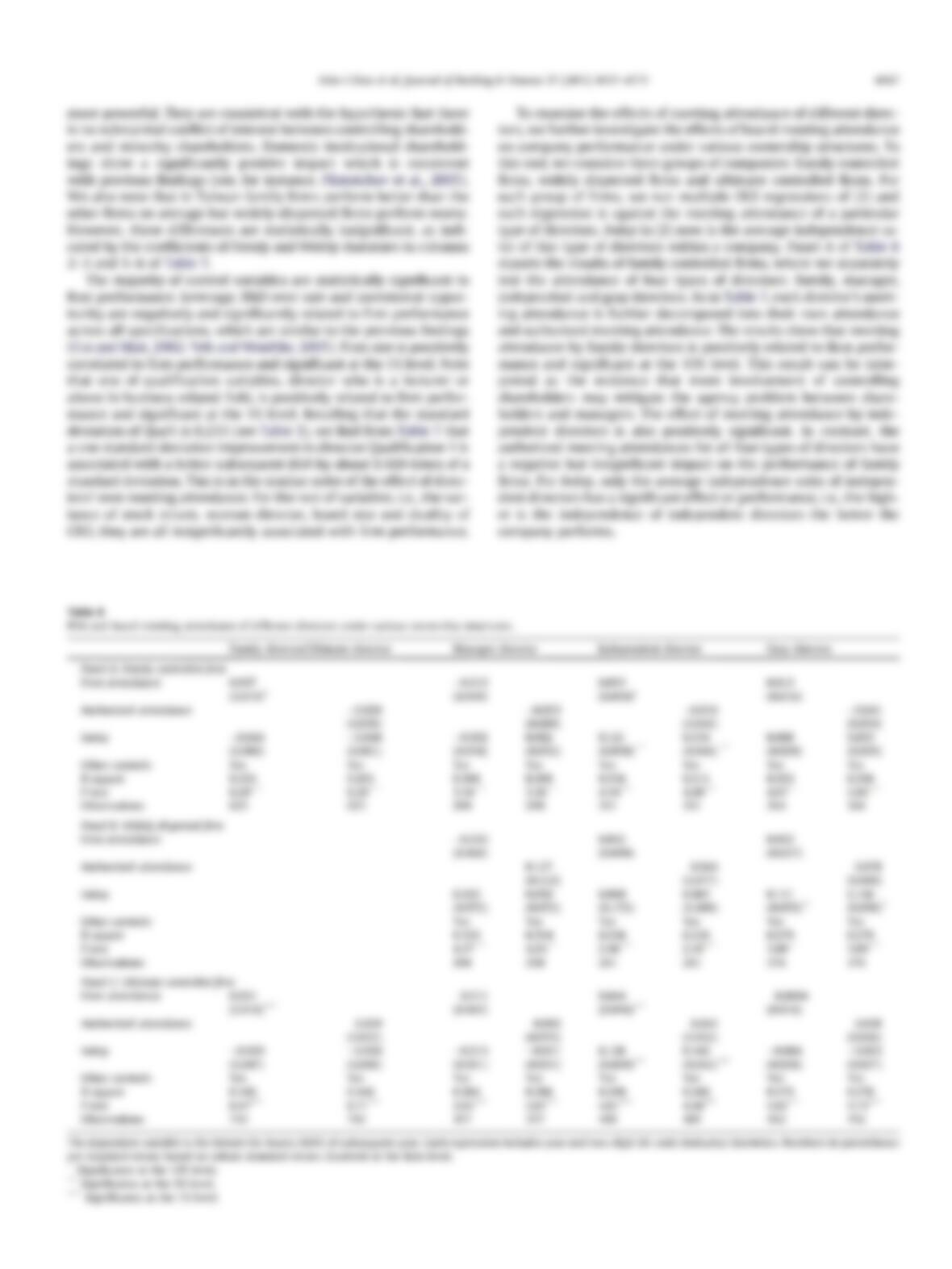
of directors in these firms separately. Independent directors seem
to play a more profound role in family or ultimate shareholder
controlled companies than in widely dispersed firms, as evi-
denced by the findings that the effect of their own attendance
to board meetings is significant on the profitability of family/ulti-
mate controlled companies but insignificant on widely dispersed
firms. The presence of family directors and ultimate directors in
board meetings also has a significant impact on these firms’
performance.
The remainder of the paper is organized as follows. Section 2
specifies the motivations and research questions of this paper. It
also presents the regression models for testing. Section 3describes
the statistics of our sample and reports the main empirical results
using firm-level and director-level data. The final section concludes
the paper.
2. Research questions and methods
This research focuses on two questions. The first is what factors
determine a director to attend more (or less) board meetings. The
second is whether and how a director’s work effort in terms of
board meeting attendance affects his/her company’s performance.
This section presents our motivations and research methods
addressing these questions.
Because we want to address these issues by considering differ-
ent firm ownership structures and different types of directors, we
need to identify the ultimate shareholder of a firm. Following La
Porta et al. (1999), we employ the cut-off of 20% control rights to
trace who is the ultimate shareholder of a company. Direct voting
rights are measured as the fraction of stocks held by a shareholder,
and indirect voting rights are measured based on the latest link in
the chain of stocks held by entities or nominal companies that are
controlled by the shareholder. The ultimate shareholder is defined
as the one who has the largest control rights by combining direct
and indirect voting rights. Thus, the ultimate shareholder of a firm
can be either an individual/family, a state agent, an institution or a
widely held corporation. We call a company which has a control-
ling ultimate shareholder ultimate controlled firm. Our focus is
on family controlled firms, ultimate controlled firms and widely
dispersed firms. Note that a family controlled firm is definitely
an ultimate controlled firm but an ultimate firm is not necessarily
a family controlled firm.
In the literature, directors of a firm are usually classified into
three types: inside directors who are current employees of the
firm, gray outsiders who are outsiders but have business ties with
the company and independent outsiders who do not have any rela-
tionship with the company (e.g., Baysinger and Bulter, 1985;
Bhagat and Black, 2002). This classification is typical and well
applicable to the US and the UK where the majority of the compa-
nies are widely dispersed firms. Because a large proportion of the
firms in our study are controlled by families or ultimate sharehold-
ers, we classify directors into eight groups: family directors who
are relatives of the controlling family, manager directors who are
current employees of the firm, state directors who are agents of
the government, institution directors who are agents of financial
and investing institutions, gray directors who are outsiders but
have business ties with the company, widely-held-corporation
directors who are nominated by another widely held corporation,
block outsiders who are large shareholders holding more than 1%
of the firm, and independent directors who do not have any rela-
tionship to the company.
3
Moreover, we call a director ultimate
director if he/she is affiliated with the ultimate shareholder of the
company. As a group, ultimate directors include all family directors
and some of state directors, institution directors and widely-
held-corporation directors.
2
The only exception is the work by Adams and Ferreira (2009), which relates board
meeting attendance to Return On Assets (ROA). However, their focus is on how female
directors affect the governance and performance of US companies. They regress board
meeting attendance on proportion of female directors in a firm and add ROA as one of
control variables.
3
Institutional, gray and block outsiders are usually classified as gray outsiders in
the US studies.
4158 Hsin-I Chou et al. / Journal of Banking & Finance 37 (2013) 4157–4171

2.1. The determinants of board meeting attendance
We are interested in the characteristics of a director that can
determine his/her board meeting attendance. We are also inter-
ested in the question that whether directors behave differently in
companies with different ownership structures and/or different
features of large shareholders. To this end, we propose the follow-
ing for empirical tests:
Attend
i;t
¼fðX
i;t
;Compensation
i;t
;Women
i;t
;Tenure
i;t
;Interlock
i;t
;
Down
i;t
;Pledged
i;t
;Meeting
i;t
;Qual1
i;t
;Qual2
i;t
;Qual3
i;t
;
Cashflow
i;t1
;Excess
i;t1
;ROA
i;t1
;Foreign
i;t
;Domestic
i;t
;
Bsize=Size
i;t
;Le
v
erage
i;t
;Cash
i;t
;In
v
est
i;t
;Var
i;t
;Family
i;t
;
Widely
i;t
e
i;t
Þð1Þ
where f() represents a linear function. In the US, Securities and Ex-
change Commission (SEC) only requires firms to disclose the names
of directors who absent more than 25% of the board meetings dur-
ing a fiscal year, and more detailed data on a director’s meeting
attendance are not available. In this study, we take the advantage
that Taiwanese firms must provide details of board meeting atten-
dance for each director. Therefore, the dependent variable (Attend)
in (1) is measured in two ways: the percentage of board meetings
attended by a director him/herself, and the percentage of meetings
attended by the authorized representatives of the director. The
descriptions of all variables in (1) can be found in Table 1.
We regress model (1) at individual director level so that sub-
script iin (1) indexes individual director and subscript tindicates
year. We consider two specifications of X. When the regression is
over all directors in the sample, Xis a vector with its elements
being dummy variables indicating whether the director under con-
sideration belongs to a particular type. Four types of directors,
namely, independent, gray, manager, and family directors, are in-
cluded as regressors. When regression is over directors of a partic-
ular type, X
i
in (1) is director i’s independence ratio (Indep), which
is used as a control variable here and its details are given in the
next Subsection.
Compensation to directorship provides incentives to enhance
the willingness of attending board meeting for a director (Chou
et al., 2010). In Taiwan, there is no strict requirement of reporting
compensation details for each director. Companies are only re-
quired to report the total compensation to all directors in a com-
pany. Also, there is no requirement of reporting board meeting
fee. Therefore, we measure Compensation in (1) as the logarithm
of average compensation to a director in a company in a year.
Table 1
Summary of variable definitions.
Variable Description
Board meeting attendance Own Meeting Attendance
(Attend)
Percentage of board meetings attended by a director him/herself
Authorized Meeting
Attendance (Attend)
Percentage of board meetings attended by representatives authorized by a director
Director variable Independence Ratio (Indep) A director’s independence status as specified by Appendix
Woman Director (Woman) Dummy variable equals one if the director is female and zero otherwise
Compensation Logarithm of compensation to a director in a year
Tenure The number of years that a director has served on the board
Qualification 1 (Qual1) Dummy variable equals one if a director is a lecturer or above in Business, Law, Finance, Accounting or
Corporate Business related fields and zero otherwise
Qualification 2 (Qual2) Dummy variable equals one if a director has qualification of justice, procurator, attorney, CPA, specialist
or technician of National Examination in Corporate Business related fields and zero otherwise
Qualification 3 (Qual3) Dummy variable equals one if a director has five years experience in business, law, finance, accounting or
corporate business related fields and zero otherwise
CEO Duality (Duality) Dummy variable equals one if CEO and chairman is the same person and zero otherwise
Director Ownership (Down) The percentage of shares held by all directors
Director Pledged Ratio
(Pledged)
The percentage of all directors’ shareholdings that are pledged for loans and credits
Director Interlock (Interlock) The number of listed firm directorships held by a director
Board variable Board Meetings (Meeting) The number of board meetings during a year
Board size (Bsize) Logarithm of the number of directors on a board
Ownership variable Ownership (Cashflow) The proportion of cash-flow rights held by the largest shareholder group
Excess The divergence between control (direct and indirect voting rights) and ownership (cash-flow rights) of
the ultimate shareholder of a company
Foreign Institutional
Shareholdings (Foreign)
The percentage of shares held by foreign institutions and funds
Domestic Institutional
Shareholdings (Domestic)
The percentage of shares held by domestic institutions and funds
Family Dummy variable equals one if the ultimate shareholder of the company is a family group and zero
otherwise
Widely Dummy variable equals one if the company is a widely dispersed firm and zero otherwise
Firm variable Leverage The ratio of book value of debt to book value of assets
Growth Opportunity (R&D) Research and development expenses over sales
Firm Size (Size) Logarithm of book value of assets
Volatility (Var) Variance of monthly returns stock over two prior years
Excess Cash (Cash) Cash and marketable security divided by the book value of total assets
Investment Opportunity
(Invest)
Capital expenditure divided by the book value of total assets
Performance variable Return On Assets (ROA) Net income divided by the book value of total assets
Earnings Per Share (EPS) Net income divided by the number of outstanding shares
Sales To Assets Ratio (Sales) Sales divided by the book value of total assets
Sales Growth Rate (Growth) The difference between current year’s sales and last year’s sales divided by last year sales
Hsin-I Chou et al. / Journal of Banking & Finance 37 (2013) 4157–4171 4159
Directors and shareholders may use their own shareholdings as
collaterals to increase control of the firm. They can collateralize
their shareholdings to borrow money from banks and in turn buy
more stocks of the firm. This, in turn, increases the deviation of
their control rights to cash flow rights. They may also pledge their
shareholdings for bank loans to invest in other opportunities.
Pledging for loans effectively decreases the personal fund required
for shareholdings (La Porta et al., 1999; Claessens et al., 2002).
Thus, the regressors of (1) include the director pledged ratio,
Pledged.
It is intuitive to expect that a director’s qualification can affect
their board meeting attendance since the qualification may be re-
lated to the effectiveness of a director’s functioning and impact.
Our database enables us to measure the qualification of a director
in three dimensions as specified in Table 1. Thus, the characteris-
tics of a director are more comprehensively portrayed.
The conflict of interest exists between managers and sharehold-
ers under the separation of ownership and control. However, own-
ership around the globe tends to be more concentrated and large
shareholders are likely to be directly involved in management. This
structure shifts the focus away from management expropriating
shareholders to majority shareholders who have the opportunity
to expropriate wealth from minority shareholders (e.g., Grossman
and Hart, 1988; Shleifer and Vishny, 1997; Bebchuk et al., 2000).
With large ownership and control, ultimate shareholders may re-
solve the agency problem between shareholders and managers.
But the power of ultimate shareholders can prevent effective mon-
itoring by other directors and the possible expropriation by ulti-
mate shareholders (mainly controlling families) is also likely to
be harmful to firm performance (e.g., La Porta et al., 1999, 2002;
Claessens et al., 2000; Faccio and Lang, 2002). This potential of
expropriation can be measured by divergence between control
and cash flow rights of the ultimate shareholder (Excess), where
control is based on direct and indirect voting rights of the ultimate
2.2. The effects of board meeting attendance on performance
An essential way that a board exerts its influence on its firm is
coming through decisions and plans made in board meetings. In
other words, the directors of a firm have to attend their board
meetings to monitor, stipulate and supervise the firm or to make
strategic decisions for it. Failure to regularly attend board meetings
can be seen as a director is unwilling or unable to fulfill his/her
duties.
7
Hence, attending board meetings is to accomplish a direc-
tor’s responsibility and should be associated with subsequent higher
firm performance. Thus, we posit the following hypothesis:
H1. Attendance of board meetings by directors themselves is
positively correlated with firm performance.
Article 205 of Taiwanese Company Law stipulates that the quo-
rum of any board meeting is a half of the number of board members
and a resolution made by a board is eligible only if a half of or more
attendees agree on it. Since authorized representatives are also
counted, some directors may occasionally or quite often ask and
authorize a shareholder or another director as their representatives
to attend board meetings.
8
A plausible reason for directors sending
representatives to board meetings can be that they are too busy to at-
tend by themselves. Some directors, especially outside directors,
have full-time jobs such as a CEO in other companies. Quite often,
family directors of a family controlled firm are the managers or direc-
tors of an affiliated firm controlled by the family. These busy directors
may not have enough time to fulfill their duties and thus may not at-
tend board meetings regularly (Fich and Shivdasani, 2006; Adams
and Ferreira, 2008). Instead of not attending board meetings by them-
selves, they may authorize a representative to attend meetings on
their behalf to ensure meetings are eligible. Although busy directors
usually have a good reputation and qualification (Kaplan and Reishus,
1990; Booth and Deli, 1996; Ferris et al., 2003), their representatives
9
4160 Hsin-I Chou et al. / Journal of Banking & Finance 37 (2013) 4157–4171