1 / 5
WHITE PAPER
Thought Leadership
WHAT’S IN A BUSINESS CONTINUITY DISASTER RECOVERY PLAN TEMPLATE?
The building blocks for a
successful recovery program
So if you’ve been tasked with creating
a BC/DR plan for your team, function,
business unit, or company, you can
likely get yourself 80% of the way there
by taking an existing disaster recovery
plan template and customizing it to your
specific situation. The goal of this white
paper, therefore, is to share insights
into effective disaster recovery plan
templates that we at Sungard AS have
gained over the last 30 years, as well
as to provide a sample template that
you can follow when writing your own
BC/DR plan.
Plan section:
Introduction
The plan introduction usually consists
of general information about a plan,
such as the information about the entity
creating the plan (i.e., the particular
company, business unit, or functional
area), maintenance history of the plan
(i.e., when the plan was last revised
and tested), the purpose of the plan,
the scenarios being targeted, and any
assumptions underlying the plan.
Some sections that we commonly
see included in the introductory
section include:
• Plan purpose: for example, to allow
company personnel to quickly and
effectively restore critical business
operations after a disruption.
• Plan objective: for example, to
identify the processes or steps
involved in resuming normal
business operations.
• Plan scope: for example, the work
locations or departments addressed.
• Plan scenarios addressed:
for example, loss of a primary
work area, loss of IT services
for a prolonged period of time,
loss of workforce, etc.
• Plan assumptions: for example,
you may want to call out the number
of work locations impacted at any
given time, that key personnel are
available for any recovery efforts,
or any assumptions you may have
made about vendor or utility service
availability.
Although business continuity (BC)/disaster recovery
(DR) plans vary from company to company, industry
to industry, and even from department to department,
most BC/DR plans will conform to a logical template.
Some plans are hundreds of pages long, while others
are only tens of pages; however, they contain the same
basic building blocks that you can use as a framework
for your own BC/DR plan.
The purpose for
BC/DR Plan is
the same for every
organization,
to document the
specific procedures
to be performed
before, during and
after a disaster
declaration.

WHAT’S IN A BUSINESS CONTINUITY DISASTER RECOVERY PLAN TEMPLATE?
2 / 5
Plan section:
Recovery Strategies and Activities
After the initial introductory section,
there are usually a number of modules
about the strategies outlined in the
plan, as well as the specific personnel
undertaking the recovery and the
recovery activities.
Examples of sections that you may
want to consider for your own
BC/DR plan include:
• Recovery Strategy Summary:
In this section, a plan will typically
outline the broad strategies to be
followed in each of the scenarios
support that relocation effort could
include identifying any equipment
needs, providing replacement
equipment, re-issuing VPN tokens,
declaration of disaster, and so on.
• Recovery Personnel: Typically,
a BC/DR plan will also identify
the specific people involved in
the business continuity efforts,
for example, naming a team lead
and an alternate team lead, as well
as the team members associated
with any recovery efforts. This
section of the plan will also include
of the recovery team, followed by
a decision point around whether
or not to declare a disaster. A plan
timeline may also assign the
recovery durations or recovery time
objectives required by the business
for each activity in the timeline.
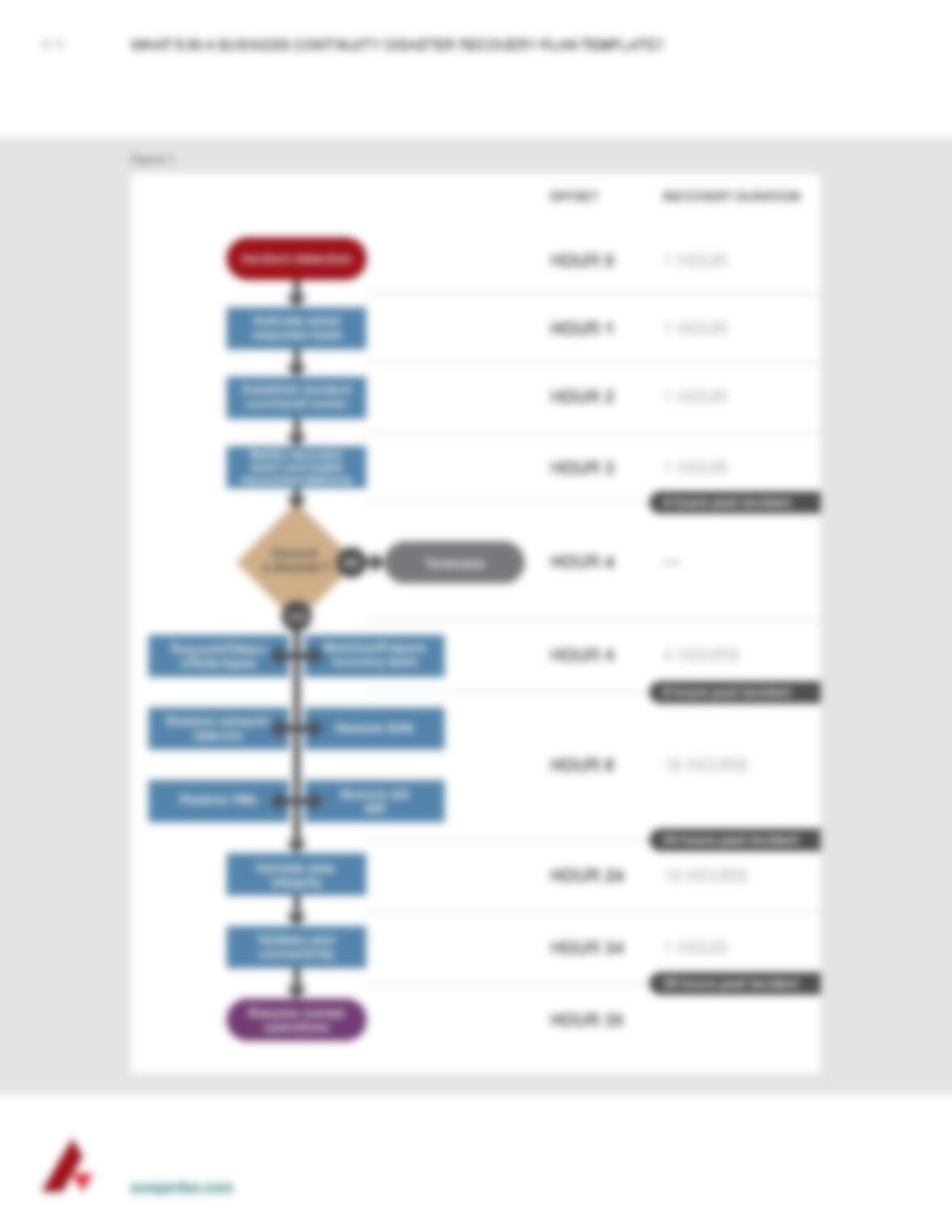
Figure 1 provides an example
timeline for an IT disaster recovery
organization is given below for
critical Tier 1 systems and the
resumption of business operations.
• Critical Vendors and their RTOs:
In this section, a plan may also list