The Purpose and Structure of Financial Markets
FINM32100 & FINM31165 — Financial Markets
by Rom´
eo T´
edongap

1Understand the meaning of the term investment and list the attributes that
distinguish one investment from another.
2Describe the investment process and types of investors.
3Discuss the principal types of investments.
4Identify the basic types of securities markets and describe their characteristics.
5Explain the initial public offering (IPO) process.
6Describe broker markets and dealer markets, and discuss how they differ from
alternative trading systems.
7Review the key aspects of the globalization of securities markets and discuss
the importance of international markets.
8Explain long purchases, margin transactions, and short sales.
Rom´
eo T´
edongap — ESSEC 2 / 63

Investments and the Investment Process
Goal of Investing
The goal of investing is to grow your money to achieve long-term financial goals.
•Investment: any asset into which funds can be placed with the expectation that
it will generate positive income and/or increase its value
•Portfolio: a collection of different investments
•Return: reward from investing
The investment’s choice depends on the investor’s initial wealth, the investor’s
objectives, and the investor’s risk aversion.
Rom´
eo T´
edongap — ESSEC 3 / 63

Investments and the Investment Process
Attributes of Investments
•Securities or Property
•Securities: financial assets, such as stocks, bonds, and options, that
represent claims on the resources of the issuer
•Liquidity: the ability to buy and sell quickly
•Property: real assets that are typically less liquid than securities
•Real property: permanently affixed to the land, such as land,
buildings, and machines
•Tangible personal property: such as gold, artwork, antiques, and
collectables
•Direct or Indirect
•Direct Investment: investor directly acquires a claim/ownership
•Indirect Investment: investor indirectly acquires a
claim/ownership via a professional investment manager (SICAV,
FCP, etc.)
Rom´
eo T´
edongap — ESSEC 4 / 63
Investments and the Investment Process
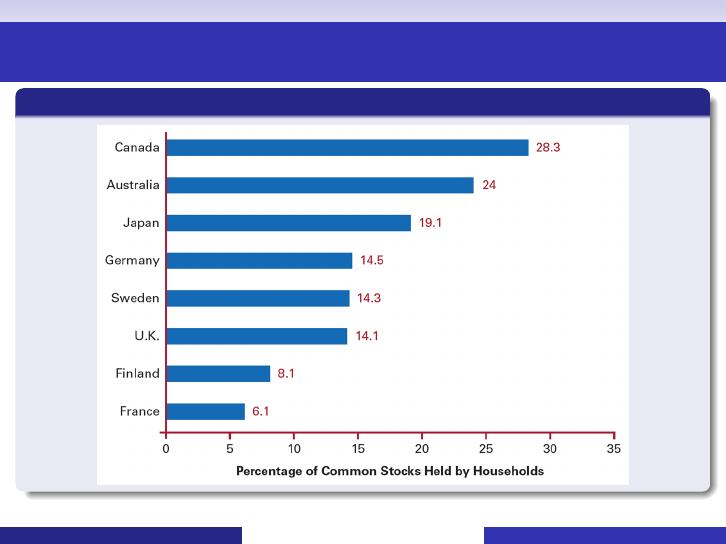
Direct Stock Ownership by Households
Rom´
eo T´
edongap — ESSEC 5 / 63

Investments and the Investment Process
Attributes of Investments
•Debt, Equity, or Derivative Securities
•Debt: investor lends funds in exchange for interest income and
repayment of loan in future (bonds)
•Equity: ongoing ownership in a business or property (common stocks)
•Derivative Securities: neither debt nor equity; derive value from an
underlying asset (options)
•Low- or High-Risk Investments
•Risk: uncertainty surrounding the return that a particular investment will
generate
•Low-risk: more predictable, lower average return
•High-risk: less predictable, higher average return
•Diversification: holding different types of assets in an investment
portfolio
Rom´
eo T´
edongap — ESSEC 6 / 63

Investments and the Investment Process
Attributes of Investments
•Short- or Long-Term Investments
•Short-Term: maturities of one year or less
•Long-Term: maturities of longer than one year
•Domestic or Foreign
•Domestic: securities issued by domestic companies
•Foreign: securities issued by foreign companies
Rom´
eo T´
edongap — ESSEC 7 / 63

Investments and the Investment Process
The Structure of the Investment Process
•Suppliers and Demanders of Funds
•Households
•Some need for loans (house, auto)
•Typically net suppliers of funds
•Government
•Federal, state and local projects & operations
•Typically net demanders of funds
•Businesses
•Investments in production of goods and services
•Typically net demanders of funds
Rom´
eo T´
edongap — ESSEC 8 / 63

Investments and the Investment Process
The Structure of the Investment Process
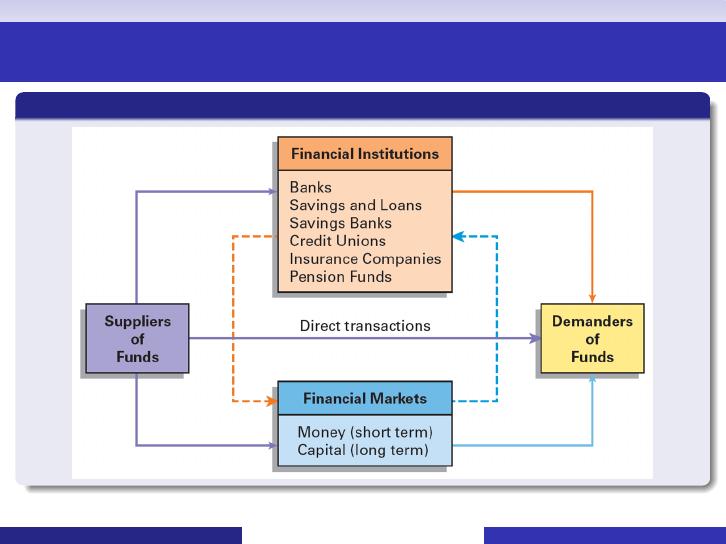
•Bringing Together Suppliers and Demanders of Funds
•Financial Markets: markets in which suppliers and demanders of funds
trade financial assets, typically with the assistance of intermediaries such
as securities brokers and dealers
•Financial Institutions: organizations, such as banks and insurance
companies, that pool the resources of suppliers of funds and use those
funds to make loans to and invest in securities issued by demanders of
funds
Rom´
eo T´
edongap — ESSEC 9 / 63
Investments and the Investment Process
The Investment Process
Rom´
eo T´
edongap — ESSEC 10 / 63

Investments and the Investment Process
The Structure of the Investment Process
•Types of Investors
•Individual Investors: individuals that manage their own funds to
achieve their financial goals
•Usually concentrate on earning a return on idle funds, building a
source of retirement income, and providing security for their
families
•Institutional Investors: investment professionals who earn their living
by managing other people’s money
•Professionals that trade large volumes of securities for individuals,
as well as for businesses and governments
•Includes banks, life insurance companies, mutual funds, pension
funds, and hedge funds
Rom´
eo T´
edongap — ESSEC 11 / 63

Types of Investments
Investors have a large variety of investments to choose from to achieve their
investment goals.
•Short-Term Investments
•Common Stock
•Fixed-Income Securities