Turk 1
Final Portfolio by Hayden Turk
Persuasive Essay
Evening Out the Playing Field:
The Wage and Resource Dispute Between the USMNT and USWNT
The wage and resource dispute between the USMNT (United States Men’s National
Team) and the USWNT (United States Women’s National Team) first arose in 2016. The dispute
confronts the fact that the women on the national soccer team work just as hard to represent their
country and deserve equality to the men’s national team in regards to their resources and wages.
The purpose of this fight is to provide an overall understanding that women can do the same
professions as men and in some cases, excel better in those fields compared to their male
counterpart. In this essay, the goal is to present statistics proving that the USWNT has had more
success in their performances and have brought in more revenue, which in turn earns them not
only
an equal pay grade, but equal resources as well. Presently, the USWNT make a fraction of
what the men do. The ambition for this paper is that the message transcends past professional
sports into the everyday American workplace. As a way to promote this fight for equality, the
1
women’s team asks that their full story be told along with the disclosure of the progress they’ve
made over the past two years; their paycheck should reflect their success.
The USMNT was created in 1916 while the USWNT wasn’t established until the 80’s, so
one would naturally think the men deserved more resources because of their longevity, no? It is
this reasoning that has caused the disparities between the teams. The women not only have more
success than the men, but bring in more revenue to the US Soccer Federation than the men do,
1 “The ambition for this paper is for the message to transcend past professional sports and into the
everyday American workplace.”

Turk 2
therefore deserving equal resources and recognition. Presently, the USWNT make a fraction of
what the men do. Since 2016, multiple articles have been published from The News Times
and
PBS
that not only supply statistics supporting the USWNT’s cause, but have followed their
progress over the years and their lawsuit against the Equal Employment Opportunity
Commission (EEOC). Soccer is the most popular sport in the world with the best fanbase, but
many spectators forget that for professional athletes, playing is their livelihood. To fans, they
may just seem like players, but that is their job! When the USWNT is having as much success as
2
they are and as they have been, their hard work and dedication should not be cheated out of their
paycheck. The USWNT is deserving of equal wage and resources proven by their success rate
over the years.
When this dispute began, the USWNT signed a deal with the US Soccer Federation
regarding playing surfaces. Part of this deal claimed that, “natural grass would be the “preferred”
surface for matches,” instead of artificial turf (Murray, “New Turf Fight Has U.S. Soccer and
Women’s Team at Odds Again”). However, half of their end-of-year matches in 2017 were
scheduled to be played on an artificial surface. The USWNT is not making a big stink about
artificial turf for no reason, many feel that artificial grass is secondary to natural grass by means
of lessening quality of play and increasing safety concerns. Artificial grass is not the only
resource that isn’t distributed fairly between the two teams. Advertising through social media for
the two teams has also been proven biased towards the men. A study has been conducted
analyzing the tweets from the US Soccer Federation’s account before and after the 2011
Women’s World Cup. A gender gap was found to be prominent within the context of the tweets
2 As soccer fans, we need to rally behind our players and support their fight for equal rights in any way
that we can.
Turk 3
sent out by the USSF, as they viewed the USWNT as less important than the USMNT, even
though this research was taken at a time when the Women’s World Cup was current news
and
the Men’s World Cup had taken place a year prior (Coche, “Promoting Women’s Soccer through
Social Media: How the US Federation Used Twitter for the 2011 World Cup”). These two
3
examples clearly show the unfair treatment towards the USWNT by the USSF. Even though an
agreement was made and signed, the USSF are still finding ways to favor the men instead of
giving the women what they deserve in terms of resources and support.
In the United States current equality era, equal payment and resources should be seen as
preliminary. However, when these equality standards are not met, proof is often needed to sway
an audience to comply. The USWNT have had tremendous success at the international level
from their beginning. They have won three Women’s World Cup titles (and have medaled the
years they weren’t crowned champions), four Olympic women’s gold medals, and eight
CONCACAF Gold Cup wins. The men, on the other hand, haven’t even qualified for a World
Cup since 2010 and prior to that, the furthest they lasted in the tournament was the quarterfinals
in 1930 (Santhanam, “Data: How Does the U.S. Women’s Soccer Team Pay Compare to the
Men?”). Letting the team’s records speak for themselves,
the women’s success alone should grant them at least
an
equal wage to the men. If their success isn’t enough for the
US Soccer Federation, maybe they should consider how
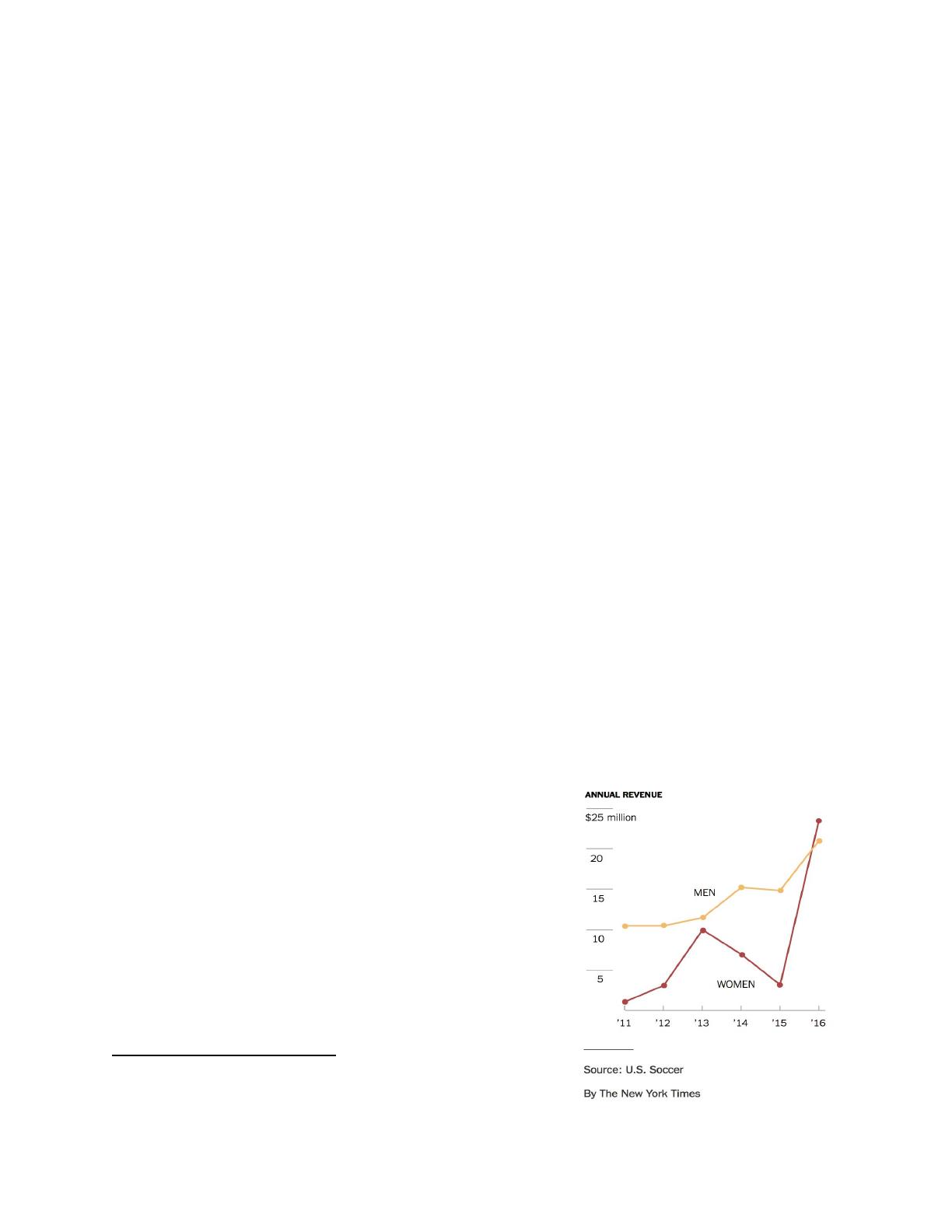
much more money the USWNT is bringing in compared to
the USMNT. As stated by a 2016 USSF Budget Report, “the
3 Social media is how most of us fans receive our information about our team’s success in major
tournaments such as the Women’s World Cup. If the publicity isn’t being evenly proportioned between the
teams, then it’s not only a disservice to the USWNT, but to their fans as well.
Turk 4
women’s team [was] projected to bring in more than $17 million in revenues, including a $5
million surplus for fiscal year 2017, nearly doubling their male counterparts, who [were]
expected to run a deficit,” (Santhanam, “Data: How Does the U.S. Women’s Soccer Team Pay
Compare to the Men?”). Based on these statistics, the USSF can’t fall back on the argument of
4
“trying to run a business” because it seems that the women have been bringing in a surplus of
revenue for US Soccer.
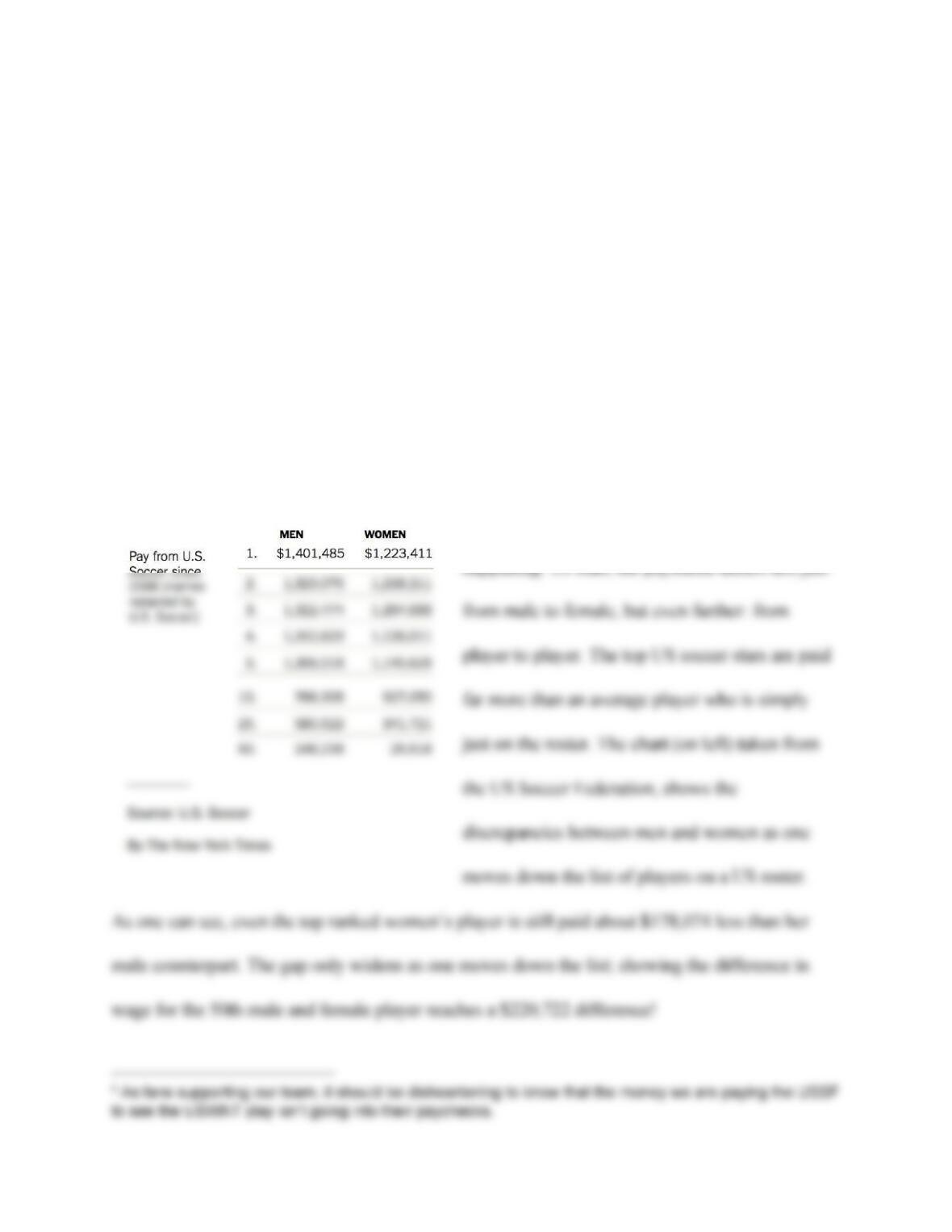
At last, the discussion of the wage discrepancies has arrived. Many people must not
realize the amount of factors that go in to explain just how unfair the payment method is between
the USWNT and the USMNT by the USSF. Simply stating that the women aren’t getting paid as
much is a severe understatement to what is truly