The primary goal of a publically owned corporation is to
Maximize shareholder’s wealth
The prime lending rate is the base rate on
Corporate loans
Money market instruments include
t-bills
The firm obtains cash from which of the following
operations, sale of assets, borrowing- all of the above
All of the following would result in an increase in stockholders equity except
the company purchased treasury stock
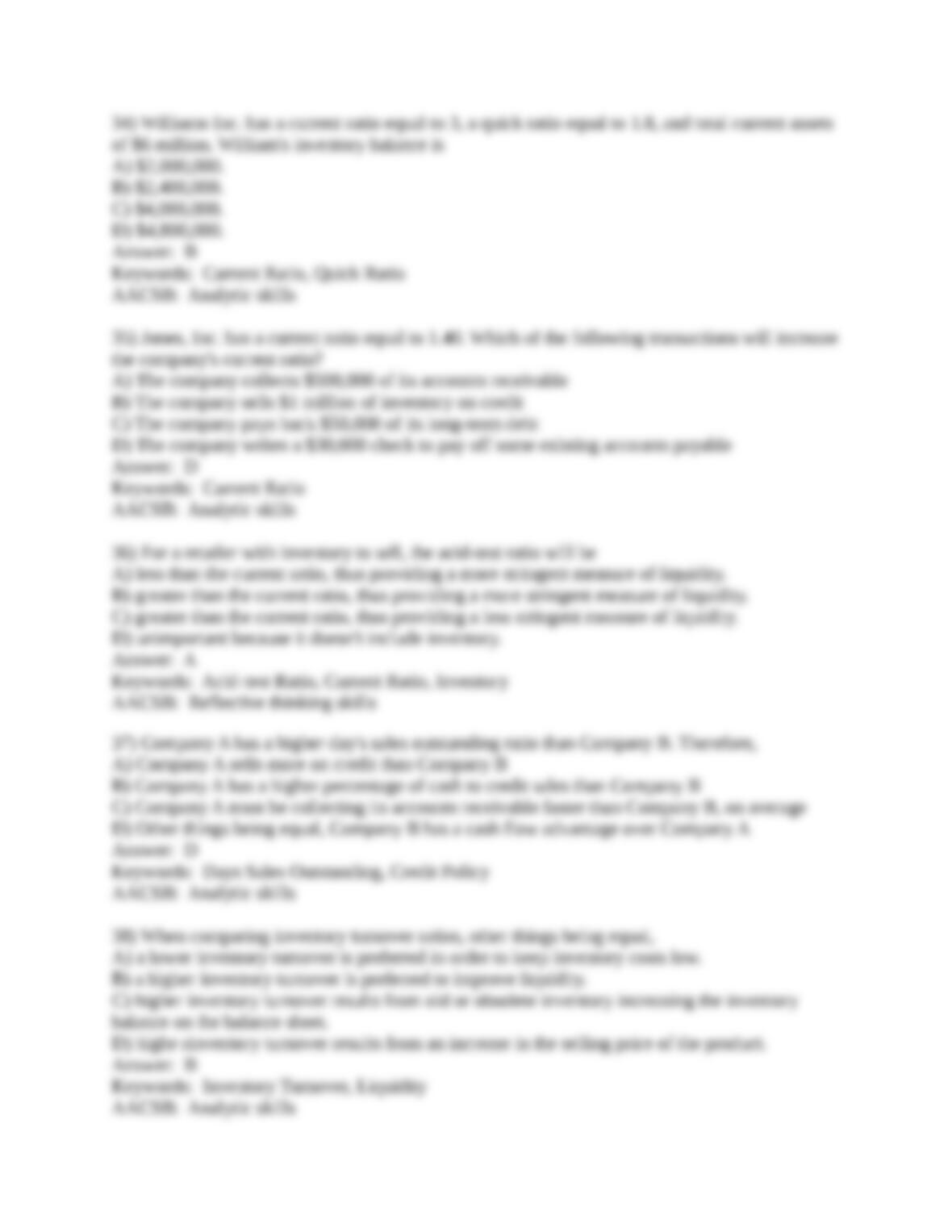
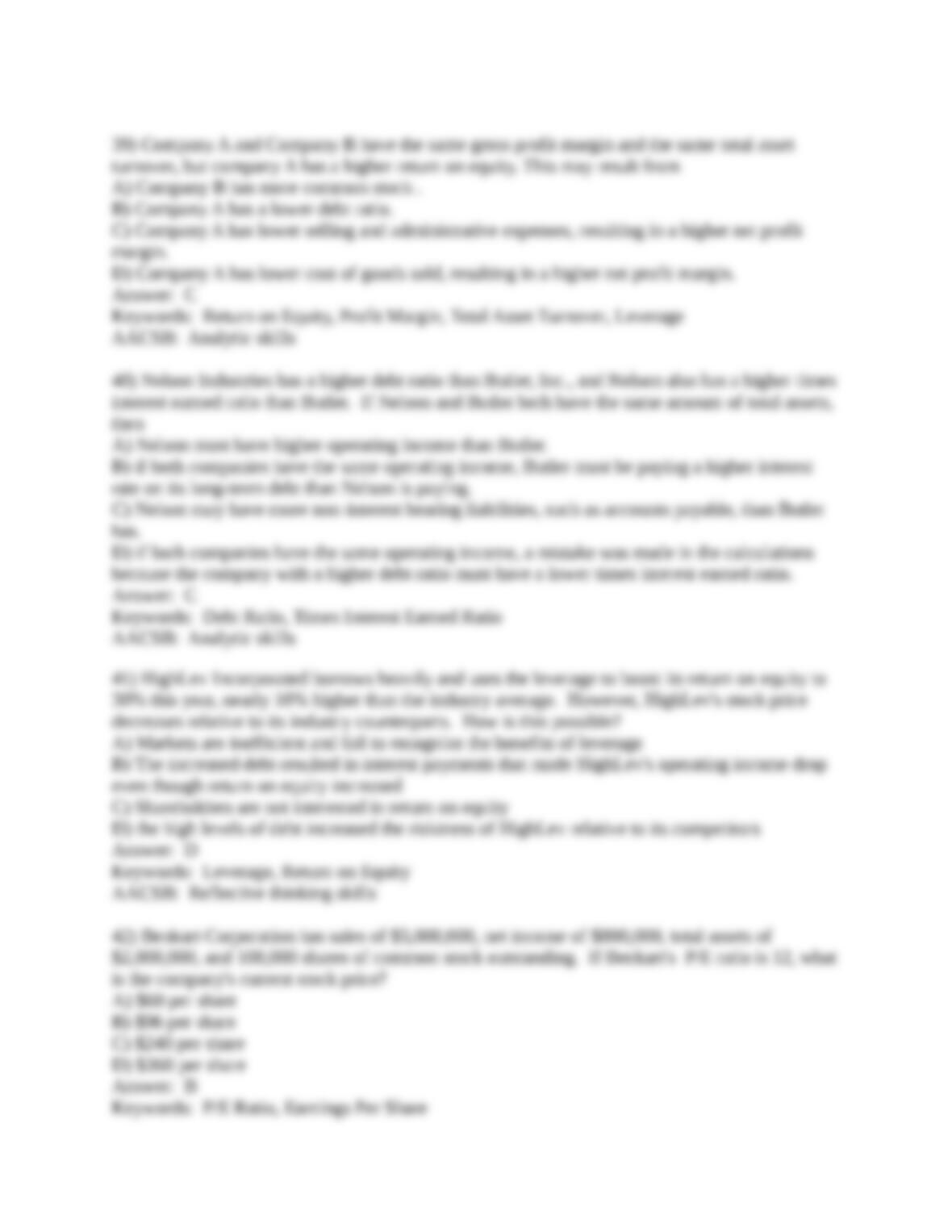
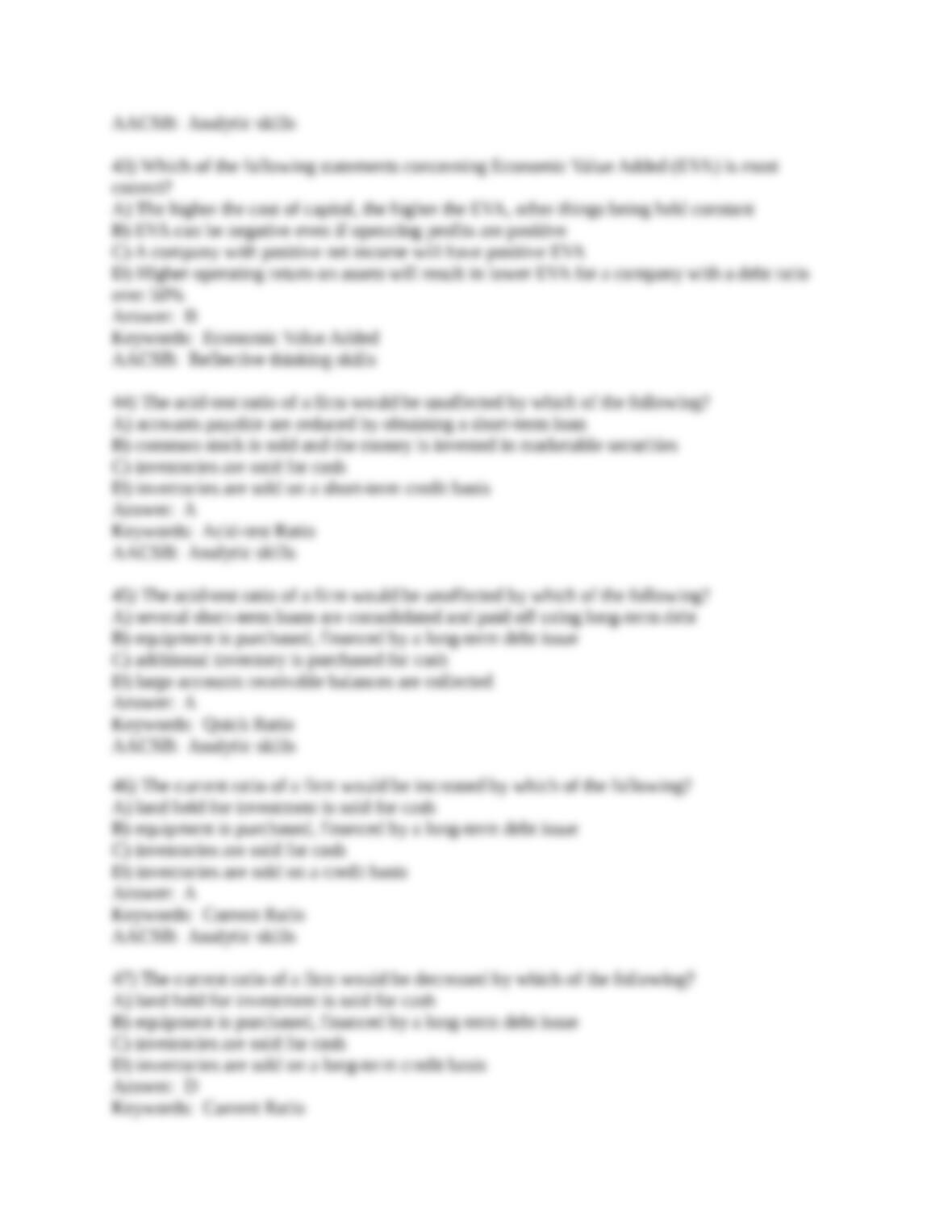
The quick ratio of a firm would be unaffected which of the following
Equipment is purchased, financed by long term debt
The current ratio of a firm would equal its quick ratio whenever
The firm has zero inventory
In an ideal world, which of the following would be used to evaluate firm
performance
Market value of assets
All of the following measure liquidity except
debt ratio
The present value of a single future sum
depends on the number of discount periods
A typical measure for the risk free rate of return is the
US treasury bill rate
A yield to maturity on a bond
is the required rate of return on the bond
The four basic determinants of business risk include all of the following except
the level of fixed cost used in the company‘s production process
All of the following are likely to result in the use of less debt in a company’s
capital structure except
an increase in a company’s marginal tax rate
The net present value always provides the correct decision provided that
capital rationing is not imposed
the calculation of incremental free cash flows over a project’s life should include
labor and mateiral saving and additional revenues
cost of capital is
the rate of return that must be earned on additional investment if firm value is to remain
unchanged
Foundations of Finance, 7e (Keown/Martin/Petty)
Chapter 1 An Introduction to the Foundations of Financial Management
1.1 Learning Objective 1
1) Financial management deals with the maintenance and creation of economic value or wealth.
Answer: TRUE
Keywords: Financial Management
AACSB: Reflective thinking skills
2) Each financial decision made by a corporate manager can be evaluated by its direct impact on
the corporation’s stock price.
Answer: FALSE
Keywords: Goal of the Firm
AACSB: Reflective thinking skills
3) The fundamental goal of a business is to maximize the retained earnings available to the
corporation’s shareholders.
Answer: FALSE
Keywords: Goal of the Firm
AACSB: Reflective thinking skills
4) Shareholder wealth maximization means maximizing the price of the existing common stock.
Answer: TRUE
Keywords: Shareholder Wealth, Goal of the Firm
AACSB: Reflective thinking skills
5) It is important to evaluate a corporate manager’s financial decision by measuring the effect the
decision should have on the corporation’s stock price if everything else were held constant.
Answer: TRUE
Keywords: Goal of the firm, Shareholder Wealth Maximization
AACSB: Reflective thinking skills
6) Corporate managers should accept investment projects that maximize profits int he short run
because of the time value of money.
Answer: FALSE
Keywords: Goal of the Firm, Profits, Time Value of Money
AACSB: Reflective thinking skills
7) The goal of the firm’s financial managers should be the maximization of the total value of the
firm’s stock.
Answer: TRUE
Keywords: Goal of the Firm
AACSB: Reflective thinking skills
8) The payment of a dividend to current shareholders will have no impact on a corporation’s
share price because the cash paid is not available to future potential shareholders who may want
to buy the corporation’s stock.
Answer: FALSE
Keywords: Goal of the Firm
AACSB: Reflective thinking skills
9) One problem with maximization of shareholder wealth as a goal is that it ignores risk taken by
the firm’s financial decisions.
Answer: FALSE
Keywords: Goal of the Firm
AACSB: Reflective thinking skills
10) The goal of profit maximization ignores the risk of financial decisions
Answer: TRUE
Keywords: Goal of the Firm
AACSB: Reflective thinking skills
11) Only a firm’s financial decisions affect its stock prices.
Answer: FALSE
Keywords: Determinants of Stock Price
AACSB: Reflective thinking skills
12) Shareholders react to poor investment or dividend decisions by causing the total value of the
firm’s stock to fall, and they react to good decisions by bidding the price of the stock up.
Answer: TRUE
Keywords: Determinants of Stock Price
AACSB: Reflective thinking skills
13) The primary goal of a publicly owned corporation is to ________.
A) maximize dividends per share
B) maximize shareholder wealth
C) maximize earnings per share after taxes
D) minimize shareholder risk
Answer: B
Keywords: Goal of the Firm, Corporation
AACSB: Reflective thinking skills
14) Maximization of shareholder wealth
A) represents a zero sum game in which one corporation gains at the expense of others.
B) provides benefits to society as scarce resources are directed to their most productive use.
C) is not a practical goal since it cannot be measured effectively.
D) is achieved only if cash flows exceed accounting profits.
Answer: A
Keywords: Goal of the Firm, Maximize Shareholder Wealth
AACSB: Reflective thinking skills
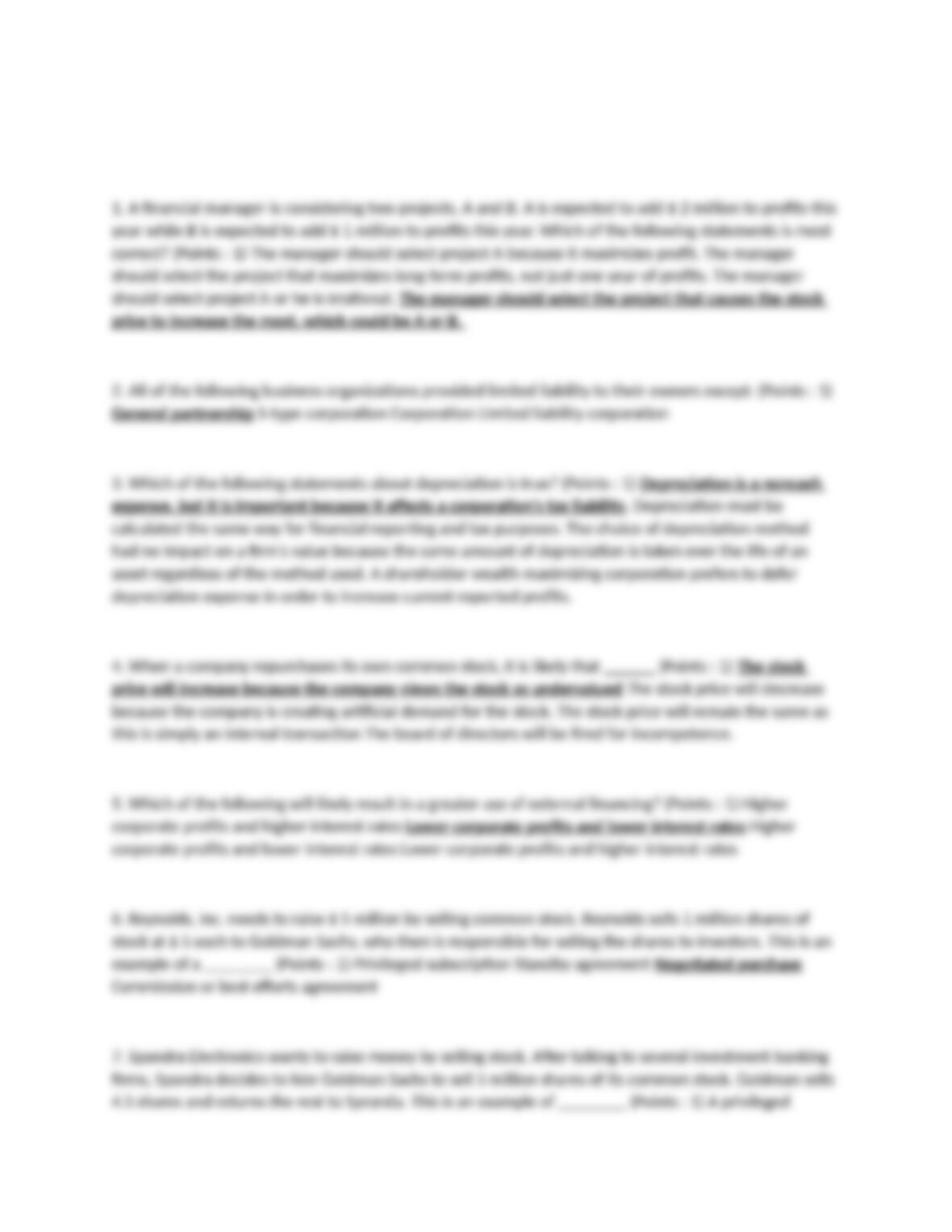
15) A financial manager is considering two projects, A and B. A is expected to add $2 million to
profits this year while B is expected to add $2 million to profits this year while B is expected to
add $1 million to profits this year. Which of the following statements is most correct?
A) The manager should select project A because it maximizes profits.
B) The manager should select the project that maximizes long-term profits, not just one year of
profits.
C) The manager should select project A or he is irrational.
D) The manager should select the project that causes the stock price to increase the most, which
could be A or B.
Answer: D
Keywords: Goal of the Firm
AACSB: Analytic skills
16) Shareholder wealth maximization means
A) maximizing earnings per share.
B) maximizing dividends per share.
C) maximizing the price of existing common stock.
D) maximizing stockholders equity.
Answer: C
Keywords: Goal of the firm, Shareholder Wealth Maximization
AACSB: Reflective thinking skills
17) The goal of the firm should be
A) maximization of profits (net income per share).
B) maximization of shareholder wealth.
C) maximization of market share.
D) maximization of sales.
Answer: B
Keywords: Goal of the Firm, Maximize Shareholder Wealth
AACSB: Reflective thinking skills
18) Which of the following goals of the firm are synonymous (equivalent) to the maximization of
shareholder wealth?
A) profit maximization
B) risk minimization
C) maximization of the total market value of the firm’s common stock
D) none of the above
Answer: C
Keywords: Goal of the Firm, Maximize Shareholder Wealth
AACSB: Reflective thinking skills
19) Which of the following is the most important goal that a corporation should strive for?
A) Maximize current profits.
B) Maximize market share.
C) Maximize revenue.
D) Maximize shareholder wealth.
Answer: D
Keywords: Goal of the Firm, Maximize Shareholder Wealth
AACSB: Reflective thinking skills
20) One of the causes of the recent financial crisis in the United States has been excessive risk
taking due to underestimation of risk. HOw does this relate to financial leverage? Can
overestimation of risk also be detrimental?
Answer: Underestimation of risk can lead managers to borrow excessively to fund more and
more projects. High levels of debt require interest and principal payments which may become
impossible to make if the company’s cash flows are reduced, even for short periods of time.
Overestimation of risk can also be problematic. Managers who take on too little risk may be
passing up desirable projects that could increase shareholder wealth. The principle that risk
requires a return does not mean that all risk is bad, but rather that additional risk is ok if
additional expected returns are high enough. If all risk was bad, companies would go out of
business and all investors would buy U.S. Treasury Bills.
Keywords: Risk Requires a Return, Goal of the Firm
AACSB: Reflective thinking skills
21) Documents uncovered after the Exxon Valdez oil spill in Alaska revealed that Exxon could
have used double-hulled oil tankers that would have prevented the spill, but the cost of refitting
their fleet of single-hulled tankers was considered too high. Exxon determined that the cost of
cleaning up an oil spill would be less than the cost of refitting the ships, thus increasing
shareholder value. Several years after the oil spill, however, Exxon was fined billions of dollars
for the spill. How do the costs of the clean up and the fines pertain to a discussion of
maximizing shareholder value and ethical responsibility?
Answer: Managers are supposed to maximize shareholder value. Exxon’s analysis of the costs
of an oil spill versus the cost of improving their tankers seems to have been a reasonable one at
the time it was undertaken. The social costs of killing birds and fish were expected to be low.
The outrage at Exxon’s conduct and the subsequent large fines will change the estimation of
future costs for similar situations. Managers need to consider the impact of their decisions on
their companies’ cash flows. Socially undesirable activities may lead to boycotts, protests, lower
sales, fines, etc. These costs must be included in their analyses. Society sets limits within which
corporations must operate or the corporations, and their shareholders, will suffer. Therefore,
acting in ethical and socially responsible ways is congruent with the goal of shareholder wealth
maximization.
Keywords: Goal of the Firm, Maximizing Shareholder Value, Ethical Responsibility, Cash Flow
AACSB: Reflective thinking skills
1.2 Learning Objective 2
1) When making financial decisions, managers should always look at marginal, or incremental
cash flows.
Answer: TRUE
Keywords: Marginal or Incremental Cash Flows
AACSB: Reflective thinking skills
2) An investment project is acceptable if the total cash received over the life of the project
exceeds the total cash spent over the life of the project.
Answer: FALSE
Keywords: Cash Flow, Time Value of Money
AACSB: Reflective thinking skills
3) If two companies have the same net income and the same level of risk, they must also have the
same stock price or the market is not in equilibrium.
Answer: FALSE
Keywords: Net Income, Risk, Timing of Cash Flow
AACSB: Analytic skills
4) Profits represent money that can be spent, and as such, form the basis for determining the
value of financial decisions.
Answer: FALSE
Keywords: Profits, Cash Flow
AACSB: Reflective thinking skills
5) The root cause of agency problems is conflicts of interest.
Answer: TRUE
Keywords: Agency Problems, Conflicts of Interest
AACSB: Reflective thinking skills
6) Investors will be indifferent between two investments if both investments have the same
expected return.
Answer: FALSE
Keywords: Risk-Return Tradeoff
AACSB: Reflective thinking skills
7) If the stock market is efficient, then investors do not need to read the Wall Street Journal or
research companies before they select which stocks to buy because market prices already reflect
all publicly available information.
Answer: FALSE
Keywords: Efficient Markets
AACSB: Analytic skills
8) Giving the company’s CEO stock options as part of his or her compensation package is an
example of an agency cost.
Answer: TRUE
Keywords: Agency Costs
AACSB: Reflective thinking skills
9) Cash flows and profits are synonymous; in other words, higher cash flows equal higher
profits.
Answer: FALSE
Keywords: Cash Flow, Profit
AACSB: Reflective thinking skills
10) Shareholder selection committees select potential board of director nominees ensuring that
board members will monitor management sufficiently to protect shareholder interests.
Answer: FALSE
Keywords: Agency Problems, Board of Directors
AACSB: Reflective thinking skills
11) Managers should not be concerned with business ethics because ethical behavior is
inconsistent with the primary goal of maximizing shareholder value.
Answer: FALSE
Keywords: Ethics, Goal of the Firm
AACSB: Ethical understanding and reasoning abilities
12) One of the problems associated with maximization of total current stock value is that it
ignores the timing of a project’s return.
Answer: FALSE
Keywords: Maximizing Shareholder Value, Timing of Returns
AACSB: Reflective thinking skills
13) The risk-return tradeoff is seen in many areas of finance.
Answer: TRUE
Keywords: Risk, Return
AACSB: Reflective thinking skills
14) The risk/return tradeoff implies that the return on a riskless asset must be zero.
Answer: FALSE
Keywords: Risk-Return Tradeoff
AACSB: Reflective thinking skills
15) The sole proprietorship has no legal business structure separate from its owner.
Answer: TRUE
Keywords: Sole Proprietorship
AACSB: Reflective thinking skills
16) An efficient market is one where the prices of the assets traded in that market fully reflect all
available information at any instant in time.
Answer: TRUE
Keywords: Efficient Markets
AACSB: Reflective thinking skills
17) The opportunity cost of any choice you make is the highest-valued alternative that you had to
give up when you made the choice.
Answer: FALSE
Keywords: Opportunity Cost, Time Value of Money
AACSB: Reflective thinking skills
18) The five basic principles of finance include all of the following except:
A) Cash flow is what matters.
B) Money has a time value.
C) Risk requires a reward.
D) Incremental profits determine value.
Answer: D
Keywords: Basic Principles of Finance
AACSB: Reflective thinking skills
19) Suppose XYZ Corporation is traded on the New York Stock Exchange. XYZ’s closing price
on Monday is $20 per share. After the market closes on Monday, XYZ makes a surprise
announcement that it has obtained a major new customer. XYZ’s stock will likely
A) open at $20 per share on Tuesday and then increase as more investors read the announcement
in the Wall Street Journal.
B) remain at $20 per share because in efficient markets the price already reflects all information.
C) open above $20 because the positive news will result in a higher valuation even though the
stock has not yet traded.
D) open below $20 because the surprise announcement creates more uncertainty.
Answer: C
Keywords: Efficient Markets
AACSB: Analytic skills
20) A corporate manager decides to build a new store on a lot owned by the corporation that
could be sold to a local developer for $250,000. The lot was purchased for $50,000 twenty years
ago. When determining the value of the new store project,
A) the cost of the lot is zero since the corporation already owns it.
B) the opportunity cost of the lot is $250,000 and should be included in calculating the value of
the project.
C) the cost of the lot for valuation purposes is $50,000 because land does not depreciate.
D) the incremental cash flow should be the $50,000 original cost less accumulated amortization.
Answer: B
Keywords: Opportunity Cost
AACSB: Analytic skills
21) To measure value, the concept of time value of money is used
A) to determine the interest rate paid on corporate debt.
B) to bring the future benefits and costs of a project, measured by its expected profits, back to the
present.
C) to bring the future benefits and costs of a project, measured by its cash flows, back to the
present.
D) to ensure that expected future profits exceed current profits today.
Answer: C
Keywords: Time Value of Money, Cash Flows
AACSB: Reflective thinking skills
22) A financial manager is evaluating a project which is expected to generate profits of $100,000
per year for the next 10 years. The project should be accepted if
A) the cost of the project is less than $1,000,000.
B) the cost of the project is less than the present value of $100,000 per year for 10 years.
C) this project’s expected profits are higher than any other projects the corporation has available.
D) the present value of the project’s cash inflows exceeds the present value of the project’s cash
outflows.
Answer: D
Keywords: Time Value of Money, Cash Flows
AACSB: Analytic skills
23) Investors want a return that satisfies the following expectations:
A) A return for delaying consumption
B) An additional return for taking on risk
C) An additional return for accepting dividends rather than capital gains
D) Both A and B.
Answer: D
Keywords: Risk, Return
AACSB: Reflective thinking skills
24) The expected return on a riskless asset is greater than zero due to
A) an expected return for delaying consumption.
B) an expected return for opportunity costs.
C) an expected return for taxes.
D) irrational investors who believe risk is always present.
Answer: A
Keywords: Risk-Return Tradeoff
AACSB: Reflective thinking skills
25) Joe, a risk-averse investor, is trying to choose between investment A and investment B. If
investment A is riskier than investment B and Joe selects investment A anyway, then
A) the actual return for investment A will be higher than the actual return for investment B.
B) the actual return for investment A will be higher than the expected return for investment B.
C) the expected return for investment A will be higher than the actual return for investment B.
D) the expected return for investment A will be higher than the expected return for investment B.
Answer: D
Keywords: Risk-Return Tradeoff
AACSB: Analytic skills
26) The principle of risk-return tradeoff means that
A) higher risk investments must earn higher returns.
B) an investor who takes more risk will earn a higher return.
C) a rational investor will only take on higher risk if he expects a higher return.
D) an investor who bought stock in a small corporation five years ago has more money than an
investor who bought U.S. Treasury bonds five years ago.
Answer: C
Keywords: Risk-Return Tradeoff, Expected Return, Actual Return
AACSB: Reflective thinking skills
27) Project A is expected to generate positive cash flow of $1 million in 10 years while Project B
is expected to generate $500,000 in 5 years. Therefore,
A) Project A is preferred because shareholder value is based on cash flow.
B) Project B is preferred because its cash flow is expected to be received sooner than the cash
flow from Project A.
C) Both projects have equal value because they average $100,000 per year.
D) Project B may be preferred to Project A if the opportunity cost of money is high enough.
Answer: D
Keywords: Time Value of Money
AACSB: Analytic skills
28) Company A reports sales of $100,000 and net income of $15,000. Company B reports sales
of $100,000 and net income of $10,000. Therefore,
A) Company A’s cash flow may be higher or lower than Company B’s cash flow even though A’s
net income is higher.
B) Company A’s cash flow is $5,000 more than Company B’s cash flow.
C) Company B is creating less value for its shareholders than Company A.
D) Company B’s accounts receivable must be higher than Company A’s accounts receivable.
Answer: A
Keywords: Cash Flow, Net Income
AACSB: Analytic skills
29) Profits are down so the controller decides to change the corporation’s accounting policy
relating to inventory costing. The change will allow the corporation to report higher income and
higher assets, although the physical inventory has not changed. Which of the following
statements is most correct?
A) The stock price is likely to increase because income is higher.
B) The stock price is likely to be unaffected because the stock market is efficient.
C) The stock price is likely to decrease because reported inventory is higher.
D) If the stock price increases, the stock market is efficient.
Answer: B
Keywords: Efficient Markets
AACSB: Analytic skills
30) All of the following statements about agency problems are true except:
A) Agency problems interfere with the goal of maximizing shareholder value.
B) Agency costs are paid by the managers who do not act in the shareholders’ best interest.
C) Agency problems result from the separation of management and the ownership of a firm.
D) The root cause of agency problems is conflicts of interest.
Answer: B
Keywords: Agency Problems