FIN 442 TEST 1 NOTES
What is Liability?
Liability Loss- Any loss that a person/org. sustains as a result of a claim or suit against that person/org. by someone
seeking damages or some other legal remedy permitted by law
– someone experienced the loss and you are responsible for covering the loss. Some kind of law suit or claim.
3rd Party coverage – I didn’t directly experience the loss, someone else experienced the loss or damage and I am
responsible for assessing and paying the loss.
1st party coverage – I (insured) experience the loss. Something happens to my property. Not what we are discussing.
Something happens to my stu&, not covered.
Liability Insurance : They will provide and pay for a defense. Defense costs will be covered whether we (insured) are held
responsible or not.
Defense can be addressed in two ways:
–Reducing the limits – within the limits (my policy will only pay out a certain dollar amount for certain loss)
–In addi&on to limits – The costs that are born due to the defense don’t reduce the limits.
Liability can come from a criminal case (involves the state pressing charges, payment of ,ne, jail, or death, or other
monetary punishments) (Insurance policies do not deal with criminal cases) or civil case (Insurance policies deal with civil
cases).
EX: OJ Simpson case. He was charged with murder (criminal component) Criminal court said there wasn’t
suffcient informa3on so he got away with that. The civil court he lost in and was ultimately responsible for paying out
the damages.
– Liability can come from torts, contracts, or statutes.
Product Liability: on average will cost us 3.1M. Manufacturer could be responsible for a loss and damage to others.
Employment Prac&ces Liability: employer sexually harasses employees, or only hire males or white people. Liability that
stems from the employees
Basis for legal Liability:
Torts: wrongful act or omission, other than a crime or breach of contract, that invades a legally protected right
– we have certain rights but the problem is that someone may violate someone’s rights. I didn’t take the
reasonable steps to avoid injuring someone or damaging.
All three torts are eligible for insurance
– Negligence
Duty owed to another person
Breach of that duty
Close causal connec3on between the negligent act (breach) and resul3ng harm
Occurrence of actual loss or damage of a type recognized by law and measurable in monetary terms
–Can be sued as an individual or an organiza3on. Have to have a duty owed to someone, have to have a
certain obliga3on or expecta3on. You have to have a breach of that duty – failed to put a product that was
safe out, supposed to make sure you aren’t tex3ng and driving but you didn’t do that so there is a breach in
duty. Have to have close causal connec3on between whatever you did and the harm.
–Ex: I make lawnmowers and there is a defect in the motor. Some guy and riding it and it just stops. The guy
says he needs to go get a lawnmower now and gets hit by a car while on his way to get a new lawnmower.
There is no rela3onship between the battery dying and the car accident.
– Inten&onal torts – Tort committed by a person who foresees (or should be able to foresee) that his/her act
will harm others
Does not require hos3le intent / malice
Should have been foreseeable
– Strict liability torts – Liability imposed by a court or by a statute in the absence of fault (i.e., when the
defendant was not negligent and did not intend to harm).
Ultra hazardous ac3vi3es (blas3ng, use of dangerous chemicals)
Dangerously defec3ve products (malfunc3oning smoke detectors; poorly manufactured 3res)
Abnormally dangerous instrumentali3es (dynamite, wild animals)
–I can be held liable even if I did nothing wrong. I can be held liability due to the fact that I am simply involved
in doing some activity. Every state has their own rules for strict liability.
Could also be negligent?
–Workers compensation: Employer is legally and ,nancially liable for my employee’s injuries. Does not fall
under health insurance because the employer is liable… A form of liability insurance.
Contracts:
–Breach of contract
Failure, without legal excuse, to ful,ll a contractual promise
–Hold harmless agreement
Contractual provision that obligates one of the parties to assume the legal liability of another party
–Contractual liability
Liability assumed through a hold-harmless agreement
Statutes
–Workers compensation
–Other statutes that de,ne legal duties and standards of care.
duties imposed by statute or ordinance may be used as evidence of a person’s duty of care in a tort action
Statutes can impose legal liability on individuals/organiza3ons
Commercial Liability Loss Exposures
•Commercial liability loss exposures are poten3al losses that can arise when an organiza3on is held to be
,nancially responsible to another individual or organiza3on for Bodily Injury (BI) or Property Damage (PD).
•Any situa3on that could result in a loss whether it has happened or didn’t happen. Iden3,ca3on is the most
important. Iden3fy the exposure.
•Most section of the policy are typically dealing with BI or PD ( bodily injury, Property Damage)
Premises and Opera&ons Liability Loss Exposures
–BI or PD caused either by:
•(1) an accident that occurs on an organiza3on’s owned, leased, or rented premises or
•(2) by an accident that arises out of the organiza3on’s ongoing (uncompleted) opera3ons but
away from the premises (i.e., accident o& premises, but due to regular opera3ons)
–Generally includes BI/PD arising out of use of mobile equipment (bulldozers, cranes, etc.) , but not
automobiles
–Also does not cover employee injury
–Occurs on the premises.
EX: woman goes to department store and wants an chair and reaches to the top shelf to get it and it
falls and injures her. She was injured on the premises. EX: Slip and fall in a puddle in a convenience
store.
EX: Storage facility that allows visitors to visit and someone gets hit by a forkliF Premises liability.
EX: CVS has an outside vendor that brings products into the store. The soF drink rep hits someone
with the handcart. They can still be held responsible operation coverage.
–ForkliF is considered mobile equipment Business auto policy that covers mobile equipment.
–Don’t have coverage for employee injury because of a worker’s compensation policy.
Products and Completed Opera&ons Liability
Products Liability: Liability that arises out of the manufacture, distribution, or sale of an unsafe, dangerous, or defec3ve
product and the failure of the manufacturer, distributor, or retailer to meet its legal duties to the user or consumer of the
product
–In actions for product liability, injured party (plain3&) must prove:
Defendant failed to take reasonable care in the design, manufacture, distribu3on, or sale of the
article that caused injury
–If lawsuit is based on strict liability, conduct is irrelevant – plain3& must prove 3 things:
1. Product was defec3ve when it leF the manufacturer’s or supplier’s custody or control
2. The defec3ve condition made the product unreasonably dangerous
3. The defec3ve product was the proximate cause of the plain3&’s injury
Completed Opera3ons: Legal responsibility of a contractor, repairer, or other en3ty for BI or PD
arising out of the en3ty’s completed work
Covers products I make and opera3ons that have been completed. If you are hired to build a building, and anything
happens while you are still building then it is considered opera3ons,
– if it is ,nished it is considered completed opera3ons.
–If deck collapses aFer it is built then it is considered completed.
–Microwaveable Popcorn Company got sued because some guy said he had popcorn lung. He ate popcorn 2
3mes a day for years and thinks he got toxins in his lungs because of the popcorn toxins Products liability.
Make sure the defendant took the correct care in the use of product.
Auto Liability
–Legal responsibility for BI or PD arising out of ownership, maintenance, or use of automobiles
–A person who negligently furnishes a defec3ve auto to another person may be held liable to a third person
injured as a proximate result of the defect
–A person who negligently entrusts an auto to a person who is unskilled in its opera3on or otherwise
incompetent to operate it may be held directly liable for resulting injuries
Insured can be held responsible for someone using their auto, whether they are trained or not trained, intoxicated. If I
allow an employee to drive a vehicle and they do something, then I as an employer can be held legally liable for the
damages they cause.
Workers Compensa&on (WC) and Employers Liability
Occupa3onal injury or illness to all employees subject to the law (imposed by statute)
“Exclusive Remedy”
1. The only remedy available to an injured employee under WC is to recover, on a no-fault
basis, the bene,ts required by the applicable statute.
Under some instances, an employee (EE) may make tort claim against an employer (ER)
1. Injury inten3onally caused by ER
2. Loss of consor3um due to EE injury caused by ERs negligence
3. Injury resulting from ERs negligence while acting in some capacity other than ER
–Compensaon for someone that is injured on the job and the employer is responsible.
–Exclusive remedy: how the person is indemni,ed WC. State statute will dictate what the bene,ts will be.
–Contributory negligence: an individual gets injured, if a court ,nds that they are even 1% responsible to their
injury, they can receive nothing.
–Employers Liability: an employee or someone related to the employee has the ability to sue. As an employee
if you are inten3onally injured by an employer then you can sue, loss of consor3um: the injured workers
family sues due to medical costs and strain on the family because of the injury. When the employer is acting
in a di&erent capacity than an employer: I get injured and there is a nurse on sta& and she try’s to assist me
and makes the injury much worse, they weren’t acting as an employer and employee rela3onship, but that
she provided medical service.
Commercial Liability Risk control
Risk control
–Reduces frequency or severity of losses
Why have a risk control program?
–Liability exposures can cause harm/injury/death to others
–Liability can result in signi,cant ,nancial consequences for the organiza3on
–Poor safety, accidents, injuries, etc. can result in reputa3onal damage
•Dealing with risk ,nancing. How do we cover a loss once a loss has already happened.
•Poor safety, accidents, injuries, etc. can result in reputa3onal damage. Target breach of security. Lot’s of
customers said they wouldn’t shop at Target anymore because they couldn’t trust them when using a credit card.
Pre-Accident Risk Control Techniques
–Considera3ons: cost-e&ec3veness; legal requirements; insurer requirements; reputa3on; organiza3onal
risk aversion
–Loss preven3on (reduce frequency)
–Loss reduc3on (reduce severity)
–Avoidance P(Loss) = 0
–Non-insurance risk transfer
Post-Accident
–Claim management – technique of mi3ga3ng the e&ects of losses aFer they occur
–Informa3on collection and dissemina3on
Controlling Liability Losses
–Premises Liability
Regular inspec3ons; maintenance programs; policies and procedures; protec3on (i.e., sprinklers,
alarms, etc.); type of business (manufacturing or retail)
a lot easier to control. You can control what happens on your property.
–O&-Premises Opera3ons
Complex – easier to control what happens at your loca3on than at the loca3on of others
not a lot of control in that environment. Guy is doing window washing and is on a sca&olding. He
drops a bucket on someone’s head. There could be rules on where the bucket should be placed.
–Motor Vehicle Liability
Control over one’s own driving
Safe-driver policies and procedures; driver selection criteria; training and educa3on; substance
abuse tes3ng; consistent disciplinary procedures
similar to premises because you have control of the ability to drive but don’t have the ability of
control when someone else is driving.
–Products-Completed Opera3ons: you have to go through certain processes to make sure the product that
you are puNng out into the world is safe.
Consistent disciplinary procedures: important because you don’t want employees to think you are treating
each other not equal. And important because if you aren’t consistent then your employees don’t know what
is exactly expected and they don’t know how you will respond the next 3me someone gets in an accident.
Issue for any org. that manufactures or sells products and/or services
Commitment to: research; tes3 ng; quality control; adherence to manufacturing policies and
procedures; clear instruc3 ons for EEs; documenta3 on of test/research results;
documenta3 on of product lot numbers
additional considera3ons: behavior of consumers; changing laws; poten3al for batch of products to be
defec3ve
–WC and Employers Liability
WC oFen represents highest-cost liability
Culture of safety; considera3on of riskiness of di&erent jobs and application of loss preven3on; post–
accident claim management is important; transi3onal duty program; post-loss inves3ga3ons; drug
and alcohol tes3ng
–Technology and Communica3on
1. Cyber-risk liability coverage
2. Methods of risk control include: ,rewalls and an3virus soFware; policies and procedures
with respect to computers and communica3on devices; pre-loss planning; reviews of
website content
Insurance policy refresher
Common Parts of an Insurance Policy:
Declara3ons: who, what, where, when, info about coverages and limits, info about the loca3on we are insuring
De,ni3ons: explana3ons for di&erent wording and parts of the policy
Insuring Agreement: Promises that the insurance company makes to the insured
–Open perils: Everything is covered unless it is speci,cally excluded (CGL)
–Named perils: Only cover the stu& that we name
condition: Stu& that is expected of the insured.
Exclusions: Stu& that is not covered
–Endorsed v. Unendorsed
–Standard v. Nonstandard (manuscript)
Occurrence v. Claims-Made Policies
• For each of the following examples, assume that each policy begins on 1/1/XX and that each policy ends on 12/31/XX
De4ni&ons
• Occurrence
Covers claims that arise out of damage/injury that took place during the policy period, regardless of when the
claim is made
In other words, the policy that responds is the policy that was in force when the BI/PD took place
• Claims Made
Requires that the claim must be made during the policy period
So, in its simplest form, it doesn’t matter when the BI/PD occurs. The policy that responds is the policy that is in
force when the claim is made.
1. Simple Example
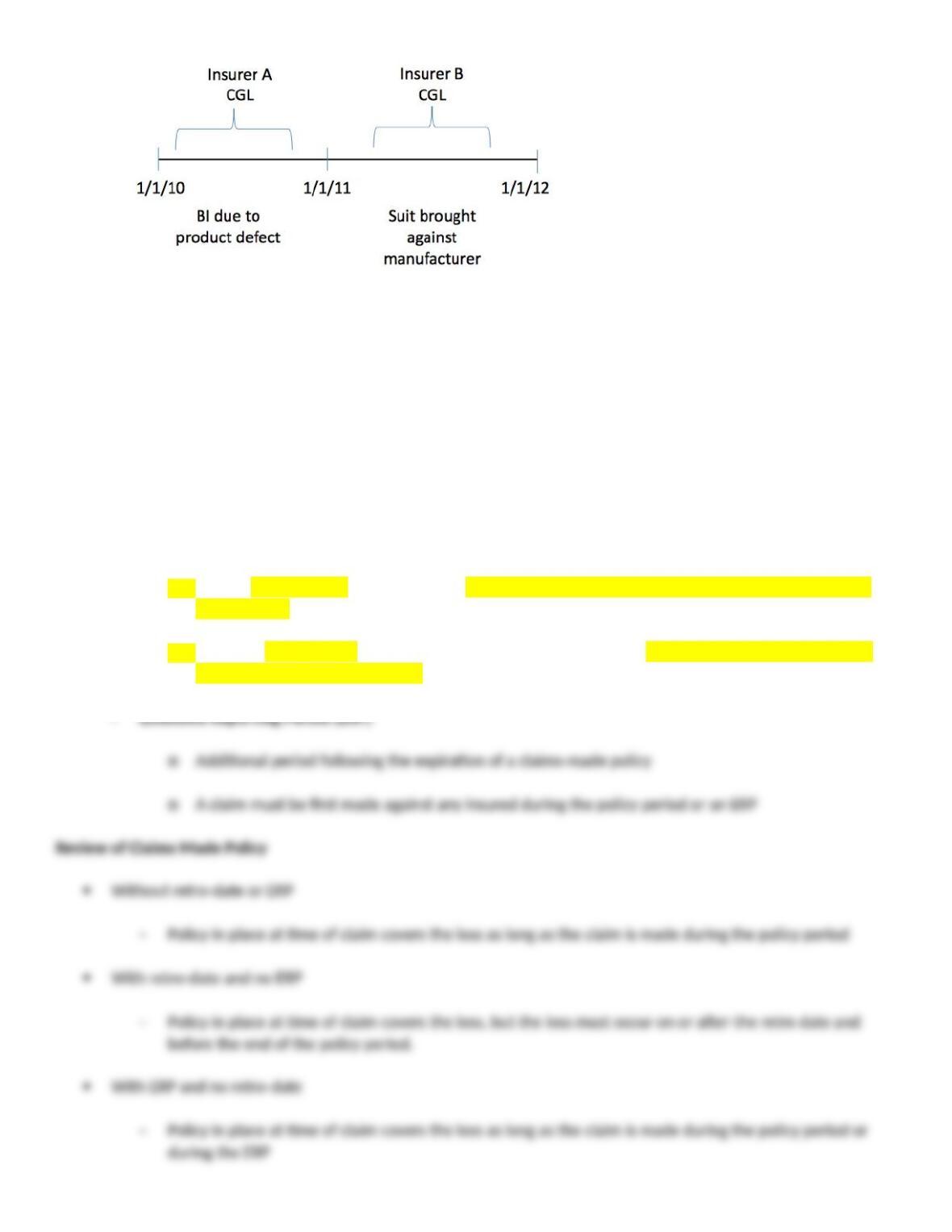
Which policy responds if both have occurrence triggers? Policy A (When did the BI and PD occur?)
Which policy responds if both have claims-made triggers (assume no retro-date and no ERP)? – Policy B
(When BI occurred and suit was brought on)
The simple example assumes:
– There is no retroac3ve date
– There is no extended repor3ng period
These two features can greatly impact whether coverage exists under a given policy!
Retroac&ve Date
oIf there is a retro-date, the BI/PD must occur on or aFer the retro-date, but before the end of the
policy period
oIf there is no retro-date, the BI/PD can occur at any 3me and the policy in place at the 3me of the
claim will cover the covered loss