Chapter Twenty Four
Futures and Forwards
Chapter Outline
Introduction
Forward and Futures Contracts
Spot Contracts
Forward Contracts
Futures Contracts
Forward Contracts and Hedging Interest Rate Risk
Hedging Interest Rate Risk with Futures Contracts
Microhedging
Macrohedging
Routine Hedging versus Selective Hedging
Macrohedging with Futures
The Problem of Basis Risk
Hedging Foreign Exchange Risk
Forwards
Futures
Estimating the Hedge Ratio
Hedging Credit Risk with Futures and Forwards
Credit Forward Contracts and Credit Risk Hedging
Futures Contracts and Catastrophe Risk
Futures and Forward Policies of Regulators
Summary
21
Solutions for End-of-Chapter Questions and Problems: Chapter Twenty Four
1. What are derivative contracts? What is the value of derivative contracts to the managers of
FIs? Which type of derivative contracts had the highest volume among all U.S. banks as of
September 2003?
Derivatives are financial assets whose value is determined by the value of some underlying asset.
As such, derivative contracts are instruments that provide the opportunity to take some action at
a later date based on an agreement to do so at the current time. Although the contracts differ, the
price, timing, and extent of the later actions usually are agreed upon at the time the contracts are
arranged. Normally the contracts depend on the activity of some underlying asset.
The contracts have value to the managers of FIs because of their aid in managing the various
types of risk prevalent in the institutions. As of September 2003 the largest category of
derivatives in use by commercial banks was swaps, which was followed by options, and then by
futures and forwards.
2. What has been the regulatory result of some of the misuses by FIs of derivative products?
In many cases the accounting requirements for the use of derivative contracts have been
tightened. Specifically, FASB now requires that all derivatives be marked to market and that all
gains and losses immediately be identified on financial statements.
3. What are some of the major differences between futures and forward contracts? How do
these contracts differ from a spot contract?
A spot contract is an exchange of cash, or immediate payment, for financial assets, or any other
type of assets, at the time the agreement to transact business is made, i.e., at time 0. Futures and
forward contracts both are agreements between a buyer and a seller at time 0 to exchange the
asset for cash (or some other type of payment) at a later time in the future. The specific grade
and quantity of asset is identified, as is the specific price and time of transaction.
One of the differences between futures and forward contracts is the uniqueness of forward
contracts because they are negotiated between two parties. On the other hand, futures contracts
are standardized because they are offered by and traded on an exchange. Futures contracts are
marked to market daily by the exchange, and the exchange guarantees the performance of the
contract to both parties. Thus the risk of default by the either party is minimized from the
viewpoint of the other party. No such guarantee exists for a forward contract. Finally, delivery
of the asset almost always occurs for forward contracts, but seldom occurs for futures contracts.
Instead, an offsetting or reverse transaction occurs through the exchange prior to the maturity of
the contract.
4. What is a naive hedge? How does a naïve hedge protect the FI from risk?
A hedge involves protecting the price of or return on an asset from adverse changes in price or
return in the market. A naive hedge usually involves the use of a derivative instrument that has
22
the same underlying asset as the asset being hedged. Thus if a change in the price of the cash
asset results in a gain, the same change in market value will cause the derivative instrument to
generate a loss that will offset the gain in the cash asset.
5. An FI holds a 15-year, par value, $10,000,000 bond that is priced at 104 with a yield to
maturity of 7 percent. The bond has a duration of eight years, and the FI plans to sell it
after two months. The FI’s market analyst predicts that interest rates will be 8 percent at
the time of the desired sale. Because most other analysts are predicting no change in rates,
two-month forward contracts for 15-year bonds are available at 104. The FI would like to
hedge against the expected change in interest rates with an appropriate position in a
forward contract. What will be this position? Show that if rates rise 1 percent as forecast,
the hedge will protect the FI from loss.
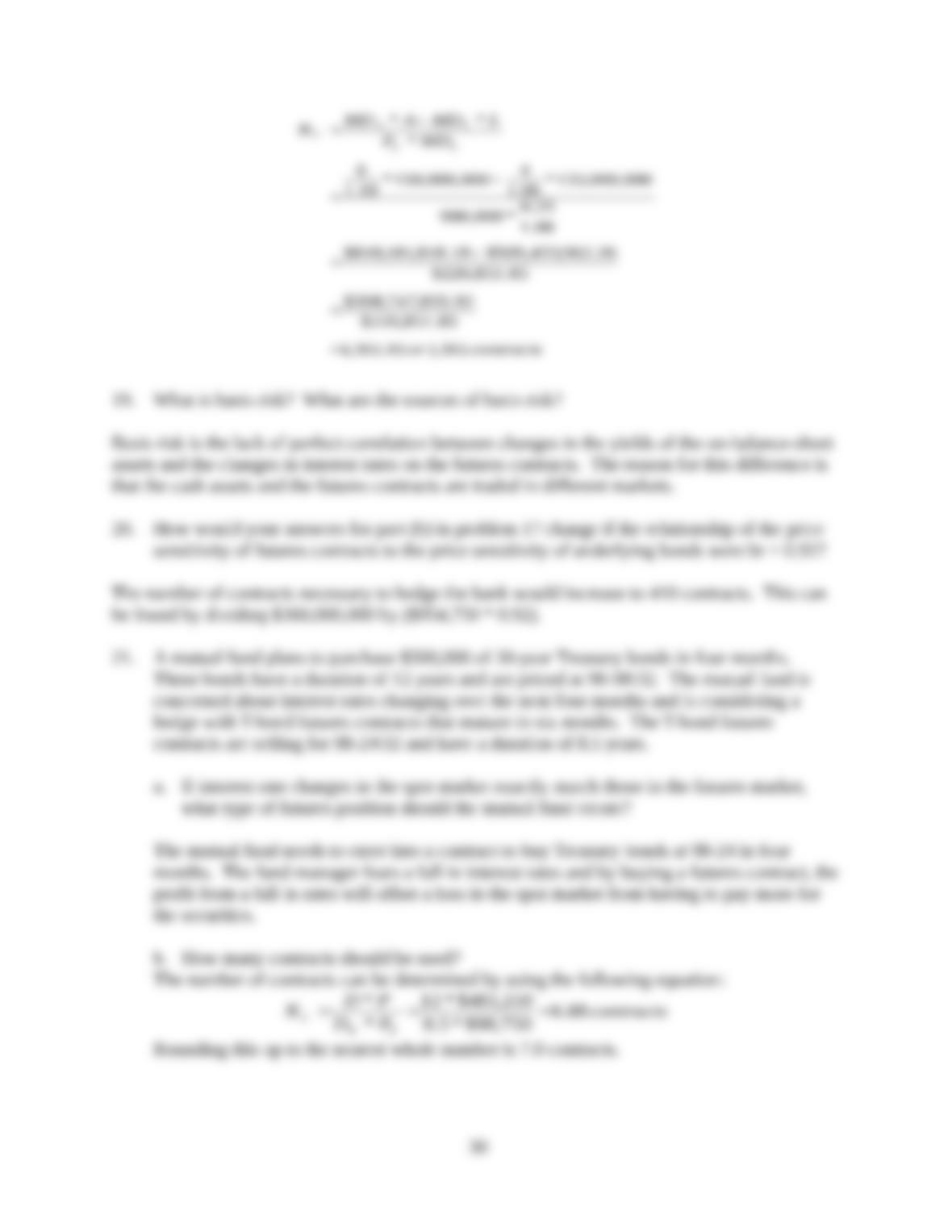
The expected change in the spot position is –8 x $10,400,000 x (1/1.07) = -$777,570. This
would mean a price change from 104 to 96.2243 per $100 face value of bonds. By entering into
a two-month forward contract to sell $10,000,000 of 15-year bonds at 104, the FI will have
hedged its spot position. If rates rise by 1 percent, and the bond value falls by $777,570, the FI
can close out its forward position by receiving 104 for bonds that are now worth 96.2243 per
$100 face value. The profit on the forward position will offset the loss in the spot market.
The actual transaction to close the forward contract may involve buying the bonds in the market
at 96.2243 and selling the bonds to the counterparty at 104 under the terms of the forward
contract. Note that if a futures contract were used, closing the hedge position would involve
buying a futures contract through the exchange with the same maturity date and dollar amount as
the initial opening hedge contract.
6. Contrast the position of being short with that of being long in futures contracts.
To be short in futures contracts means that you have agreed to sell the underlying asset at a future
time, while being long means that you have agreed to buy the asset at a later time. In each case,
the price and the time of the future transaction are agreed upon when the contracts are initially
negotiated.
7. Suppose an FI purchases a Treasury bond futures contract at 95.
a. What is the FI’s obligation at the time the futures contract was purchased?
You are obligated to take delivery of a $100,000 face value 20-year Treasury bond at a
price of $95,000 at some predetermined later date.
b. If an FI purchases this contract, in what kind of hedge is it engaged?
This is a long hedge undertaken to protect the FI from falling interest rates.
c. Assume that the Treasury bond futures price falls to 94. What is the loss or gain?
23
The FI will lose $1,000 since the FI must pay $95,000 for bonds that have a market value
of only $94,000.
d. Assume that the Treasury bond futures price rises to 97. Mark-to-market the position.
In this case the FI gains $2,000 since the FI pays only $95,000 for bonds that have a market
value of $97,000.
8. Long Bank has assets that consist mostly of 30-year mortgages and liabilities that are
short-term time and demand deposits. Will an interest rate futures contract the bank buys
add to or subtract from the bank’s risk?
The purchase of an interest rate futures contract will add to the risk of the bank. If rates increase
in the market, the value of the bank’s assets will decrease more than the value of the liabilities.
In addition, the value of the futures contract also will decrease. Thus the bank will suffer
decreases in value both on and off the balance sheet. If the bank had sold the futures contract,
the increase in rates would have allowed the futures position to reflect a gain that would offset (at
least partially) the losses in value on the balance sheet.
9. In each of the following cases, indicate whether it would be appropriate for an FI to buy or
sell a forward contract to hedge the appropriate risk.
a. A commercial bank plans to issue CDs in three months.
The bank should sell a forward contract to protect against an increase in interest rates.
b. An insurance company plans to buy bonds in two months.
The insurance company should buy a forward contract to protect against a decrease in
interest rates.
c. A thrift is going to sell Treasury securities next month.
The thrift should sell a forward contract to protect against an increase in interest rates.
d. A U.S. bank lends to a French company; the loan is payable in francs.
The bank should sell francs forward to protect against a decrease in the value of the franc,
or an increase in the value of the dollar.
e. A finance company has assets with a duration of six years and liabilities with a duration
of 13 years.
The finance company should buy a forward contract to protect against decreasing interest
rates that would cause the value of liabilities to increase more than the value of assets, thus
causing a decrease in equity value.
24
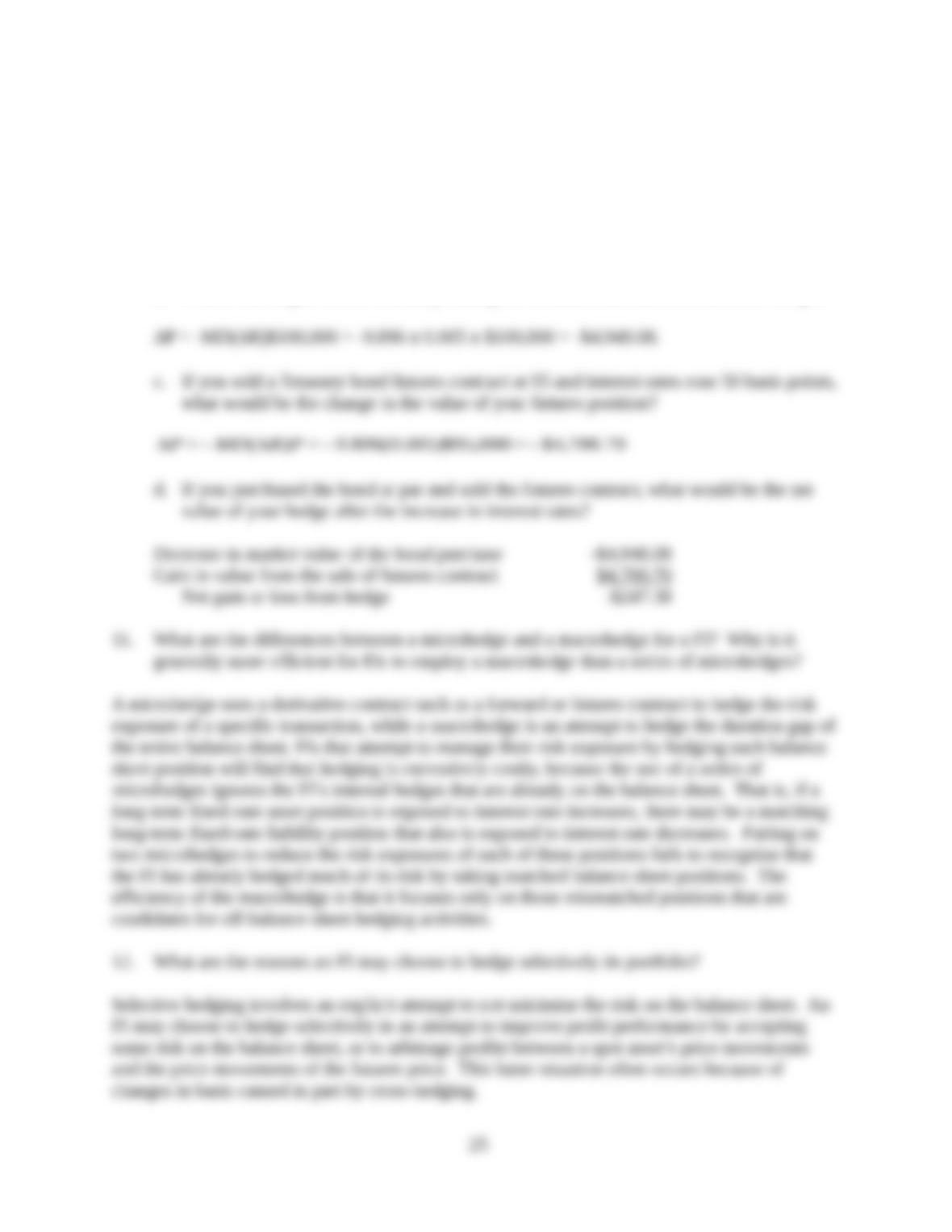

10. The duration of a 20-year, 8 percent coupon Treasury bond selling at par is 10.292 years.
The bond’s interest is paid semiannually, and the bond qualifies for delivery against the
Treasury bond futures contract.
a. What is the modified duration of this bond?
The modified duration is 10.292/1.04 = 9.896 years.
b. What is the impact on the Treasury bond price if market interest rates increase 50 bps?