hbr.org | December 2008 | Harvard Business Review 45
FOUR YEARS AGO, Fiat was a laughingstock. When-
ever you opened a newspaper in Italy, there was
another embarrassing story: Fiat had lost more
money; its new car had fl opped; a strike was on
somewhere. Even more worrying to me was the
fact that the company had gone through four
CEOs in three years. Imagine showing up in June
2004 and being the fi fth guy to try to resuscitate
what appeared to most people to be a cadaver.
And just imagine what top management thought. These
poor fellows saw this executive (almost a foreigner – I’d left
Italy in 1966) coming from outside the car industry to be their
new leader. They all sat there thinking: “Here we go again.
We’re going to have to teach this guy what the business is
about, and if he ends up being like the last one, we’re screwed.”
I could see it written all over their faces. I would have felt ex-
actly the same had I been in their shoes.
What’s more, this is an incredibly tough business. I used to
think that chemical companies set the benchmark for value
destruction, but the auto industry is certainly up there. With a
few exceptions – Toyota in Japan and Porsche in Germany – car
companies have consistently destroyed value over the years.
Fiat was one of the worst offenders.
We’ve come a long way since then. Our bottom line is solidly
in the black, and our latest car – the Cinquecento, one of the
smallest compacts in the world – is the talk of the industry.
Getty Images
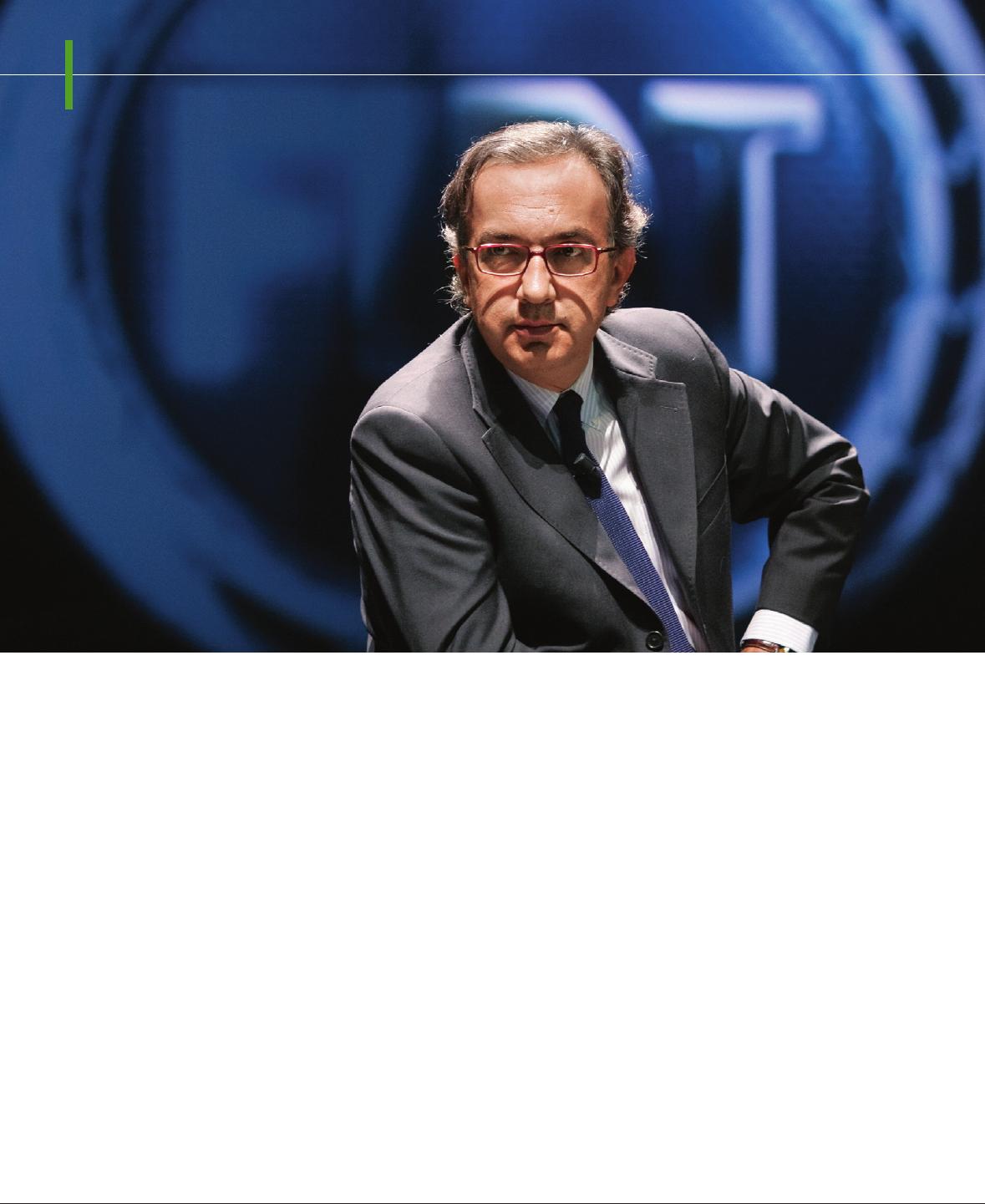
Fiat’s Extreme Makeover
My job as CEO is not to make business decisions –
it’s to push managers to be leaders.
First Person
BY SERGIO MARCHIONNE
1711 Marchionne.indd 451711 Marchionne.indd 45 10/30/08 2:10:18 PM10/30/08 2:10:18 PM
First Person Fiat’s Extreme Makeover
To complete that journey, we’ve had to
make some major changes to the way
the company runs. We’ve abandoned
the Great Man model of leadership that
long characterized Fiat and have created
a culture where everyone is expected
to lead. My job as CEO is not to make
decisions about the business but to set
stretch objectives and help our manag-
ers work out how to reach them.
Finding and Engaging with
New Leaders
From day one I recognized that Fiat had
a leadership problem. Traditionally, all
important decisions in Italian compa-
nies are made by the CEO. It probably
worked fi ne as a leadership model back
in the 1950s, but today it’s quite unsus-
tainable. A business like Fiat is far too
back from my fi rst trip to our operations
in Brazil and Argentina, we probably
made 20 leadership moves to promote
As I give people more responsibility,
I also hold them more accountable. A
leader who fails to meet an objective
should suffer some consequences, but I
don’t believe that failing to meet an ob–
jective is the end of the world. Markets
and economies aren’t perfectly predict-
able, and in an organization this size,
you can always offset a failure here with
a success there. But if you want to grow
leaders, you can’t let explanations and
excuses become a way of life. That’s a
characteristic of the old Fiat we’ve left
far behind.
Setting Targets but Sharing
Decisions
In addition to fi nding leaders, I had to
get people energized around a clear and
ambitious target. When I announced
IDEA IN BRIEF
In 2004, Sergio Marchionne
became the fi fth CEO in three
years at the struggling Italian
automaker Fiat.
He identifi ed a new generation
of leaders, set ambitious tar-
gets, and pushed the company
to be less inward-looking by
benchmarking against compa–
nies like Apple.
As a result, the time to market
for a new model was slashed
from four years to 18 months,
and Fiat’s bottom line is now
solidly in the black.
1711 Marchionne.indd 461711 Marchionne.indd 46 10/30/08 2:10:25 PM10/30/08 2:10:25 PM
1711 Marchionne.indd 471711 Marchionne.indd 47 10/24/08 6:40:33 PM10/24/08 6:40:33 PM
1711 Marchionne.indd 481711 Marchionne.indd 48 10/30/08 2:10:31 PM10/30/08 2:10:31 PM