Ferrari Case
In general, one of the main advantages of entering the Initial Public Offering is to raise
the company’s capital. To enter this market, you need to go through a commission, after which
you can register. There is such a ‘quiet period’ when the company cannot promote itself, so that
investors do not know that the company is entering the securities market (they could not find out
how interesting the shares of this company can be) and target prices were not set. But Ferrari did
not invest in advertising; Formula 1 did it for it, in which Ferrari was directly involved. The IPO
also helps to increase the liquidity of securities, which is a big plus for investors. But there are
also disadvantages that a company can meet when entering the primary securities market. The
company will have to invest in entering the market (generate a credible business plan; gather a
qualified management team; create an outside board of directors).
Any analysis has its pros and cons, it all depends on what situations it is used. DCF has
both pros and cons. The main disadvantage is that this analysis is quite difficult to do. You need
to have a large amount of accurate data, which entails errors that can occur if the data is
inaccurate. It is also difficult to determine the Weighted Average Cost of Capital. In present
value models, benefits are often defined in terms of cash expected to be distributed to
shareholders (dividend discount models) or in terms of cash flows available to be distributed to
shareholders after meeting capital expenditure and working capital needs (free-cash-flow-to–
equity models).
The simplicity of using multiples is both an advantage and a drawback of valuation. That
is a downside since complex knowledge is distilled into either a single value or a set of values.
This effectively disregards other factors, such as growth or decline that influence the intrinsic
value of a company. This simplicity helps a financial analyst, however, to make simple
computations to calculate the valuation of a business. Meanwhile, using the multiples analysis
can also lead to difficulty in comparing companies or assets.
To determine the price per share, a company needs to use all factors such as history,
product, how popular it is, and how well it is made. Ferrari makes high-quality premium cars, the
choice of models for this brand is not so large, also cars are not produced for a stream, people are
in line to get their car. Also, if you buy one of the sports cars, over time the price for it will not
fall too much, in some cases even rise. Therefore, Ferrari can be called the company that dictates
the prices for their cars. The company produced limited editions of some of its models, for
example, the LaFerrari model, 499 cars were produced in total. It is also worth comparing the
indicators with competitors and their sales, which will make it clear approximately in which
direction it is worth moving. A direct competitor for Ferrari was the Maserati company. One of
the advantages of Ferrari was that the production costs were low compared to the price of the
car, which gave them large profits. For example, if we take Exhibit 5 sales by region, we see that
Ferrari sales did not grow in one, but Maserati doubled sales. Also, if we take the average price
for a Ferrari car about $ 350k, and for a Maserati, it is about $ 70k, then the Maserati is in the
role of catch-up. Another fact that was written above is that Ferrari did not invest in advertising,
which also gives more profit.
To calculate the initial price for the stock we can use FCFE valuation model. First of all
we can take data from Exhibit 8, Total Operating Profit will be our EBIT from this we need to
subtract taxes. After that we need to subtract growth in NWC and Capex from Net Operating
Income and then add depreciation. As a result of that we will find FCFE for the firm. Next, you
need to calculate the value of the firm, for this, you can use the PV and discount this cash flows
formula by replacing the percentage with the cost of capital. As a result, we get the value of the
firm and, as a result, divide this number by the number of shares.
CL2
By selling either debt or equity shares, businesses fund their activities. A main distinction
between these assets is that, while equity is not, debt is an obligation of the issuing firm. This
means that when a company issues debt, it is contractually obligated to repay the amount it
borrows (i.e., the principal or face value of the debt) at a specified future date. The cost of using
these funds is called interest, which the company is contractually obligated to pay until the debt
matures or is retired. If the corporation sells stock shares, it is not under obligation to refund the
money it receives from lenders, nor is it under pressure to make annual returns to shareholders
for the use of its funds. Instead, owners, once all liabilities have been charged, have a claim on
the company’s cash.
Common shares represent an ownership interest in a company and are the predominant
type of equity security. As a result, investors share in the operating performance of the company,
participate in the governance process through voting rights, and have a claim on the company’s
net assets in the case of liquidation. Companies may choose to pay out some, or all, of their net
income in the form of cash dividends to common shareholders, but they are not contractually
obligated to do so.
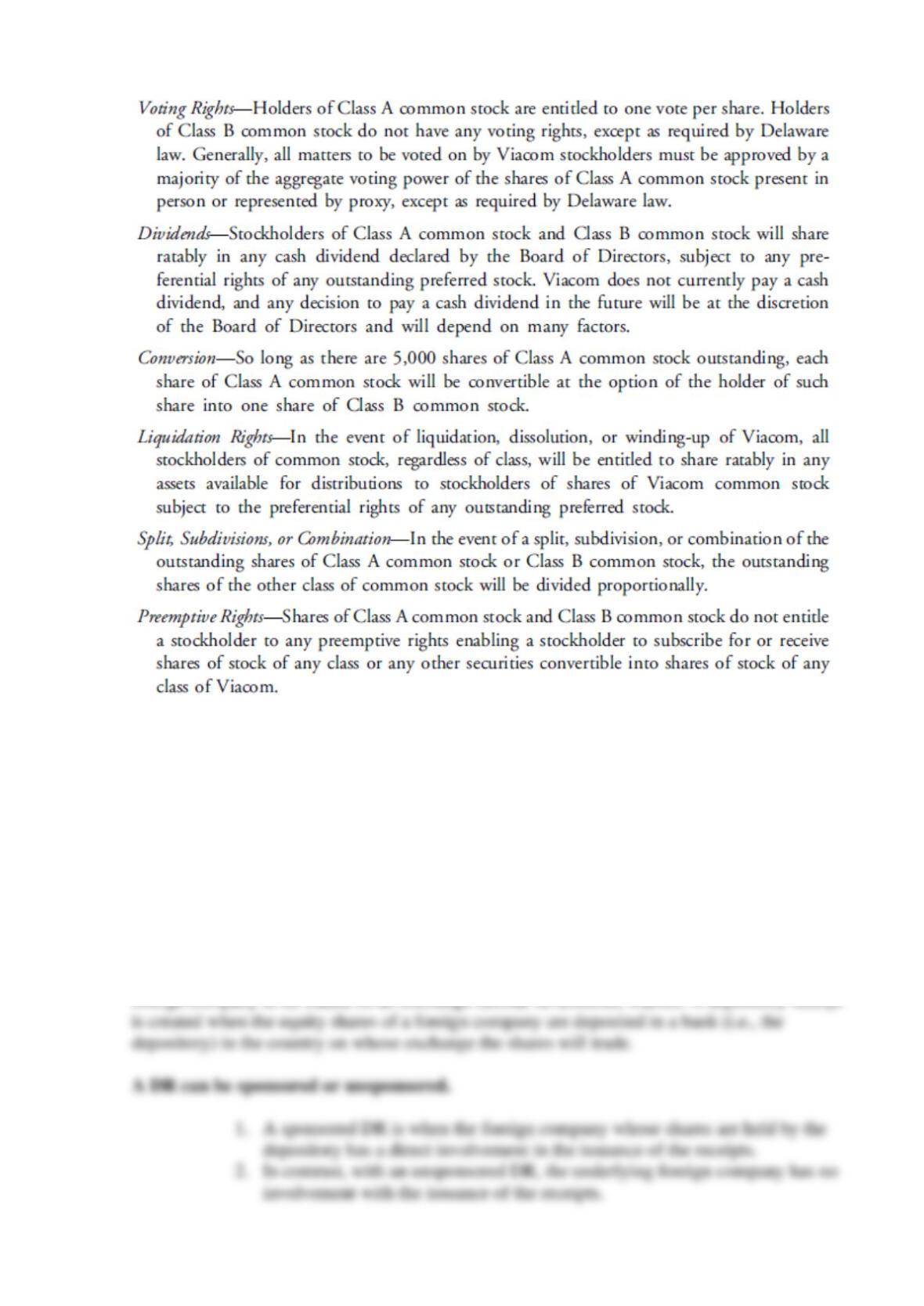
Voting rights provide shareholders with the opportunity to participate in major corporate
governance decisions, including the election of its board of directors, the decision to merge with
or take over another company, and the selection of outside auditors.
Voting shares
1. Regular shareholder voting, where each share represents one vote, is referred
to as statutory voting.
2. To better serve shareholders who own a small number of shares, cumulative
voting is often used. Cumulative voting allows shareholders to direct their total
voting rights to specific candidates, as opposed to having to allocate their
voting rights evenly among all candidates.
Participating preference shares
The shareholders to receive the standard preferred
dividend plus the opportunity to receive an additional dividend if the company’s profits
exceed a prespecified level.
Nonparticipating preference shares do not allow shareholders to share in the profits of
the company. Instead, shareholders are entitled to receive only a fixed dividend payment and the
par value of the shares in the event of liquidation. The use of participating preference shares is
much more common for smaller, riskier companies where the possibility of future liquidation is
more of a concern to investors.
Convertible preference shares
* They allow investors to earn a higher dividend than if they invested in the company’s
common shares.
* They allow investors the opportunity to share in the profits of the company.
* They allow investors to benefit from a rise in the price of the common shares through the
conversion option.
* Their price is less volatile than the underlying common shares because the dividend payments
are known and more stable.
Direct Investing
Investing directly often results in less transparency and more volatility because
audited financial information may not be provided on a regular basis and the market may be less
liquid. Alternatively, investors can use such securities as depository receipts and global
registered shares, which represent the equity of international companies and are traded on local
exchanges and in the local currencies.
A depository receipt (DR) is a security that trades like an ordinary share on a local exchange and
represents an economic interest in a foreign company. It allows the publicly listed shares of a