1
1.0 Introduction
According to English Oxford Dictionary, gender had been defined as either of
the two sexes (male and female), especially considered with reference to social and
cultural difference rather than biological ones. Gender inequality refers to there is no
equal treatment between men and women and the unequal treatment can be in a whole
or partial basis of the gender. There are a few causes of gender inequality such as bad
mentality, where women are discriminated that they are only suitable for jobs like
nurturing and housekeeping, while men are suitable for careers involving high level of
authority and decision making (Women Unlimited, 2017). Besides, poor level of
education is also one of the major causes of gender inequality because many families
do not pay attention to a girl child as they perceived them are not good compared to
men. Even though religion plays a very important role to an individual, however some
weaknesses exits and acts as cages to women (Women Unlimited, 2017). Lastly, culture
and traditions are also causes of gender inequality, due to belief of certain ethnic groups,
where they do not support women leadership and think women are not important
(Women Unlimited, 2017).
There are many statements about feminism, which are the advocacy of women’s
rights on the basis of the equality of the sexes, theory of political, economic and social
equality of the sexes (Caprino, 2017). Besides, feminism can be also defined as the
belief that men and women should have equal rights and opportunities (Caprino, 2017).
Roots of feminism were buried in ancient Greece and it was recognize by four waves
of feminism.
The first wave of feminism started in 1830’s to early 1900’s; where women fight
for equal contract and property rights (Dorey-Stein, 2018). Women realised that they
2
must gain political power in the late 19th to 20th centuries, and their political agenda
expanded to various issues such as economic, sexual and reproductive matters (Dorey-
Stein, 2018). The second wave of feminism started at 1960’s to 1980’s, where feminism
started to focus on the workplace, family, sexuality and reproductive rights (Dorey–
Stein, 2018). During the second wave, many women cared so much about civil issues
such as Black Civil Rights Movement, Asian American Civil Rights Movement, Gay
and Lesbian Movement because they want to strengthen their voices by fighting for
gender equality to ensure women will be heard (Dorey-Stein, 2018). The third wave
happen in 1990’s to early 2000’s, main issues were to subdue the difference between
men and women and reproductive rights of women (Dorey-Stein, 2018). The fourth
wave of feminism happened recently, focusing on empowerment of the internet by
constant connectivity (Dorey-Stein, 2018).
Currently, fighting for women’s rights have become too often and now
feminism have been synonym with man-hating and now gender equality was
considered as men issue too (Watson, 2017). The attitudes and action of men and boys
plays an important role in achieving gender equality. One of the global issues for gender
inequality is the world is trying to achieve gender equality in educations but female still
own a higher percentage of not getting a proper education (Peace Corps, 2009). Besides,
women’s health and safety is also one of the global issues. AIDS had becoming a major
effect to women because this issue can allow women to have less opportunity for
unequal power in sexual partnership (Peace Corps, 2009). Final global issues about
gender inequality is focus on getting gender equality in women’s political and economic
empowerment (Peace Corps, 2009). It is not surprise that women only own 1% of
world’s wealth although women comprise 50% of the population (Peace Corps, 2009).
3
Women are under presented as decision makers at all levels including at home or public
area.
Globally, there are no country has fully achieved gender equality. Countries like
Finland, Sweden and Iceland lead the world towards minimizing the gap between male
and female because there are equal distribution in terms of income, opportunities and
resources for men and women (Peace Corps, 2009). On the other hand, countries that
have relatively high gender gaps are in Africa, Middle East and South Asia (Peace
Corps, 2009).
2.0 Literature Review
Gender inequality occurs if the distribution of women and men differ in some
characteristics such as education, political, economic and others (Sinden, 2017). This
will cause most of the women being disadvantaged by inequalities of power that come
out from social, growth and development of economic (Sinden, 2017). However,
gender equality is not just a women’s issue but is everybody’s issue. Most of the anti–
feminists have guide people believes that feminism is only for women. They also
bringing wrong information about feminism and put a wrong interpretation on view
feminists as dangerous issue (Moedas, 2016).
Therefore, feminists is there to fight for social, political and economic equality
of the sexes. Feminists have categorised fairness of gender into two different concepts
which are “difference” and “equality” (Naldini, 2011). Feminists explained that the
meaning of difference is men are different with women while equality is mean men are
same with women in some characteristics (Naldini, 2011). Feminists believe that there
is a new wave of feminism, not only women but men who are activists for equality
(Naldini, 2011). They also strongly encouraged men to involve themselves in issue
4
about gender equality as women are because they believes that change on this large
scale can be affected mainly by demographic (Lechliter, 2016). Gloria Steinem, a social
activist, writer, editor, lecturer and the Mother of modern Feminism. She claimed that
the solutions still remain the challenge in workplace although there is consciousness
exists (Sousa, 2016). Therefore, she suggested choose the best possible talent from
gender, race and religion but not from suitability (Sousa, 2016). Other than that, hiring
people should base on years to up-skill rather than follow the exact same role is also
suggested by Gloria.
In new gender equality system, it is possible that structural change and social
economic developments rather than feminist activism (Squires, 2007). Government
globe strongly agrees that gender equality as a central policy goal (Squires, 2007).
Governments around the world have introduced new gender equality institutional to
support gender equality by focusing on gender quotas, women’s policy agencies and
gender mainstreaming as three distinct strategies as key to increase widespread
commitment to gender equality within political sphere (Squires, 2007).
In Europe, new online tool that developed together with the European Institute
for Gender Equality is used to identify the gaps in equal representation to be addressed
and to apply appropriate strategies (Moedas, 2016). Besides, Michelle Obama as a
lawyer and the previous first lady of the United States is very care about gender equality
issue in education. There are 62 million girls are denied an education all over the world
(Oath Inc, 2018). Therefore, she started organized UpForSchool campaign which aims
to fight for change on that problem and make sure all children get a better education
and to increase the number of girls going to school at the same times (Oath Inc, 2018).
This UpForSchool campaign is then organised by the A World at School movement
and have launched in to world leaders at the United Nations General Assembly in 2015
(Oath Inc, 2018).
3.0 Objectives
The objective of this assignment is
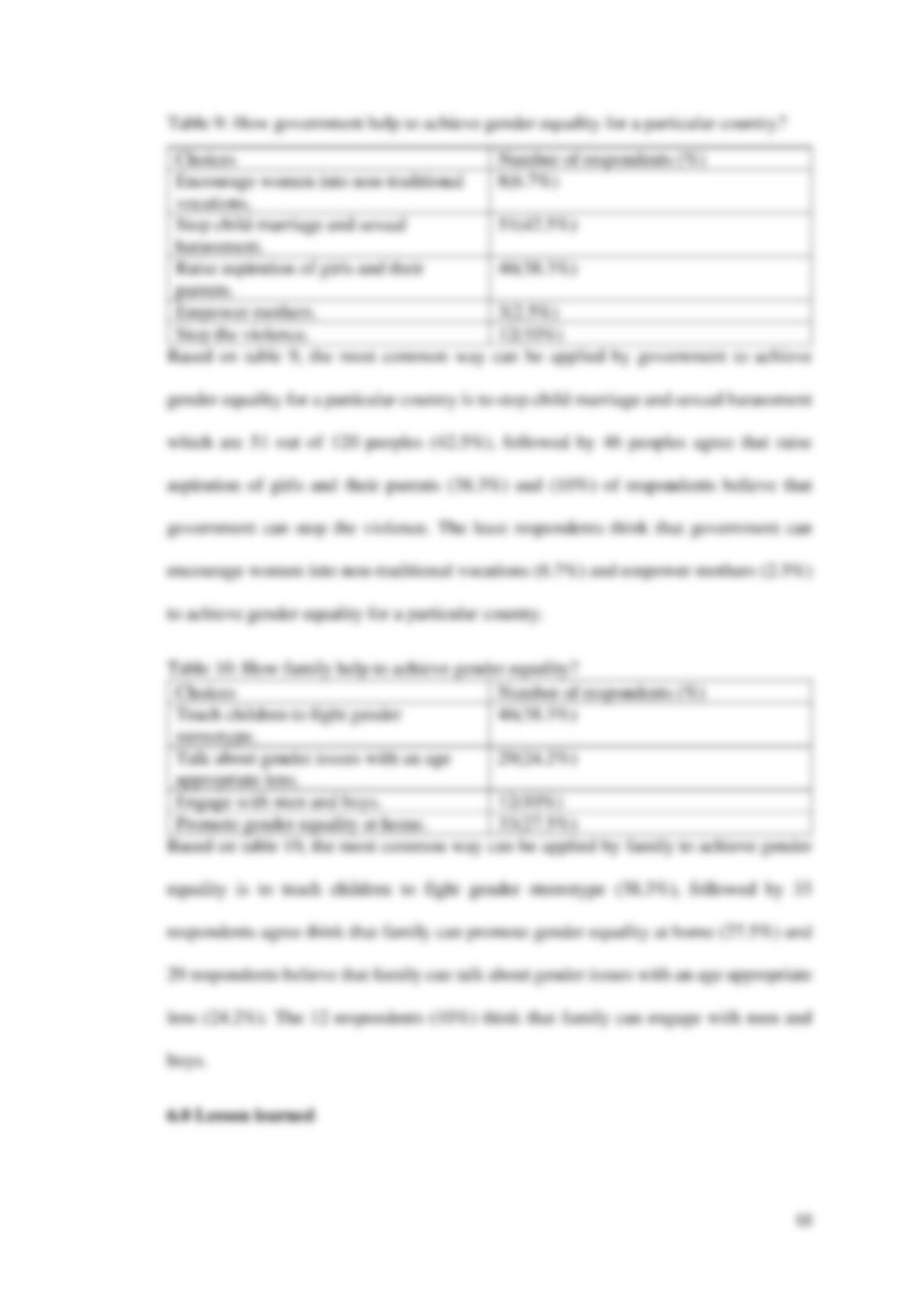
3.1 To determine whether gender inequality still exists in current society.
3.2 To define and understand feminism.
3.3 To find ways on how individual, government and family achieve gender
equality.
4.0 Methodology
The approach of research that used in this assignment is quantitative approach
by using questionnaire method. The questionnaire method is a close ended