Shelter-in-Place for
Active Shooter
When disaster strikes, it may be safer to stay in your home, place of
employment, or other location. Learn where to go, what to do, and
how long you should shelter-in-place for the hazards in your area.
An active shooter is an individual engaged in attempting to kill
people in a confined space or populated area. Active shooters
typically use firearms and have no pattern to their selection of
victims
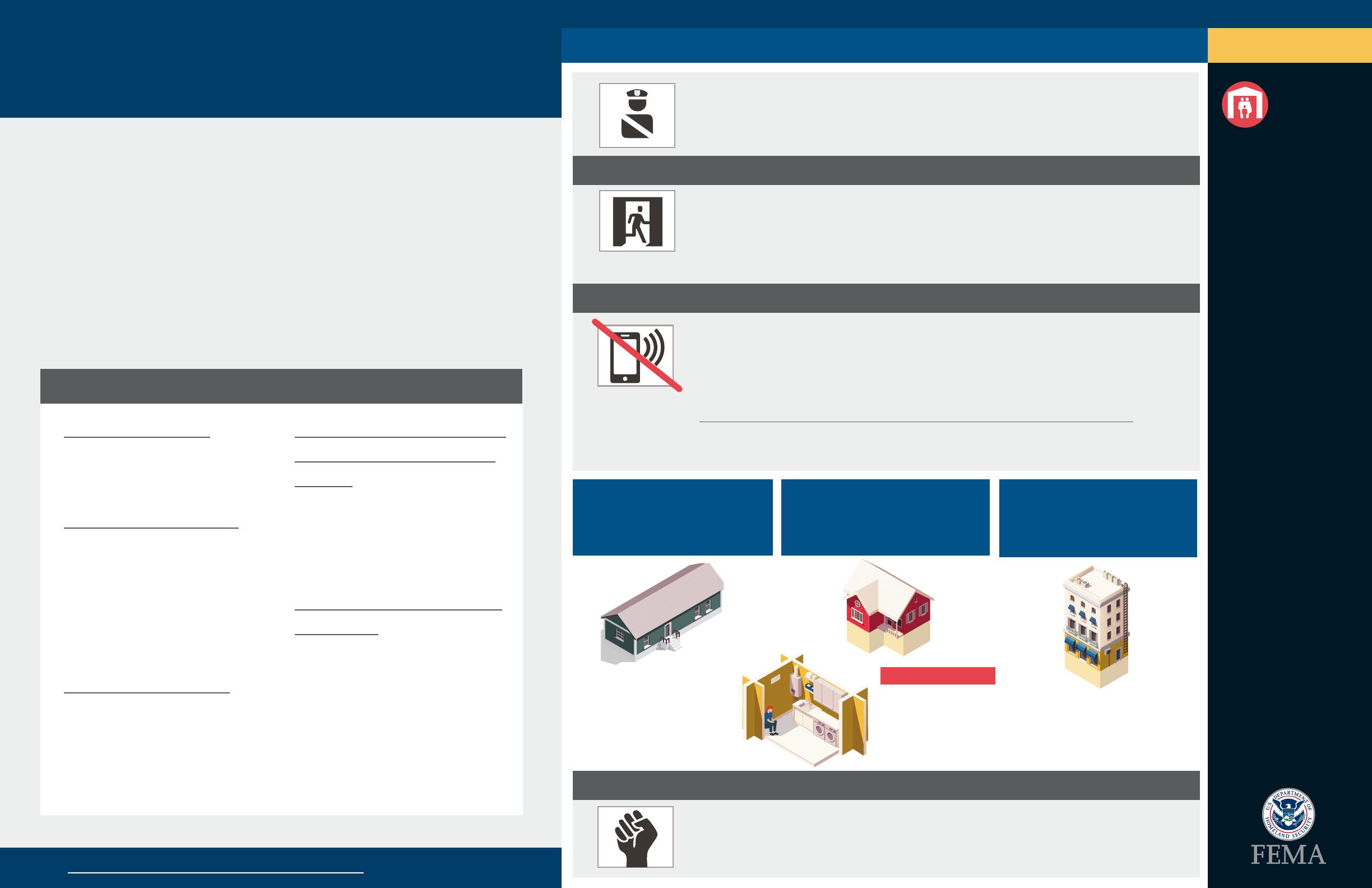
Take Additional Safety Measures
If you see suspicious activity,
let an authority know right
away.
When you visit a building
such as a shopping mall or
healthcare facility, take
time to identify two nearby
exits. Get in the habit of
doing this.
Map out places to hide.
In rooms without windows,
behind solid doors with locks,
under desks, or behind heavy
furniture.
Many places, such as houses
of worship, workplaces, and
schools, have plans in place
to help you respond safely.
Ask about these plans and get
familiar with them.
If you participate in an active
shooter drill, talk with your
family about what you learned
and how to apply it to other
locations.
Visit https://community.fema.gov/ProtectiveActions/s/ for more information.
Run. Hide. Fight.
First Officers on scene will not stop to help the injured.
Their priority is to end the incident as fast as possible. Rescue teams will
move in after the first officers and will treat and move the injured to safety.
Run
r Get away That is your top priority!
r Leave behind any belongings.
r Help others if you can, but you must escape.
r Warn others to stay away from the area.
r Call 9-1-1 when you are safe.
Hide
r Stay out of the shooter’s view.
r Lock and block entrances and turn off lights.
r Groups of people should spread out when hiding.
r Text 9-1-1 and text message others to silently communicate.
r Stay in place until given the–all-clear signal.
Silence electronic devices and make sure they don’t vibrate.
Devices that buzz or ring will bring attention to places of hiding.
If you are in a
Manufactured or
Mobile Home
If you are in a
1- or 2-Story Building
May have an attic and/or basement
If you are in a
Multistory Building
Includes schools, apartments,
and offices
For all structures
r stay inside
r lock and block the doors
r close blinds
r turn off all the lights
Fight as a last resort!
r Commit to your actions. Fight. Do not hesitate.
r Be prepared to inflict severe injury to shooter.
r Throw objects or improvise weapons (staplers, scissors, chairs).
How long to
shelter-in-place?
Stay in place
until law
enforcement
gives you notice
that the danger
is over.
Shelter-in-Place for
Chemical Hazard
If told not to evacuate or it is too late to evacuate
When disaster strikes, it may be safer to stay in your home, place of
employment, or other location. Learn where to go, what to do, and
how long you should shelter-in-place for the hazards in your area.
Chemical agents are poisonous vapors, aerosols, liquids and solids
that have toxic effects on people, animals or plants.
Take Additional Safety Measures
Go inside as quickly
as possible. Bring any
pets indoors.
Lock all doors and
windows for a better seal.
Turn off the air conditioner
or heater, all fans, close
the fireplace damper and
any other place that air
can come in from outside.
If available, tape plastic
over window(s) in the
internal room you are
sheltering. Use duct tape
around the windows and
doors and make an unbroken
seal. Tape over vents and
seal any electrical outlets.
Do not drink water from
the tap. Stored water
will be safer.
Listen for current emergency
information and instructions
from authorities.
Visit https://community.fema.gov/ProtectiveActions/s/ for more information.
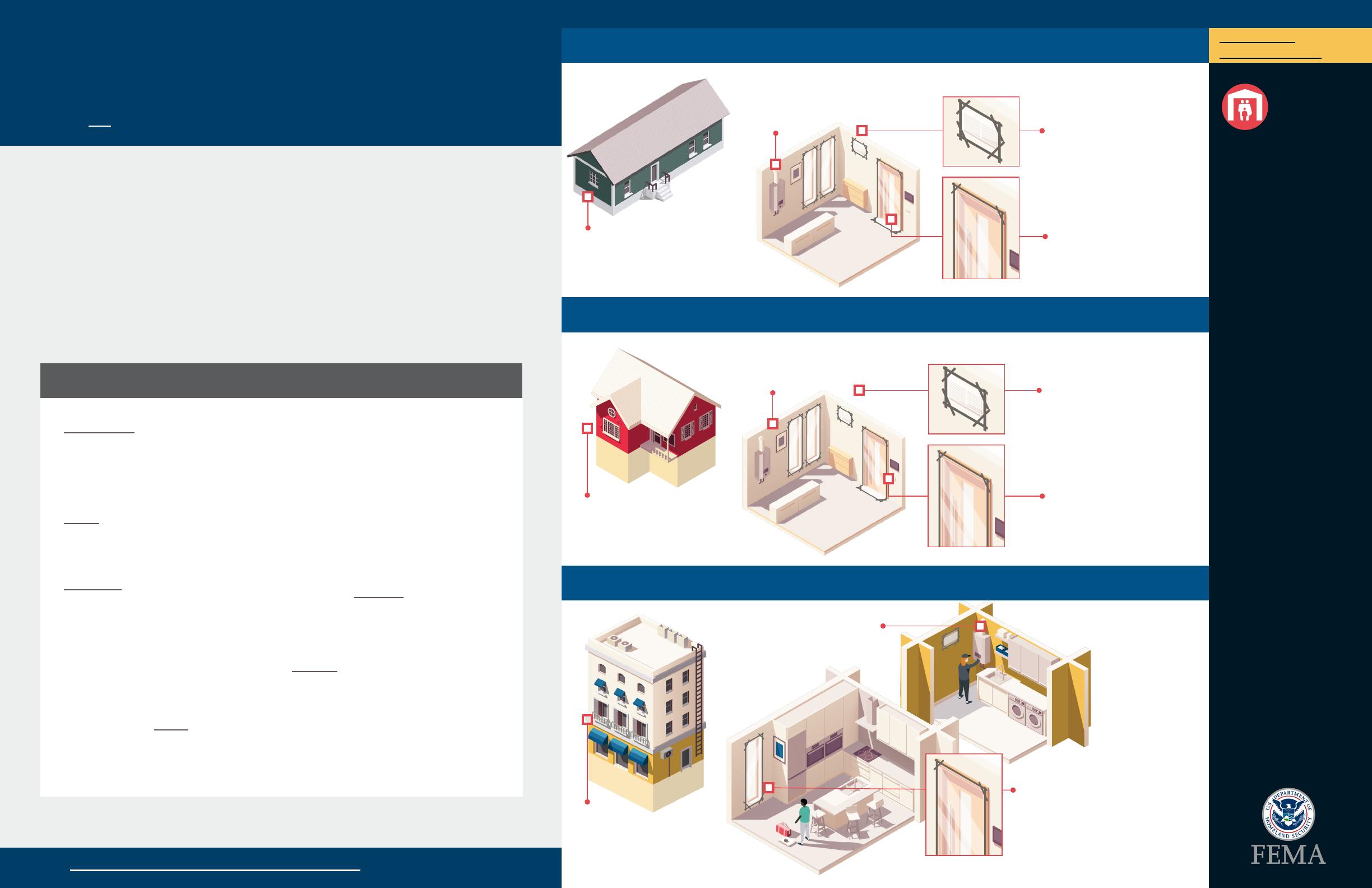
If you are in a Manufactured or Mobile Home
Stay inside your home. Lock
windows and doors for a
better seal.
Turn off all fans, heater
or air conditioner. Use duct tape
around the windows
and doors and make
an unbroken seal.
Tape plastic over any
windows in the room.
If you are in a 1- or 2-Story Building May have an attic and/or basement
Turn off all fans, heater
or air conditioner.
Stay inside your home. Lock
windows and doors for a
better seal.
Use duct tape around
the windows and doors
and make an unbroken
seal.
Tape plastic over any
windows in the room.
If you are in a Multistory Building Includes schools, apartments, and offices
Turn off all fans, heater
or air conditioner.
Stay inside your home.
Lock windows and doors
for a better seal.
Use duct tape around the
windows and doors and
make an unbroken seal.
Tape plastic over any
windows in the room.
How long to
shelter-in-place?
A shelter-in-
place will last
approximately
12 hours or less,
rarely will it go
longer.
Shelter-in-Place for
Earthquake
When disaster strikes, it may be safer to stay in your home, place of
employment, or other location. Learn where to go, what to do, and
how long you should shelter-in-place for the hazards in your area.
Earthquakes are the sudden, rapid shaking of the earth, caused by
the breaking and shifting of underground rock. Earthquakes can
collapse buildings and cause heavy items
to fall, resulting in injuries and property damage.
Take Additional Safety Measures
Drop, Cover, and Hold On
like you practiced.
Drop to your hands and
knees. Cover your head
and neck with your arms.
Hold on to any sturdy
furniture until the
shaking stops.
Crawl only if you can
reach better cover
without going through
an area with more debris.
If in bed, stay there.
Turn onto your stomach.
Cover head and neck
with a pillow.
Secure TVs, shelves and
other heavy furniture.
If you are in a high-rise
building, expect fire alarms
and sprinklers to go off.
DO NOT use elevators.
Visit https://community.fema.gov/ProtectiveActions/s/ for more information.
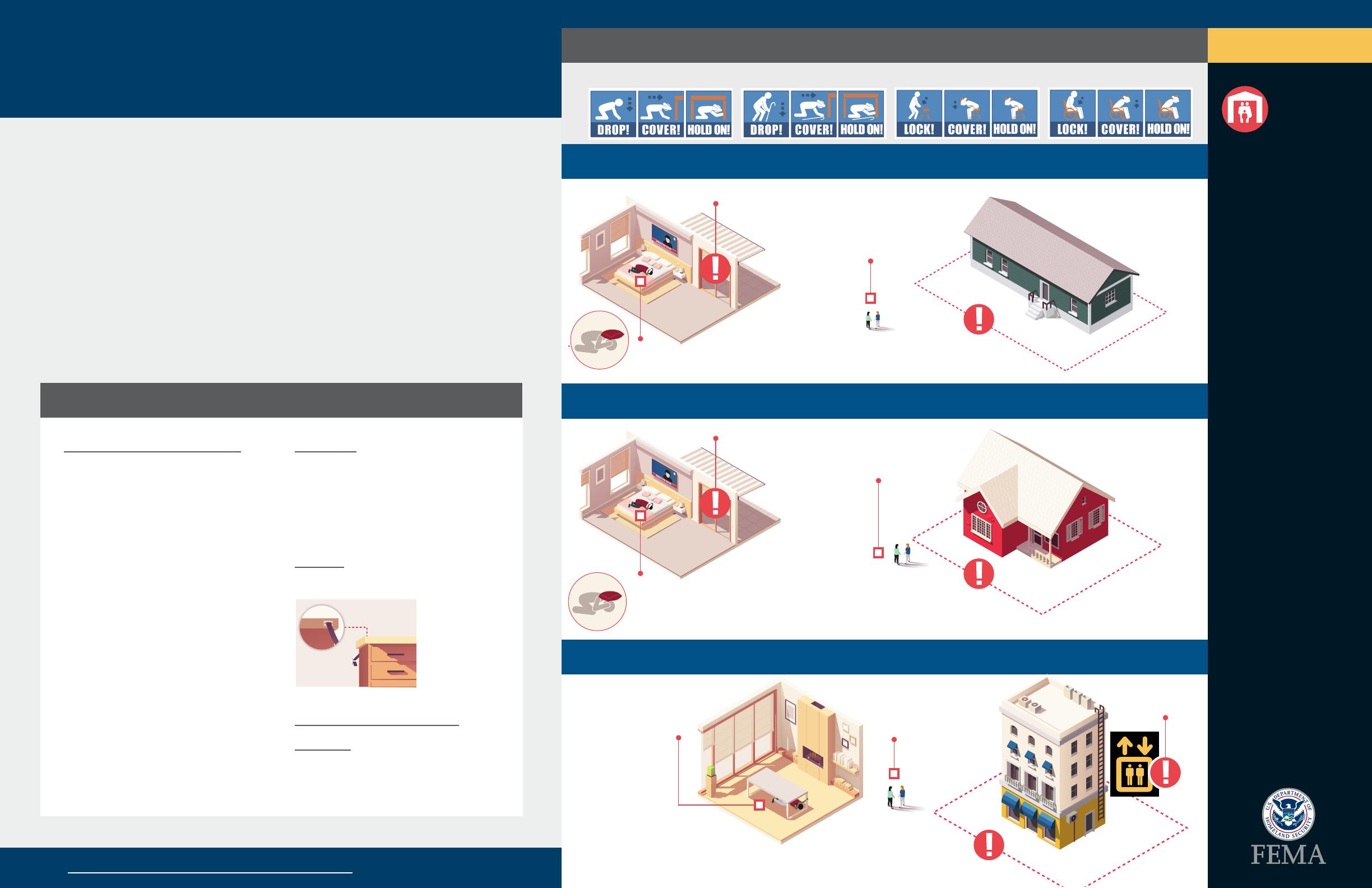
What to do
During an earthquake, stay where you are. Drop, Cover and Hold On.
If you are in a Manufactured or Mobile Home
Do not
run outside.
Use a pillow to cover your
head and neck.
If you are
already outside,
stay outside.
If you are inside,
do not run outside.
If you are in a 1– or 2-Story Building May have an attic and/or basement
Do not
run outside.
Use a pillow to
cover your head
and neck.
If you are
already outside,
stay outside.
If you are inside,
do not run outside.
If you are in a Multistory Building Includes schools, apartments, and offices
Take cover under
a sturdy table,
hold on and
cover your neck
and head.
DO NOT RUN OUTSIDE
IF OUTSIDE, STAY OUTSIDE
If you are already
outside, stay
outside.
If you are inside,
do not run outside.
DO NOT RUN OUTSIDE
IF OUTSIDE, STAY OUTSIDE
Do not use
elevators.
How long to
shelter-in-place?
For the length of
the earthquake.
Shelter-in-Place for
Flooding/Flash Flooding
If told not to evacuate or it is too late to evacuate
When disaster strikes, it may be safer to stay in your home, place of
employment, or other location. Learn where to go, what to do, and
how long you should shelter-in-place for the hazards in your area.
Flooding is the most common natural disaster in the United States.
Floods may develop slowly or quickly without warning. Flash flood
is due to an extreme volume of water in a short period caused by
heavy rainfall, a levee or dam failure, or a sudden release of water
by a debris or ice jam.
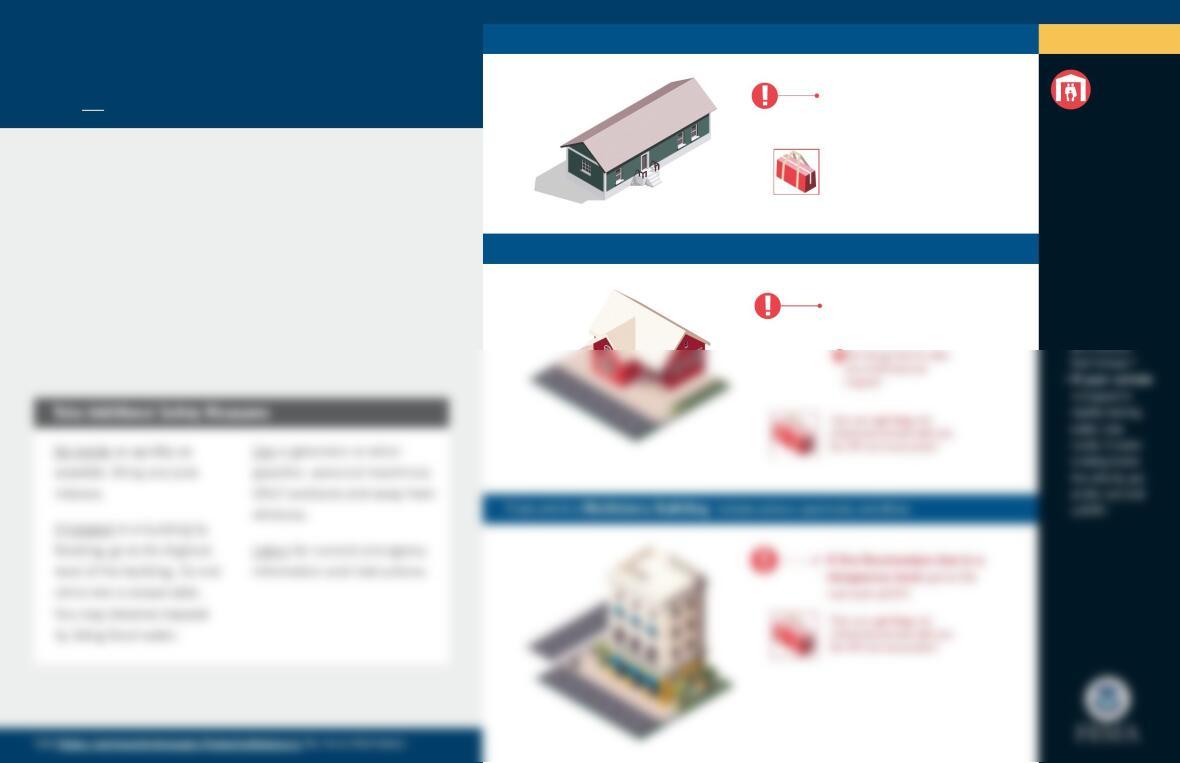
If you are in a Manufactured or Mobile Home
If the floodwaters rise to a
dangerous level, get on the
roof and call 911.
Take your go-bag and
critical documents with you
(for SIP and evacuation)
If you are in a 1– or 2-Story Building May have an attic and/or basement
If the floodwaters rise to
a dangerous level, get on
the roof and call 911.
How long to
shelter-in-place?
If safe, stay
inside until local
authorities provide
other instructions.
If told to evacuate,
do so immediately.
• Do not drive
around
barricades.
• Stay off bridges
over fast
moving water.