FEASIBILITY REPORT
ON
THE FULL INTEGRATION OF
SURGICAL ROBOTS IN MEDICAL
SURGERY
TABLE OF CONTENT
INTRODUCTION
(add your bulleted subheadings)
LEARNING FROM HISTORY
●Historical Examination and its Implication on
Feasibility
●The Puma 560
●The da Vinci Surgical System
●Historical Timeline of Success
●Historical Timeline of Failures
●Surgical Robots Statistical Analysis
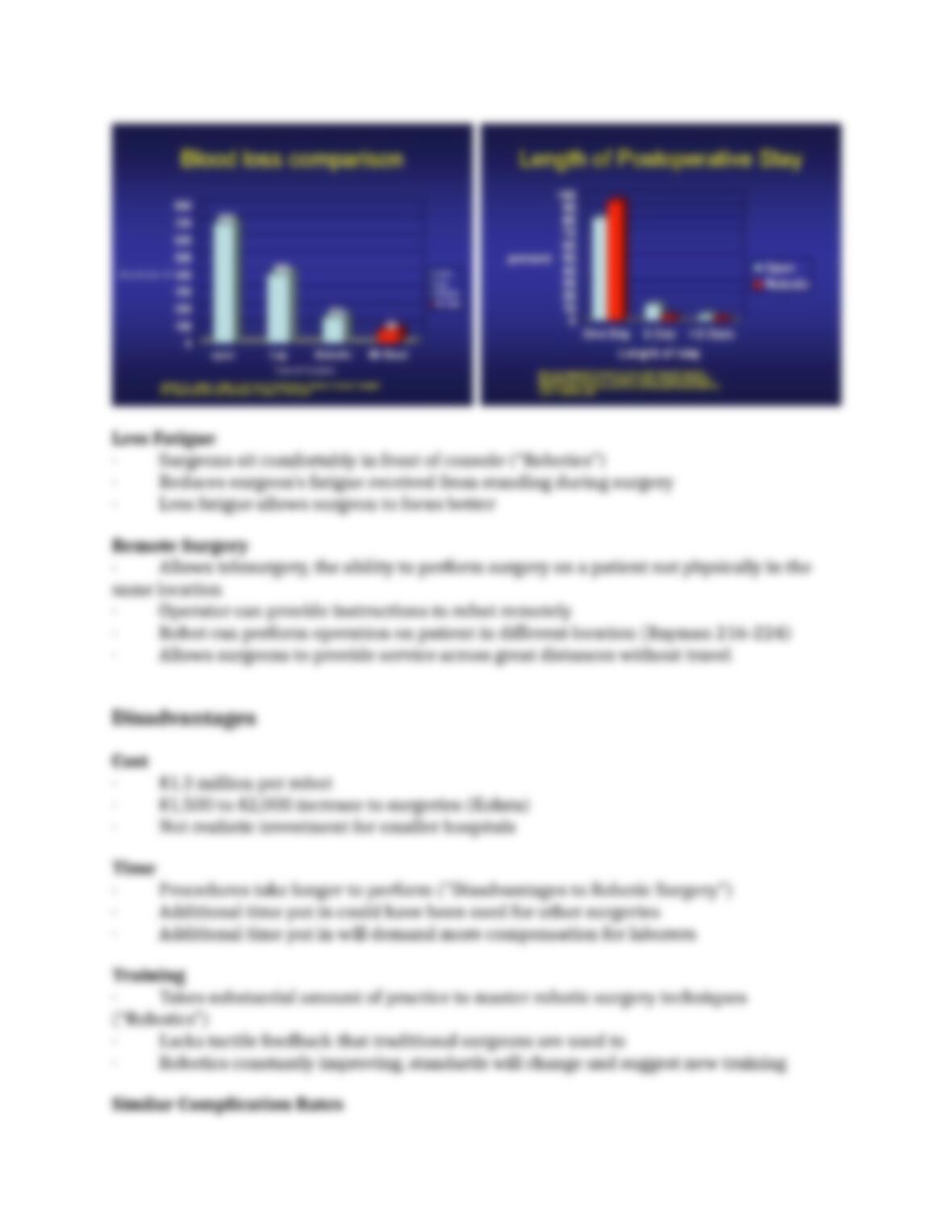
PROS AND CONS
Advantages
○Minimally Invasive
○Faster Recovery
○Less Fatigue

○Remote Surgery
Disadvantages
○Cost
○Time
○Training
○Similar Complication Rates
ETHICAL CONSIDERATION
●Life-or-Death Judgments
●Responsibility and Liability
●Issues of Trust
●Marketing/Perception by the Public
FEASIBILITY DECISION
WORKS CITED


INTRODUCTION
Background
Human quest for perfection is a never-ending phenomenon. This human endeavor has led
to many successes and failures. What we are today is in fact a consequence of one such
attitude. Our relentless struggle for efficiency and innovation had led to many discoveries,
and robot is one among many successfully created technologies.
Definition
“A reprogrammable, multifunctional manipulator designed to move material, parts, tools, or
specialized devices through various programmed motions for the performance of a variety
of tasks”(Dowling). A robot is a mechanical device that is programmed to display artificial
intelligence in its operation. The study and implementation of such device is known as
robotics. In today’s sophisticated world, robotics is used in numerous fields like defense,
construction, astronomy, and health. Their reliability, accuracy, durability, and versatility
have attracted immense interest among people. Huge amount of capital is being poured in
making these devices more advance and precise, so that these devices can serve their best
to people in time of need. Among many different fields, robotics is expected to be very
significant in the field of medicines. Today, in the medical industry, several forms of robotics
is being implemented from creating patient databases which includes doctor visits,
diagnosis histories, and follow up records, to surgeon’s assistance during surgical
operations.
Our Objective / Purpose
The aim of this report is to analyze the feasibility of fully integrating robotics in medical
surgical operations. Will surgical robots be sustainable and fully implementable in the long
run, or will there be major bumps on the way? Is it feasible to fully integrate robots into
major surgical operations, and will it be long lasting and efficient. These are the questions
we hope to answer at the end of our research. Our objective analysis will be based on 3
distinct standpoints:
●Learning from history: This implies gaining foresight from examining past trials and
advancements of the use of medical and surgical robots.
●Ethical consideration: We shall be examining the ethical implications of implementing
surgical robotics and what it means for people from diverse backgrounds and cultures.
●Pros and Cons: Our objective research will dig deep into the advantages and
disadvantages of integrating surgical robotics into the medical field, which will serve as
one of our basis in reaching a feasibility decision.
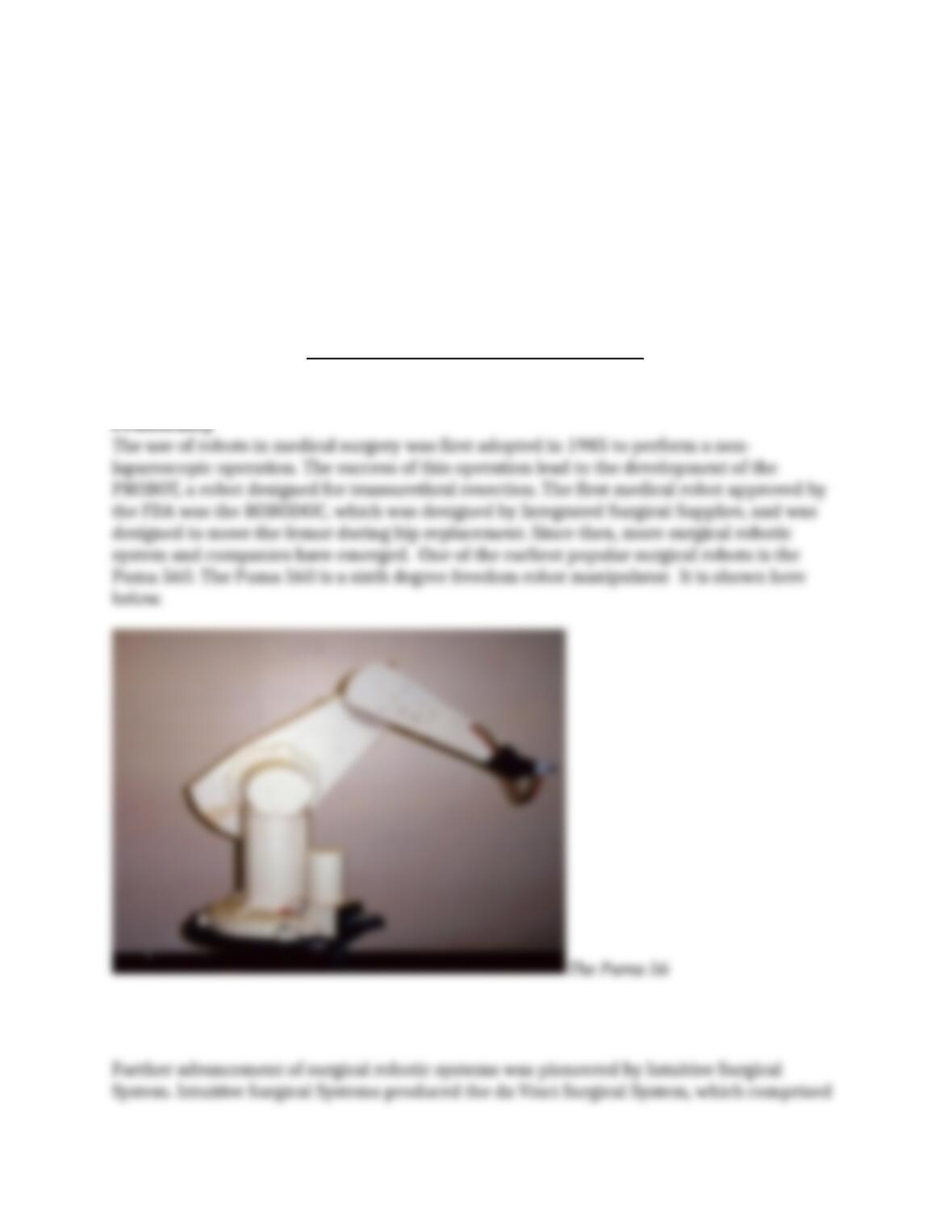
Robots were brought into medical field around 1985 with the introduction of Puma 560,
which was used to perform neurosurgical biopsies. Since then, the use of robots in medicine
has increased. PROBOT and ROBODOC are example of such surgical robots. Among many
surgical robots, one that grabbed the most attention was the da Vinci Surgical system, a
redesign of Automated Endoscopic System for Optimal Positioning (AESOP). It was
introduced by Computer Motion, Inc. of Santa Barbara, CA (www.ncbi.nlm.nih.gov).
Despite the opportunity surgical robotics technology may offer in terms of successes in
surgical operations, its feasibility over the long-term is still not clear. Craving for a change
is one thing, but adopting that change is whole new different decision. Surgical robots
might improve precision, accuracy, operation duration, patient recovery, and micro
observations during the time of surgery, but people around the world have differences.
Some are well off while others are economically challenged. Affordability, success and
failures, ethical standpoint, pros and cons of robots involvement in surgery are major
points while discussing its feasibility. Under the basis of these criteria, we expect to reach a
feasibility decision at the end of the report: whether the full integration of surgical robots
into surgical operations is both implementable and sustainable, or not feasible.
LEARNING FROM HISTORY
Historical Examination of Surgical Robots and its implication on