1099 NEW YORK AVE, NW SUITE 520 WASHINGTON, DC 20001
PHONE: 202.828.4405 E-MAIL: info@techpolicyinstitute.org WEB: www.techpolicyinstitute.org
An Economic Analysis of the Proposed Comcast/Time Warner Cable Merger
May 2014
Scott Wallsten

1
An Economic Analysis of the Proposed Comcast/Time Warner Cable Merger
Scott Wallsten*
May 6, 2014
Comcast has proposed acquiring Time Warner Cable (TWC) for around $45 billion.1 Despite the
transaction being a horizontal merger, it does not raise traditional horizontal issues: although the
firms operate in the same product markets, they are in different geographic market because their
service territories do not overlap. This point has not been controversial. Instead, opposition to the
merger has focused primarily on vertical concerns—how the merger may affect upstream and
downstream products.
Even so, for antitrust agencies the basic question remains the same as for all mergers: do the pro-
competitive, efficiency-enhancing effects outweigh any potential anticompetitive harms of the
merger? The Department of Justice must decide whether to challenge the merger on the grounds
that the potential loss of competition in some relevant market is greater than the pro-competitive
efficiencies, while the FCC must decide whether to affirmatively permit the merger to happen,
partly on antitrust grounds and partly on “public interest” criteria. In this paper I explore the
possible pro-competitive benefits and anti-competitive harms.
Comcast outlines certain benefits in its public interest statement.2 It believes the merger will
bring certain cost efficiencies—about $1.5 billion a year after a few years and a one-time $400
million savings.3 The benefits to residential consumers depend on how much more quickly
Comcast would upgrade TWC’s network than TWC would have and how much consumers value
those benefits. The benefits to business customers flow from the presence of a stronger
competitor in the market for business services—a market in which Comcast and Time Warner
Cable currently have negligible market share. Finally, larger scale may create additional
incentives for Comcast to innovate if its larger size allows it to realize higher returns to
investments that have high fixed costs.
The possible harms depend on the extent to which a larger Comcast has an increased incentive
and ability to discriminate against competing video or broadband content. This question is
complicated for three reasons. First, as a profit-maximizing firm, Comcast must balance the
benefits of any incentive to discriminate unfairly against incentives to have content available on
its platforms. We do not know whether increasing Comcast’s reach without increasing its share
of subscribers in any given area would have a bigger effect on its incentive to discriminate or on
its desire to increase demand for its product, which mitigates incentives for bad behavior.
* Senior Fellow and Vice President for Research, Technology Policy Institute. Contact: scott@wallsten.net. The
views expressed here are mine alone, and do not necessarily reflect the views of TPI, its staff, or the members of its
board of directors.
1 More specifically, Comcast will exchange each of TWC’s outstanding 284.9 million shares for 2.875 Comcast
shares. At a price of $52 per Comcast share (the approximate price as of market close May 1), that offer equals
about $42.5 billion. http://corporate.comcast.com/news-information/news-feed/time-warner–cable-to-merge-with-
comcast-corporation.
2 Comcast Corporation and Time Warner Cable, Comcast Corp and Time Warner Cable for Consent to Transfer
Control of Licenses and Authorizations: Applications and Public Interest Statement, April 8, 2014.
3 It is not clear how the proposed divestiture of subscribers to Charter affects these estimates.
2
Second, on the video side a better negotiating position by the distributor may be a consumer
benefit rather than a harm given rapidly increasing programming fees. Even if a decreasing rate
of increase in programming fees does not necessarily translate into lower consumer prices, the
change does not harm consumers.
Some arguments offered against the merger, meanwhile, seem irrelevant. Most importantly is a
general “big is bad” so “bigger is worse” argument, but this is not generically true—large firms
do some things better and small firms do other things better. Indeed, increased size is an
important contributor to the claimed benefits of the merger given the role of economies of scale
in high fixed-cost industries.
This paper examines in more detail the potential benefits and costs of the merger that antitrust
authorities must weigh in deciding whether to approve the deal.
Potential Benefits
Comcast contends that the merger will yield significant efficiencies, mostly related to economies
of scale. It explains that these efficiencies will yield benefits to Comcast itself in terms of cost
savings, to TWC residential consumers through faster upgrades, to business consumers by
creating a viable competitor in that market, and to all consumers through increased innovation
from its larger scale. I examine each of these claims in turn.
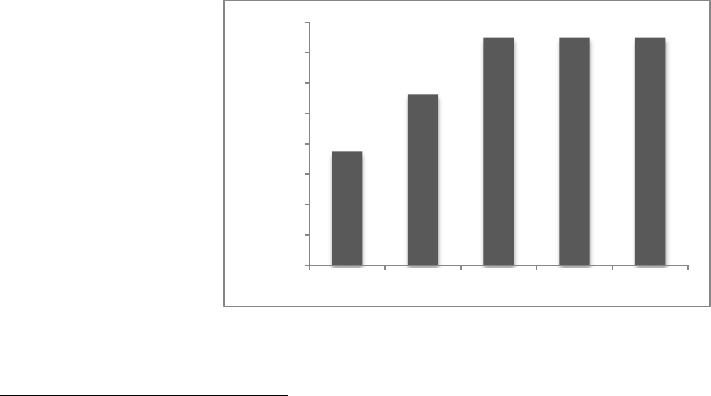
On the cost side of the ledger, Comcast estimates that the “synergies”—presumably through
gains from scale efficiencies—will yield cost savings of $1.5 billion a year in operating expenses
by the third year and continuing into the future, plus short-term “capital expenditure efficiencies”
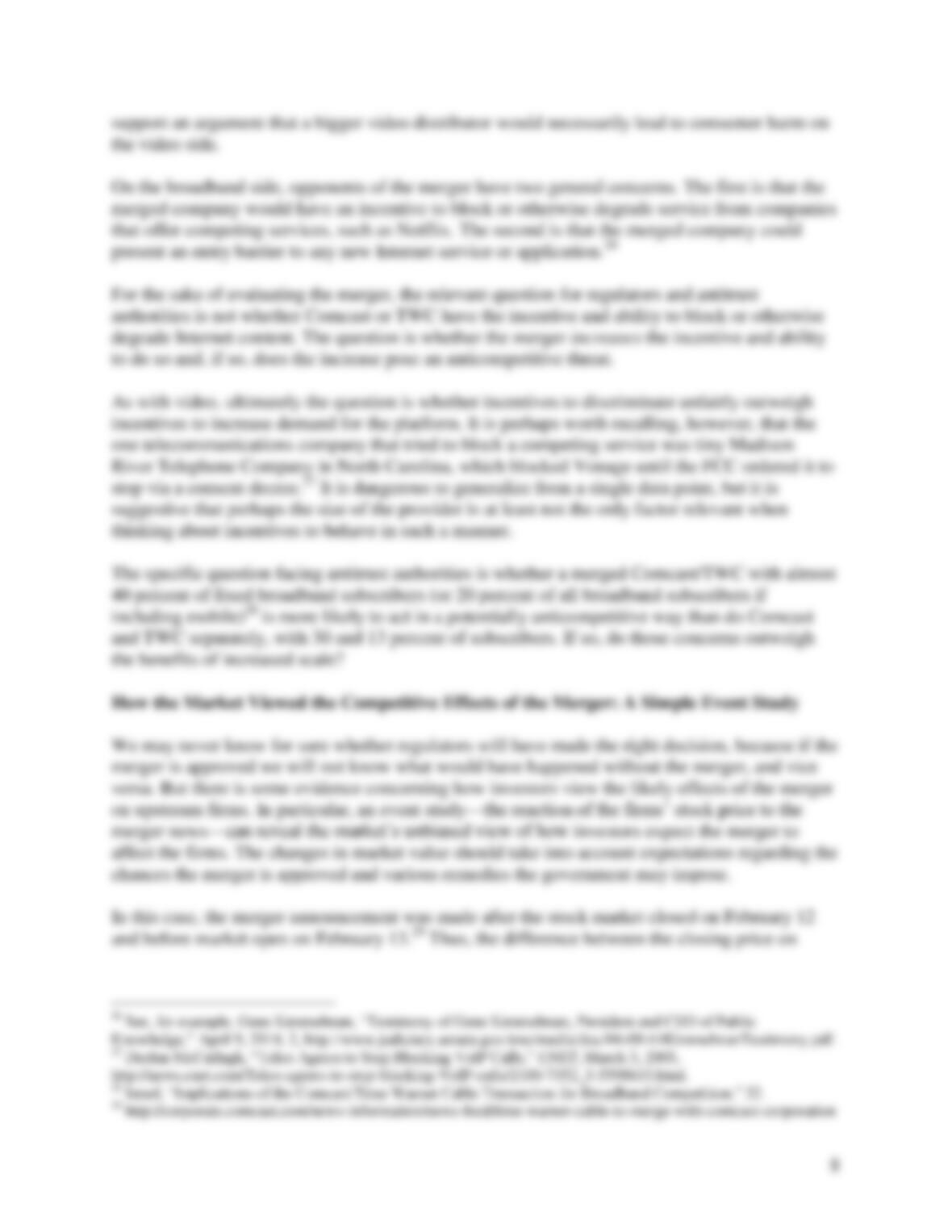
of $400 million, or about 10 percent of TWC’s operating expenses (Figure 1).4 Reducing costs
without reducing output is unambiguously a net economic benefit.
Figure 1: Cost Savings From the Merger
Source: Derived from Angelakis (2014).5
4 Michael J. Angelakis, Declaration of Michael J. Angelakis In the Matter of Applications of Comcast Corp. and
Time Warner Cable Inc. For Consent to Transfer Control of Licenses and Authorizations, n.d., 3.
5 Ibid.
0
0.2
0.4
0.6
0.8
1
1.2
1.4
1.6
Year 1
Year 2
Year 3
Year 4
Year 5+
$ billions
Business Customers
Cable companies have, for some years, recognized the business market as potentially lucrative
but have remained minor players in that market. By one estimate, Comcast has 20 percent of the
small business market and five percent of middle-sized companies.6 TWC, meanwhile, had 12
percent of the market for small and mid-sized businesses in 2013.7 Neither firm has gained
traction in the market for large businesses. One reason for their absence from the market for
large businesses—or businesses that have offices across cable company territories—appears to
be the costs of aggregating communications services into a single network across territories.
Rosston and Topper (2010) explain in their filing for Comcast that the FCC itself has
acknowledged “that customers prefer services delivered on a single provider’s network….”8
Because neither Comcast nor TWC is an established incumbent in the market to serve
businesses, a stronger presence—and, more specifically, a presence with a larger footprint—is
likely to yield benefits to these consumers.9 Neil Smit, President and CEO of Comcast cable
estimates this market to be “about a $15 billion opportunity.”10
Residential Customers
Residential consumers—TWC consumers, presumably—will benefit, Comcast says, by
accelerated upgrades to TWC’s infrastructure and access to Comcast’s technology and large
video-on-demand library. The residential consumer benefits of these actions, therefore, depend
on how quickly the upgrades would happen under Comcast ownership relative to TWC, how
much consumers value the upgrades, and how much prices change under Comcast relative to
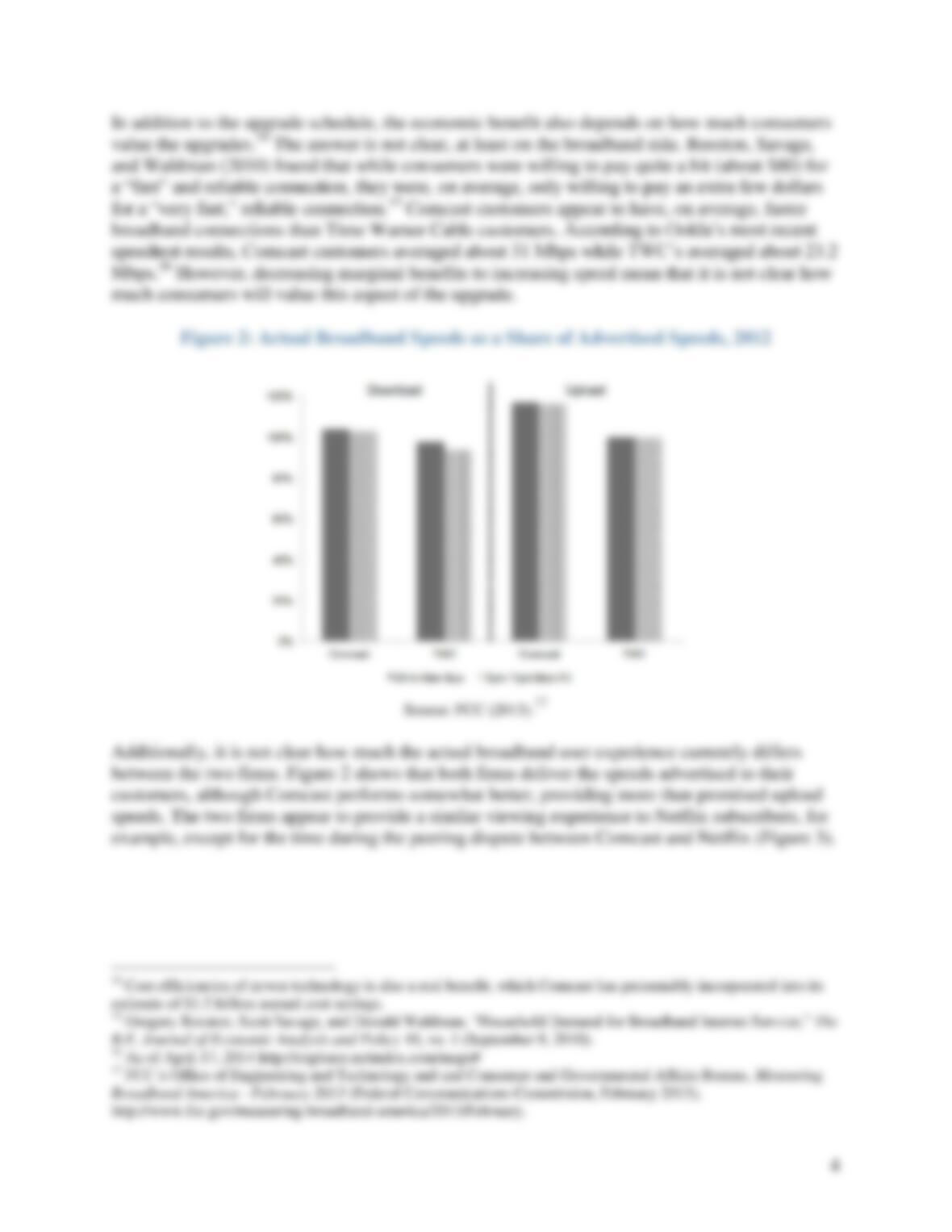
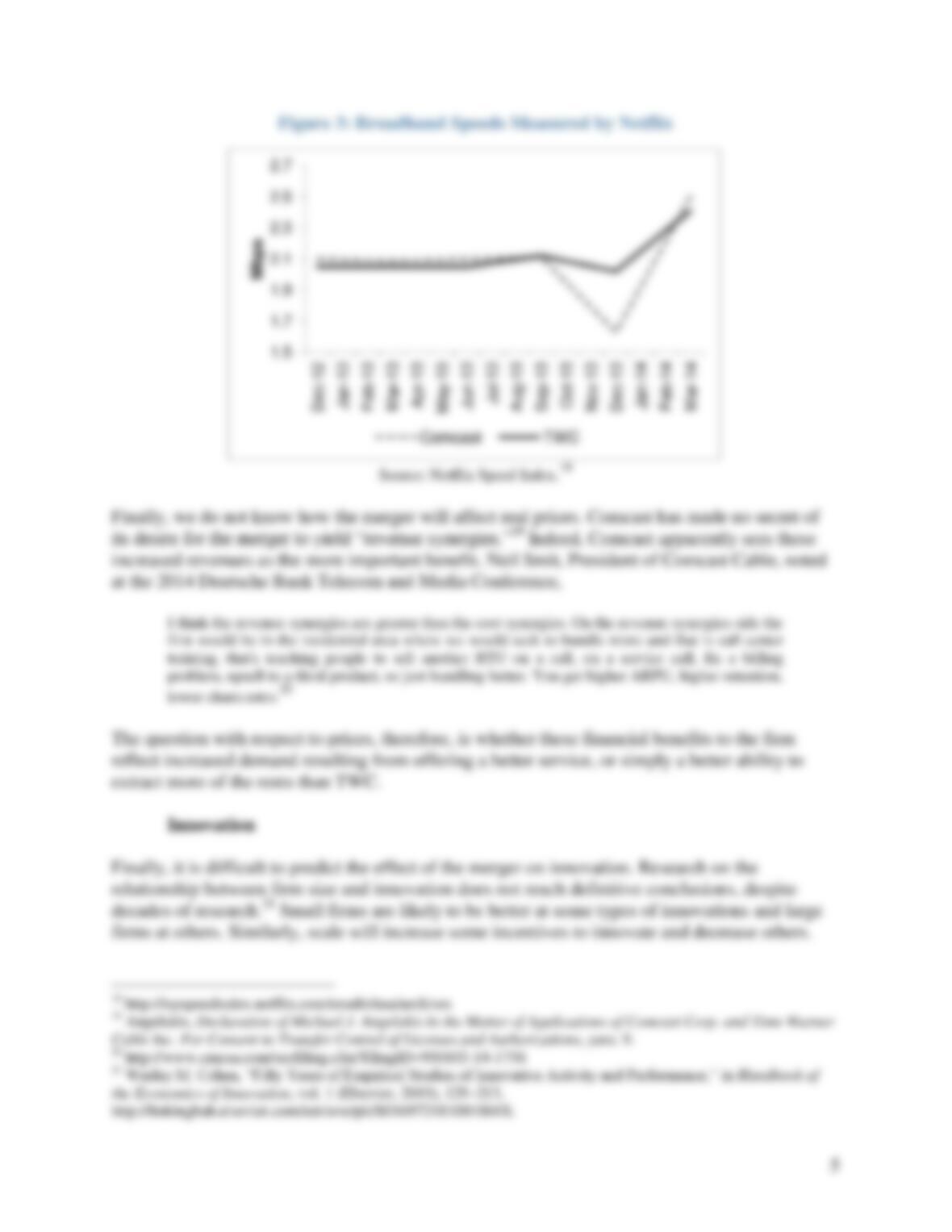
changes under TWC.