11.19.2018
NAICS CODES: 722513
SIC CODES: 5812
INDUSTRY PROFILE
Fast-Food & Quick-Service
Restaurants
First Research, a D&B company, is the leading provider of Industry Intelligence Tools that help sales and
marketing teams perform faster and smarter, open doors and close more deals. First Research performs the
“heavy lifting” by analyzing hundreds of sources to create insightful and easy to digest Industry Intelligence that
can be consumed very quickly to better understand a prospect’s or client’s business issues. Customers include
leading companies in banking, accounting, insurance, technology, telecommunications, business process
outsourcing and professional services. Used by more than 60,000 sales professionals, First Research can
benefit any organization which has prospects in multiple industries.
Attention: This Profile purchase is an individual license and is not to be distributed to additional individuals even
within the same organization. For corporate or small business subscription information, visit
www.firstresearch.com or call 866-788-9389 or toll-free International 800-486-8666.
About First Research
Companies in this industry operate restaurants in which customers order and pay at a counter. Major companies
include US-based Chipotle, McDonald’s, Wendy’s, and Yum Brands (KFC, Pizza Hut, Taco Bell), as well as Café
de Coral (Hong Kong), Greggs (UK), Seven & i Food Systems (Japan), and Restaurant Brands International
(Canada).
Consumer food service sales are expected to grow most rapidly in Latin America, the Middle East/Africa region,
and the Asia/Pacific region. The world’s 10 largest fast-food chains have a combined global brand value of about
$240 billion, according to Millward Brown.
The US fast-food and quick-service restaurant industry includes about 275,000 restaurant locations with
combined annual revenue of about $225 billion. Full-service restaurants and specialty eateries such as coffee
shops are covered in separate industry profiles.
Demand is driven by consumer tastes and personal income. The profitability of individual companies depends on
efficient operations and effective marketing. Large companies have advantages in purchasing, finance, and
marketing. Small companies can compete effectively by offering superior food or service. The US industry is
highly fragmented: the 50 largest companies account for about 20% of revenue.
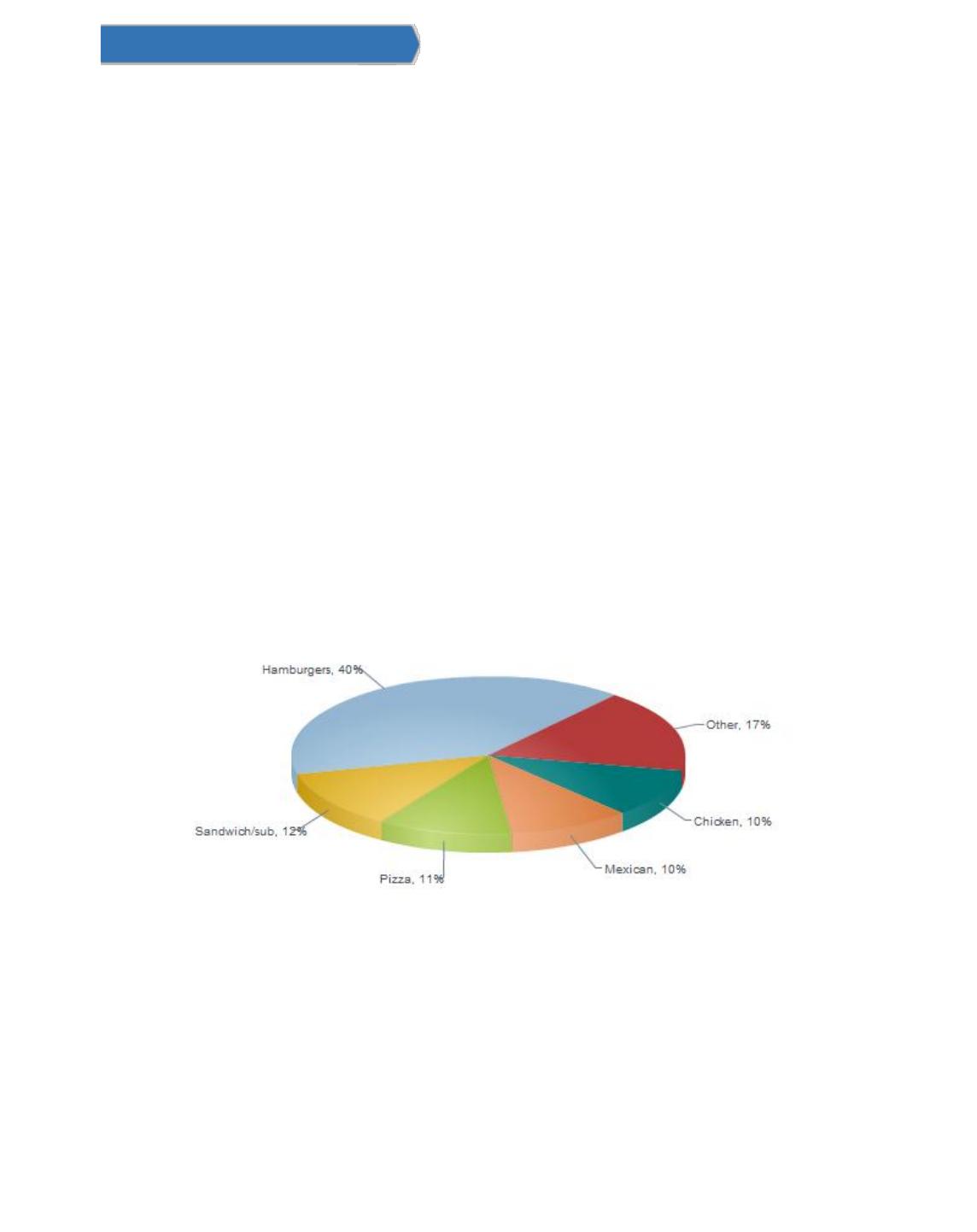
Most fast-food and quick-service establishments specialize in a particular type of cuisine. Hamburger restaurants
account for about 40% of sales among US limited-service establishments, while sandwich, pizza, chicken, and
Mexican food restaurants each account for about 10%.
Share of Limited-Service Restaurant Sales by Menu Category – US Census Bureau (2012)
The industry includes national and regional chains, franchises, and independent operators. While the industry
is fragmented, many independent operators are franchises of large national chains, such as Burger King,
Wendy’s, and Subway.
Most quick-service restaurants have a food preparation area, dining area, and parking lot, and many have a
drive-thru; some have children’s play areas. The average size of a quick-service restaurant varies, depending
on seating and equipment requirements. A typical freestanding Burger King location averages between 2,000 and
3,500 square feet with seating for 40 to 80 customers; a Domino’s Pizza delivery unit, with no in-store seating, is
typically about 1,500 square feet. Some companies may also operate kiosks with no seating area in high-traffic
locations such as airports and retail area food courts.
Because the industry is volume-driven, transaction speed is extremely important and most fast food can be
prepared and served quickly. Limited menus require few ingredients and make food assembly easier. Simple
preparation procedures help control quality by minimizing worker error. Sales volume is highest during lunch, so
companies increase staffing and food production to meet demand.
Industry Overview
Competitive Landscape
Products, Operations & Technology

Technology
Digital point-of-sale (POS) systems help restaurants operate more efficiently by facilitating communication
between the front of house and the kitchen. Restaurant employees use POS systems to record customer orders,
coordinate seating, take reservations, and manage other important tasks. Many establishments have adopted
mobile and tablet-based POS systems to supplement conventional touchscreen monitor displays, in addition to
self-ordering kiosks.
Inventory management systems help restaurant operators maintain steady supply levels and reduce waste due
to spoilage. Shipments from food distributors can be made more traceable and secure with the help of blockchain
technology.
Restaurants’ use of customer-facing technology is predicted to rise, spurred by growing consumer acceptance
and the opportunity to reduce labor costs. Some fast-food chains, particularly pizza delivery businesses, use
online ordering systems that make ordering from home easy and convenient. Other chains are creating
mobile apps or using existing third-party platforms, such as Facebook Messenger, to allow customers to place
orders ahead of time from smartphones and other handheld devices. Many quick-service establishments now
offer complimentary Wi-Fi access, along with access to electrical outlets for customers’ devices.
Fast-food restaurants may also adopt energy-efficient kitchen equipment, solar panels, and other sustainable
and eco-friendly technology to help attract more business and cut costs long-term.
Quick-service restaurants appeal broadly to consumers in all major demographic groups. Companies typically
promote their brands through mass media, including television, radio, and print publication advertising, as well as
on social media websites like Twitter and Instagram. Many franchises are required to contribute to national
advertising funds as a percentage of their sales. Companies use the internet to market their restaurant brands
and post information regarding menus and operating hours. Some restaurant operators invest heavily in mobile
marketing to reach younger consumers, and many large chains have developed branded smartphone
applications to build customer loyalty and gather marketing data.
Gross margins for fast-food companies are typically about 55% of net sales. Customers typically pay at the
time of sale, so receivables are low — less than 10 days’ sales on average. Franchise agreements can cover 10
to 20 years and typically require an initial payment, royalties (4% to 5% of sales), and advertising fees (2% to
5% of sales). The industry is labor-intensive: average annual revenue per employee in the US is about $50,000.
Regulation
Federal, state, and local government laws regulate restaurant operation, food safety, and worker protection. Local
officials regularly inspect restaurants to enforce health, sanitation, safety, fire, and liquor licensing regulations.
Noncompliance can result in temporary or permanent closure.
Consumer food service sales are expected to grow most rapidly in Latin America, the Middle East/Africa region,
and the Asia/Pacific region. The world’s 10 largest fast-food chains have a combined global brand value of about
$240 billion, according to Millward Brown. Major companies based outside the US include Café de Coral (Hong
Kong), Greggs (UK), Seven & i Food Systems (Japan), and Restaurant Brands International (Canada). US-based
chains including KFC, McDonald’s, and Subway have thousands of franchised locations around the world.
China’s fast-food market is expanding, but the country’s economic slowdown and changing consumer tastes are
hampering sales growth for the industry. Still, China remains a major focus of international expansion for many
foreign chains as smaller cities become more urbanized. KFC and Pizza Hut parent Yum Brands is the national
market leader, with more than 7,300 total locations in China. McDonald’s has more than 2,500 units there, and the
company plans to open more than 2,000 new restaurants in mainland China, Hong Kong, and South Korea by the
end of 2022. To reduce their exposure to market risks in Asia, both chains are shifting away from
company-owned stores to focus on growing their franchising operations, which typically generate steady cash
flow and require less capital investment.
Accommodating different cultures and food preferences can challenge US-based chains that operate globally. As
burger restaurants continue international expansion, many attempt to win over customers who prefer cheaper,
traditional fare by offering menu items that cater to local markets. For example, McDonald’s offers green tea ice
cream and rice dishes in China, while customers in India can order a McVeggie burger made primarily from fried
potatoes and peas.
Sourcing ingredients and ensuring food safety can also be a major challenge in some developing markets. Quick-
service restaurants are typically supplied by local or regional food distributors, but a lack of a sophisticated
Sales & Marketing
Finance & Regulation
International Insights
supply chain can create difficulties. McDonald’s and Yum Brands, for example, suffered significant sales losses
in 2014 following a high-profile scandal in which a major supplier was accused of selling expired meat to fast-food
chains throughout China and Japan.
In the US, states with the most fast-food and quick-service restaurants are California, Texas, New York, Florida,
and Illinois. Restaurants tend to locate in markets with rapidly growing populations. The states that gained the
most people between 2016 and 2017 were Texas, Florida, California, Washington, and North Carolina.
Labor management is a constant challenge for quick-service restaurants. Typical jobs include food preparation,
cashier, and janitorial positions. Average hourly wages for the industry in the US are significantly lower than the
Regional Highlights
Human Resources