Gene 3200 Fall 2016 Exam 5 Short Answer Name___________________ Answers________
1
Short Answer Section (Answer within the space provided)
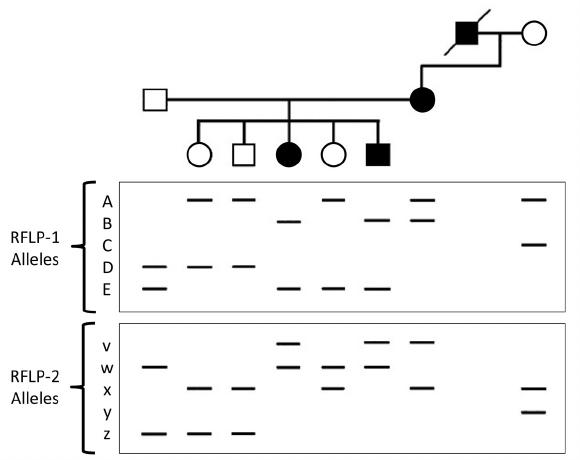
1. You are genetically mapping a rare form of osteoporosis that shows autosomal dominant inheritance in a
family. Some results from two of the RFLPs you are using to perform the mapping are shown below:
a) (2 pts) What allele at RFLP–1 did the affected mother inherit from her father (deceased)?
Allele B
b) (2 pts) What allele at RFLP–2 did the affected mother inherit from her father (deceased)?
Allele v
c) (2 pts) Based on this limited data, which RFLP is most likely to be linked to the mutation?
The RFLPs are equally likely to be linked to the mutation.
2. (5 pts) A company wants to develop a new strain of potato that has a longer shelf life. Previous research has
shown that the Spd gene encodes an enzyme that contributes to the breakdown of potato starch overtime and
decreases shelf life. As the company’s lead geneticist on this project, you tasked with developing strains of
potato where Spd gene function is reduced or eliminated. Based on our discussions in class, which of the
following Spd null strains would be classified as a GMO by the FDA (United States Food and Drug
Administration):
Strain A: A strain that carries a spontaneous nonsense mutation in the Spd gene.
Strain B: A strain that was created by Tilling for mutations in the Spd gene.
Strain C: A strain that has a deletion in the Spd gene that was generated with CRISPR/cas (this strain
has a deletion in Spd, but carries no transgenes).
Strain D: A strain that carries a transgene that produces an siRNA complementary to the Spd transcript.
The siRNA silences Spd through RNAi.
Strain E: A strain that was produced by exposing potato seeds to gamma radiation and then performing
biochemical assays to find mutants that have reduced Spd enzyme activity.
Only strain D would be designated as a GMO based on current FDA policies. (This is the only strain that
contains foreign DNA sequence).
Gene 3200 Fall 2016 Exam 5 Short Answer Name___________________ Answers________
3. Research studies of Icelanders have identified “human knockouts.”
a. (3 pts) List three reasons why the Icelandic population been the subject of extensive genetic studies.
1) Small founding population (population is relatively homogeneous)
2) Excellent genealogical/family database (dating back several hundred years)
3) Comprehensive/detailed medical records for nearly everyone in the population
4) Extensive informed consent and privacy measures implemented
b. (3 pts) Define the meaning of “human knockout.”
An individual who has mutations that are predicted to completely inactivate each allele of a gene (note:
each allele may carry a different inactivating mutation. i.e., human knockouts may be compound
heterozygotes).
c. (4 pts) How were these human knockouts identified? How did the researchers determine whether an
individual in their study was a human knockout?
They were identified by whole-genome sequencing.
The researchers scanned all coding regions in the human genome for sequence variants that are strongly
predicted to produce a loss of function allele (e.g., nonsense mutations, splice mutations, missense
mutations in conserved codons, loss of start codons, and frameshift mutations).