ISSN: 2278–3369
International Journal of Advances in Management and Economics
Available online at www.managementjournal.info
RESEARCH ARTICLE
Kamau, Charles Guandaru | Mar.–April. 2012 | Vol.1 | Issue 2|42–49 42
Factors Influencing Sample Size for Internal Audit Evidence Collection in the
Public Sector in Kenya
Kamau, Charles Guandaru*, Kariuki, Samuel Nduati
*Corresponding Author: E–mail:
guandaruaman@yahoo.co.uk
Jomo Kenyatta University of Agriculture and Technology, Kenya.
Abstract
The internal audit department has a role of providing objective assurance and consulting services designed to add
value and improve an organization’s operations. In performing this role the internal auditors are required to provide
an auditor’s opinion which is supported by sufficient and reliable audit evidence. Since auditors are not in a position to
examine 100% of the records and transactions, they are required to sample a few and make conclusions on the basis of
the sample selected. The literature suggests several factors which affects the sample size for audit purposes of the
internal auditors in the public sector in Kenya. This research collected data from 32 public sector internal auditors.
The research carried out simple regression and correlation analysis on the data collected so as to test hypotheses
and make conclusions on the factors affecting the sample size for audit purposes of the internal auditors in the public
sector in Kenya. The study found out that that materiality of audit issue, type of information available, source of
information, degree of risk of misstatement and auditor skills and independence are some of the factors influencing the
sample size determination for the purposes of internal audit evidence collection in public sector in Kenya.
Keywords
: Audit evidence, Internal auditors, Materiality, Sample size.
Introduction
ISA 500 requires that the auditors should design
and perform audit procedures that are appropriate
in the circumstance for the purpose of obtaining
sufficient and appropriate evidence. It further
explains that audit evidence is necessary to support
the auditor’s opinion and report. It is cumulative in
nature and is primarily obtained from audit
procedures performed during the course of the
audit. It may, however, also include information
obtained from other sources such as previous audits
or a firm’s quality control procedures for client
acceptance and continuance. In addition to other
sources inside and outside the entity, the entity’s
accounting records are an important source of audit
evidence. Auditors may not be in a position to carry
out 100% examination and verification of records
and transactions. Therefore auditors use sampling
concept to choose a sample of records and
transactions, carry out examination of the sample
and use the results to draw conclusions about the
fairness of a company´s financial statements.
Consequently, auditors can only provide assurance
but not absolute assurance that the financial
statements are fairly presented [1].The internal
auditing standards asserts that an internal auditor
has a professional duty and an ethical
responsibility to evaluate carefully all the evidence
and the reasonableness of his or her conclusions
and, then, to decide whether further actions may be
needed to protect the interests of the organization,
its stakeholders, the outside community, or the
institutions of society [2].Internal audit aims to
increase the accountability of government
ministries by ensuring transparency, validating key
systems of internal control, and committing
resources against key risks. To achieve this task
the internal auditors are required to collect audit
evidence to support their findings. Audit evidence
collected is on the basis of sampling technique that
helps the auditors to collect and analyze the
required information. This research looks into the
various factors affect the size of the sample that the
auditors will select for the purpose of audit
evidence collection.
Statement of the Problem
Internal auditing is defined by IIA as an
independent, objective assurance and consulting
activity designed to add value and improve an
organization’s operations. The Internal audit helps
an organization achieve its objectives by bringing a
systematic, disciplined approach to evaluate and
improve the effectiveness of risk management,
control, and governance processes [2] Internal
Available online at www.managementjournal.info
auditor’s opinion should be supported by sufficient
and reliable audit evidence. IIA proposes that
internal auditors in the process of providing
assurance should carry out objective examination of
evidence for the purpose of providing an
independent assessment on risk management,
control, or governance processes for the
organization [2]. Beasley, Carcello and Hermanson
[3] observed that the most common problem found
in 80%
Objectives of the Study
of the cases, was the auditor’s failure to
gather sufficient audit evidence. Many of the cases
which they studied involved inadequate evidence in
areas such as asset valuation, asset ownership and
management representations.Gathering internal
audit evidence is a challenge for many auditors
since they are required to carry out their work
independently yet at the same time they are part of
management. Attitude of the auditees towards the
internal auditor complicates the process of audit
evidence gathering. This study therefore sought to
explore the factors affecting the sample size for
internal audit evidence collection in public sector in
Kenya.
• To find out the effect of materiality on the sample
size for internal audit evidence collection
• To identify the effect of type of information on the
sample size for internal audit evidence collection
• To identify the effect of source of information on
Audit evidence gathering is fundamental in
carrying out audit engagements. It’s on the basis of
the audit evidence gathered that the internal
auditor makes conclusions about an audit issue.
Gathering audit evidence is a complex activity
which depends on a number of factors,
understanding these factors is important for the
internal auditors. This research may be of great
significance in improving the performance of the
auditors in the public sector.
Conceptual Framework
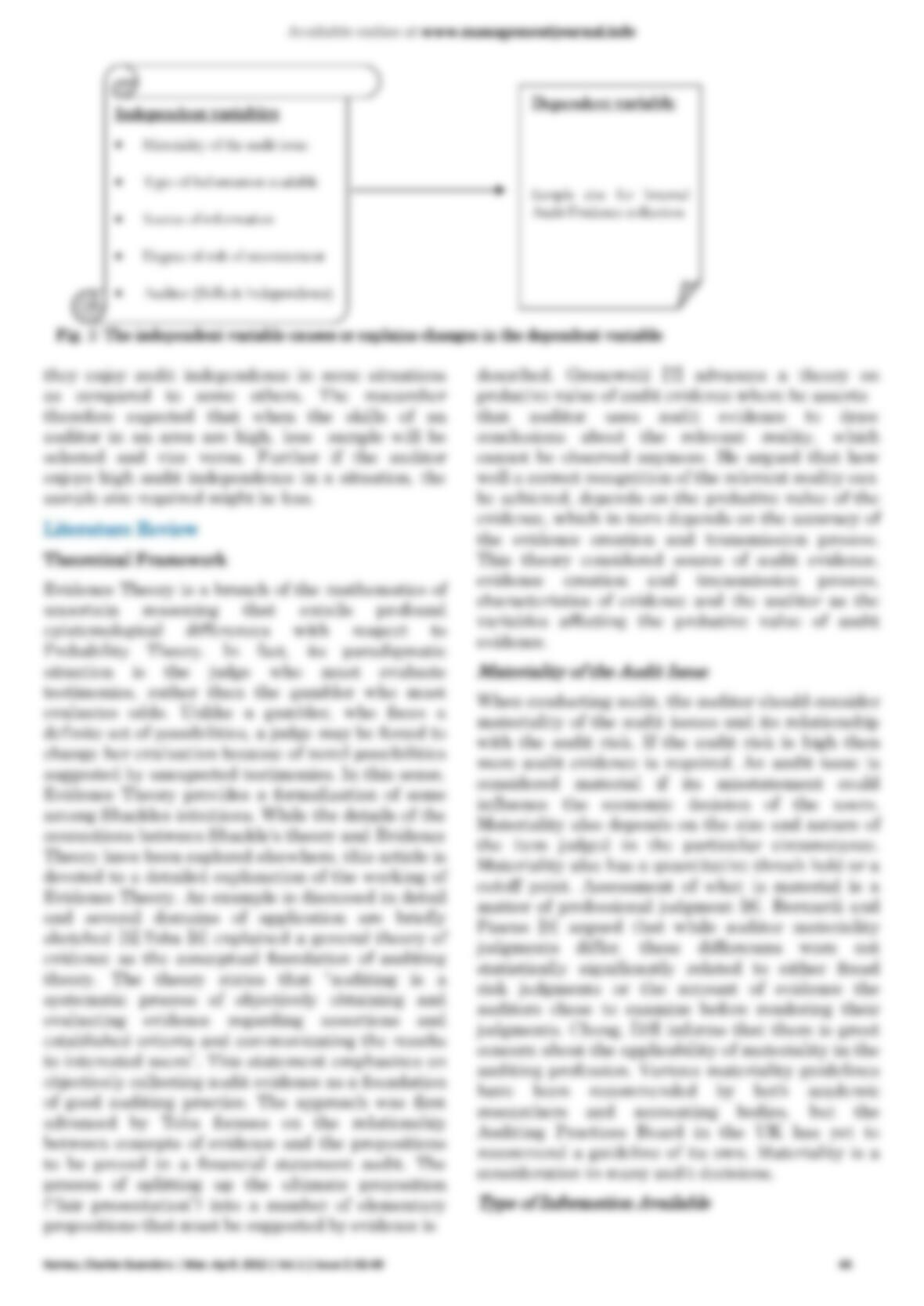
Conceptual framework is a visual or written
product that explains graphically or in narrative
form, the main things to be studied. It describes the
key factors, concepts, and variables and the
presumed relationship among them [4]. According
to Nachmias, “the variable that the researcher
wishes to explain is the dependent variable.” The
independent variable causes or explains changes in
the dependent variable. In this research, the
internal audit evidence was the dependent
variable.Several factors may influence the internal
audit sufficiency in public sector in Kenya. These
factors become the independent variables in this
research. They include:
Materiality of the Audit Issue
The internal audit evidence required largely
depends on the materiality level of the audit issue