mathematics
Article
Factors Influencing Passengers’ Satisfaction with the Light Rail
Transit Service in Alpha Cities: Evidence from Kuala Lumpur,
Malaysia Using Structural Equation Modelling
Ahmad Nazrul Hakimi Ibrahim 1, Muhamad Nazri Borhan 1,2,* , Muhamad Razuhanafi Mat Yazid 1,2 ,
Riza Atiq Rahmat 1and Sotaro Yukawa 3
Citation: Ibrahim, A.N.H.; Borhan,
M.N.; Mat Yazid, M.R.; Rahmat, R.A.;
Yukawa, S. Factors Influencing
Passengers’ Satisfaction with the
Light Rail Transit Service in Alpha
Cities: Evidence from Kuala Lumpur,
Malaysia Using Structural Equation
Modelling. Mathematics 2021,9, 1954.
https://doi.org/10.3390/math9161954
Academic Editors: Gregorio Esteban
Giménez and Javier Valbuena
Received: 27 July 2021
Accepted: 12 August 2021
Published: 16 August 2021
Publisher’s Note: MDPI stays neutral
with regard to jurisdictional claims in
published maps and institutional affil-
iations.
Copyright: © 2021 by the authors.
Licensee MDPI, Basel, Switzerland.
This article is an open access article
distributed under the terms and
conditions of the Creative Commons
Attribution (CC BY) license (https://
creativecommons.org/licenses/by/
4.0/).
1Department of Civil Engineering, Faculty of Engineering and Built Environment, Universiti Kebangsaan
Malaysia, Bangi 43600, Malaysia; nazrulhakimi@siswa.ukm.edu.my (A.N.H.I.);
razuhanafi@ukm.edu.my (M.R.M.Y.); rizaatiq@ukm.edu.my (R.A.R.)
2Sustainable Urban Transport Research Centre (SUTRA), Faculty of Engineering and Built Environment,
Universiti Kebangsaan Malaysia, Bangi 43600, Malaysia
3Department of Economics, Osaka University of Commerce, Mikuriyasakae-machi, Higashiosaka-shi,
Osaka 577-8505, Japan; s77yukawa@nifty.com
*Correspondence: mnazri_borhan@ukm.edu.my
Abstract:
Policy makers and service providers must have a good understanding of the determinants
of passengers’ satisfaction with light rail transit (LRT) in order to be able to formulate effective
strategies that ensure passenger satisfaction, which would in turn help to retain existing passengers
and attract new ones. This is seen as the most important determinant of the long-term financial
performance of LRT service. In this context, the present study seeks to establish the influence of
passenger expectation, perceived quality and perceived value on their satisfaction with the service
provided. A total of 417 responses from a self-administrated questionnaire were collected from LRT
passengers in Kuala Lumpur, Malaysia. The proposed model was tested using a structural equation
model. The results proved the significant and direct effect of perceived quality and perceived value
on passenger satisfaction. Of the factors, perceived quality is the most critical construct determining
the satisfaction level of LRT passengers. The present study concludes by deriving the theoretical and
managerial implications on the field of transport. This study provides beneficial information which
helps service providers, authorities, policy makers, planners, and researchers formulate effective
strategies to increase the use of LRT service, especially in Kuala Lumpur, Malaysia, and other alpha
and metropolitan cities in general.
Keywords:
light rail transit; public transport; railway; service quality; satisfaction; structural
equation model
1. Introduction
The rapid population growth and urban development in many cities worldwide has
led to the massive urbanisation and intricate transformation of the urban landscape. This is
one of the phenomena faced by the increasingly higher number of rural people migrating to
urban areas in the pursuit of better employment and education opportunities; this has con-
tributed to a higher degree of urban agglomeration. For instance, approximately 80% of the
urban population in European countries is the result of the urbanisation phenomenon [1].
The major impact of this phenomenon is a higher demand for transportation. In this regard,
the provision of a proper public transport network is of critical importance to reduce
dependence on motorised transport. Kwan et al. [
2
] emphasised that an inadequate public
transport network leads to the dependence of motorised transport for mobility. This has
contributed to a number of social economic burdens, including massive traffic congestion,
risks of road accidents, longer travel time, higher cost, and environmental problems such
as air pollution and high carbon dioxide emissions [
2
–
4
]. In addition, the use of motorised
Mathematics 2021,9, 1954. https://doi.org/10.3390/math9161954 https://www.mdpi.com/journal/mathematics

Mathematics 2021,9, 1954 2 of 15
transport could have an adverse impact on human health due to air and noise pollution
and the involuntary adoption of a sedentary lifestyle [5,6].
As one of the most developed countries in Southeast Asia, Malaysia experiences
significant urbanisation and urban agglomeration. The rate of urbanisation in Malaysia is
projected to be about 70% in the year 2020 [
7
]. Kuala Lumpur is one of the cities in Malaysia
experiencing a rapidly expanding metropolitan area and massive urban development.
Ranked as an alpha (an alpha level city is a city that serves the main node in the global
economic network) world city, Kuala Lumpur is the financial, cultural and economic centre
of the country and is one of three Malaysian Federal Territories [
8
]. Kuala Lumpur has a
very high population density of 6891 people/km
2
. The population of Kuala Lumpur in
2016 is 1.76 million, and by the year 2020 Kuala Lumpur is expected to have a population
of 2.2 million [
8
,
9
]. In its role as an alpha and capital city, Kuala Lumpur is the centre for
several activities such as high technology development, education-training, commercial
and financial, international business and trade, and others, all of which influence the
number of trips made within the city area. Trips in the Kuala Lumpur area are made
using private motorised transport such as cars and motorcycles. Chuen et al. [
10
] and
Kwan et al. [
2
] found that only 17% (1.24 million) of the trip in Kuala Lumpur are made by
public transport, and 83% (6 million) of the trips are made by private motorised transport.
In addition, Mohamad and Kiggudu [
11
] reported that 70% of the vehicles plying the
major roads during the morning rush hour are single-occupancy vehicles. These evidences
proved that the commuting methods used by the residents of Kuala Lumpur are extremely
inefficient. This has contributed to the negative effects of the dependence on private motor
vehicles discussed in previous works [10–13].
A large amount of transport literature has contended that public transport is a vital
element in the global effort to promote sustainable transport [
2
,
13
,
14
]. This endeavour
could reduce the dependency on private transport and promote the use of sustainable trans-
port; in Kuala Lumpur, for instance, the rail transit service provides an efficient, reliable,
affordable and eco-friendly travel alternative. However, according to
Masirin et al. [15]
,
the ridership for the rail transit in Kuala Lumpur is still low, even though the govern-
ment has been making a large investment to encourage the use of rail transit and increase
the ridership of rail transit in the past few decades. Similarly, Zulkifli et al. [
16
] and
Ibrahim et al. [17]
reported that one of the most serious concerns in Asian transport litera-
ture is the low ridership of rail transit. The low ridership of rail transit in Kuala Lumpur
is similar with the low rate of public transport usage reported in many other parts on the
globe [
13
,
18
]. Generally, the poor public transport usage is due to the convenience of using
private transport, including better flexibility, comfort, privacy and speed, compared to the
utilisation of public transport [1,19].
According to Kwan et al. [
2
], one reason for the low intention to use the railway for
commuting in Kuala Lumpur is because the rail transit network only connects 10–20% of
the urban area. In addition, several studies have reported that the reason for the lack of
enthusiasm to use rail transit is the failure to provide the level of quality service expected
by the passengers [
13
,
20
,
21
]. This has caused dissatisfaction with the service provided.
According to Shen et al. [
22
], passengers who are not satisfied with the public transport
service would not be loyal to the service and would not recommend it to others. Numerous
studies have investigated passengers’ satisfaction with rail transit [
22
–
24
] and reported
that passengers’ satisfaction with the service provided is a primary factor influencing their
decision to use and promote the railway service to others in the future. Thus, the provision
of a high-quality service that meets passengers’ expectations would result in passenger
satisfaction, which in turn ensures passenger retention and attracts potential passengers to
use the service.
As has been pointed out in the various marketing and transport literature, an indi-
cator of a successful public transport service which ensures the ability to survive in the
transport market and the ability to compete with other forms of travel mode is the number
of passengers that the system is able to retain and attract [
22
,
25
]. Thus, there is a critical

Mathematics 2021,9, 1954 3 of 15
need for the authorities and rail transit service providers to determine whether the services
provided adequately satisfy passengers’ needs and satisfaction. In addition, the factors
which influence passengers’ satisfaction with rail transit have to be established to enable
researchers, policy makers, engineers, service providers and the authorities to formulate
strategic measures which would enhance passengers’ satisfaction with rail transit and thus
increase ridership. Therefore, this paper attempts to investigate the factors influencing the
satisfaction of rail transit passengers based on the evidence from the light rail transit (LRT)
in Kuala Lumpur. The covariance-based structural equation model (CB-SEM) approach
is used to assess the relationship between the constructs, namely passenger expectation,
perceived quality, perceived value and passengers’ satisfaction with the LRT service. There
are several advantages offered by this approach. In a statistic point of view, SEM is an
advanced linear model approach which involves the multiple regression analysis to inves-
tigate the consistency of the hypothesised model with the data collected [
26
]. Additionally,
Williams et al. [
27
] stated that SEM is a multivariate analytical method employed to assess
and evaluate the complex causal relationship between constructs, even when the relation-
ship is hypothetical direct or not directly observable. In general, the SEM approach is
popular and is preferred in social science and management studies because it can assess the
measurement model and structural path efficiently, especially when the structural model
consists of multiple dependent variables, latent constructs based on multi-item indicator
variables, and multiple stages/levels of constructs in a structural model [
28
]. Due to its
robustness, the SEM approach has gained attention in the transportation sector. The present
study hopes to provide useful information that would help service providers, authorities,
policy makers, planners and researchers formulate effective strategies to increase the use
of rail transit, especially in Kuala Lumpur, and in other alpha and metropolitan cities
in general.
The rest of the paper is organised as follows. Section 2discusses the reviewed literature
and hypothesis development. Section 3describes the adopted methodology. Section 4
presents and analyses the results of the study, and Section 5explains their implications.
Section 6draws the conclusion from the present study.
2. Hypothesis Development and Conceptual Framework
2.1. Passenger Expectation
Passenger expectation is derived from the passengers’ earlier experience with other
products or service providers, and this experience shapes the passengers’ expectation of
the ability of any company to provide a product or service in the future [
29
,
30
]. According
to Fornell [
29
], passenger expectation is positively and directly related with perceived
performance, quality of service, perceived value and customer satisfaction. This contention
is supported by Oliver [
31
,
32
] based on the expectancy-disconfirmation model framework,
which considers expectations as one of the most important antecedents of perceived quality,
perceived value and user satisfaction.
Numerous previous works in the field of transportation have reported passenger
expectation as an important factor influencing passenger satisfaction. Shen et al. [
22
]
investigated urban rail and found that passenger expectation can influence perceived
quality, perceived value and passenger satisfaction. Another study of the Chinese public
transport service by Zhang et al. [
33
] showed a similar trend of the relationship, and their
findings are supported by those made by Shen et al. [22]. Hussain et al. [34] reported that
passenger expectation has a considerable positive influence on perceived quality, although
the researchers were not able to demonstrate any significant effect on perceived value
based on their investigation of the airline service in the United Arab Emirates (UAE).
This outcome is congruent with the findings of an investigation on the public transport
in Suzhou, China [
35
]. Based on a review of the literature, it is evident that passenger
expectation may influence perceived quality, perceived value and passenger satisfaction.
Thus, on the basis of this evidence, the following hypotheses are proposed:
Mathematics 2021,9, 1954 4 of 15
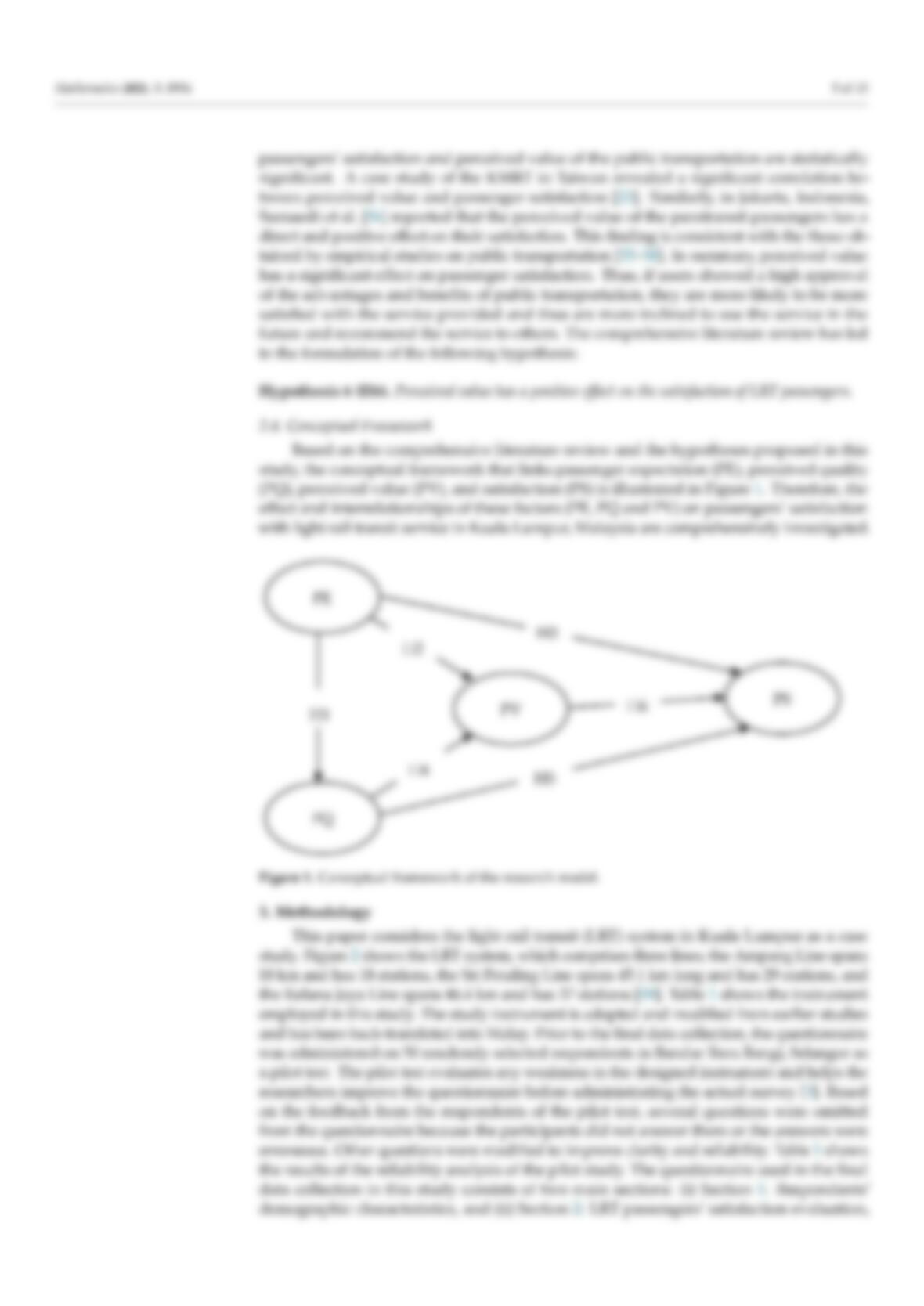
Hypothesis 1 (H1).
Passengers’ expectation towards LRT service has a positive effect on per-
ceived quality.
Hypothesis 2 (H2).
Passengers’ expectation towards LRT service has a positive effect on per-
ceived value.
Hypothesis 3 (H3).
Passengers’ expectation towards LRT service has a positive effect on the
satisfaction of LRT passengers.
2.2. Perceived Quality
To date, exploration of the theories and practices of service quality has been attracting
increasing attention from practitioners and researchers from many different fields. Service
quality is defined as the overall customer assessment of the service provider’s perfor-
mance [
36
]. Additionally, Lai and Chen [
23
] proposed that service quality is a degree to
which the provided service fulfils the consumer’s needs. In much of the reviewed literature,
service quality is considered an important predictor of customer satisfaction [
37
–
40
]. A
high service quality leads to higher perceived quality by the customer. Perceived quality,
or perceived service quality, is consumer perception of the services offered by an entity
that includes the full accomplishment of superiority [
41
], and several studies reported that
it is a key factor influencing customer (or passenger) satisfaction, including in the field
of transportation.
In a study investigating rail-based public transport, Mouwen [
40
] found that travel
speed and punctuality are among the service quality which have the strongest influence
on user satisfaction. Lai and Chen [
23
] found that the quality of service provided by the
Kaohsiung Mass Rapid Transit (KMRT) is a statistically significant factor influencing the
passengers’ perceived value, satisfaction and involvement. In addition, Shen et al. [
22
]
reported that perceived quality has a significant positive and direct effect on the perceived