European Journal of Business and Management www.iiste.org
ISSN 2222-1905 (Paper) ISSN 2222-2839 (Online)
Vol.13, No.10, 2021
56
Factors Affecting Intention to Purchase Voluntary Pension
Insurance in Vietnam
Duc Hieu Ninh*, Hoang Chau Giang Dang, Huyen Trang Ngo, Lam Phuong Bui, Thao Linh Le
School of Advanced Educational Programs, National Economics University, 207 Giai Phong Road, Vietnam
Abstract:
The research was carried out with the aim to identify factors affecting the intention to purchase voluntary pension
insurance in Vietnam. With data collected from 334 subjects across the country, mainly in Hanoi, the results
showed that attitude towards risk, subjective norms, percieved behavioral control, past experiences and corporate
branding have positive influences on the central factor, which is intent. After quantitative analysis, the study
proposes recommendations for businesses to improve their services as well as methods of distribution to meet the
needs of potential customers to save in pension funds. Additionally, the study will provide the basis for regulators
to come up with measures to promote the retirement insurance market and at the same time, raise public awareness
about social security.
Keywords: voluntary pension insurances, pension funds, puchase intention, TPB, annuity.
DOI: 10.7176/EJBM/13-10-06
Publication date:May 31st 2021
1. Introduction
Voluntary pension insurance or private pension plan is a type of periodical insurance contract between an insurance
company and an individual or an organization with the purpose to ensure income after retirement or in the case of
loss the ability to work. The emergence of private pension plan is inevitable since the majority of labors today
thrives for financial autonomy when they reach retirement age. Instead of relying on relatives or expecting financial
support from the State, people want to take a more proactive approach towards planning for retirement. In addition,
the pressure of population aging on the social security system plus the current limitations of social insurance further
consolidate the role of private pension plans.
The biggest benefit that comes from voluntary pension insurance is the guarantee of income for workers after
retirement. The demand for retirement income is especially important for those unofficial workers who are known
to have unstable jobs, lack labour contracts or work on verbal contracts to earn low income. With addtional source
of income, the elderly can be self-controlled and secured to live a peaceful and comfortable life. In addition,
voluntary pension insurance often comes with guaranteed health benefits, which is a top concern at old ages. It
can be seen that the number of people paying social insurance and compulsory retirement insurance is still modest
compared to the total number of workers in our country. The development of voluntary pension insurance aims to
broaden the choice for workers, increase the supply of pension funds and promote the importance of saving for
retirement. With the funding support from private sectors, Vietnamese government focuses on battling the
challenges of aging population posed for the social security system. Viet Nam is at high risk of facing the unwanted
outcomes due to population aging, provided the proportion of people aged 60 and over expected to double by 2050,
according to UN projections. With our country’s current budget, the payment of pension for wokers is becoming
increasingly difficult and there is a call for voluntary pension insurance funds to help alleviate this pressure.
Based on current situation in pension policies, the research team decided to select research topic on factors
affecting the decision to buy voluntary pension insurance of people in Vietnam to analyze the demand for this new
type of retirement scheme and propose solutions to increase public recognition as well as the urge to save in
pension funds. In addition, the research team hopes that the relationship between factors affecting people’s need
to buy voluntary pension insurance will help insurance companies comes up with solutions to diversify products
and takes advantage of the support from social security policies in our country.
2. Literature Review
2.1. Theories on behavioral intentions, and behaviours of consumers
The theory of Reasoned Action (TRA): The theory of reasonable action was first developed in 1967 by Martin
Fishbein. TRA was formed with the aim of explaining an individual’s voluntary behavior by considering the
potential motive to perform such behavior. In other words, this theory proposes that individuals have different
facilities and motivations in their decision-making process with a belief that the implementation of behavior will
lead to a specific result. The TRA doctrine has also shown that a person’s intention to perform a behavior is likely
to predict whether or not they would actually perform it. The stronger the intention will lead to increased efforts
to carry out the behavior and increase the likelihood that the behavior is carried out. Based on the theory of
reasonable action, the element of intention will be influenced by attitudes to behavior and subjective norms related
to behavior.

European Journal of Business and Management www.iiste.org
ISSN 2222-1905 (Paper) ISSN 2222-2839 (Online)
Vol.13, No.10, 2021
57
The Theory of Planned Behavior (TPB): Planned Behavior Theory developed by Icek Ajzen in 1991 is based
on reasonable action theory (Fishbein and Ajzen, 1980). The TPB model is considered more optimal than the TRA
model in predicting and explaining consumer behavior due to its ability to account for involuntarily behaviors.
Similar to the TRA model, the central factor is identified as the intention to perform the behavior, influenced by
attitudes to behavior, subjective norms of behavior and one new factor is the perceived behavioral control.
Experiental Marketing Theory (SEMs): Schmitt first mentioned the term “Experiental Marketing” in 1999.
This is considered a newer, more modern form of marketing than traditional methods. This new method still sees
consumers as reasonable beings, but added with one more factor which is emotional. Instead of just buying based
on the process of matching product’s usage to benefits it offers, under Schmitt’s marketing concept, people now
have the tendency to go for products that bring them satisfied experiences. Schmitt’s SEMs (Strategic Experiental
Module) model consists of 5 factors: Sense, Feel, Think, Act, and Relate. Under the Experience Marketing theory,
consumers will be more likely to buy a product if they have had a positive experience with it. For that reason,
many studies have also applied the SEMs model to the study of purchasing intention and proved that this model is
of research significance (Chao Chien et al., 2012; Khan and Rahman, 2015).
Hierarchy of Effects Theory: An impact hierarchy theory model was developed in 1961 by Lavidge and
Steiner to measure the effectiveness of an advertising strategy on consumer purchasing decisions. The model holds
that consumers acknowledge, process and use marketing informations in three stages: thinking-cognative phrases,
feeling-affective phrase and doing-cognative phrase. These three stages also reflect the level of consumer brand
awareness under the influence of advertising campaigns. At the initial stage, customers need to be introduced to
the company’s products and brands. Next, businesses will try to build trust, attract positive customer feelings about
products and brands. And finally firms would rather hope that the promotion strategy is attractive enough to make
consumers arrive at decisions to buy products. The theory of Lavidge and Steiner (1961) forms the basis for
considering the impact of brand awareness on purchasing intention.
2.2. Empirical researches on intention to purchase voluntary pension insurance
In Western countries, saving is considered as one of the top concerns. In today’s society, when issues such as
population explosion, aging population, economic crisis, epidemic … are still going on, saving is a necessary form
of protection. The lifespan of the population has increased but the growth of pension funds is not enough to serve
the elderly population, accompanied by economic crises: stock prices plummeted, bank interest rates fell,… Spain
has created a strong incentive to save in the community (Letamendia & Silva, 2015). The forms and purposes of
saving vary in the US, however, young people generally tend to save and accumulate their weath. In particular,
due to the fact that young people have more financial knowledge and prone to participate in venture capital forms,
accept more debts and risks, they create conditions for generating savings to hedge against investment losses
(Outcault, 2012). Lusardi and Tufano (2009) support the above view that those with more financial knowledge
tend to spend more economically and have less debt. Besides, Maison et al. (2019), after doing research in Poland,
concluded that when the financial situation or income is positively related to the demand for saving.
In Asia, research by Hong et al. (2002) also found that Korean people tend to accumulate wealth as a form of
savings, especially after turning 40. In China, the imbalance in the sex ratio is believed to have a positive effect
on household savings. Specifically, families with sons were observed to accumulate and save more (Zhang and
Wei, 2011).
Awareness about owning annuities and saving for retirement age is increasingly focused. In the study of
demographic factors influential in the intention to save voluntary retirement funds in Malaysia, Radduan Yuso et
al. (2018) suggested that those who are considered seasoned savers with lots of past experience in saving and have
the adequate money and time resources will tend to save higher for retirement age. Also in Malaysia, in the study
of Hassan et el. (2016), the results showed that people aged 40 and over paid greater attention to pension issues.
At the same time, the factors of education and psychology also positively affect the attitude towards retirement
planning. The higher the level of education, the more interested they are in pension savings. The level of individual
interest in making a retirement plan in the long run holds a close relationship with a business’s ability to provide
retirement insurance. In particular, the more people care about retirement-age financial matters, the more they
interest in the retirement funds provided by the business and the higher the likelihood of them joining those funds.
Besides demographic factors, many studies applied models and theories surounding behavioral intention.
Yusof et al. (2018) applied the Decomposed Theory of Planned Behaviour (DTPB) model to the study of the
intention to join voluntary pension funds and concluded that the perceived behavioral control had the strongest
impact. Besides, attitude also has a great influence on the intention to participate. According to Yusof et al. (2018),
a person will start depositing in voluntary retirement funds if they can estimate the economic benefits and consider
whether the schemes would suit their lifestyle or not. In addition, according to Amin (2012), the attitude has a
much greater effect on purchase intention of risk-takers.
In the study of Paola Bongin et al. (2018) the subjective norms is the forecasting factor that contributes the
most to the investing intention. That means students who live in an environment where their loved ones talk about
European Journal of Business and Management www.iiste.org
ISSN 2222-1905 (Paper) ISSN 2222-2839 (Online)
Vol.13, No.10, 2021
pensions and consider saving in retirement as important will be more willing to save for their future. The next
influential factor is knowledge about pension insurance. The results of the study showed that the sooner a person
acquired knowledge about principles of insurance, the more likely young people would participate in retirement
planning schemes. Numerous studies have also shown a positive link between financial knowledge and the
intention to buy insurance (Mahdzan and Victorian, 2013; Zakaria et al., 2016; Jahan and Sabbir, 2018).
Sri Lanka is facing the reality that a large number of customers stop paying pension insurance halfway through.
Researcher Heenkenda (2016) did an investigation to find out what factors influenced that decision. Ignorance of
the benefits of private pension plans and marketing failures led to the decision to stop depositing into insurance
companies of the majority of people.
In Vietnam, the number of studies on factors affecting insurance demand has increased significantly in recent
years, showing the attraction and exploitation potential of this field, especially in life insurance sector. However,
when going specifically into a branch of life insurance, which is voluntary pension insurance or annuity insurance,
the number of research papers is limited. Studies on the intention to purchase life insurance show that demographic
factors such as gender, age, education level along with the advice and introduction of relatives play an important
role, directly influencing the decisions of individuals (Huynh Truong Huy et al., 2020). Besides, the attitude
towards insurance and the perception of liability also has a significant impact on the ability of people to save in
insurance funds (Do Hoang Anh and associates, 2019).
For private pension plans, two studies by Nguyen Tien Dung et al., (2015) and Truong Thanh Thuy (2016)
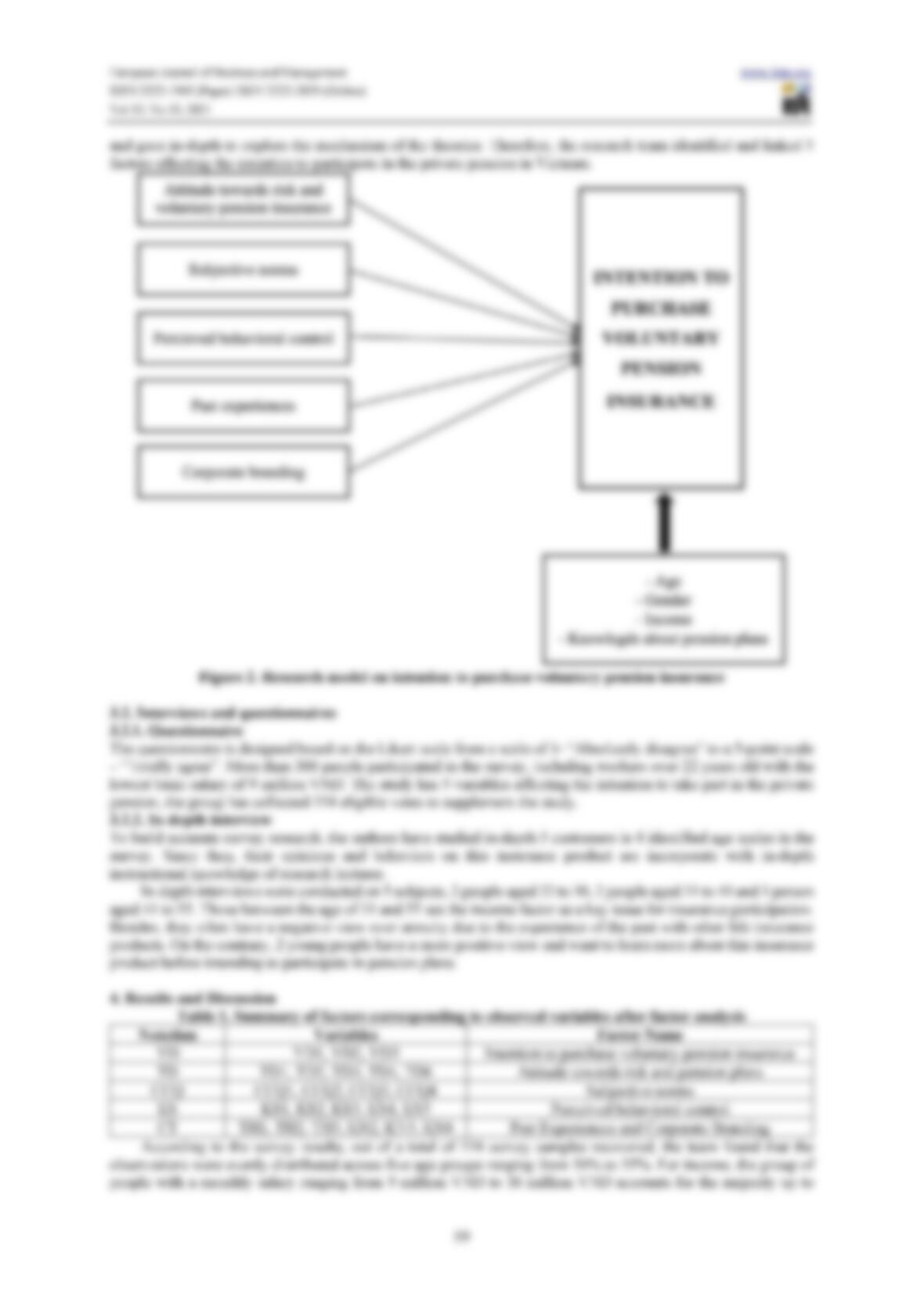
both inherited Ajzen’s TPB model and proved that 3 factors of attitude, subjective norms and perceived behavior