FABM 2
LESSON 1 – THE INCOME STATEMENT
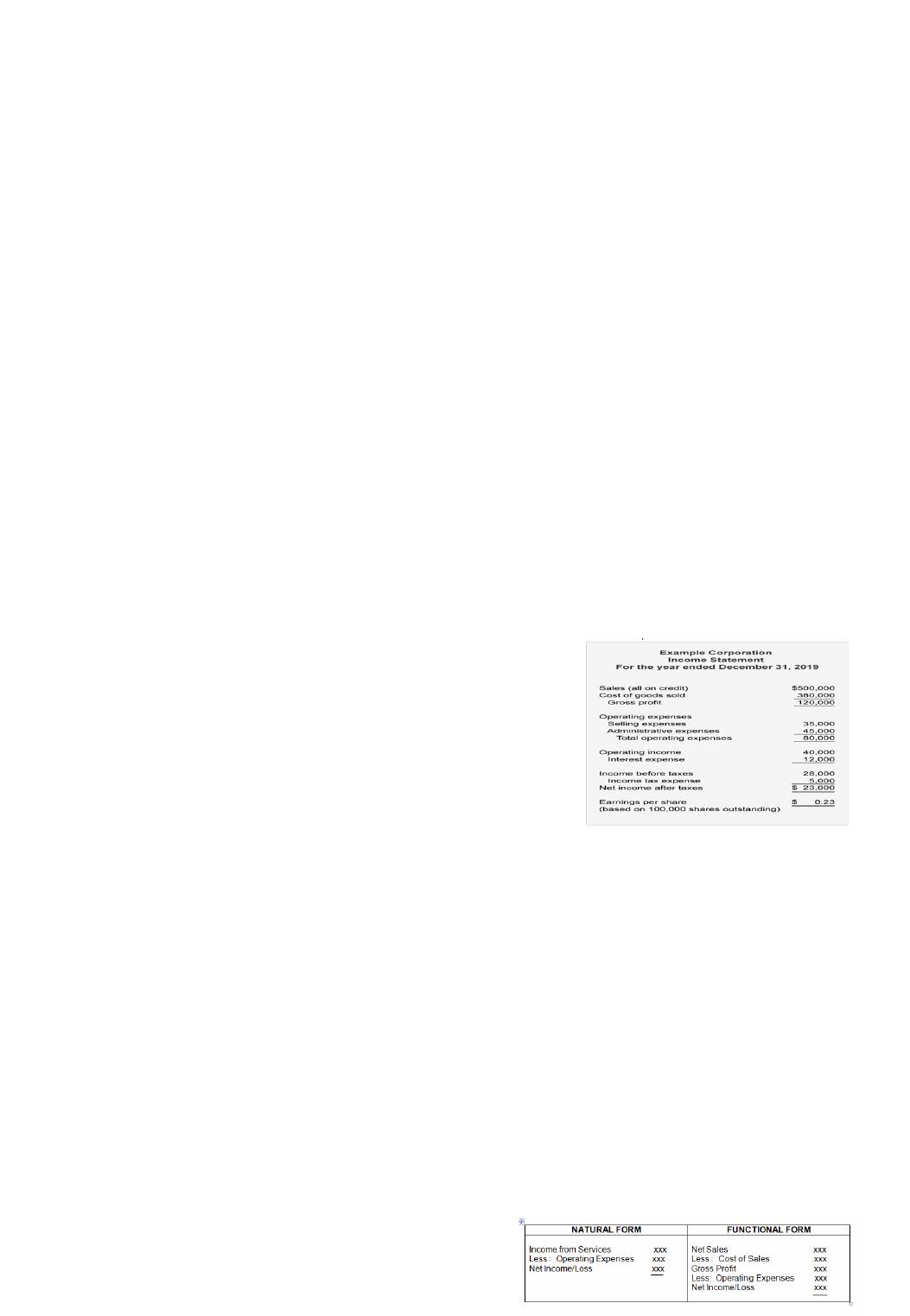
An INCOME STATEMENT is a report that shows how
much revenue a company earned over a specific time
period (usually for a year or some portion of a year). Also
shows the costs and expenses associated with earning that
revenue. The literal “bottom line” of the statement usually
shows the company’s net earnings or losses. This tells you
how much the company earned or lost over the period.
Income statements also report earnings per share (or “EPS”).
This calculation tells you how much money shareholders
would receive if the company decided to distribute all of the
net earnings.
❖ At the top of the income statement is the total amount
of money brought in from sales of products or services.
This top line is often referred to as gross revenues or
sales. It’s called “gross” because expenses have not been
deducted from it yet. So the number is “gross” or
unrefined.
❖ The next line is money the company doesn’t expect to
collect on certain sales. This could be due, for example,
to sales discounts or merchandise returns.
❖ When you subtract the returns and allowances from the
gross revenues, you arrive at the company’s net
revenues. It’s called “net” because, if you can imagine a
net, these revenues are left in the net after the deductions
for returns and allowances have come out.
❖ The next line after net revenues typically shows the costs
of the sales. This number tells you the amount of money
the company spent to produce the goods or services it
sold during the accounting period.
❖ The next line subtracts the costs of sales from the net
revenues to arrive at a subtotal called “gross profit” or
sometimes “gross margin.” It’s considered “gross”
because there are certain expenses that haven’t been
deducted from it yet.
❖ The next section deals with operating expenses. These
are expenses that go toward supporting a company’s
operations for a given period – for example, salaries of
administrative personnel and costs of researching new
products. Marketing expenses are another example.
Operating expenses are different from “costs of sales,”
which were deducted above, because operating expenses
cannot be linked directly to the production of the
products or services being sold.
❖ Depreciation is also deducted from gross profit.
Depreciation takes into account the wear and tear on
some assets, such as machinery, tools and furniture,
which are used over the long term. Companies spread the
cost of these assets over the periods they are used. This
process of spreading these costs is called depreciation or
amortization. The “charge” for using these assets during
the period is a fraction of the original cost of the assets.
❖ After all operating expenses are deducted from gross
profit, you arrive at operating profit before interest and
income tax expenses. This is often called “income from
operations.”
❖ Next companies must account for interest
income and interest expense. Interest income is the
money companies make from keeping their cash in
interest-bearing savings accounts, money market funds
and the like. On the other hand, interest expense is the
money companies paid in interest for money they borrow
❖ Finally, income tax is deducted and you arrive at
the bottom line: net profit or net losses. (Net profit is also
called net income or net earnings.)
Earnings Per Share or EPS
❖ Most income statements include a calculation of earnings
per share or EPS. This calculation tells you how much
money shareholders would receive for each share of
stock they own if the company distributed all of its net
income for the period.
❖ To calculate EPS, you take the total net income and
divide it by the number of outstanding shares of the
company.
FORMS OF INCOME STATEMENT
1. Natural Form –the nature of expense method. It
presents expenses according to nature. This type of
income statement is used in a service business. It is also
called the single-step income statement since a single
step of deducting expenses from revenue is performed to
arrive at the net income or net loss.
2. Functional Form –the cost of sales method. It presents
expenses according to function (e.g. cost of sales, selling
expenses, administrative expenses). This type is used in
a merchandising business. It is also called
the multiple-step income statement since a series of
steps is performed to arrive at the net income or net loss.
Comparison of the Natural Form and the Functional
Form Income Statements
LESSON 2–2 A REVIEW OF THE SINGLE-STEP
INCOME STATEMENT
The following are the accounts that compose the Single-Step
Income Statement.
1. Service Income includes revenues earned or generated
by the business in performing services for a customer or
client. The following are different examples of income
and the accounting terms used to describe the income.
Example: Laundry Services by a laundry shop (Laundry Income)
Medical Services (Medical Fees)
Dental Services by a dentist (Dental Fees)
Advisory Services by a consultant Consultancy Fees)
Accounting or Auditing Services by a certified public accountant
(Audit Fees)
2. Salaries or Wages Expense includes all payments made
to employees or workers for rendering services to the
company.
3. Utilities Expense is an expense related to the use of
electricity, fuel, water, and telecommunications facilities.
4. Supplies Expense covers office supplies used by the
business in the conduct of its daily operations.
5. Insurance Expense is the expired portion of premiums
paid on insurance coverage such as premiums paid for
health or life insurance, motor vehicles or other
LESSON 2-3 THE MULTIPLE-STEP INCOME
STATEMENT
COMPONENTS OF THE MULTIPLE-STEP INCOME
STATEMENT
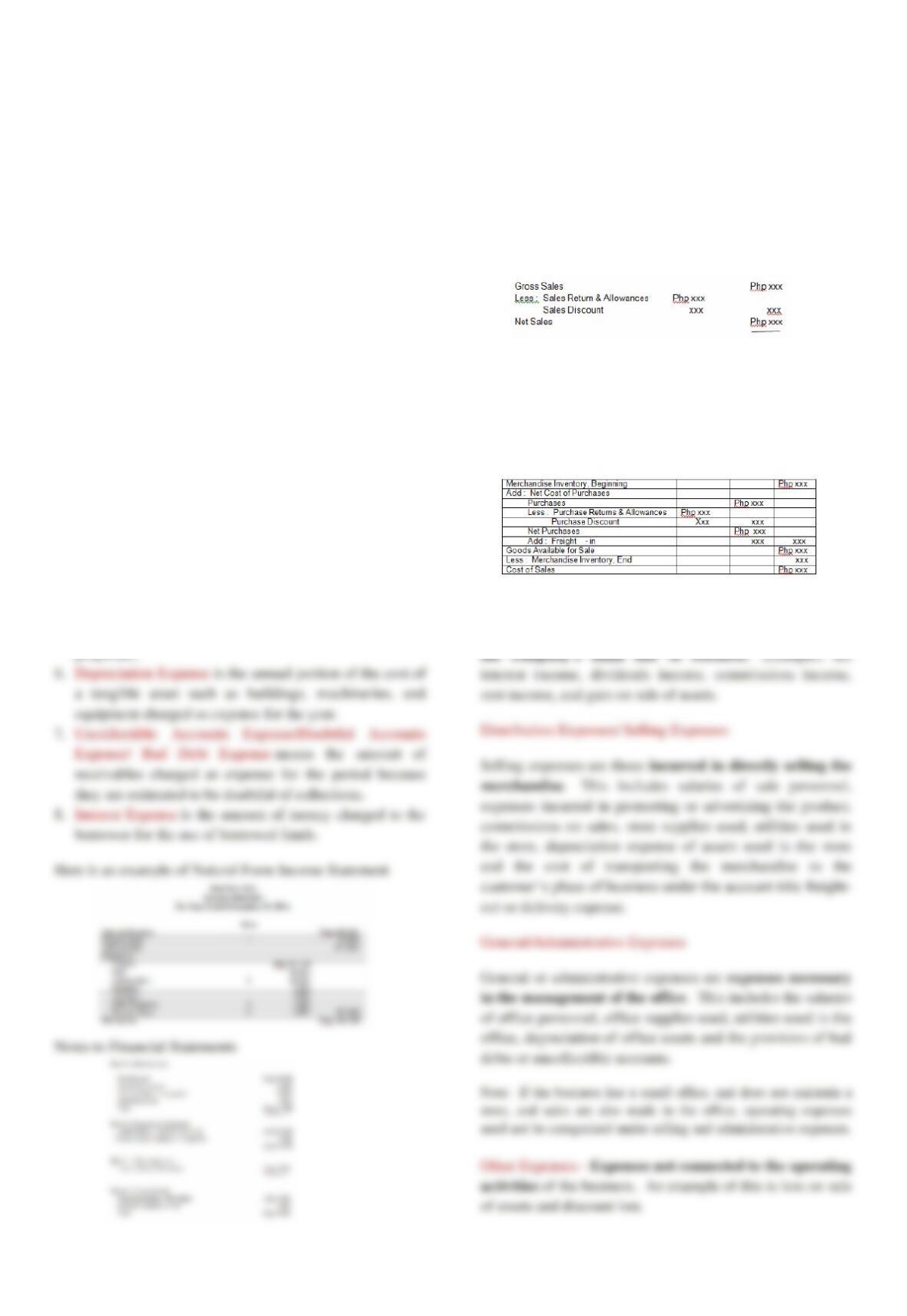
Net Sales
The first line after the heading of the income statement is
the NET SALES. To show the details of its computation, it
is supported by a note to financial statement.
Cost of Sales
The cost of sales or cost of goods sold represents the cost of
merchandise inventory sold by the business to its
customers. This comprises the company’s biggest expense
and is deducted from net sales to arrive at the gross profit.
Other Income
Other income is income derived from sources other than