Teaching Guide for Senior High School
FUNDAMENTALS OF
ACCOUNTANCY, BUSINESS,
AND MANAGEMENT 2
SPECIALIZED SUBJECT
This Teaching Guide was
collaboratively developed and
reviewed by educators from public
and private schools, colleges, and
universities. We encourage teachers
and other education stakeholders to
email their feedback, comments, and
recommendations to the Commission
on Higher Education, K to 12
Transition Program Management Unit
– Senior High School Support Team at
k12@ched.gov.ph. We value your
feedback and recommendations.
The Commission on Higher Education
in collaboration with the Philippine Normal University
This Teaching Guide by the
Commission on Higher Education is
licensed under a Creative
Commons Attribution-
NonCommercial-ShareAlike 4.0
International License. This means
you are free to:
Share — copy and redistribute the
material in any medium or format
Adapt — remix, transform, and
build upon the material.
The licensor, CHED, cannot revoke
these freedoms as long as you
follow the license terms. However,
under the following terms:
Attribution — You must give
appropriate credit, provide a link to
the license, and indicate if changes
were made. You may do so in any
reasonable manner, but not in any
way that suggests the licensor
endorses you or your use.
NonCommercial — You may not use
the material for commercial
purposes.
ShareAlike — If you remix,
transform, or build upon the
material, you must distribute your
contributions under the same license
as the original.
Development Team
Team Leader: Joselito G. Florendo
Writers: Reymond Patrick P. Monfero, Carlsberg S.
Andres, Dani Rose C. Salazar, Christopher B.
Honorario
Technical Editor: Brad Neiel T. dela Cruz
Copyreader: Daniel Day V. Aguillon
Illustrator: Patricia G. De Vera
Cover Artists: Maria Cecilia C. Manalo
Published by the Commission on Higher Education, 2016
Chairperson: Patricia B. Licuanan, Ph.D.
Commission on Higher Education
K to 12 Transition Program Management Unit
Office Address: 4th Floor, Commission on Higher Education,
C.P. Garcia Ave., Diliman, Quezon City
Telefax: (02) 441-0927 / E-mail Address: k12@ched.gov.ph
Senior High School Support Team
CHED K to 12 Transition Program Management Unit
Program Director: Karol Mark R. Yee
Lead for Senior High School Support:
Gerson M. Abesamis
Course Development Officers:
John Carlo P. Fernando, Danie Son D. Gonzalvo,
Stanley Ernest G. Yu
Lead for Policy Advocacy and Communications:
Averill M. Pizarro
Teacher Training Officers:
Ma. Theresa C. Carlos, Mylene E. Dones
Monitoring and Evaluation Officer:
Robert Adrian N. Daulat
Administrative Officers:
Ma. Leana Paula B. Bato, Kevin Ross D. Nera,
Allison A. Danao, Ayhen Loisse B. Dalena
Printed in the Philippines by EC-TEC Commercial, No. 32 St.
Louis Compound 7, Baesa, Quezon City, ectec_com@yahoo.com
Consultants
THIS PROJECT WAS DEVELOPED WITH THE PHILIPPINE NORMAL UNIVERSITY.
University President: Ester B. Ogena, Ph.D.
VP for Academics: Ma. Antoinette C. Montealegre, Ph.D.
VP for University Relations & Advancement: Rosemarievic V. Diaz, Ph.D.
Ma. Cynthia Rose B. Bautista, Ph.D., CHED
Bienvenido F. Nebres, S.J., Ph.D., Ateneo de Manila University
Carmela C. Oracion, Ph.D., Ateneo de Manila University
Minella C. Alarcon, Ph.D., CHED
Gareth Price, Sheffield Hallam University
Stuart Bevins, Ph.D., Sheffield Hallam University

Table of Contents
Lesson 1: Statement of Financial Position (SFP) . . . . . . . . .
1
Lesson 2: Statement of Comprehensive Income (SCI) . . . . . . . .
19
Lesson 3: Statement of Changes in Equity (SCE).. . . . . . . . . . . .
36
Lesson 4: Cash Flow Statement (CFS) . . . . . . . . . . . . . . . . . . . .
46
Lesson 5: Analysis and Interpretation of Financial Statements 1
61
Lesson 6: Analysis and Interpretation of Financial Statements 2
78
Lesson 7: Accounting Books – Journal and Ledger. . . . . . . . . . .
96
Lesson 8: Basic Documents and Transactions Related to Bank
Deposits . . . . . . . . . . . . . . . . . . . . . . . . . . . . . . . . . . . . . . . . . .
115
Lesson 9: Basic Reconciliation Statement . . . . . . . . . . . . . . . . .
124
Lesson 10: Accounting Practice Set. . . . . . . . . . . . . . . . . . . . . .
139
Lesson 11: Income and Business Taxation . . . . . . . . . . . . . . . . .
171
Lesson 12: Soil Resources . . . . . . . . . . . . . . . . . . . . . . . . . . . . .
164
Lesson 13: Human Activity and the Environment . . . . . . . . . . .
172

Introduction
As the Commission supports DepEd’s implementation of Senior High School (SHS), it upholds the vision
and mission of the K to 12 program, stated in Section 2 of Republic Act 10533, or the Enhanced Basic
Education Act of 2013, that “every graduate of basic education be an empowered individual, through a
program rooted on…the competence to engage in work and be productive, the ability to coexist in
fruitful harmony with local and global communities, the capability to engage in creative and critical
thinking, and the capacity and willingness to transform others and oneself.”
To accomplish this, the Commission partnered with the Philippine Normal University (PNU), the National
Center for Teacher Education, to develop Teaching Guides for Courses of SHS. Together with PNU, this
Teaching Guide was studied and reviewed by education and pedagogy experts, and was enhanced with
appropriate methodologies and strategies.
Furthermore, the Commission believes that teachers are the most important partners in attaining this
goal. Incorporated in this Teaching Guide is a framework that will guide them in creating lessons and
assessment tools, support them in facilitating activities and questions, and assist them towards deeper
content areas and competencies. Thus, the introduction of the SHS for SHS Framework.
The SHS for SHS Framework, which stands for “Saysay-Husay-Sarili for Senior High School,” is at the
core of this book. The lessons, which combine high-quality content with flexible elements to
accommodate diversity of teachers and environments, promote these three fundamental concepts:
SAYSAY: MEANING
Why is this important?
Through this Teaching Guide,
teachers will be able to facilitate
an understanding of the value
of the lessons, for each learner
to fully engage in the content
on both the cognitive and
affective levels.
HUSAY: MASTERY
How will I deeply understand this?
Given that developing mastery
goes beyond memorization,
teachers should also aim for
deep understanding of the
subject matter where they lead
learners to analyze and
synthesize knowledge.
SARILI: OWNERSHIP
What can I do with this?
When teachers empower
learners to take ownership of
their learning, they develop
independence and self-
direction, learning about both
the subject matter and
themselves.
SHS for SHS
Framework

Earth Science is a Core Subject taken in the first semester of Grade 11. This learning area is
designed to provide a general background for the understanding of the Earth on a planetary
scale. It presents the history of the Earth through geologic time. It discusses the Earth’s
structure and composition, the processes that occur beneath and on the Earth’s surface, as
well as issues, concerns, and problems pertaining to Earth’s resources.
Implementing this course at the senior high school level is subject to numerous challenges
with mastery of content among educators tapped to facilitate learning and a lack of
resources to deliver the necessary content and develop skills and attitudes in the learners,
being foremost among these.
In support of the SHS for SHS framework developed by CHED, these teaching guides were
crafted and refined by biologists and biology educators in partnership with educators from
focus groups all over the Philippines to provide opportunities to develop the following:
Saysay through meaningful, updated, and context-specific content that highlights important
points and common misconceptions so that learners can connect to their real-world
experiences and future careers;
Husay through diverse learning experiences that can be implemented in a resource-poor
classroom or makeshift laboratory that tap cognitive, affective, and psychomotor domains
are accompanied by field-tested teaching tips that aid in facilitating discovery and
development of higher-order thinking skills; and
Sarili through flexible and relevant content and performance standards allow learners the
freedom to innovate, make their own decisions, and initiate activities to fully develop their
academic and personal potential.
These ready-to-use guides are helpful to educators new to either the content or biologists
new to the experience of teaching Senior High School due to their enriched content
presented as lesson plans or guides. Veteran educators may also add ideas from these
guides to their repertoire. The Biology Team hopes that this resource may aid in easing the
transition of the different stakeholders into the new curriculum as we move towards the
constant improvement of Philippine education.
About this
Teaching Guide

This Teaching Guide is mapped and aligned to the DepEd SHS Curriculum, designed to be highly
usable for teachers. It contains classroom activities and pedagogical notes, and is integrated with
innovative pedagogies. All of these elements are presented in the following parts:
1. Introduction
•Highlight key concepts and identify the essential questions
•Show the big picture
•Connect and/or review prerequisite knowledge
•Clearly communicate learning competencies and objectives
•Motivate through applications and connections to real-life
2. Motivation
•Give local examples and applications
•Engage in a game or movement activity
•Provide a hands-on/laboratory activity
•Connect to a real-life problem
3. Instruction/Delivery
•Give a demonstration/lecture/simulation/hands-on activity
•Show step-by-step solutions to sample problems
•Give applications of the theory
•Connect to a real-life problem if applicable
4. Practice
•Discuss worked-out examples
•Provide easy-medium-hard questions
•Give time for hands-on unguided classroom work and discovery
•Use formative assessment to give feedback
5. Enrichment
•Provide additional examples and applications
•Introduce extensions or generalisations of concepts
•Engage in reflection questions
•Encourage analysis through higher order thinking prompts
6. Evaluation
•Supply a diverse question bank for written work and exercises
•Provide alternative formats for student work: written homework, journal, portfolio, group/individual
projects, student-directed research project
Parts of the
Teaching Guide
As Higher Education Institutions (HEIs) welcome the graduates of
the Senior High School program, it is of paramount importance to
align Functional Skills set by DepEd with the College Readiness
Standards stated by CHED.
The DepEd articulated a set of 21st century skills that should be
embedded in the SHS curriculum across various subjects and tracks.
These skills are desired outcomes that K to 12 graduates should
possess in order to proceed to either higher education,
employment, entrepreneurship, or middle-level skills development.
On the other hand, the Commission declared the College
Readiness Standards that consist of the combination of knowledge,
skills, and reflective thinking necessary to participate and succeed –
without remediation – in entry-level undergraduate courses in
college.
The alignment of both standards, shown below, is also presented in
this Teaching Guide – prepares Senior High School graduates to the
revised college curriculum which will initially be implemented by AY
2018-2019.
College Readiness Standards Foundational Skills
DepEd Functional Skills
Produce all forms of texts (written, oral, visual, digital) based on:
1. Solid grounding on Philippine experience and culture;
2. An understanding of the self, community, and nation;
3. Application of critical and creative thinking and doing processes;
4. Competency in formulating ideas/arguments logically, scientifically, and creatively; and
5. Clear appreciation of one’s responsibility as a citizen of a multicultural Philippines and a
diverse world;
Visual and information literacies, media literacy, critical thinking
and problem solving skills, creativity, initiative and self-direction
Systematically apply knowledge, understanding, theory, and skills for the development of
the self, local, and global communities using prior learning, inquiry, and experimentation
Global awareness, scientific and economic literacy, curiosity,
critical thinking and problem solving skills, risk taking, flexibility
and adaptability, initiative and self-direction
Work comfortably with relevant technologies and develop adaptations and innovations for
significant use in local and global communities
Global awareness, media literacy, technological literacy,
creativity, flexibility and adaptability, productivity and
accountability
Communicate with local and global communities with proficiency, orally, in writing, and
through new technologies of communication
Global awareness, multicultural literacy, collaboration and
interpersonal skills, social and cross-cultural skills, leadership
and responsibility
Interact meaningfully in a social setting and contribute to the fulfilment of individual and
shared goals, respecting the fundamental humanity of all persons and the diversity of
groups and communities
Media literacy, multicultural literacy, global awareness,
collaboration and interpersonal skills, social and cross-cultural
skills, leadership and responsibility, ethical, moral, and spiritual
values
On DepEd Functional Skills and CHED College Readiness Standards

K to 12 BASIC EDUCATION CURRICULUM
SENIOR HIGH SCHOOL – ACCOUNTANCY, BUSINESS AND MANAGEMENT (ABM) SPECIALIZED SUBJECT
K to 12 Senior High School ABM Specialized Subject – Fundamentals of Accountancy, Business and Management 2 May 2016 Page 1 of 6
Grade: 12 Course Title: Fundamentals of Accountancy, Business and Management 2
Semester: 1st Semester, 1st Quarter No. of Hours/ Semester: 80 hours/ semester
Prerequisite: Fundamentals of Accountancy, Business and Management 1
Course Description: The course deals with the preparation and analysis of financial statements of a service business and merchandising business using horizontal and
vertical analyses and financial ratios. Knowledge and skills in the analysis of financial statements will aid the future entrepreneurs in making sound economic decisions.
CONTENT
CONTENT STANDARD
PERFORMANCE STANDARDS
LEARNING COMPETENCIES
CODE
1. Statement of
Financial
Position (SFP)
The learners demonstrate an
understanding of
…
account titles under the assets, liabilities,
and capital accounts of the Statement of
Financial Position, namely, cash,
receivables, inventories, prepaid
expenses, property, plant and
equipment, payables, accrued expenses,
unearned income, long-term liabilities
and capital that will equip him / her in
the preparation of the SFP using the
report form and account form
The learners shall be able to
…
solve exercises and problems that
require preparation of an SFP for
a single proprietorship with proper
classification of accounts as
current and noncurrent using the
report form and the account form
The learners
…
1. identify the elements of the SFP and
describe each of them
ABM_FABM12-Ia–b-
1
2. classify the elements of the SFP into
current and noncurrent items
ABM_FABM12-Ia–b-2
3. prepare the SFP of a single
proprietorship
ABM_FABM12-Ia–b-3
4. prepare an SFP using the report form
and the account form with proper
classification of items as current and
noncurrent
ABM_FABM12-Ia–b-4
2. Statement of
Comprehensive
Income (SCI)
the service income and operating
expenses of a service business as well as
sales, contra sales, purchases, contra
purchase accounts, cost of goods sold
and general administrative and selling
expenses of a merchandising business
that will equip him / her in the
preparation of the SCI for both service
and merchandising businesses
solve exercises and problems that
require preparation of SCI for a
service business and a
merchandising business
1. identify the elements of the SCI and
describe each of these items for a
service business and a merchandising
business
ABM_FABM12-Ic–d-5
2. prepare an SCI for a service business
using the single-step approach
ABM_FABM12-Ic–d-6
3. prepare an SCI for a merchandising
business using the multistep approach
ABM_FABM12-Ic–d-7
3. Statement of
Changes in
Equity (SCE)
the forms of business organization,
namely, single proprietorship,
partnership, and corporation, and the
solve exercises and problems that
require preparation of an SCE for
a single proprietorship
1. discuss the different forms of business
organization
ABM_FABM12-Ie-8

K to 12 BASIC EDUCATION CURRICULUM
SENIOR HIGH SCHOOL – ACCOUNTANCY, BUSINESS AND MANAGEMENT (ABM) SPECIALIZED SUBJECT
K to 12 Senior High School ABM Specialized Subject – Fundamentals of Accountancy, Business and Management 2 May 2016 Page 2 of 6
CONTENT
CONTENT STANDARD
PERFORMANCE STANDARDS
LEARNING COMPETENCIES
CODE
structure of a SCE of a single
proprietorship that will equip him / her in
the preparation of the said financial
report
2. prepare an SCE for a single
proprietorship
ABM_FABM12-Ie-9
4. Cash Flow
Statement
(CFS)
the components and the structure of a
CFS that will equip him / her in the
preparation of the said financial report
solve exercises and problems that
require preparation of a CFS
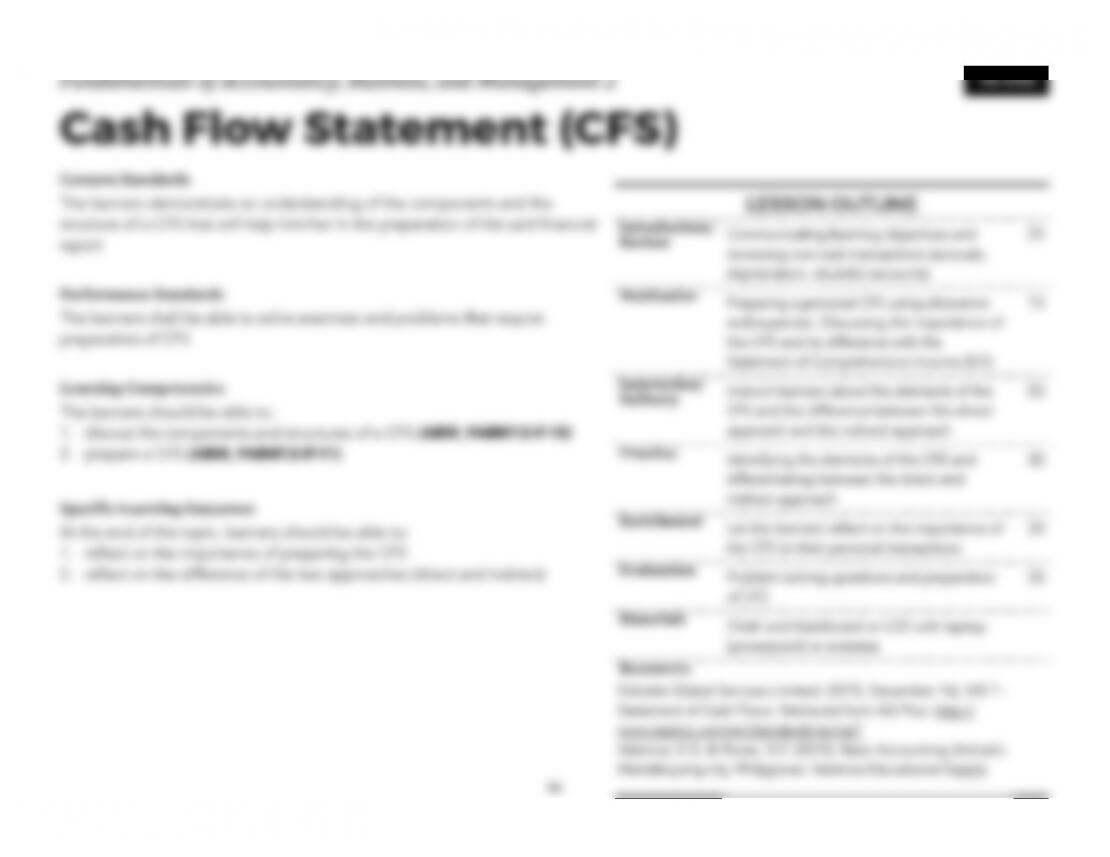
1. discuss the components and structures
of a CFS
ABM_FABM12-If–10
2. prepare a CFS
ABM_FABM12-If–11
5. Analysis and
Interpretation
of Financial
Statements
the methods or tools of analysis of
financial statements to include horizontal
analysis, vertical analysis, and financial
ratios to test the level of liquidity,
solvency, profitability, and stability of the
business
solve exercises and problems that
require computation and
interpretation using horizontal
analysis, vertical analysis, and
various financial ratios
Using the downloaded sample
financial statements, he / she
performs horizontal and vertical
analysis, computes various
financial ratios and interprets the
level of liquidity, solvency,
stability, and profitability of the
business
1. define the measurement levels,
namely, liquidity, solvency, stability,
and profitability
ABM_FABM12-Ig-h-
12
2. perform vertical and horizontal
analyses of financial statements of a
single proprietorship
ABM_FABM12-Ig-h-
13
3. compute and interpret financial ratios
such as current ratio, working capital,
gross profit ratio, net profit ratio,
receivable turnover, inventory
turnover, debt-to-equity ratio, and the
like
ABM_FABM12-Ig-h-
14

K to 12 BASIC EDUCATION CURRICULUM
SENIOR HIGH SCHOOL – ACCOUNTANCY, BUSINESS AND MANAGEMENT (ABM) SPECIALIZED SUBJECT
K to 12 Senior High School ABM Specialized Subject – Fundamentals of Accountancy, Business and Management 2 May 2016 Page 3 of 6
Grade: 12 Course Title: Fundamentals of Accountancy Business and Management 2
Semester: 1st Semester, 2nd Quarter No. of Hours/ Semester: 80 hours/ semester
Course Description: The course deals with the preparation of basic business forms and documents, including bank transactions and a simple bank reconciliation
statement. Integration of information technology in accounting will also be introduced. The students will prepare an accounting practice set that requires the application of
learning in the first three accounting courses.
CONTENT
CONTENT STANDARD
PERFORMANCE STANDARDS
LEARNING COMPETENCIES
CODE
1. Accounting Books –
Journal and Ledger
The learners demonstrate an
understanding of…
debits and credits, journal entries to
record basic business transaction
and using t-accounts, and posting to
general ledgers
The learners shall be able to…
prepare journal entries for basic
business transactions; solve
exercises and problems that require
using the t-account
The learners
…
1. differentiate the journal from the
general ledger
ABM_FABM12-IIa-b-
1
2. determine the normal balance of
an account
ABM_FABM12-IIa-b-
2
3. prepare journal entries to record
basic business transaction
ABM_FABM12-IIa-b-
3
4. determine balances of accounts
using the t-account
ABM_FABM12-IIa-b-
4
2. Basic Documents and
Transactions related to
Bank Deposits
the types of bank accounts, basic
transactions, and documents related
to bank deposits and withdrawals
share samples of bank account
forms and documents in class and
discuss their uses and importance
1. identify the types of bank
accounts normally maintained by
a business
ABM_FABM12-IIc-5
2. differentiate a savings account
from a current or checking
account
ABM_FABM12-IIc-6
3. prepare bank deposit and
withdrawal slips
ABM_FABM12-IIc-7
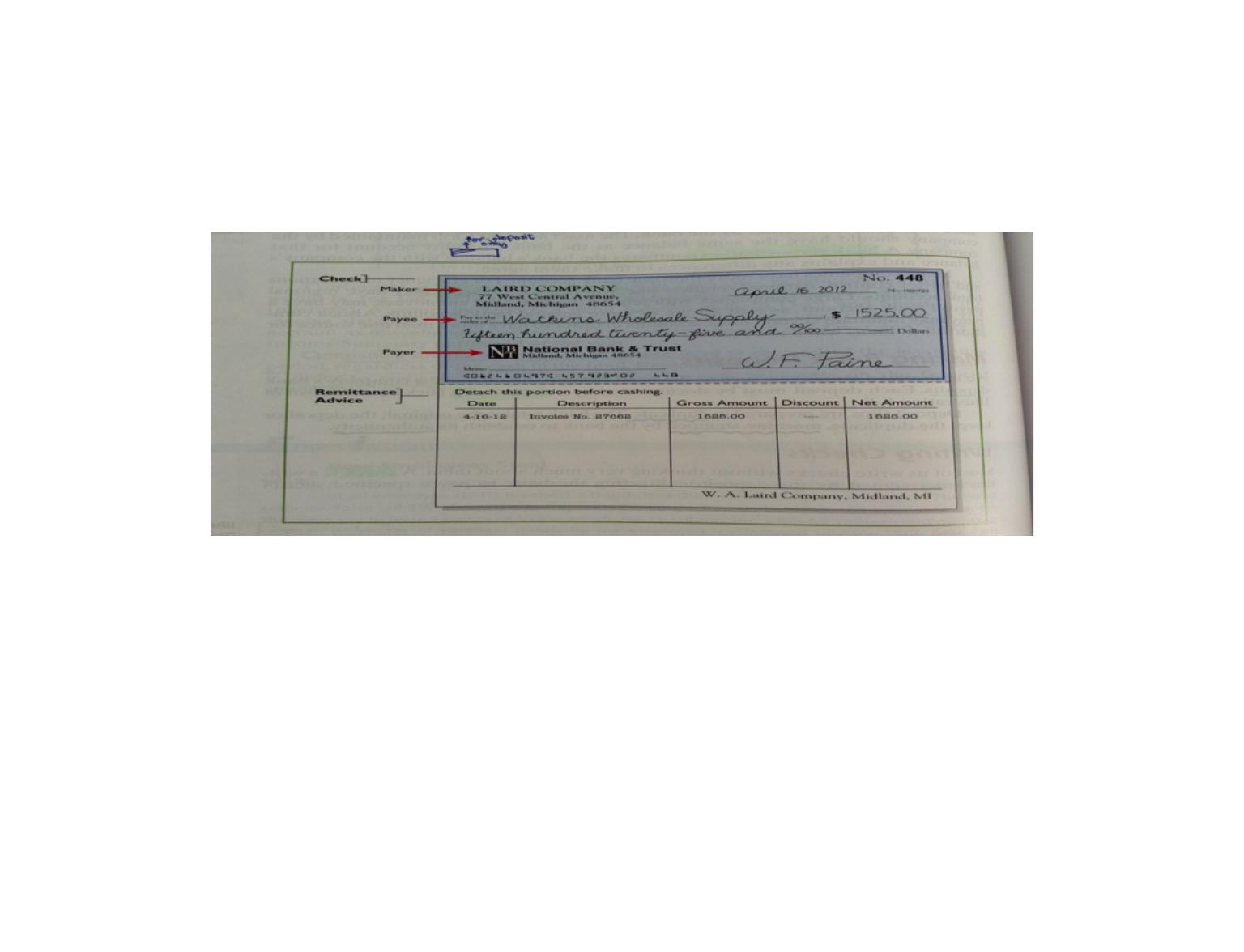
4. identify and prepare checks
ABM_FABM12-IIc-8
5. identify and understand the
contents of a bank statement
ABM_FABM12-IIc-9
3. Bank Reconciliation
Statement
a bank reconciliation statement, its
nature and structure, and
reconciling items and methods of
preparation
solve exercises and problems
involving the following:
1. identification of the proper
treatment of reconciling items
in the bank reconciliation
statement
1. describe the nature of a bank
reconciliation statement
ABM_FABM12-IId-
10
2. identify common reconciling
items and describe each of them
ABM_FABM12-IId-
11
3. analyze the effects of the
identified reconciling items
ABM_FABM12-IId-
12

K to 12 BASIC EDUCATION CURRICULUM
SENIOR HIGH SCHOOL – ACCOUNTANCY, BUSINESS AND MANAGEMENT (ABM) SPECIALIZED SUBJECT
CONTENT
CONTENT STANDARD
PERFORMANCE STANDARDS
LEARNING COMPETENCIES
CODE
2. preparation of a bank
reconciliation statement
4. prepare a bank reconciliation
statement
ABM_FABM12-IId-
13