With the financial calamity experienced by the United States during the ‘Great Recession’ and
the economic integrity of the enfire nafion being severely challenged throughout its durafion, a number
of various fiscal and monetary policies were undertaken throughout the period in a#empts to mifigate
and prevent current and future potenfial economic anguishes from adversely a$ecfing the populafion at
large. Among the many plans of acfion taken to reduce such economic distresses as extraordinarily high
levels of unemployment and contracfionary consumer spending and investment, was the Federal
Reserve’s decision to pursue a form of expansionary monetary policy with the end goal of achieving the
lowest nominal interest rate possible, e$ecfively 0%. Ben Bernanke, the Federal Reserve Chairman at the
fime, believed that despite so many cifizens having lost such significant porfions of their refirement,
savings, and wealth during the market crash, that maintaining a zero interest rate would encourage the
necessary spending and investment by the populous to avoid a full on economic depression.
The idea behind this theory is that in keeping interest rates significantly lower than before the
crisis, the cost to borrow money from financial insfitufions for consumer purchases and investment
decisions would be lower and the opportunity cost of saving in those same insfitufions would be higher
due to the near non-existent returns they would be receiving on their savings, thus spurring and
encouraging higher levels of economic acfivity on the part of the consumer populous. As can be seen
from examining economic indicators such as annual GDP, unemployment levels and stock market growth
pattern, the results that followed this policy posifively reffect, at least in part, what the Federal Reserve
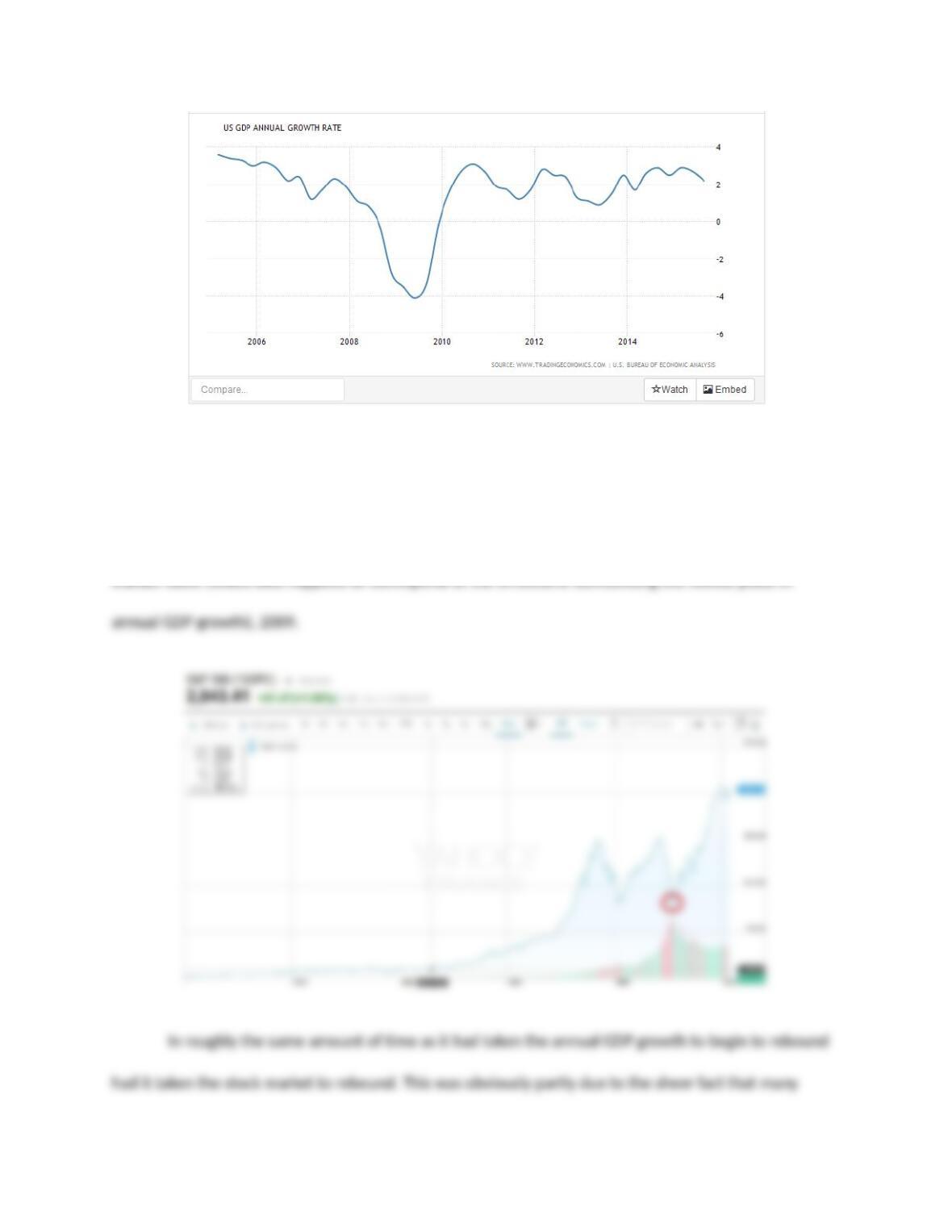
was ulfimately trying to achieve. Looking at the graph illustrated on the next page, US GDP growth
fightened up shortly a3er entering the crisis in early 2008 and actually experienced negafive growth
rates in and around 2009. Many economists argue however that the quick rebound between 2009 and
2010 can be greatly a#ributed to high consumer spending and investment as a result of the Fed’s
decisions to adopt expansionary monetary policy decisions at the beginning of the crisis.
Examining such market indices as the S&P 500, NASDAQ and the like may also shed a li#le light
on the impact of the Federal Reserve’s decision to drop interest rates in the wake of the financial crisis.
Looking at the graph of the S&P 500 provided below, the red circle indicates the lowest point in the index