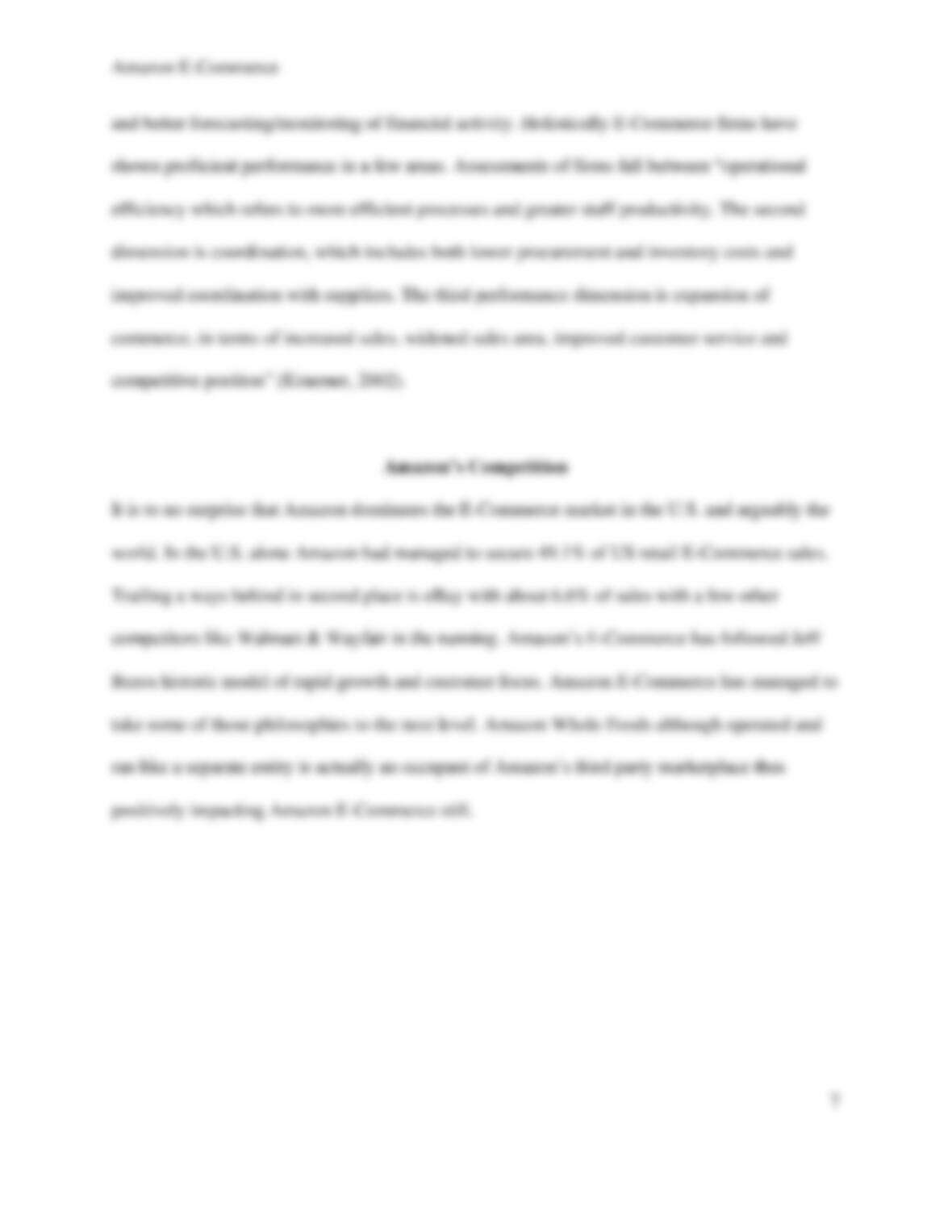
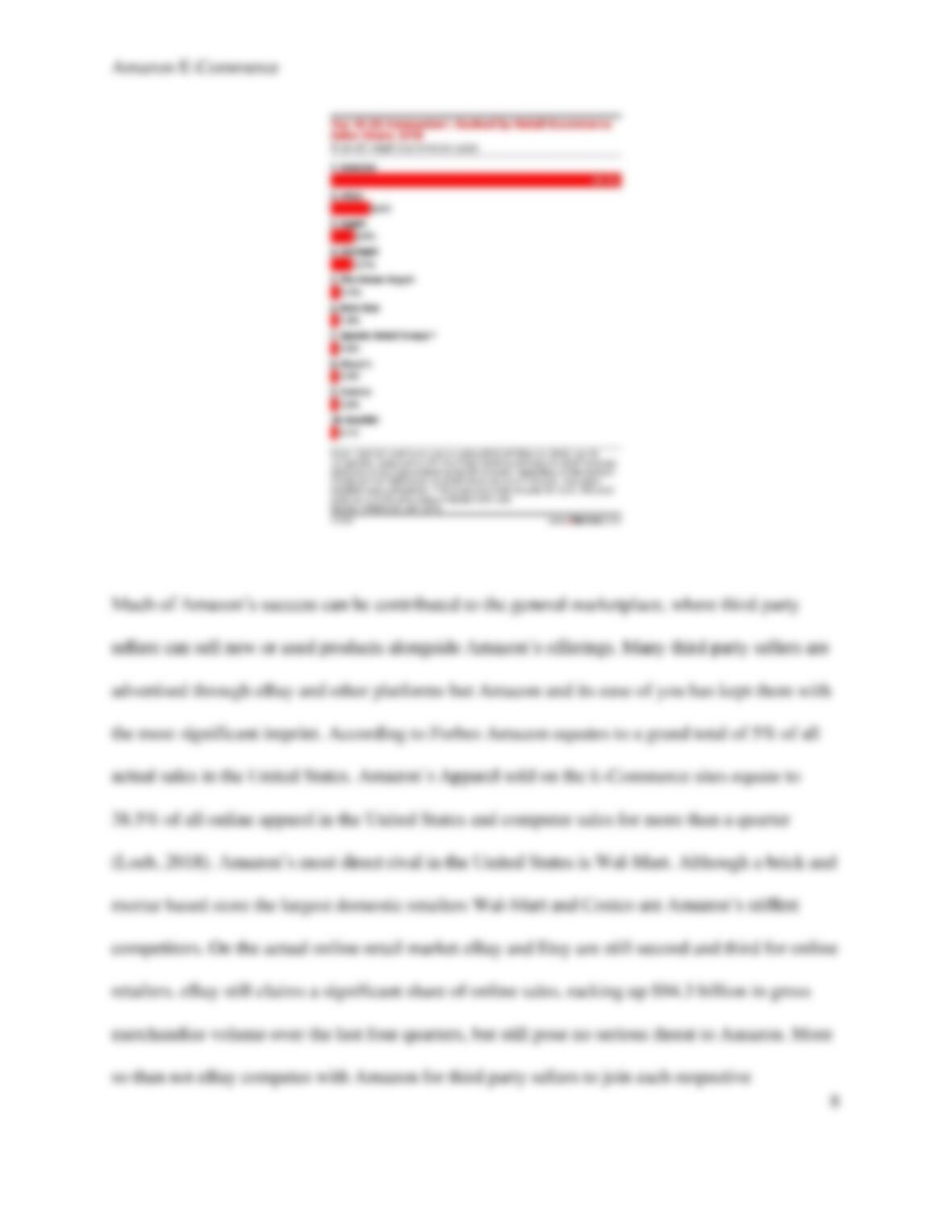
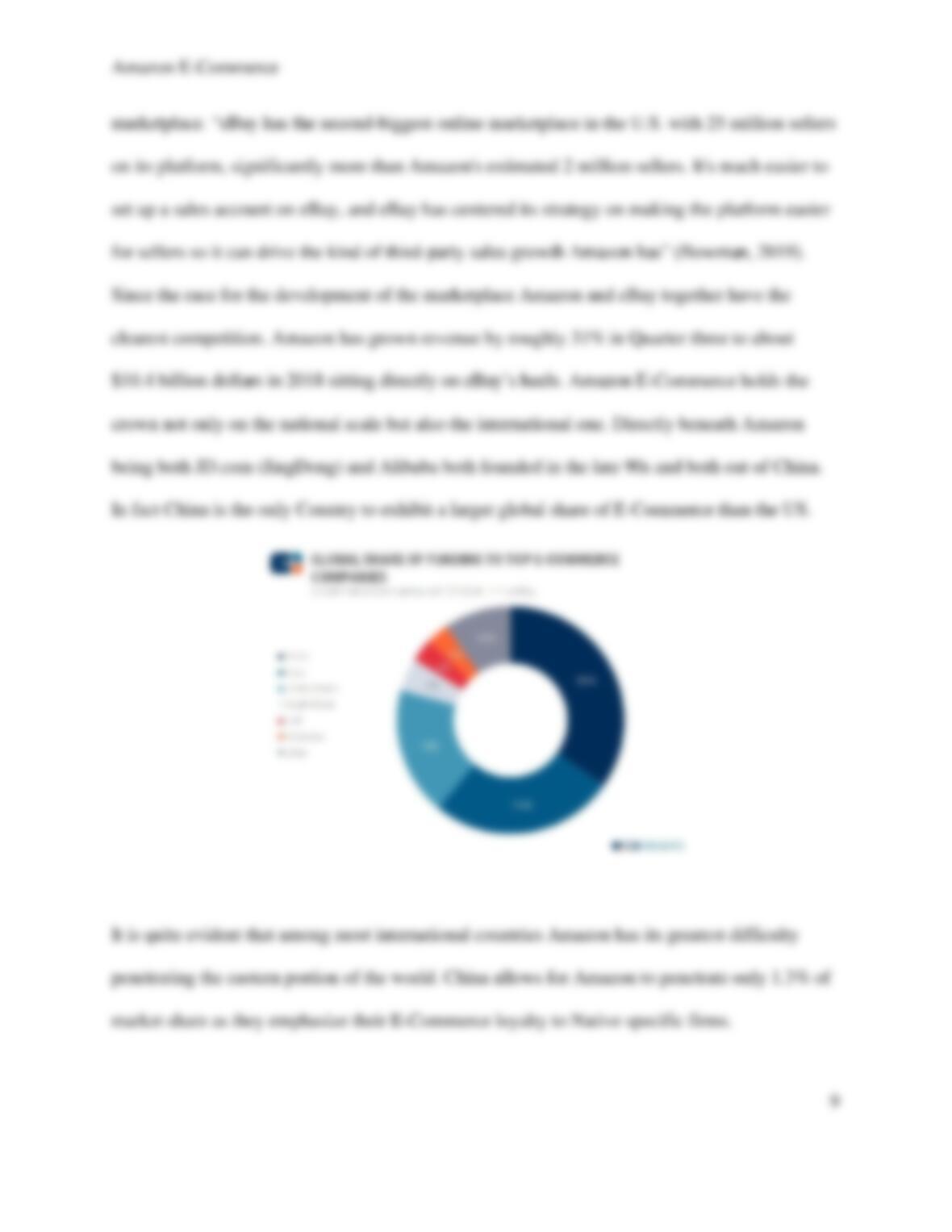
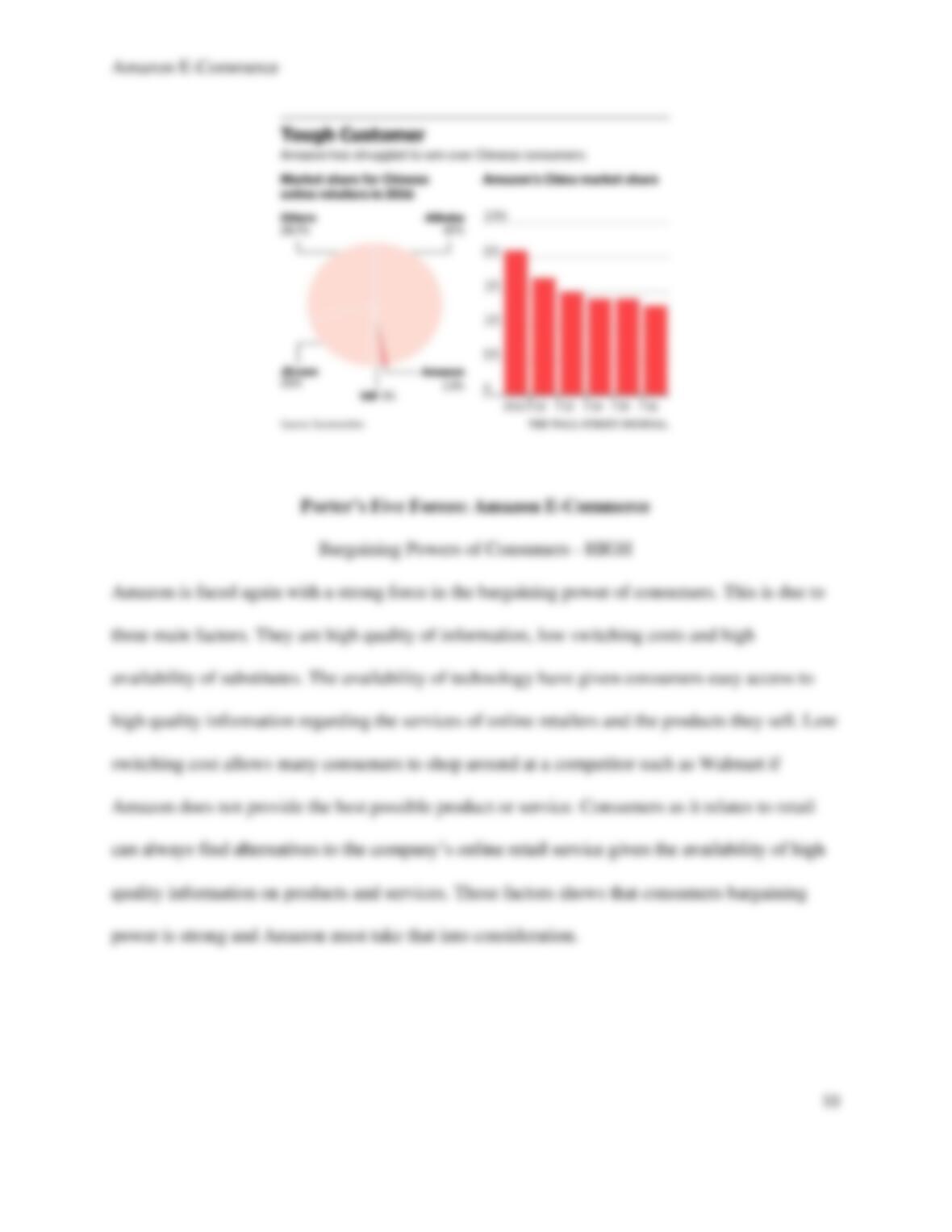
Amazon E-Commerce
0
Amazon E-Commerce and its Pivotal Position in the Global Economy
Stefanie Carey, Rashard L. Smith, Emmett Ayomanor, Elvis Andrews
Morgan State University
Amazon E-Commerce
1
Table of contents
Abstract …………………………………3
Amazon E-Commerce overview & History …………………………………4-10
The E-Commerce Industry as a Whole …………………………………5
Key Players in E-Commerce …………………………………6-7
Amazon’s Competition …………………………………7-10
Porter’s Five Forces: Amazon E-Commerce ………………………………10-14
• What can Amazon do to gain bargaining powers of consumers? …………………………………
Competitive Rivalry …………………………………10
• What can Amazon do about the threats from competitors? …………………………………
Threat of New Entrants …………………………………11
• What can Amazon do about the threat of new entrants? …………………………………
Threat of Substitutes …………………………………12
• What can Amazon do about substitute threat? …………………………………
Summary & Analysis of the Porter’s Five Forces …………………………………13
PESTEL Analysis- Amazon E-Commerce …………………………………14
• Political Factor …………………………………15
• Economical Factor …………………………………16
• Sociocultural Factor …………………………………17
• Technological Factor …………………………………18
• Environmental Factor …………………………………19
• Legal Factor …………………………………20
• Take Away from Pest ………………………………21-22
Amazon E-Commerce
2
Amazon’s Value Chain Analysis …………………………………22
• Amazon operations …………………………………23
• Amazon’s outbound logistics …………………………………24
• Amazon marketing and sale ………………………………24-25
• Amazon Services …………………………………25
• Amazon Support Activities …………………………………26
SWOT Analysis: Amazon E-Commerce ………………………………26-29
• Amazon’s Strengths – Internal Strategic Factors …………………………………26
• Amazon’s Weaknesses – Internal Strategic Factors …………………………………27
• External strategic factors (Opportunity for Amazon) …………………………………28
• External Strategic Factors (Threats) …………………………………29
Recommendation …………………………………30
References ………………………………31-34
Amazon E-Commerce
3
Abstract
“Amazon is one of the most monopolistic and well positioned firms of the marketplace that the
Western world has ever seen. Last year Amazon did $136B in revenue with double digit growth
every year” (Ward, 2018). Since its founding Amazon seems to be expanding their reach and
market share. To date Amazon has 10 marketplaces across the globe, from the obvious Europe
and North America; to Japan, China, and India; and are in the process of rolling out in Australia.
Amazon is divided into three main segments; North America, International & Amazon Web
Services. Divided under those segments are five main business units being Alexa: The Voice
Assistant, Amazon Whole Foods, Amazon Prime, Amazon Web Services, and Amazon E-
Commerce & Global Retail. The target business unit is Amazon E-Commerce. Amazon E-
Commerce has been leaving its imprint in the global economy over the past few years, and the
future remains just as bright. Securing a staggering 50% of the United States E-Commerce,
Amazon remains a potent force to be reckoned with. The following content will be an external
analysis on Amazon, the E-Commerce Business Unit. The purpose of this analysis is to gather
conclusive evidence through PESTLE analysis; Porter’s Five Forces; Value Chain Model; and
SWOT Analysis to determine a competitive strategy in the best interest of Amazon E-
Commerce.
Amazon E-Commerce
4
Amazon E-Commerce and its Pivotal Position in the Global Economy
Amazon Company Overview & History
In May of 1995, a gentleman by the name of Jeff Bezos launched a website whose platform was
to primarily sell books. Operating primarily out of his garage, his aim was to simply provide
consumers an online book retailer. Being the visionary that Bezos was, he had always
envisioned this book selling store to becoming a seller of all things. And that remains true until
this day. Originally Bezos wanted to name the company “Cadabra”. Cadabra would model after
the magical world to describe a ‘magical place’. His philosophy was that Cadabra would grow
into becoming the largest online bookseller. That name would go on to being only a prototype
and would be changed a few years later as attorneys suggested it sounded too similar to
“Cadaver”. Bezos not yet discouraged would opt to name the firm Amazon. The name would be
model after The “Amazon” the largest running river in the world, which would later spark a keen
undertone to Amazon global strategy. Early into Amazon’s development would pose a roller
coaster of factors that would prove as both threats and opportunities for Bezos. Bezos believed
that Amazon’s success was contingent on a few variables, being customer-centric as well as
diverse in terms of commodities. At its origin Amazon would sell only books but by 1999
Amazon would have gone on to selling DVDs, music, video games, electronics and clothing.
Time Magazine would go on to name Bezos the “Person of the Year” as Amazon would become
recognized as a pioneer in popularizing online shopping. Amazon believes that if the firm does
not listen to its customers it will fail, and Amazon has done tremendous in catering to the desires
of its many customers, both business and individual. In parallel to the loyal customers Amazon
has developed the firm also has made a resolute footprint in ownership. Although not 100%
Amazon E-Commerce
5
vertically integrated Amazon owns a plethora of its support entities which have proved helpful in
both short term and long-term matters.
The E-Commerce Industry as a Whole
“E-Commerce is growing at an exponential rate. The credit card company Visa, for example
reports that its clients’ Internet purchases reached the $13 billion mark this year accounting for
1% of its total charge activity. The figure is expected to reach the $100 billion mark and 11% of
its total transactions by the year 2003” (Tedeschi, 1998). There is an obvious understanding that
following the technological revolutions that took place in the 90s, E-Commerce would reflect as
a direct correlation to technology in business. The connection between the two has been made
since as early as 1998, suggesting that in present day growth has been exponential. “Among the
most popular items of E-Commerce, according to the Better Business Bureau are books, CDs,
and subscriptions to magazines (Gefen, 1999). Amazon being a large major player in this market
since its founding in 1995. There is no coincidence that Amazon has been such a vital player in
E-Commerce in 1999, the same way they remain one today. In earlier times the expansion of
globalization is what led to what we refer to now as the digital economy. E-Commerce replacing
the traditional method in which we as mankind do business. Set aside from the historical hand to
hand transaction or even the basic forms of international trade technology now today gives us the
prerogative of instant gratification. E-commerce has played a key role in the emerging of the
current economy. “In 2004 Amazon was on top in what online service met. 6 website servers, 32
million customers in 150 different countries, 900,000 associate programs linked with Amazon or
having contents of Amazon. Because of his tremendous importance in the e-commerce industry,
Amazon has the power to influence the entire industry” (Donici, 2012). The Better Business
Amazon E-Commerce
Bureau suggests that E-Commerce is an industry of inevitable growth, but among the most
impactful are those firms that promote trust and confidence in over the internet. Trust is a
primary factor holistically in business and it stems from being customer focused. Jeff Bezos was
ahead of his time in understanding by emphasizing these things early in Amazon’s development.
A sense of familiarity that is formed by a firm that makes customer focus a priority. That
familiarity yields loyalty and that loyalty yields power, a chain reaction of business components
that have proven valor in determining the success of those key E-Commerce firms.
Key Players in E-Commerce
Springing back to the late 90s Global E-Commerce helped revitalize the B2C or Business to
Consumer platform. Not only B2C but B2B or Business to Business transformation also
occurred. “Our findings provide support for Porter’s (1986) thesis that upstream business