Extending sustainability to suppliers:
a systematic literature review
Cristina Gimenez
Department of Operations Management and Innovation, ESADE Business School, Universitat Ramon Llull, Avda, Spain, and
Elcio M. Tachizawa
Department of Business Administration, Universidad Carlos III de Madrid, Getafe, Spain
Abstract
Purpose – To make their supply chains more socially responsible, many companies are implementing supplier assessment tools and collaborative
practices. The aim of this paper is to provide a systematic literature review on the governance structures used to extend sustainability to suppliers. More
specifically, the authors aim to answer two questions: “What is the impact of these mechanisms or governance structures on sustainable
performance?” and “What are the enablers of these mechanisms?”.
Design/methodology/approach – A structured literature review is carried out that analyses published studies, evaluates contributions, summarises
knowledge and identifies managerial implications and lines for further research.
Findings – Both assessment and collaboration have a positive impact on environmental performance and corporate social responsibility, although the
most recent collaborative paradigm stresses that assessment alone is not enough. Some enablers of these practices are identified.
Research limitations/implications – Although the authors believe that the right search terms have been used, the choice of these terms could be a
limitation of this study. Also, the selection of the articles could be considered subjective, although the papers were reviewed by two researchers.
Practical implications – Supplier assessment and collaboration are effective in improving sustainability. However, the results also indicate that
assessment alone is not enough. Firms also need to adopt a collaborative approach. Finally, a list of enablers to implement these practices is provided.
Originality/value – The paper summarises knowledge related to the impact of supplier assessment and collaboration on sustainability, and describes
the enablers of such initiatives, providing some managerial implications and lines for further research.
Keywords Sustainable supply chains, Sustainability, Structured literature review, Research, Supply chain management, Sustainable development
Paper type Literature review
Introduction
The most widely-adopted definition of sustainability is that of
the World Commission on Environment and Development
(1987, p. 8): “development that meets the needs of the
present without compromising the ability of future
generations to meet their needs”. Unfortunately this
macroeconomic definition is difficult for companies to apply
and provides little guidance for organisations (Hart, 1995;
Starik and Rands, 1995). The way it is usually operationalised
is through the triple bottom line, a concept developed by
Elkington (1998), which simultaneously considers and
balances economic, environmental and social issues from a
microeconomic point-of-view.
Recently, there has been rising concern about sustainability
both among managers and researchers. About 80 per cent of
the world’s largest 250 companies report on their social and
environmental performance, up from about 50 per cent in
2005 (KPMG, 2008). The concept has also recently begun to
appear in the literature of business disciplines such as
operations and supply chain management (SCM) (Carter and
Rogers, 2008).
One of the most challenging aspects is that the boundary of
responsibility often extends beyond the reach of a
corporation’s ownership and direct control. A high level of
environmental performance achieved by one firm can be
brought to naught by its suppliers’ poor environmental
management (Faruk et al., 2002). The same argument applies
to product safety, labour conditions and other social issues.
For example, in 2007 Mattel had to recall 20 million
children’s toys because some suppliers used materials
containing traces of lead; in 1996 Nike was vilified because
some subcontractors were using child labour.
Firms have recognised the need to develop strategies that
extend their traditional corporate governance processes
beyond the firms’ boundary to their supply chain partners
(Kytle and Ruggie, 2005). The most visible indicator of this
extension is the emergence of corporate social responsibility
The current issue and full text archive of this journal is available at
www.emeraldinsight.com/1359-8546.htm
Supply Chain Management: An International Journal
17/5 (2012) 531– 543
qEmerald Group Publishing Limited [ISSN 1359-8546]
[DOI 10.1108/13598541211258591]
Received 24 September 2010
7 October 2010
15 March 2011
26 August 2011
13 November 2011
26 November 2011
Accepted 15 December 2011
The authors acknowledge financial support from research grant
ECO2010-16840 – Sustainability through Supply Chain Management,
Spanish Ministry of Science and Innovation.
531

(CSR) oriented purchasing strategies, such as laying down
standards that suppliers must meet in order to win business
(Keating et al., 2008).
Despite many multinational corporations’ efforts to
implement social and environmental issues in their supply
chains, a gap exists between the desirability of supply chain
sustainability in theory and its implementation in practice
(Bowen et al., 2001). The literature suggests that to make
their supply chains more socially responsible, many
companies are implementing the following practices:
supplier assessment tools, codes of conduct and
collaboration with suppliers (Keating et al., 2008; Andersen
and Skjoett-Larsen, 2009).
Although Svensson (2007) proposes that second and n-
order supply chains should be considered in order to enhance
sustainability, most of the recent literature on supply chain
CSR practices has focused on governance mechanisms which
extend CSR practices to suppliers. We follow Raynolds
(2004) and define governance as “the relations through which
key actors create, maintain, and potentially transform network
activities” (p. 728). Accordingly, by governance mechanisms
we refer to those practices used by firms to manage
relationships with their suppliers with the aim of improving
their sustainability performance. One stream of the literature
on supply chain CSR practices and supply chain governance
covers the implementation of supplier codes of conduct
(e.g. Krueger, 2008; Yu, 2008) while others have
reconsidered the underlying market governance mechanisms
in the light of proposals for more extensive collaboration
(e.g. Lim and Phillips, 2008; Vachon and Klassen, 2008;
Jiang, 2009a, b; Spence and Bourlakis, 2009).
Due to the recent proliferation of papers on this topic and
their mixed results the need arises to summarise the existing
knowledge and identify some managerial implications and lines
for further research. This paper aims to provide a systematic
literature review on the governance structures used to extend
sustainability to suppliers. More specifically, we aim to answer
two questions: What is the impact of these mechanisms or
governance structures on sustainable performance
(environmental, social and economic performance)? And
what are the enablers of these mechanisms?
By conducting a systematic literature review on the
extension of sustainable practices to suppliers, we will
contribute to both the academic and professional
communities. For researchers, we will summarise what is
known and suggest some lines for further research. For
professionals, we will provide some managerial guidelines
regarding the impact of these practices and how they can be
implemented.
The paper is structured as follows: first, we provide a
summary of the methodology used to identify the papers;
then, the results of the review, and finally, some conclusions.
Methodology
We now describe in detail the screening methodology
employed. First, we decided the keywords to be used in our
study (the “ *” sign was used at the end of some keywords to
expand the range of possible studies, since many papers use
slightly different keywords for the same concept,
e.g. “sustainable” instead of “sustainability”). In order to
broadly encompass the potential list of studies that might be
related to our research questions, we selected two classes of
keywords:
1 words related to sustainability/corporate social
responsibility (i.e. “csr” keywords): “sustainab *”,
“environment *”, “green” and “corporate social
responsibility”; and
2 words related to SCM (i.e. “SCM” keywords): “supply”,
“purchasing”, “procurement” and “logistics”.
Our search was based on all possible combinations between
those two types of keywords.
We employed a meta-search engine (MetaLib) that accessed
and compared the most well-known academic data bases
(ABI/INFORM Global, Academic Research Library,
Academic Search Premier (EBSCO), EconLit (EBSCO),
Emerald Journals (Emerald), ISI Web of Knowledge (Cross
Search), JSTOR Business and NBER Working Papers) and
aggregated the results into a single list. In this search we only
considered articles that had a management focus. Articles
dealing specifically with technology were not included in our
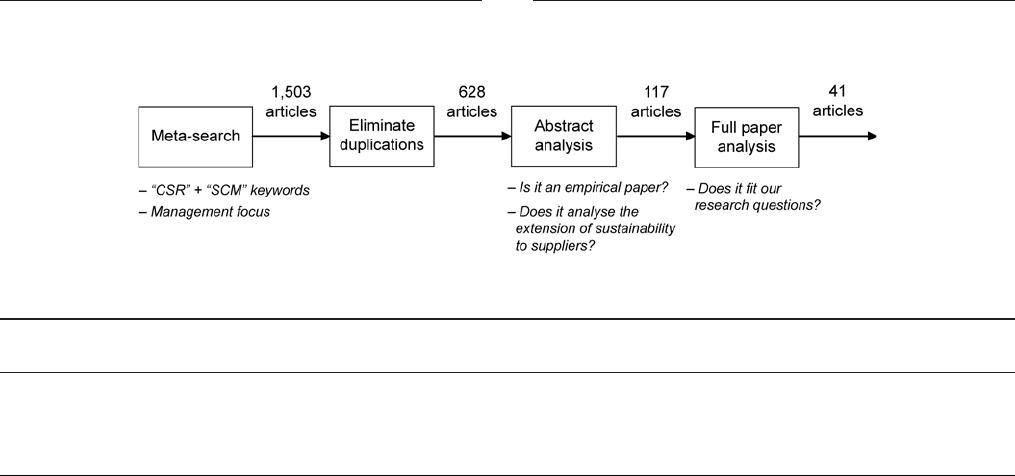
list. This first step generated a total of 1,503 papers (15 July
2011). After deleting duplicated results, the total number of
articles was reduced to 628. After that, we carefully read the
abstract of these 628 papers, focusing on two criteria: does the
paper analyse the transfer of sustainability practices to the
supply base? Is it based on empirical data? Papers had to meet
both criteria in order to be considered. Using this procedure,
we were left with 117 papers. As decisions regarding inclusion
and exclusion remain relatively subjective, this stage of the
systematic review was conducted by all the authors. Tranfield
et al. (2003) recommends this stage to be done by more than
one reviewer.
Lastly, we read each article and selected those that could
provide any insight to the research questions that were
mentioned in the previous section, i.e. What is the impact of
the different governance structures on sustainable
performance (environmental, social and economic
performance)? And what are the enablers of these
mechanisms? After this final screening, only 41 papers
remained. The following sections analyse these papers in
detail. For the analysis, we followed the recommendations by
Denyer and Tranfield (2009) and went beyond mere
description of the papers included in this study. We recasted
the information into a different arrangement and developed
knowledge that was not apparent from reading the individual
papers in isolation.
Figure 1 illustrates the process followed.
Analysis
Our review includes 41 papers covering the extension of
sustainable practices to suppliers. Table I classifies the papers
according to the scope (environmental, social or both issues),
the methodology used (case study or survey) and the period of
publication.
Although sustainable SCM covers the three pillars of the
triple bottom line (economic, environmental and social
impact), most papers focused on the environmental issue
(25 out of 41 papers are on Green SCM). Socially-oriented
practices have been rarely studied and when they have been
covered, it has been under the umbrella of CSR practices
(which covers both social and environmental issues). Our
results are consistent with the findings of previous studies.
Extending sustainability to suppliers: a systematic literature review
Cristina Gimenez and Elcio M. Tachizawa
Supply Chain Management: An International Journal
Volume 17 · Number 5 · 2012 · 531 –543
532
Seuring and Muller’s (2008) literature review on sustainable
SCM showed that few papers consider all dimensions of
sustainability simultaneously.
Early papers on Green SCM were based on exploratory
case studies. However, over the last decade there has been a
spate of papers on Green SCM based on surveys. The papers
on sustainable SCM, which include social and environmental
issues were published in 2008 or later and were mainly based
on exploratory case studies. This could indicate that Green
SCM is at a more mature “research stage” than sustainable
SCM. Over the next few years, we expect to see a rise in the
number of papers based on surveys covering the three pillars
of sustainable SCM.
Extending sustainability to suppliers: the impact of
different supply chain practices on performance
The extension of sustainability to suppliers is being adopted
by industry but the extent and mode of implementation vary
significantly (Rao, 2002). In this paper, we classify these
practices into two approaches: assessment and collaboration.
Assessment includes any activity related with evaluating
suppliers (e.g. questionnaires and company visits), whereas
collaboration refers to working directly with suppliers
providing them with training, support or other activities.
Similar classifications have been used in previous studies
(e.g. Klassen and Vachon, 2003; Vachon, 2007; Jiang, 2009a,
b; Carsten et al., 2010; Foerstl et al., 2010; Large and
Gimenez Thomsen, 2011).
In this paper, we focus on those supply chain practices or
governance mechanisms that imply a “hands-on” approach or
direct management by the buying firm. A “hands-off” or
indirect management approach based on standards is not the
focus of this paper (for further information on this type of
approach please refer to Raynolds, 2004; Ponte and Gibbon,
2005; Raynolds and Murray, 2007; Raynolds, 2009). The
main reason why our paper focuses on the “hands-on”
approach is that we adopt the premise that the buying firm
has chosen to invest personnel, time and resources to increase
the performance and/or capabilities of suppliers. The same
premise has been adopted in previous studies in supplier
development (e.g. Krause, 1999; Krause et al., 2000) and
sustainable SCM (e.g. Klassen and Vachon, 2003; Vachon,
2007; Jiang, 2009a, b; Carsten et al., 2010; Foerstl et al.,
2010; Large and Gimenez Thomsen, 2011).
In this section, we will review and analyse all those papers
that study whether the implementation of supplier assessment
and/or collaboration with suppliers contributes to improving
firms’ environmental, social and/or economic performance.
Environmental performance is often related to energy
efficiency and the reduction of waste, pollution, emissions,
environmental accidents, etc.; social sustainability to labour
conditions, diversity, connectedness within and outside the
community, quality of life, etc.; and, economic sustainability
to operational efficiency, market share, sales, etc.
Our literature review shows that 23 papers cover the impact
of different sustainable SCM practices on performance. Eight
additional papers are included in this section of the review,
because, although they do not consider the impact of these
practices on performance, they do analyse their impact on
environmental investment decisions, the development of
suppliers’ environmental capabilities or the suppliers’
compliance with codes of conduct. Table II provides a
summary of the literature on this topic. The papers were
classified under four categories:
1 those that consider only assessment;
2 those that consider only collaboration;
3 those that consider assessment and collaboration under a
unique construct (e.g. Green Purchasing, Green SCM,
etc.); and
4 those that consider the impact of each type of practice
independently.
In category 1, Murray (2000), Simpson et al. (2007), Yu
(2008) and Ciliberti et al. (2009) considered only assessment
andanalyseditsimpactonsocialandenvironmental
performance. Whereas Murray (2000) and Ciliberti et al.
(2009) found support for a positive effect of the
implementation of assessment practices on environmental
and social performance, Simpson et al. (2007) and Yu (2008)
did not. In particular, Simpson et al. (2007) found that the
presence of assessment by itself does not help translate
customer requirements into suppliers’ environmental
Table I Methodologies and scope of the papers included in the review
1996-2000 2001-2005 2006-2011
Scope Case study Survey Case study Survey Case study Survey Total
Green SCM 5007 4925
Social 0000 314
CSR: Sustainable SCM (social and environmental issues) 0000 9312
Total 5007161341
Figure 1 Screening methodology
Extending sustainability to suppliers: a systematic literature review
Cristina Gimenez and Elcio M. Tachizawa
Supply Chain Management: An International Journal
Volume 17 · Number 5 · 2012 · 531 –543
533

Practices
suppliers
(2007) G Survey X Sup. EC They found the customer’s environmental performance requirements only elicited a supplier response when
relationship-specific investments were made. Contracts and supplier assessment practices had no impact on
environmental commitment
meet the production target in less hours but they earn less because they are paid by the hour)
(2009) S Case X (P) Supply chain directors can impose SA8000 certification throughout the supply chain. Subsequent transaction
costs are reduced
partnership with suppliers
(2009) G Case X (P) There are greater environmental efficiencies when engaging proactively with supply chain partners immediately
adjacent to the primary company
(2011) G Case X (P) Joint eco-design with suppliers reduces costs, toxic waste and energy consumption
turn leads to better economic performance
firms with higher levels of quality management practices adoption
competitiveness. Economic performance improves with competitiveness and greening suppliers
performance
performance; whereas competitive pressures significantly improve the economic benefits arising from Green
Purchasing
performance
discussion provided on this finding
performance measures is needed
(continued)
Extending sustainability to suppliers: a systematic literature review
Cristina Gimenez and Elcio M. Tachizawa
Supply Chain Management: An International Journal
Volume 17 · Number 5 · 2012 · 531 –543